Part 2: The Biker Built His Daughter A Harley Sidecar — Every Year, He Promised To Build Her Another
I met Bear because my diner sat three blocks from Route 66.
Maggie’s Roadhouse.
Bad coffee. Good pie. Truckers at dawn. Bikers by noon.
Bear came in every Tuesday and Thursday after physical therapy appointments with Ellie. Same booth. Same order. Black coffee for him. Chocolate milk for her. Fries cut extra small because her hands struggled with larger food.
He never asked for help.
That was the first thing you noticed about him.
Not pride exactly. More like habit.
A man who learned somewhere along the line that needing people could get somebody hurt.
When he walked, his boots hit the diner floor heavy. Leather creaked. Wallet chain rattled against denim. He carried road smell with him — gasoline, hot engine oil, cigarette smoke that lived permanently inside old cuts.
The first time Ellie dropped her fries, Bear didn’t sigh.
Didn’t rush her.
He simply crouched down beside her wheelchair, picked up each fry one by one with those giant scarred hands, then handed them back like it was the most normal thing in the world.
“Round two, peanut,” he said.
That’s when I started watching him differently.
The Road Saints MC rolled deep through Tucumcari. Loud bikes. Loud laughs. Hard faces. Most towns tolerated them more than welcomed them.
But around Ellie, those men turned soft in strange little ways.
Mouse — a bald biker built like a refrigerator — carried coloring books in his saddlebags.
Rico, covered neck to wrist in prison tattoos, learned how to fix the straps on Ellie’s leg braces.
Even Preacher, who looked like he had buried bodies somewhere in Arizona, let Ellie braid tiny pink ribbons into his beard once a month.
Brotherhood looked different around that child.
One night after closing, I saw Bear alone in the garage behind his house.
The Harley sat stripped apart under hanging work lights. Sparks flew blue from the welding torch. Metal hissed. Country radio crackled low in the background.
Ellie’s old sidecar sat beside the new frame.
That stopped me.
The old one looked almost untouched.
“Why build another already?” I asked.
Bear shut off the torch. Silence hit hard after the buzzing.
“She grew.”
That was it.
Just two words.
He wiped sweat from his beard with a rag blackened by grease. His forearms were covered in fresh burns from welding sparks. Fingernails trimmed clean despite the oil stains. That detail stuck with me.
Men like Bear usually looked half-falling apart.
But his tools were lined up perfectly.
Measurements written carefully on masking tape.
Inside the unfinished sidecar was something I didn’t expect.
Tiny handprints.
Pink paint under clear coat along the inner frame.
Ellie’s hands.
“She helped build it,” Bear muttered.
Then he reached under the workbench and pulled out a shoebox filled with old sidecar parts. Seatbelts. Foam padding. Broken brackets.
Every year labeled neatly in marker.
AGE 2.
AGE 3.
AGE 4.
Like chapters.
“You keep all of it?”
Bear nodded once.
“Proof she got bigger.”
That sentence stayed with me for days.
Because most parents measure growth on kitchen walls.
Bear measured it in steel.
Then came the first crack in the story.
One afternoon Ellie asked him something while signing clumsily with stiff fingers.
I only caught part of it.
“Mom… ride… someday?”
Bear froze.
Not visibly to most people.
But I saw his jaw tighten.
Saw his thumb stop moving against the coffee mug.
Then he signed back slowly.
“Maybe someday.”
Ellie smiled.
Bear didn’t.
That night, Mouse told me the part nobody in town talked about.
Ellie’s mother used to ride too.
Used to.
The crash happened six years earlier on Interstate 40 outside Santa Rosa.
Rain.
Oil slick.
Pickup truck drifting across lanes.
That part everybody knew.
What they didn’t know was who had been driving.
Bear.
Mouse told me quietly one night outside the diner while Harleys ticked hot in the parking lot.
“Brother ain’t forgiven himself since.”
Ellie had been a baby then. Barely one year old. Her mother, Dani, rode in the sidecar during a charity run because Ellie had a fever and stayed home with Bear’s sister.
The truck clipped them.
Bear kept the bike upright long enough to save Dani from going under traffic.
Didn’t save her life.
Head injury.
Three days later, she was gone.
And Bear blamed himself for every second.
After that, he disappeared from the club for almost a year.
Drank hard.
Got arrested twice.
Nearly lost custody of Ellie.
Then one morning he walked into the clubhouse carrying blueprints.
Not for a bike.
For a sidecar.
“Build it,” he told the club.
The brothers thought he was losing his mind.
Ellie’s diagnosis had just become official. Cerebral palsy caused by complications after birth and early oxygen deprivation. Doctors said she would likely never walk independently.
Most men in that situation sell the motorcycle.
Bear started welding.
By the time Mouse finished telling me all this, I understood something ugly and beautiful at the same time:
That sidecar was not transportation.
It was penance.
Then came the county fair.
That was the night everybody thought the story had reached its ending.
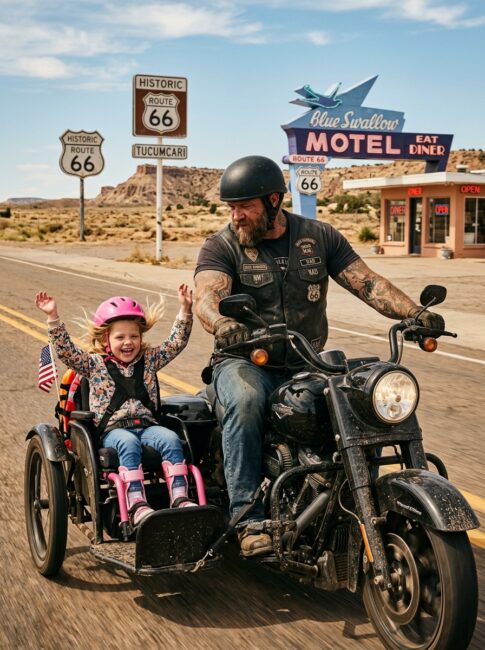
Bear parked the Harley near the livestock barns while Ellie rode beside him in the newest sidecar model, painted deep midnight blue with silver pinstriping she chose herself.
Kids stared.
Adults too.
Some smiled.
Some didn’t.
One man muttered too loud near the funnel cake stand:
“That’s irresponsible.”
Bear heard him.
Everybody heard him.
The biker turned slowly. Boots crunching gravel. Leather shifting. The whole midway seemed to tighten.
The man pointed toward Ellie.
“You got a disabled child strapped to a motorcycle.”
Ellie’s smile vanished instantly.
Bear walked toward the man.
Slow.
Controlled.
Dangerous.
Mouse and Rico moved too, ready if things went bad.
I honestly thought fists were coming.
Instead, Bear crouched beside Ellie’s sidecar and checked every latch silently.
Click.
Click.
Click.
Then he looked up at the stranger.
“You see danger,” he said quietly. “She sees sky.”
Nobody spoke.
The man still shook his head.
“She could get hurt.”
Bear’s face changed then.
Not angry.
Worse.
Honest.
“She already did, brother.”
That shut the whole fairground up.
Then Ellie tugged his sleeve gently.
Bear immediately softened, adjusting her blanket before she could even ask.
That should have been the climax.
The scary biker defending his daughter against the world.
Everybody in town talked about it for weeks.
But the real twist came three nights later.
And it started with a fire.
At 2:11 a.m., Bear’s garage caught fire.
Electrical short near the welding bench.
By the time the first sirens hit Route 66, flames were already punching through the roof.
I drove over in pajama pants and boots like half the town did.
The Road Saints arrived even faster.
Harleys thundered into the dirt lot one after another, engines cutting hard in the smoke-filled dark.
Firefighters shouted.
Neighbors backed away.
But Bear ran toward the garage.
Mouse grabbed him first.
“Brother, no.”
Bear shoved him off.
Not violently.
Desperately.
“My girl’s chair!”
That’s what stunned everybody.
Not tools.
Not the Harley.
The wheelchair mount.
The sidecar.
Inside that garage sat the custom build Ellie needed for school, therapy, life. Insurance would never fully cover another custom rig like that.
The roof groaned overhead.
Sparks rained into the driveway.
Then something happened I still think about.
The entire club moved.
No speeches.
No orders.
Just movement.
Mouse and Rico dragged hoses. Preacher smashed side windows with a shovel. Two prospects rolled tool chests out through smoke. Another brother pushed the Harley clear before flames hit the fuel tank.
And Bear disappeared inside.
The fire captain screamed after him.
Too late.
For twenty seconds nobody saw him.
Then he emerged through black smoke carrying not the sidecar—
—but a metal storage box.
He hit the driveway coughing hard, arms wrapped around that box like it held gold.
Mouse ripped it from his hands.
“What the hell is this?”
Bear tried catching breath.
“Pictures.”
The garage burned behind him.
The sidecar melted.
The welding bench collapsed.
Years of tools turned black under the heat.
But Bear only stared at the box.
Later, after dawn, Mouse opened it carefully on my diner counter.
Inside were hundreds of photos.
Ellie in every sidecar since infancy.
Ellie wearing tiny helmets.
Ellie asleep against blankets while desert highways rolled behind her.
And Dani.
Dani welding beside Bear in old photos before Ellie was born.
Dani sketching sidecar designs on napkins.
Dani laughing beside unfinished frames.
At the bottom sat a sealed envelope.
Bear looked sick when he saw it.
“Never opened it,” he muttered.
It was addressed in Dani’s handwriting.
FOR THE YEAR SHE OUTGROWS IT.
Nobody breathed while he opened it.
Inside was a single folded page.
And suddenly the entire story changed.
Bear read the letter twice before speaking.
His hands shook so badly the paper crackled loud in the diner silence.
Finally he handed it to Mouse.
Mouse read quietly.
Then covered his mouth.
I asked what it said.
Bear stared out the window toward the burned garage.
“She knew,” he whispered.
Knew what?
“She knew Ellie would need bigger builds every year.”
Turns out Dani had been designing adaptive sidecars with Bear before the accident ever happened.
Not because of Ellie.
Because of Bear’s younger brother, Noah.
The club never talked about Noah.
Now I understood why.
Noah had cerebral palsy too.
Severe.
Wheelchair-bound his entire life.
Their father hated weakness. Hated hospitals. Hated “special treatment.” Noah barely left the house growing up.
Except with Bear.
Teenage Bear used to sneak Noah onto old dirt bikes rigged with homemade side supports. Just little rides down empty New Mexico roads at sunset.
Their father beat him for it once.
Bear kept doing it anyway.
Then Noah died at seventeen from pneumonia complications.
Years later, when Ellie was born with cerebral palsy, Bear took it like punishment from God.
But Dani didn’t.
She started designing mobility sidecars in secret.
The letter explained everything.
If Ellie grows, we build bigger.
If braces change, we rebuild mounts.
If roads get rougher, we improve suspension.
You don’t stop carrying her because carrying gets heavier.
Bear pressed both hands over his eyes when Mouse finished reading.
Not crying.
Trying not to.
Then came the second twist.
Inside the envelope were blueprints.
Professional-level blueprints.
Dani had spent months secretly contacting adaptive engineers and disability charities before she died. She believed the sidecar system could help other families too.
At the bottom of the last page she wrote:
Don’t build one bike for our daughter. Build roads for daughters like her.
That wrecked Bear harder than the fire.
Because suddenly the sidecar was no longer grief.
It was inheritance.
The next morning the club gathered at the burned garage.
No ceremony.
Just work.
Hammers.
Generators.
Coffee in foam cups.
The sound of sockets turning and steel being dragged across concrete.
Brotherhood sounds.
By noon, donations started arriving.
A welding shop from Albuquerque sent materials.
A rehab clinic offered engineering help.
Veterans from Amarillo brought tools.
Even the man from the county fair showed up carrying an envelope full of cash.
Bear almost refused it.
The man shook his head.
“I was wrong.”
Bear looked at him a long moment.
Then nodded once.
That was enough.
Three weeks later, the garage stood again.
Bigger.
Cleaner.
One wall painted with Ellie’s tiny pink handprints.
Above the workbench, Bear hung Dani’s letter in a frame blackened slightly at the corners from smoke damage.
Then he built the next sidecar.
Not alone anymore.
Ellie supervised from her wheelchair like a tiny tattooed foreman.
“More pink,” she demanded constantly.
Mouse learned sewing.
Rico handled chrome polish.
Preacher carved tiny wooden birds into the dashboard because Ellie loved birds but couldn’t hold them safely.
When the bike finally rolled out onto Route 66 again, half the town came outside to watch.
The Harley thundered low.
Ellie’s curls flew wild in the desert wind.
And Bear smiled.
Not the hard grin bikers use for photos.
Something quieter.
Like a man finally riding toward something instead of away.
Every year after that, Bear rebuilt the sidecar.
Every single year.
Different colors.
Different supports.
Different seat angles as Ellie grew taller.
The old ones stayed hanging in the garage rafters like metal ghosts.
AGE 5.
AGE 6.
AGE 7.
Sometimes late at night after closing the diner, I’d hear the grinder whining from Bear’s garage two streets over.
Steel sparks lighting the dark blue New Mexico sky.
Harley radio low in the background.
Tools clinking softly.
Ritual sounds.
Ellie got older too.
Speech therapy.
Arm braces.
Wheelchair upgrades.
Hard days.
Hospital days.
Days where her muscles hurt so badly she bit her lip until it bled.
But every morning at 7:12, Bear rolled the Harley out anyway.
Always kneeling first beside the sidecar.
Always checking straps twice.
Always touching Ellie’s forehead gently before starting the engine.
The whole town learned the sound of that bike.
Kids waved from bus stops.
Truckers honked.
Tourists on Route 66 took pictures.
But locals knew something outsiders didn’t.
That Harley wasn’t carrying a disabled little girl.
It was carrying proof.
Proof that love sometimes looks like welding burns and sleepless nights and grease trapped permanently beneath a father’s fingernails.
On Ellie’s tenth birthday, the club threw her a ride parade stretching nearly a mile down old Route 66.
Forty-three Harleys.
One pink sidecar leading all of them.
Bear rode slowly that day.
Not because the bike couldn’t go faster.
Because Ellie kept turning around to make sure everybody was still behind her.
They were.
Every last brother.
At sunset they stopped outside Tucumcari Mountain.
Ellie looked at Bear and signed carefully with stiff fingers:
“Flying today.”
Bear swallowed hard.
Then signed back:
“Tomorrow too, peanut.”
Last winter I stopped by the garage during a snowstorm.
Bear was alone under the work lights.
Older now.
More gray in the beard.
Hands slower than before.
The newest sidecar frame sat half-finished beside him.
Bigger again.
He didn’t hear me enter at first.
Just kept welding.
Blue sparks flashing across old scars.
On the workbench sat a notebook filled with measurements.
Every year of Ellie’s life documented in fractions of inches.
Height.
Weight.
Hip width.
Leg support angle.
Growth recorded in steel.
Finally he shut the torch off.
The garage fell quiet except for snow tapping the roof.
“You ever get tired?” I asked.
Bear looked toward the unfinished sidecar.
Then toward a photo of Ellie taped above the bench — laughing wild in the desert wind.
He shrugged once.
“Means she’s still growing.”
That was all.
Outside, snow covered old Route 66 in silence.
Inside, the Harley waited beside another future he was building one weld at a time.
And somewhere under the smell of steel and gasoline, a father kept his promise.
One more year.
One more ride.
One more sidecar.
Follow the page for more biker stories that hit harder than engines.