Part 2: A 12-Year-Old Boy Stole His Biker Neighbor’s Harley At Midnight And Wrecked It Two Blocks Away — But The Biker Didn’t Call Police, He Asked For Three Months
Part 2
Before the stolen Harley, Mason Reed had already been drifting toward trouble in the slow way adults often miss because it does not look dramatic at first.
He was not a bad kid.
That mattered to Earl from the beginning, though it took the rest of us longer to see it. Mason was the kind of boy who knew which neighbors left bikes unlocked, which corner store clerk would look away if candy disappeared, and which adults were too tired to follow through when they threatened consequences. He had quick hands, quicker lies, and a talent for acting bored when he was really desperate for someone to notice him before he did something stupid enough to become visible.
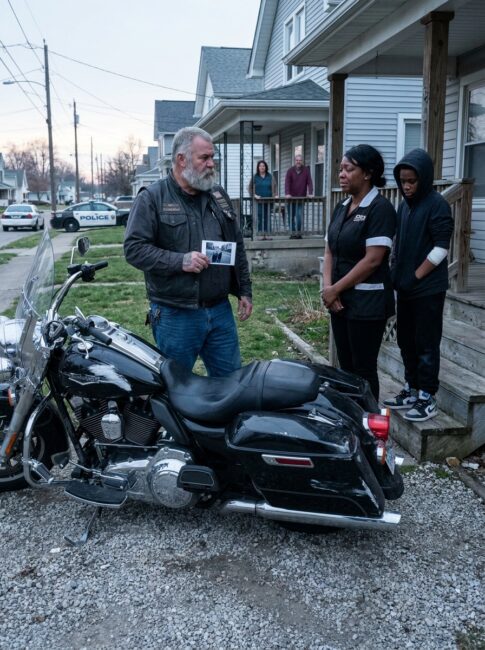
His mother noticed plenty.
She just could not always be there.
Tasha left the house before sunrise most mornings, her hair tied back, shoes still damp from the night before, one lunch bag for herself and one note on the kitchen table for Mason. Eat something. Lock the door. Do your homework. I love you. By the time she came home, he was often asleep or pretending to be. She checked his backpack, paid bills in whispers, and stood in the bathroom some nights with both hands on the sink, trying not to cry loudly enough for him to hear.
Mason knew she was tired.
That made him both ashamed and angry.
Those feelings had nowhere good to go.
Earl understood that kind of boy better than anyone expected. He had grown up without a steady father, learned engines before he learned emotional language, and spent the first half of his life believing consequences only came in two shapes: getting hit or getting abandoned. It took years, a military mechanic who refused to give up on him, and one old Harley with a cracked fuel line to teach him something different.
Repair could be discipline.
That was why he did not call the police.
Not because stealing a motorcycle was small. It was not. Mason could have died. He could have hurt someone else. He could have caused damage far beyond scratched paint and a bent crash bar. Earl knew that better than every neighbor muttering about “kids these days” from behind curtains.
But he also knew that a police report might teach Mason only one thing.
I got caught.
Earl wanted him to learn something harder.
I broke something real.
So the first afternoon, at 3:45 p.m., Mason crossed the street to Earl’s garage with his backpack still on and his face arranged into a scowl. Tasha watched from her porch, arms crossed tight over her uniform shirt, looking like she had agreed to the plan but not yet trusted it. Earl stood by the open garage door in a work shirt, jeans, and boots, the Harley parked in the center with its wounds fully visible under bright shop lights.
Mason looked at the scratch on the tank.
Then looked away.
Earl pointed at a stool.
“Sit.”
Mason sat.
Earl placed a notebook on the workbench.
“You’re going to write down every damaged part.”
Mason frowned.
“I thought I was fixing it.”
“You can’t fix what you won’t look at.”
That was the first lesson.
For an hour, Mason inspected the Harley while Earl named each injury without raising his voice. Gouged saddlebag. Bent crash bar. Scratched tank. Scuffed mirror. Torn grip end. Damaged turn signal housing. Mason wrote them down in messy handwriting, slowly at first, then with more attention when Earl made him start over because “thing by handlebar” was not a proper part name.
At the end, Mason asked, “How much?”
Earl looked at him.
“What?”
“How much money did I mess up?”
Earl wrote the number on the paper.
Mason went pale.
That was the second lesson.
Some things are not expensive because people are greedy.
They are expensive because someone worked long hours to earn them.
Part 3
The first week was mostly silence.
Mason arrived after school, dropped his backpack near the door, washed his hands because Earl required clean hands before touching tools, and stood beside the Harley with the guarded expression of a boy waiting for humiliation. Earl gave instructions. Mason followed badly. Earl corrected him. Mason rolled his eyes. Earl made him do it again.
There were no speeches.
No threats.
No dramatic apology demanded on command.
That frustrated Mason at first.
Children used to chaos often trust yelling more than patience because yelling at least has a shape they recognize. Earl’s garage was different. It smelled like oil, metal, leather, soap, and coffee. Tools hung in careful rows. Old license plates covered one wall. A small radio played classic rock low enough to work under. On the bench, beside a jar of bolts, sat a framed photo of Earl at twenty with a busted old motorcycle and a grin nobody on our street had ever seen on his older face.
Mason studied that photo once.
“You stole stuff when you were a kid?”
Earl glanced at him.
“Yep.”
Mason looked surprised by the honesty.
“Motorcycles?”
“No. I wasn’t dumb enough to steal one before I knew how to ride.”
Mason almost smiled.
Earl did not.
“I stole tools. Gas. Once, a watch from a man who was kinder to me than I deserved.”
“What happened?”
“He made me work it off.”
Mason looked around the garage.
“That why you’re doing this?”
“Partly.”
“What’s the other part?”
Earl handed him a microfiber cloth.
“You remind me of someone who almost disappeared.”
Mason did not ask who.
Maybe he knew.
By the second week, the work became more precise. Earl taught him how to clean chrome without scratching it, how to remove a saddlebag, how to label bolts, how to sand a damaged surface slowly enough not to make the wound bigger. Mason hated sanding. His arm got tired. His back hurt. He complained that it was boring.
Earl said, “Breaking is fast. Fixing is boring.”
That line stayed with Mason.
I know because Tasha told me later he repeated it at the kitchen table when she asked why his hands smelled like polish.
By the third week, Mason stopped arriving late.
By the fourth, he started arriving early.
Not much.
Five minutes.
Then ten.
He began asking questions before Earl assigned tasks. Why did the paint need primer? Why did chrome pit if moisture sat too long? Why were torque specs important? Why did Earl keep the Harley covered if he rode it almost every weekend? Earl answered every question like it deserved respect, even the ones Mason asked only to fill silence.
One afternoon, Mason brought a soda from the corner store and placed it on the bench near Earl.
Earl looked at it.
“You steal that?”
Mason’s face snapped up.
“No.”
Earl held his gaze.
Mason pulled a receipt from his pocket and slapped it on the workbench.
Earl nodded.
“Good.”
That was the first time Mason understood trust was not a feeling.
It was something built in small, documented pieces.
Part 4
The neighborhood kept watching.
Of course we did.
At first, people approved because they thought Mason was being punished. There is a certain kind of satisfaction adults feel when a child who caused damage is made to sweat for it, and I will admit I felt some of that myself. We saw him through Earl’s open garage door, bent over the Harley with a rag, sanding block, or small wrench, and we told ourselves the biker had found a punishment better than court.
But by the second month, the scene looked less like punishment and more like apprenticeship.
That made people uncomfortable in a different way.
Mason no longer kept his shoulders hunched every afternoon. He still made mistakes, but now he cursed under his breath at the work instead of at himself. Earl taught him to lay tools out in order before starting. He taught him to put bolts in labeled cups. He taught him never to force a part that should slide with patience. He taught him that paint needed preparation more than speed, and that rushing a repair was just another way of disrespecting what had been broken.
Tasha began stopping by after work.
At first, she stood near the driveway with her purse over one shoulder, too tired to step inside and too nervous to leave. Earl always offered coffee. She always refused until one cold evening when she accepted and nearly cried into the cup because it was the first hot thing anyone had handed her all day without asking for payment.
“I don’t know how to thank you,” she told him.
Earl shook his head.
“Don’t thank me yet. He still hates wet sanding.”
Tasha laughed.
Then covered her mouth, surprised by the sound.
Mason heard it from under the shop light and looked over. His face changed when he saw his mother smiling in that garage. Not embarrassed. Not defensive. Just changed. Sometimes children do not know they are allowed to feel safe until they see their parents rest for one minute.
Halfway through the second month, Mason asked Earl why he never had kids.
The question came while they were polishing the repaired saddlebag, and I think Mason asked it because the garage had begun to feel like a place where questions did not get thrown back as insults.
Earl kept polishing.
“Almost did.”
Mason waited.
Earl said, “Long time ago. Woman I loved had a son. I was going to marry her. Be his stepdad. Didn’t work out.”
“She dump you?”
“Cancer took her.”
Mason looked down.
“Sorry.”
“Me too.”
“You miss the kid?”
Earl paused.
“Every day.”
Mason did not know what to do with that.
So he polished harder.
After that, something between them softened. Mason still had a mother, but he had never had a man stand beside him consistently without taking something, leaving suddenly, or making promises too big to keep. Earl never promised forever. He promised Tuesday at 4 p.m. Then Wednesday. Then Thursday.
For Mason, that was bigger.
Part 5
The paint repair took three tries.
That was the hardest part.
The scratch on the tank had looked simple from a distance, but under Earl’s shop lights it became a long white reminder of the night Mason mistook wanting for permission. Earl could have done the repair himself in less time, and probably better. Instead, he made Mason learn surface prep, masking, primer, sanding, patience, and the particular humility of ruining your own first attempt because your hand moved too fast.
The first paint pass ran.
Mason panicked.
“I messed it up.”
“Yep,” Earl said.
Mason’s eyes flashed.
“That’s it?”
“What do you want me to do, throw a wrench?”
Mason looked away.
Earl lowered the spray gun.
“You made a mistake. Now you learn the repair for the repair.”
Mason stared at him.
“The repair for the repair?”
“Life’s mostly that.”
The second attempt came out uneven.
The third finally blended.
When Earl showed Mason how to buff the finish after curing, Mason held the polisher like it might bite him. Earl stood behind him, one hand hovering near the cord, explaining pressure, motion, heat, and the danger of staying too long in one place. Mason’s face tightened with concentration. Sweat gathered near his hairline. For once, he did not complain about how long it took.
When the shine began returning, Mason stopped breathing right.
He could see his own face in the tank.
Not clearly yet.
But enough.
Earl noticed.
“That’s what work does,” he said.
“What?”
“Lets you see yourself different.”
Mason swallowed.
During the final weeks, the Harley slowly became whole again. New grip end. Repaired saddlebag. Straightened crash bar. Replaced signal housing. Polished chrome. Paint restored so cleanly even the neighbors had to admit the scratch was almost impossible to find. Mason’s hands changed too. They became less restless, more careful. He stopped touching things without permission. He started wiping tools before putting them back.
One afternoon, Earl caught him standing beside the bike with his arms crossed, studying the tank.
“What?”
Mason shook his head.
“Nothing.”
“Say it.”
Mason hesitated.
“I didn’t know stuff took this long.”
Earl nodded.
“That’s why stealing feels easy. You only touch the last part of somebody else’s work.”
Mason looked at the Harley.
Then at his own hands.
That was the lesson Earl had been waiting for him to learn without being told.
Part 6
The final day came at the end of a rainy Thursday, three months after Mason had dropped the Harley two blocks from home.
Earl rolled the Road King out of the garage and into the driveway just before sunset. The street looked ordinary: trash bins near curbs, porch lights flickering on, a dog barking somewhere behind a fence, Tasha standing beside her mailbox still in her diner uniform, and Mason wiping his hands on a clean rag like he did not know what to do with them now that the work was finished.
The Harley looked new.
Not because every part had been replaced, but because every scar had been answered. The chrome shone. The saddlebag was smooth. The crash bar sat straight. The tank reflected the orange sky so clearly that Mason could see the outline of his own face stretched across it.
Earl walked into the garage and came back with the keys.
Mason’s eyes widened.
Tasha stepped forward.
Earl held up one hand gently, telling her without words to wait.
He placed the keys in Mason’s palm.
The boy froze.
For three months, those keys had represented everything he had taken, everything he had damaged, everything he had not understood. Now they were heavy in his hand for a different reason.
Earl pointed toward the motorcycle.
“You fixed it.”
Mason nodded slowly.
“You know what it’s worth now?”
Mason looked at the bike, then at the keys.
“Yeah.”
“Still want to steal it?”
Mason shook his head immediately.
“No.”
“Why?”
Mason’s mouth tightened.
“Because it’s yours.”
Earl waited.
Mason looked down at the keys again.
“And because I know what it costs.”
That answer was better.
Earl took the keys back, not quickly, not dramatically, just closing his hand around them with the quiet finality of a lesson completed.
“When you’re eighteen,” he said, “and if your mama says you’re still worth putting up with, I’ll teach you to ride.”
Tasha laughed and cried at the same time.
Mason tried to smile, but his face folded before he could manage it. He turned away, embarrassed, and Earl pretended not to notice. That was another kindness. Not every tear needs an audience.
From across the street, I expected Mason to stop coming after that.
The debt was paid.
The bike was repaired.
The punishment, if you could still call it that, was over.
But the next afternoon, at 3:42, Mason crossed the street with his backpack.
Earl was in the garage changing oil on a neighbor’s truck.
“You got something for me to do?” Mason asked.
Earl looked at him over the hood.
“You done stealing motorcycles?”
“Yeah.”
“You done learning?”
Mason shook his head.
Earl tossed him a rag.
“Then wash your hands.”
And just like that, the boy stayed.
Part 7
Mason kept coming to Earl’s garage long after the Harley was fixed.
At first, people still joked that Earl had scared him straight, because that is the easy version and people love easy versions. But anyone who actually watched could see fear had very little to do with it. Mason did not walk to that garage like a boy under sentence. He walked like a boy who had found a door that opened at the same time every afternoon.
Earl taught him oil changes, tire pressure, brake pads, spark plugs, patience with stripped bolts, and the sacred rule that if you borrow a tool, it goes back cleaner than you found it. Mason taught Earl how to use a smartphone calendar because Earl kept forgetting school holidays and once waited in the garage for twenty minutes on a teacher workday. Tasha began trusting the garage as an extension of home, the place her son could be after school when she was still working and the world had too many corners.
Years moved.
Mason grew taller.
His voice dropped.
His hands, once quick for all the wrong reasons, became steady enough to rebuild a carburetor under Earl’s watch. He got a part-time job at the county garage when he was sixteen. He kept his grades high enough because Earl checked them every Friday and called bad excuses “cheap fuel.” On his eighteenth birthday, Tasha, Earl, and half the block stood in the driveway while Earl uncovered the same black Road King Mason had once stolen.
The bike was older now.
So was Earl.
But the chrome still shone.
Earl held up the keys.
“You remember the deal?”
Mason smiled.
“When I’m eighteen, you teach me to ride.”
Earl glanced at Tasha.
She folded her arms.
“Parking lot only.”
“Yes, ma’am,” Earl and Mason said at the same time.
Mason did not ride into traffic that day. Earl was too smart for that, and Tasha would have removed both their heads. They went to an empty church parking lot, where Mason learned clutch, balance, throttle, brake, respect, and the difference between controlling power and being controlled by it.
He stalled twelve times.
Earl made him start again twelve times.
At the end, Mason sat on the bike with both feet down, helmet on, breathing hard, grinning so wide he looked twelve again and nothing like the boy who had once rolled stolen thunder into the dark.
Years later, Mason became a mechanic.
A good one.
The kind customers trusted because he explained what was broken before asking for money. In the corner of his own shop, he kept an old photo of Earl’s Harley with one sentence written underneath.
Breaking is fast. Fixing is boring. Fixing is worth it.
Earl died when Mason was twenty-six.
At the funeral, Tasha sat in the front row, holding Mason’s hand like she had when he was little. The black Road King stood outside the chapel, polished one last time by the boy who had once damaged it and the man who had learned its value by repairing every scar.
Earl left the Harley to Mason.
Not because Mason stole it once.
Because he came back every day afterward and became the kind of man who would never steal from another person’s work again.
At the reading of the will, Mason cried so hard he had to sit down.
Then he took the keys, held them for a long time, and whispered, “I know what it costs.”
That was Earl’s real lesson.
Not punishment.
Repair.
Follow the page for more stories about the people we almost judge too quickly.