Part 2: A 14-Year-Old Boy Hated Every Biker After His Father Died In A Motorcycle Crash — Until His 70-Year-Old Grandfather Sat On The Silent Harley For Five Days
Part 2
Before grief turned the Harley into an enemy, that garage had been Ryan’s favorite room in the house.
It was not beautiful in any polished way. The concrete floor had oil stains that no cleaner could fully erase. A row of old license plates hung crookedly above the workbench. Coffee cans held bolts, washers, zip ties, and mysterious little metal pieces Daniel insisted were important even when Claire threatened to throw them out. The garage smelled like motor oil, leather, dust, old wood, and the peppermint gum wrappers Daniel kept dropping into the same coffee mug near the toolbox.
Ryan loved every inch of it.
On Saturday mornings, Daniel would open the garage door just enough to let light spill across the Harley, then sit on a rolling stool while Ryan handed him tools with the concentration of a surgeon. Daniel was forty-two, white American, broad-shouldered, with sandy blond hair, a trimmed beard, and the kind of easy laugh that made neighbors forgive him for starting the bike too early once in a while. He worked as an electrician, rode carefully most days, and treated the Harley less like a machine than a companion that had carried him through younger years he did not fully explain.
Ryan sat on the passenger seat when Daniel cleaned it.
Sometimes Daniel let him climb up behind him while the bike stayed off, both of them in the garage, pretending they were riding somewhere far away. Ryan would wrap his arms around his father’s waist, press his cheek against the back of Daniel’s jacket, and listen as Daniel described imaginary roads. Mountains. Deserts. Bridges over rivers. Diners with bad coffee and pie good enough to risk the coffee.
“You’ll ride for real when you’re old enough,” Daniel would say.
Ryan always asked when that was.
Daniel always said, “Older than you think and younger than your mother wants.”
Claire always shouted from the kitchen, “I heard that.”
Arthur had been part of those memories too. He visited on Sundays, walking slower than he used to but still carrying himself like a man who trusted tools more than chairs. He and Daniel argued about oil brands, tire pressure, old carburetors, and whether modern bikes had too many electronics. Ryan listened like they were discussing sacred law.
Arthur had never been loud with affection.
He loved in repairs, quiet rides, full gas tanks, and the way he always checked the chain on Ryan’s bicycle without being asked. When Daniel died, Arthur’s grief arrived almost silently, which made people mistake it for strength. At the funeral, he stood beside the casket in his old vest with one hand on the wood and did not cry where anyone could see.
Ryan saw that.
It made him angrier.
To a fourteen-year-old drowning in pain, silence can look like not caring.
So when Arthur came to the house after the funeral, Ryan did not see a grandfather. He saw another biker who had survived the thing that took his father. That felt unfair in a way Ryan could not explain without breaking open, so he turned unfairness into hatred and threw it at the safest person.
Arthur accepted it.
Not because it did not hurt.
Because he knew grief needed somewhere to slam the door.
That was why he went to the garage instead of Ryan’s bedroom.
He did not go there to claim Daniel’s bike.
He went there because he knew the Harley was the one place Ryan could still find his father, if anger ever got tired enough to let him look.
Part 3
For five days, Arthur kept the same ritual.
He arrived at four in the afternoon, just after Ryan came home from school. He parked his old pickup at the curb, not his motorcycle, because he knew the sound of another engine might push the boy deeper into his room. He entered through the side door with Claire’s permission, nodded to her gently, and walked straight to the garage without asking whether Ryan wanted to see him.
The first day, Claire cried in the laundry room.
The second day, she stood in the kitchen holding a dish towel she had already folded three times.
The third day, she asked Arthur if he was sure this was helping.
Arthur looked through the door toward Daniel’s Harley.
“No,” he said. “But chasing him ain’t helping either.”
That was the kind of honesty Claire needed.
So she let him continue.
Arthur would remove the gray cover, fold it neatly, and sit on the Harley with the engine off. He did not touch the ignition. He did not move the mirrors. He did not put his feet on the pegs. He sat as if occupying a pew in a church where the altar happened to be made of chrome, leather, and memory.
From upstairs, Ryan watched.
At first, he watched angrily.
He told himself Arthur was being disrespectful, sitting on a dead man’s motorcycle like it was his now. He told himself old bikers always took what they wanted and called it tradition. He told himself if his father had never learned to ride, none of this would have happened. He fed the anger because anger felt warmer than the frozen place inside his chest.
But Arthur did nothing that anger could use.
He did not start the bike.
He did not wear Daniel’s helmet.
He did not invite Daniel’s biker friends over.
He did not even talk to the motorcycle out loud, though once Ryan thought he saw the old man place his hand lightly on the fuel tank and close his eyes.
On the fourth day, Ryan almost went downstairs.
He made it to the hallway.
Then he heard Claire moving in the kitchen and retreated, embarrassed by the possibility that someone might see him wanting anything from the garage.
On the fifth day, rain tapped softly against the window.
That was what did it.
The accident had happened in rain, and for weeks Ryan had hated the sound so much he wore headphones at night. But that afternoon, the rain sounded less like the crash and more like all the mornings he and his father had sat in the garage waiting for weather to pass. Daniel used to say, “Rain doesn’t cancel a ride. It just makes patience louder.”
Ryan hated remembering that.
He needed to remember it anyway.
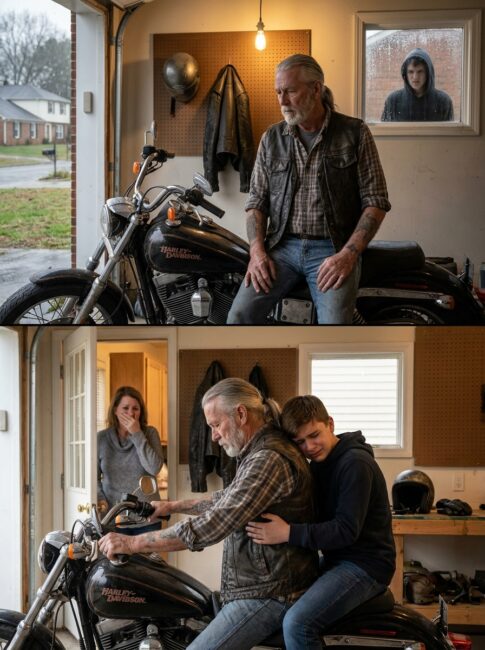
He went downstairs barefoot, opened the kitchen door to the garage, and stood just inside.
Arthur was sitting on the Harley, old vest creased, silver hair tied back, hands resting on his knees. He did not turn immediately. He gave the boy the dignity of being there without being greeted like a miracle.
Finally, Ryan spoke.
“Why do you keep sitting there?”
Arthur looked at him then.
“Because your dad sat here every day he could.”
“You’re not him.”
“No.”
“You can’t bring him back.”
“No.”
Ryan’s face twisted.
“Then what’s the point?”
Arthur looked down at the passenger seat behind him.
“Some things don’t bring people back,” he said. “They just keep a place from going cold too fast.”
Ryan looked at that seat.
The place where his arms used to wrap around his father.
The anger inside him shifted, and underneath it was something much more dangerous.
Longing.
Part 4
Arthur did not invite Ryan onto the bike.
That mattered.
He understood that an invitation too soon could feel like pressure, and pressure was the last thing grief needed. So he stayed still, looking toward the closed garage door, while Ryan stood near the workbench with his hands clenched inside the sleeves of his hoodie.
The Harley seemed larger in the silence.
Daniel’s helmet sat on a shelf nearby, black with a small scratch near the visor. His gloves were folded beside it. His leather jacket hung from a hook, sleeves empty, shoulders holding the shape of a man who would never shrug into it again. Ryan looked everywhere except directly at those things, because looking straight at absence can feel like touching a hot stove.
Arthur followed his gaze.
“You want me to cover it back up?”
Ryan shook his head before he could decide whether he meant it.
“No.”
Arthur nodded.
The rain kept falling.
For a while, neither of them spoke. Claire watched from the kitchen doorway for half a second, then stepped away, giving them the kind of privacy that hurts a mother because she cannot enter it. I saw the garage light from my window, warm against the gray afternoon, and understood somehow that something fragile was happening inside.
Ryan moved closer.
Not all the way.
Just one step.
Then another.
He stopped beside the rear seat.
His hand hovered over the leather without touching it.
Arthur kept his voice low.
“That was your spot.”
Ryan’s jaw tightened.
“Don’t.”
“Okay.”
Arthur stopped.
That was the first time Ryan realized his grandfather would respect the word.
He touched the seat then, barely, with two fingers.
Leather has a memory of its own. Not magical, not alive, but shaped by use, softened by weight, marked by years of weather, hands, jeans, heat, and time. The passenger seat was still worn where Ryan had sat during those garage rides with Daniel. The front seat still held the creases of Daniel’s body. The whole motorcycle carried the quiet evidence of a man who had loved it daily.
Ryan whispered, “It smells like him.”
Arthur closed his eyes.
“Yeah.”
“I thought it would be gone.”
“Not yet.”
Ryan touched the seat more fully.
Motor oil.
Leather.
Peppermint gum.
A trace of his father’s work jacket.
Memory came so suddenly that his knees nearly buckled. He saw Daniel laughing over his shoulder. Daniel telling him to hold tight even though the bike was not moving. Daniel tapping the mirror and saying, “See? Co-pilot has to watch the road too.” Daniel’s back beneath his cheek. Daniel’s voice in the garage.
Ryan had not cried at the funeral.
He had not cried when relatives hugged him too tightly.
He had not cried when men in leather stood outside the house with lowered heads.
But with two fingers on that seat, his face collapsed.
Arthur did not reach for him.
Not yet.
Ryan stepped closer, climbed onto the rear seat like he had done a hundred times when the bike was off, and sat behind his grandfather. His arms stayed at his sides for a moment, stiff and lost. Then, slowly, he wrapped them around Arthur’s waist.
The same way he had held Daniel.
Arthur’s old hands closed over the boy’s arms.
Ryan pressed his forehead against the back of Arthur’s vest.
“Grandpa,” he whispered.
“Yeah, son.”
“I can smell Dad.”
Arthur’s voice broke for the first time.
“I know.”
Then Ryan began to sob.
Not quietly.
Not neatly.
Not like a boy trying to be strong.
He cried like someone had finally opened the door grief had been locked behind.
Part 5
They sat on the silent Harley for thirty-seven minutes.
Claire told me the exact time later, not because she had meant to count, but because she had been standing in the kitchen with her hands over her mouth, watching the clock, afraid that if she moved too soon the moment would vanish. Arthur sat on the front seat. Ryan sat behind him, arms locked around his grandfather’s ribs, crying into the back of that old leather vest until the anger drained enough to leave him exhausted.
The engine stayed off.
That was the most important part.
The Harley did not need to move to carry them somewhere.
When Ryan finally stopped crying, he did not let go immediately. Arthur did not ask him to. The old man’s posture had begun to sag from holding still, and his hip was probably hurting, but he stayed because sometimes love is measured by how long you can remain uncomfortable so someone else can fall apart safely.
At last, Ryan whispered, “I hate motorcycles.”
Arthur nodded.
“You can.”
“I hate that Dad loved them.”
“You can hate that too.”
Ryan swallowed.
“Do you?”
Arthur took a long breath.
“Some days.”
That answer surprised Ryan enough that he lifted his head.
Arthur looked at the garage door.
“I hate the road that took him. I hate the gravel. I hate that he made one mistake and didn’t get to make another. I hate that I taught him the thing that killed him.”
Ryan’s arms tightened.
“But bikes didn’t love him less than we did,” Arthur continued. “They were part of how he felt alive. That makes it complicated, not evil.”
Ryan was quiet for a long time.
Fourteen-year-olds often want grief to be simple because simple pain feels easier to fight. But Daniel had not been killed by a tribe, a symbol, or a jacket. He had died in an accident while doing something he loved and sometimes underestimated. That truth was not clean. It gave Ryan no easy enemy.
It did, however, give him back his father.
Not the crash.
The man before it.
Arthur pointed gently toward the fuel tank.
“You know he used to tap this twice before every ride?”
Ryan sniffed.
“For luck?”
“For your mom. Once for her, once for you.”
Ryan stared at the tank.
“He never told me.”
“Your dad had a lot of quiet habits.”
That evening, Ryan did not apologize for hating bikers. Arthur did not ask him to. But before leaving, Ryan helped pull the gray cover halfway over the Harley. He stopped before covering the seat completely, then folded the cover back just enough to leave the leather exposed.
Arthur noticed.
Said nothing.
The next day, Ryan came to the garage before Arthur arrived.
He stood beside the Harley and breathed in.
Part 6
Healing did not make Ryan suddenly love motorcycles again.
That would have been too easy and too false.
For weeks, he still flinched when a loud bike passed the house. He still avoided Daniel’s riding friends. He still snapped once when Claire suggested donating some of the old gear. But he no longer called every biker a killer, and that was the first small bridge back from the place grief had trapped him.
Arthur kept visiting.
Not every day now, because the ritual had done its first quiet work, but often enough that the garage no longer felt abandoned. Sometimes he and Ryan sat on the Harley without speaking. Sometimes Ryan asked questions about Daniel’s younger years. Sometimes Arthur answered. Sometimes he said, “That story is for when you’re older,” which annoyed Ryan enough to make him look fourteen again instead of forty.
One Saturday, Ryan asked if Daniel had ever been scared riding.
Arthur laughed softly.
“All the time if he was smart.”
“Dad was scared?”
“Being brave without fear is just stupidity wearing boots.”
Ryan almost smiled.
That became another opening.
Arthur began teaching Ryan about the motorcycle without teaching him to ride. Tire wear. Brake lines. Oil level. The importance of listening to a machine before trusting it. He explained what likely happened in the crash with painful honesty, not to blame Daniel, but to remove the monster Ryan had built in his mind. Loose gravel on wet pavement. Too much lean. Not enough time. A mistake with a terrible price.
Ryan listened.
Sometimes he walked away.
Arthur let him.
Claire began hearing laughter from the garage again in tiny pieces, never enough to erase the grief, but enough to remind her the house had not died with Daniel. Once, she found Ryan sitting on the passenger seat alone, Daniel’s old jacket across his lap. He looked embarrassed when she saw him, but she only touched the doorway and said, “Dinner in ten.”
He nodded.
She did not make it bigger than it was.
On Daniel’s birthday, Arthur brought a small cloth pouch.
Inside was an old keychain Daniel had used before Ryan was born, a scratched metal circle with the words RIDE HOME stamped into it. Arthur placed it in Ryan’s hand.
“Your dad gave this back to me when you were little,” he said. “Said he didn’t need a reminder anymore because you and your mom were home.”
Ryan closed his fingers around it.
That night, he asked Claire if they could leave Daniel’s jacket in the garage instead of the hall closet.
“Where in the garage?” she asked.
Ryan looked toward the Harley.
“On the hook where he left it.”
So they did.
Not as a shrine.
As a place.
There is a difference.
Part 7
A year after the accident, Ryan rode a motorcycle again.
Not on the road.
Not fast.
Not because anyone pressured him.
Arthur took him to an empty church parking lot on a clear morning, with Claire watching from a folding chair near the shade and Daniel’s old helmet sitting on the tailgate. The bike was not Daniel’s Harley. Arthur chose a smaller training motorcycle, quiet and manageable, because memory is not a license to ignore safety. Ryan wore protective gear, listened carefully, and looked pale enough that Arthur asked three times whether he wanted to stop.
Ryan said no.
Then yes.
Then no again.
Arthur accepted every answer.
Finally, Ryan sat on the training bike, both feet planted, hands on the grips, engine off. He stayed that way for several minutes, breathing through the fear. Then he looked over at Daniel’s Harley in the driveway back home, visible only in his mind, and realized the fear was no longer hatred. It was love with nowhere easy to stand.
Arthur started the small engine.
Ryan cried a little before he moved.
Nobody teased him.
He rode ten feet.
Stopped.
Rode ten more.
Stopped again.
By the end of the morning, he had made three slow circles around the parking lot and looked both terrified and proud. Claire hugged him too hard. Arthur pretended to inspect the bike so nobody would see him wipe his eyes. Ryan knew anyway.
Daniel’s Harley remained in the garage.
For years, they did not sell it.
Ryan cleaned the seat sometimes. Not too much, because he still believed some of his father lived in the smell of it. On hard days, he sat behind the empty front seat and remembered the shape of Daniel’s back. On better days, he sat up front with Arthur beside him and learned where his father’s hands had rested.
When Ryan turned eighteen, Claire asked what he wanted to do with the Harley.
He thought for a long time.
Then he said, “Keep it warm.”
Arthur smiled at that.
By then, his walking had slowed even more, and getting onto the bike took effort. Ryan helped him swing one leg over, then climbed onto the passenger seat behind him, much too grown now for the old position and somehow still exactly the same boy. He wrapped his arms around his grandfather’s waist.
The engine stayed off.
The garage smelled like leather, oil, dust, and peppermint gum because Ryan had started keeping a pack on the workbench.
Arthur looked down at the tank.
“You still smell him?”
Ryan closed his eyes.
“Yeah.”
Arthur nodded.
“Good.”
They sat there together, three generations held by one silent motorcycle, grief no longer sharp enough to cut every breath, but still present enough to prove love had been real.
Ryan never stopped missing his father.
He simply stopped confusing the thing Daniel loved with the thing that took him.
And some evenings, when the garage light glowed warm against the dark, neighbors could still see him sitting on that old Harley with the engine off, keeping the seat warm for a man who had once made him feel safe just by being close enough to hold.
Follow the page for more stories about the people we almost judge too quickly.