Part 2: A 6-Foot-6 Biker Built a Tiny Doorbell Only His Toddler Could Reach, and the Way He Answered It Made Every Parent Rethink Home
PART 2, THE GIRL WHO WANTED TO BE BIG
Maisie Walker was small in a world built for taller people.
That may sound obvious, but adults forget what smallness feels like. Door handles lived above her head. Light switches required stretching. Kitchen counters hid everything interesting. Grocery carts towered over her. Public sinks were too high, chairs too deep, coat hooks impossible, and most adult conversations happened somewhere above her curls as if the important parts of life floated in air she could not reach.
Most days, Maisie did not mind.
She had stools. She had parents who lifted her. She had a father who could pick her up with one arm and place her on his shoulders as if she weighed less than his leather vest. She had a mother who let her carry small bags from the car even if the bag held only socks. She had a world full of workarounds.
But some things felt different.
The doorbell became one of them.
It began when Maisie started noticing visitors. The mail carrier rang the bell. Delivery drivers rang the bell. Grandma rang the bell. Neighbors rang the bell. Friends rang the bell. Even the man who came to repair the dryer rang the bell and was greeted by Griffin with more politeness than Maisie thought a dryer deserved.
Every time, the house reacted.
The chime rang.
The dog barked.
Griffin or Claire came to the door.
Someone announced, “We have company.”
That phrase fascinated Maisie.
Company.
Company meant people mattered enough to stop what was happening. Company meant the door opened. Company meant grown-ups smiled, moved chairs, made coffee, offered cookies, and asked questions like “How was your drive?” Company did not have to yell from outside. Company pressed a button, and the whole house knew they were there.
Maisie wanted that.
She did not explain it well at first because three-year-olds often feel things long before they can build the right sentence around them. She began trying to reach the adult doorbell when she and Claire came home from preschool. She stood on her toes. She jumped once and missed. She dragged a small plastic garden pot toward the door until Claire gently moved it away because porch steps and wobbly pots were a bad combination.
“Mommy, I do it.”
“I know, baby. It’s too high.”
Maisie frowned at the doorbell like it had insulted her.
One afternoon, Griffin came home early from the motorcycle shop and saw her standing on the porch, arm stretched upward, fingers opening and closing beneath the silver button. His Harley was still ticking warm in the driveway. His boots were wet from a spring rain. His hands smelled faintly of oil and metal.
“What are you reaching for, bug?”
Maisie did not look at him.
“The bell.”
Griffin smiled.
“You want to ring it?”
“Yes.”
He started to lift her.
She pulled away.
“No. Me do it.”
That was the part he missed at first.
Like many strong fathers, Griffin had spent most of Maisie’s life helping by lifting. Lift to the sink. Lift to the chair. Lift to see over the fence. Lift to touch the Christmas star. He thought lifting was love. Sometimes it was.
But not this time.
This time, being lifted was the problem.
Maisie wanted the doorbell to answer her own hand.
Griffin crouched beside her, knees popping, bringing his giant frame down to the porch boards until his eyes were close to hers.
“Why do you want to ring it so bad?”
Maisie looked at the door.
Her lower lip moved before the words came.
“People ring and you open.”
“Yeah.”
“I come home too.”
Griffin’s smile faded.
Maisie swallowed.
“I want to be company.”
That sentence hit him harder than any wrench ever had.
PART 3, THE PROMISE ON THE PORCH
Griffin did not answer right away.
He looked at his daughter, then at the doorbell, then at the front door he had walked through a thousand times without considering what it looked like from Maisie’s height. The adult button was just an object to him. To her, it was proof that arrival mattered. It was a ritual of being noticed.
Claire came up the walkway with Maisie’s lunchbox and saw Griffin kneeling on the porch, face changed.
“What happened?”
Maisie turned to her mother.
“I want to be company.”
Claire stopped.
The porch became very quiet.
Griffin’s voice came out softer than usual.
“You are more important than company.”
Maisie frowned because adults say beautiful things that do not fix the unreachable button.
“But I can’t ring.”
That was when Griffin understood. Love that only adults can explain is not always enough for children. They need love they can touch. Love they can do. Love at their height.
He sat down on the porch step, not caring that the boards were damp, and pulled Maisie gently into the space between his knees.
“Okay,” he said. “We’ll fix it.”
Claire raised one eyebrow.
Griffin looked at her.
“Safely.”
“Thank you for adding that.”
Maisie sniffed.
“I get a bell?”
Griffin nodded solemnly.
“You get your own bell.”
“Like people?”
“Better than people.”
“Mine?”
“Yours.”
Maisie looked suspicious, as if contracts with fathers required more detail.
“What happen when I ring?”
Griffin’s mind moved quickly. He could install a small wireless button. Simple. Low. Safe. Different chime. But the hardware was not the heart of the matter. The response was.
“When you ring,” he said, “I open the door.”
“You say hi?”
“I say more than hi.”
Maisie leaned closer.
“What?”
Griffin straightened as much as he could while sitting and gave his deepest formal voice.
“I say, Good afternoon, Miss Maisie. Welcome home. We have been expecting you.”
Claire turned away because she was already crying.
Maisie stared at him.
“Again.”
Griffin repeated it with even more dignity.
Maisie smiled slowly.
“Again.”
He did it a third time, adding a bow that nearly knocked his knee against a flowerpot.
Maisie laughed.
That laugh sealed the promise.
The next morning, Griffin went to the hardware store. He took Maisie with him because if the bell was hers, she needed to choose it. The clerk looked nervous when the huge biker walked in carrying a toddler in pink sneakers, but relaxed when Maisie began asking every button whether it could live on her door.
The one she chose was bright yellow.
Griffin tried to show her a simple white one.
Maisie shook her head.
“Yellow says hello.”
Griffin looked at the clerk.
“Yellow says hello.”
The clerk nodded as if this was now official electrical guidance.
That afternoon, Griffin measured the height while Maisie stood against the door with one hand raised. He marked the spot. Claire watched from the porch swing. Linda Marsh, across the street, pretended to water flowers that had already received plenty of water.
Griffin drilled carefully.
Maisie held a plastic toy screwdriver and announced she was helping.
When the little yellow button was finally mounted, Griffin connected the chime and stepped back.
“All right,” he said. “Test it.”
Maisie pressed the button.
Inside, the new chime rang.
Griffin opened the door from inside, bowed deeply, and gave the line exactly as promised.
Maisie stepped in like a queen.
PART 4, THE RULE OF THE BELL
The tiny doorbell came with rules.
That surprised people later, because online strangers saw a cute video and assumed the whole thing was spontaneous chaos. It was not. Griffin was playful, but he was also careful. A doorbell could be fun, but the front door was still a front door. So he and Claire made the rules simple enough for a toddler and serious enough for safety.
Maisie could ring her bell when she came home with a grown-up.
She could not open the door alone.
She could not ring it at midnight unless there was an emergency, which she misunderstood for two days and declared that wanting crackers was an emergency.
She could ring it once, maybe twice if Dad was in the bathroom, but not thirty-seven times, a number discovered through field research on day three.
She could invite guests to see it, but only family could press the special bell unless Maisie gave permission.
That last part mattered to her.
The bell was not a toy for everyone.
It was hers.
Every time Maisie came home from preschool, the ritual happened. Claire parked the car. Maisie gathered whatever treasures had survived the day: a drawing, a rock, a leaf, a sticker, half a cracker she insisted was for later. She marched up the walkway. She pressed the yellow bell. Inside, Griffin appeared.
Sometimes he wore a welding apron.
Sometimes a grease-stained shop shirt.
Sometimes his black leather vest.
Once he opened the door wearing a dish towel over one shoulder because he had been cooking spaghetti and the sauce was fighting back.
But he always bowed.
Always.
“Good afternoon, Miss Maisie. Welcome home. We have been expecting you.”
Then Maisie would enter and announce what kind of day she had.
A dinosaur day.
A yellow day.
A no-nap day.
A glue-on-my-sleeve day.
A day where Emma got two crackers and Maisie only got one and justice was clearly damaged.
Griffin listened with the seriousness of a man receiving a diplomatic report from a small country.
At first, Claire thought the ritual would fade.
Toddlers often move from fascination to abandonment with breathtaking speed. One week they love ducks. The next week ducks are old news and spoons are the center of civilization. But the doorbell stayed.
Weeks passed.
Maisie still rang it.
Griffin still opened.
The ritual began to change the house.
Not dramatically. Not like a movie. Quietly, in the ways children measure belonging. Maisie stopped asking to be carried up the porch steps. She walked. She stood taller when she pressed the bell. She started telling grandparents, “I announce myself.” She practiced Griffin’s formal welcome with her dolls. She made Claire wait outside her bedroom once so she could open the door and say, “Welcome home, Mommy. I expected you.”
Claire cried in the hallway after that.
Because parents often work hard to teach children manners, numbers, colors, letters, and schedules, but sometimes a child teaches the parent what dignity looks like at three feet tall.
The tiny bell became part of their family language.
If Maisie had a hard day, Griffin gave a softer bow.
If she had a happy day, he made the welcome grander.
If she was tired, he opened the door slowly and knelt instead of booming the words.
He learned to read her by the way she pressed the button.
One quick press meant excitement.
A long press meant worry.
Two small presses meant she wanted him to come fast.
That little yellow button became more than a chime.
It became a way for Maisie to say, I’m here. See me. Answer me.
And every time, Griffin answered.
PART 5, THE VIDEO THAT WENT EVERYWHERE
The video was never meant to be public.
That mattered to Claire.
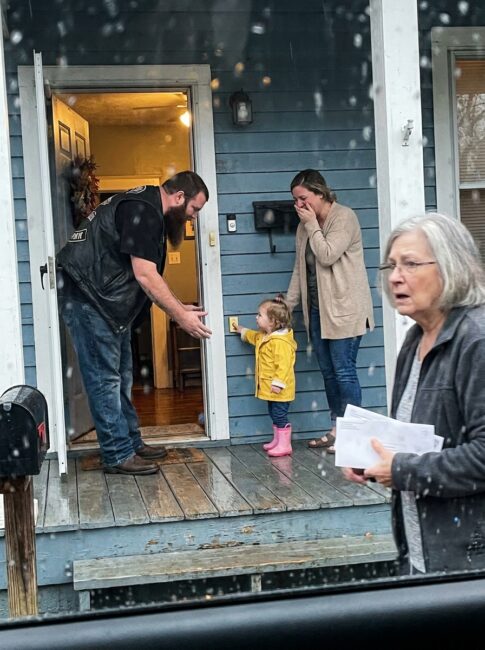
She recorded it on a rainy Tuesday because her sister had asked why Maisie kept calling herself “the important guest.” Claire thought a short clip would explain the joke. She stood near the sidewalk, phone in hand, as Maisie climbed the porch steps wearing her yellow raincoat and pink boots. The camera shook a little because Claire was carrying a lunchbox, a wet umbrella, and a paper bag of preschool artwork that had already begun melting at one corner.
Maisie pressed the bell.
The little chime rang inside.
The door opened.
Griffin filled the doorway, huge and serious, black shirt stretched across his broad chest, beard combed, tattooed hands folded in front of him. Then he bowed like a palace guard who had been waiting all day for this exact arrival.
“Good afternoon, Miss Maisie,” he said. “Welcome home. We have been expecting you.”
Maisie lifted a soggy painting.
“I made a purple cow.”
Griffin gasped.
“Then this house has been blessed.”
Maisie walked in proudly.
Griffin followed her with the painting held carefully in both hands like a royal document.
Claire sent the video to her sister.
Her sister cried, laughed, and asked if she could share it with a small parenting group. Claire said yes, as long as Maisie’s preschool name and address were not mentioned. The sister posted it with a simple caption:
My niece wanted to feel important when she came home. Her biker dad installed a doorbell at her height and greets her like this every day.
By morning, the internet had found it.
The video spread because people thought it was adorable at first. A giant biker bowing to a toddler. A tiny yellow doorbell. Pink rain boots. Purple cow painting. The contrast was irresistible. People shared it with laughing emojis, crying emojis, heart emojis, comments about fathers, childhood, and how every kid deserves a grand entrance.
Then Claire added the reason.
Maisie had wanted to ring the adult doorbell because she thought visitors mattered more when the house heard them arrive. She told Griffin she wanted to be company too. Griffin installed the bell because he did not want his daughter to feel like she had to be lifted into importance. He wanted her to have something at her height that said she already belonged.
That was when the tone changed.
People stopped seeing only cute.
They saw the tenderness under it.
Parents wrote that they had never considered how many parts of a home children could not reach. Teachers wrote that toddlers often want agency more than attention. Grandparents wrote about building step stools, low hooks, tiny mailboxes, little shelves, anything that told a child, this house has space made for you.
One father wrote, “I thought my son wanted to press elevator buttons because he was being annoying. Maybe he wanted to feel like he had a job.”
One mother wrote, “I watched this and realized my daughter always asks me to knock on her bedroom door because she wants her room respected too.”
Then came the jokes, because the internet cannot survive tenderness without trying to make it funny.
“Can Griffin welcome me home too?”
“I am thirty-four and would like to be expected.”
“Where do I apply to be Miss Maisie?”
“Yellow says hello is now my life motto.”
Griffin hated the attention.
Maisie loved the idea that people liked her bell, though she understood none of the size of it.
But the thing that wrecked everyone came three days later when a local reporter asked Griffin why he kept doing the full bow every time.
He shrugged and gave the answer in his rough biker voice.
“My kid wanted to feel important. So every time she comes home, she is the most important guest this house will ever have.”
That sentence went farther than the video.
PART 6, THE LITTLE BELLS THAT FOLLOWED
After the video spread, little doorbells began appearing in other houses.
Not all at once. Not because everyone copied the exact idea. But parents started paying attention to the small ways children asked to belong. One family installed a lower coat hook beside the adult ones. Another put a tiny mailbox by the bedroom door so their son could receive official letters from his parents. A grandmother added a low garden gate latch so her granddaughter could announce visits to the tomatoes. A father in Oregon installed a second doorbell for his wheelchair-using son, who had spent years waiting for someone else to press buttons placed too high.
Claire showed Griffin some of the messages.
He sat at the kitchen table after Maisie was asleep, reading with one hand over his beard.
The attention made him uncomfortable, but the messages did not.
One came from a mother in Arizona:
My daughter has dwarfism. We added a bell at her height today. She rang it six times and told us, “Now the house hears me.” Thank you.
Griffin read that one twice.
Another came from a father in Michigan:
My little boy is nonverbal. I put a button by the garage door that plays a chime. He presses it when he wants me to come see what he built. I didn’t know he wanted a way to call me without yelling.
Claire cried over that one.
Griffin walked outside and stood on the porch for a long time, looking at the yellow button.
It was just plastic and wiring.
It was also not just plastic and wiring.
That was the thing about parenthood. Sometimes the smallest object becomes a bridge because a child tells you, in their own language, where the gap is. Adults often miss those moments because the request sounds inconvenient, silly, repetitive, or too small to matter. Can I press the button? Can I carry the bag? Can I stir the pancake mix? Can I open the mailbox? Can I pour the dog food? Can you knock first? Can I do it myself?
Underneath many of those questions is a deeper one.
Do I matter here?
Griffin had answered with a doorbell.
The Iron Hollow Riders teased him, of course.
When Caleb “Preacher” Hayes, a fifty-eight-year-old Black American biker with deep brown skin, a gray beard, tattooed hands, and a deep steady voice, saw the video, he called Griffin immediately.
“Brother, I need you to greet me like that at the clubhouse.”
Griffin hung up.
Denise Carter, a fifty-six-year-old Black American woman biker with deep brown skin, silver braids, sharp eyes, and no patience for men pretending not to be soft, stopped by the next Sunday with a tiny brass plaque shaped like a crown. It had no words, because Griffin refused readable signs on the porch after the video went viral, but Maisie declared the crown belonged above the bell.
Griffin installed it.
Maisie approved the height.
That mattered most.
PART 7, THE MOST IMPORTANT GUEST
Years later, the yellow doorbell was still there.
It had been replaced twice because weather and toddler enthusiasm are both hard on hardware, but Griffin always kept the same height. As Maisie grew, the bell stayed low, which made it funnier and more meaningful. At six, she had to bend slightly to press it. At seven, she rolled her eyes if Griffin bowed too dramatically in front of friends, but she still smiled when she thought nobody saw. At eight, she asked if they could keep it forever, even when she became taller than the adult bell.
Griffin said yes.
“Even when I’m big?”
“Especially then.”
“Why?”
“Because it reminds me you were always important before you could reach anything.”
She pretended not to like that answer.
Claire saw her face.
She liked it.
The ritual changed with age. Griffin no longer opened the door every single time, because children grow and routines stretch. But on Sundays, after grocery runs, school events, long rides with Claire, or hard days when Maisie came home quiet, she still sometimes pressed the little yellow button.
And Griffin came.
Maybe slower, because knees do not improve with time.
Maybe with more gray in his beard.
Maybe with grease on his hands or reading glasses tucked in his shirt collar.
But he still opened the door.
“Good afternoon, Miss Maisie,” he would say, bowing just enough to make her laugh. “Welcome home. We have been expecting you.”
When Maisie turned ten, she asked about the video. Not the simplified version she had always known, but the real story. Why it had spread. Why people cared. Why grown-ups cried over something as silly as a tiny doorbell.
Griffin sat with her on the porch steps.
The yellow button was beside them, faded from sunlight.
“You told me once you wanted to be company,” he said.
Maisie frowned.
“I said that?”
“You were three.”
“I was dramatic.”
“You were honest.”
She leaned against his shoulder.
He continued, “I realized I was always carrying you up to important things instead of building important things where you could reach them.”
Maisie was quiet.
Griffin looked at the street.
“I didn’t want you to feel important only when somebody lifted you. I wanted you to know this house already had a place for your hand.”
That was when Maisie understood, not fully perhaps, but enough.
She reached over and pressed the little bell.
Inside the house, the familiar chime rang.
Claire opened the door this time.
She looked at her daughter, then at Griffin, and without missing a beat, gave the family line.
“Good afternoon, Miss Maisie. Welcome home. We have been expecting you.”
Maisie laughed, but her eyes filled.
Because childhood rituals are funny when you are little, embarrassing when you are almost big, and sacred when you finally realize what your parents were really saying.
The internet moved on, as it always does. New videos. New stories. New reasons to laugh and cry before breakfast. But the tiny doorbell kept working in one house in Knoxville, doing what it had always done best. Not making a family famous. Not proving Griffin was a perfect father. He was not. No parent is. It simply reminded a child, again and again, that arrival matters.
Griffin still refuses to call himself wise.
He says he was just a bald-headed biker with a drill, a daughter with a broken heart, and enough sense to install a button where she could reach it.
But Claire says it was more than that.
It was the difference between telling a child you matter and building something that lets her feel it with her own hand.
Years later, when parents ask him what the tiny doorbell meant, Griffin gives the answer that made strangers cry the first time and still does.
“My daughter wanted to feel important. So every time she came home, she was the most important guest in the house.”
That is the whole story.
A small button.
A big father.
A little girl who wanted the house to hear her.
And a front door that opened like love had been waiting on the other side all along.
Follow the page for more unforgettable biker stories about devoted fathers, brave little hearts, and the rough-looking love that turns tiny moments into memories a child carries forever.