Part 2: A Biker Brought A Pink Lunchbox To School — Then His Daughter Said What Broke Him
My name is Frank Hollis, and I spent twenty-two years as a sheriff’s deputy before I took the security job at Roosevelt Elementary.
That means I notice hands first.
Not faces. Not clothes. Hands.
Hands tell you if a man is angry. If he is scared. If he is reaching. If he has done hard work or hard time. If he wants to hurt somebody or if he is trying not to fall apart.
The biker’s hands confused me.
They were rough hands. Scarred hands. Tattooed hands. The kind that made my old deputy brain start counting exits. But the hand holding that lunchbox was careful. Too careful. His thumb kept rubbing the unicorn sticker on the front, not like a man admiring it, but like he was checking whether it was still there.
I asked for ID.
He gave it without argument.
Name: Thomas Shaw.
The office secretary, Linda, checked the student file. Emergency contact. Father. Authorized pickup. Cleared.
Still, procedure was procedure.
“You can leave it here,” I said. “We’ll take it to her.”
He looked at the lunchbox.
Then down the hallway.
“I need to hand it to her.”
“I can’t let visitors past the office without a badge and approval.”
“I’m her father.”
“I understand that.”
“No,” he said quietly. “You don’t.”
That made me stiffen.
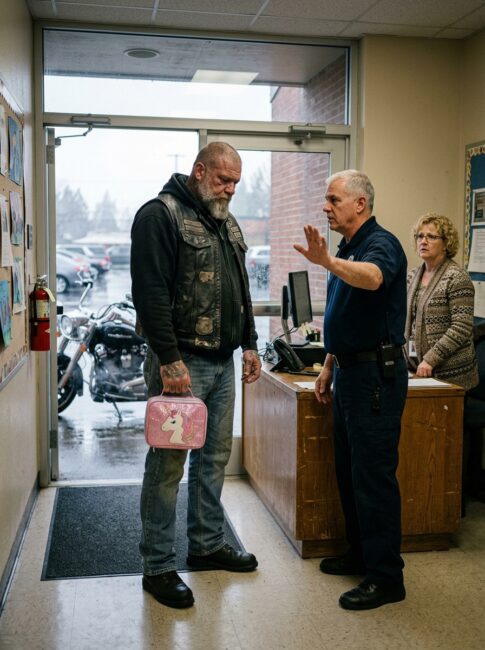
He saw it. He took half a step back. Not because I scared him. A man that size did not scare easy. He stepped back because he knew what he looked like. That hit me later.
At the time, I just saw the leather cut, the tattoos, the boots, the jaw tight enough to crack teeth.
Linda picked up the phone to call Emma’s teacher.
Thomas Shaw stood silent by the office window, one big shoulder blocking the light. Outside, his Harley ticked as it cooled. Inside, children’s artwork hung on the wall. Paper turkeys. Crayon houses. A crooked poster that said KIND HANDS, KIND WORDS.
He looked wrong in that room.
And somehow, the lunchbox looked right.
While we waited, I noticed something tucked into the inside seam of his vest. A little purple hair tie. Not worn as decoration. Tied around one of the inner snaps like it had been saved there. A cheap child’s hair tie with a plastic star on it.
He caught me looking and closed the vest with his free hand.
That was the first seed.
I missed what it meant.
Emma’s teacher arrived two minutes later. Ms. Ramirez. Hispanic American woman, early thirties, gentle voice, eyes already tired from carrying too much of other people’s pain. She looked at Thomas and softened immediately.
“Mr. Shaw,” she said. “She’s in the cafeteria. She realized during morning reading.”
Thomas swallowed.
“Did she eat anything?”
Ms. Ramirez shook her head. “She said she wasn’t hungry.”
His jaw moved once.
“She says that when she is.”
The way he said it did not sound like a fact.
It sounded like a father trying to memorize a child in real time.
Ms. Ramirez glanced at me. “Frank, he’s cleared.”
I still hesitated.
That is the part I am not proud of.
Because school security is not about feelings. It is about caution. But caution can wear the same face as judgment if you are not careful.
Thomas saw my hesitation and held out the lunchbox.
“Then you take it,” he said.
His voice broke on take.
Not loud. Not dramatic. Just a crack through gravel.
“I just need her to know I brought it.”
Ms. Ramirez did something then that I have respected ever since. She did not argue policy. She did not shame me. She simply said, “I’ll walk with him.”
So I handed Thomas a visitor badge.
It looked ridiculous clipped to his leather cut.
A little white sticker against black road-worn hide.
VISITOR.
He stared at it for half a second like the word hurt.
Then he followed us down the hallway.
His boots were too loud on the tile. Every step echoed past the first-grade artwork and bulletin boards. Kids looked out of classroom doors. One little boy whispered, “Is he a motorcycle guy?” Another whispered, “He looks scary.”
Thomas heard both.
His shoulders lowered.
Not anger.
Shame.
That was the second thing I missed.
We reached the cafeteria just as first grade was sitting down. Plastic trays clattered. Milk cartons popped open. Somebody laughed too loudly. The room smelled like chicken nuggets, applesauce, bleach, and kid sweat.
At the far end of the first-grade table sat Emma Shaw.
Six years old. White American girl. Small for her age. Blonde hair pulled into two uneven pigtails, one already slipping loose. Blue cardigan. Pink sneakers. Empty hands folded in her lap while everyone around her opened lunchboxes or trays.
She was staring at the table like if she looked hard enough, she could disappear into it.
Thomas stopped in the doorway.
The lunchbox handle creaked in his fist.
Ms. Ramirez leaned down near Emma and said softly, “Honey, someone came to see you.”
Emma looked up.
She saw the biker first.
Not her father.
The biker.
The big man in black leather standing in the school cafeteria with red eyes, tattooed hands, and a pink unicorn lunchbox.
For one second, her face did not change.
Then her mouth trembled.
Thomas walked toward her slowly, like he was approaching a frightened animal. He did not say her name across the room. Did not make a scene. He crouched beside the bench, but even crouched he looked enormous next to her.
He set the lunchbox on the table.
“Brought it,” he said.
Two words.
That was all.
Emma looked at the lunchbox. Then at him.
And then she whispered, “I thought you forgot me too.”
The cafeteria kept moving for half a second.
Then somehow it didn’t.
Not fully. Kids still chewed. A tray still scraped. But every adult within ten feet went still.
Thomas’s face changed.
I have seen men get bad news. I have stood in doorways with deputies behind me and watched fathers hear things no father should hear. I have seen anger. Shock. Collapse.
This was different.
It was like Emma’s words went straight through the leather, the tattoos, the beard, the big man armor, and found the softest part of him with no warning.
He blinked once.
His eyes filled.
Nothing fell.
Bikers like him do not cry easy. Maybe they learn to hold it because the world keeps testing whether they are allowed to feel. Maybe grief grows calluses on the outside and stays raw underneath.
Thomas lowered himself from a crouch to both knees.
Right there on the cafeteria floor.
Beside the first-grade table.
His boots squeaked. His leather creaked. His visitor sticker peeled at one corner.
He put one hand on the table, not touching her yet.
“Baby girl,” he said, voice rough and low, “I can forget keys. I can forget my wallet. I can forget what day the trash truck comes.”
Emma’s chin shook.
“But I don’t forget you.”
She looked at him like she wanted to believe it and was afraid belief might hurt.
“You forgot Mom’s scarf at the hospital,” she whispered.
He closed his eyes.
That was twist one.
This was not just about a lunchbox.
This was about the first day back after losing the center of their home.
Thomas Shaw’s wife, Rachel, had died twelve days earlier from a brain aneurysm that came fast and gave no one enough time to bargain. One morning she was packing lunches. That afternoon she was in surgery. Two days later, Thomas was standing beside a hospital bed holding Emma in one arm and signing paperwork with the other hand.
Rachel had been the organized parent.
The calendar parent.
The lunchbox parent.
The one who remembered spirit day, library books, permission slips, extra socks, birthday cupcakes, and which stuffed animal Emma needed after bad dreams.
Thomas was the road parent.
The Harley parent.
The one who fixed things, carried things, drove through storms, checked noises under the hood, and looked terrifying at parent-teacher night until Rachel kicked his boot under the table and made him smile.
When Rachel died, Thomas did not become careless.
He became overloaded.
Grief turned every small task into a room with no light switch.
He left his keys in the freezer. Put cereal in the fridge. Forgot to pay the power bill until the warning notice came. He slept in a recliner because the bed still smelled like her shampoo. He braided Emma’s hair badly every morning while watching online videos on his cracked phone.
That morning, Emma had been brave.
First day back.
Blue cardigan. Pink sneakers. Unicorn lunchbox packed by Dad, with the sandwich cut wrong but the apple slices peeled because Mom used to do that. Thomas placed it on the counter while looking for the car keys.
Then the school bus came.
Then Emma left.
Then the lunchbox stayed behind.
Thomas did not notice until 10:56, when he reached for his coffee at the auto shop and saw the pink box sitting beside his tool bag.
He had been twenty-two miles away.
At Red Rock Custom Repair outside Eagle Point, near the highway.
He shut off the compressor, grabbed the lunchbox, and ran.
Not drove slow. Not waited for lunch period to pass. He rode.
Twenty-two miles in cold wind, lunchbox strapped inside his jacket at first, then held in one arm at every red light like a promise. He knew she could get cafeteria food. He knew the school would feed her.
That was not the point.
The point was Emma had lost one parent who would never come back.
Thomas refused to become the parent who forgot.
But in the cafeteria, kneeling beside his daughter, he learned he already looked like one.
Emma was not mad about food.
She was afraid the forgetting had started.
That was the true crisis.
Not the security stop. Not the hallway. Not the adults staring.
A six-year-old girl thought love could vanish the same way her mother had.
Thomas touched the purple hair tie inside his vest.
I saw it then.
He pulled it free.
Emma’s eyes went wide.
“Mom’s star,” she said.
He nodded.
“Found it in the car. Been carrying it.”
“Why?”
“Because I don’t know how to do your hair right yet.”
Emma sniffed.
“You make one side lumpy.”
“I know.”
“And too tight.”
“I know that too.”
“And you say bad words when the rubber band snaps.”
A tiny sound moved through the adults nearby. Not laughter exactly. Relief trying to breathe.
Thomas looked at his tattooed hands.
“These hands are better with wrenches.”
Emma touched one of his knuckles.
“They’re okay.”
That nearly did it.
His mouth tightened. His eyes shone. Still, nothing fell.
Then he opened the lunchbox.
Inside was a peanut butter sandwich cut into two rough triangles, apple slices in a plastic bag, a cheese stick, baby carrots, and one folded napkin. The sandwich was smashed on one side from the ride.
Emma stared at the napkin.
Mom always wrote notes on napkins.
Thomas followed her gaze.
“I tried,” he said.
Emma unfolded it.
The handwriting was big and uneven, like a man pressing too hard because he feared the words might not count otherwise.
Eat three bites, tiny mechanic. Dad loves you. Mom does too.
Emma read it twice.
Then she leaned forward and wrapped both arms around his neck.
The biker froze.
Only for half a second.
Then one huge tattooed hand came up and covered her back like a shield.
That was twist two.
The man everyone thought was too rough for an elementary school had ridden across town with lunch because he was terrified of failing a child at the exact moment she needed proof that someone stayed.
The cafeteria aide wiped her eyes.
Ms. Ramirez turned away.
I stood there in my security polo feeling about two inches tall.
Because I had stopped him like he was danger.
And maybe he was.
But not to his daughter.
To her, he was the wall between her and the idea that everyone leaves.
After a minute, Emma pulled back and whispered, “Can you sit with me?”
Thomas looked around the cafeteria.
Every chair at the first-grade table was built for a child. The room waited to see what he would do.
He looked at me.
Maybe because I was security. Maybe because I had been the first wall he had to get past.
I should have said no. Visitors did not usually sit at lunch without prior clearance. Rules existed for reasons.
Instead, I dragged over an adult folding chair from the wall.
It scraped across the tile loud enough to make every kid turn.
Thomas gave me one small nod.
Not thanks.
Something heavier.
He sat beside Emma, knees too high, leather cut creaking, pink lunchbox between them. He did not talk much while she ate. He just opened the cheese stick, peeled the apple bag, and reminded her to drink water.
The kids stared at his tattoos.
One boy asked, “Are you in a motorcycle gang?”
Thomas said, “No.”
Another asked, “Did those hurt?”
Thomas looked at his arms. “Some.”
Emma said, “My dad fixes motorcycles.”
The way she said my dad made Thomas look down at the table fast.
A little Black American girl across from them pointed at his beard and said, “You look like a pirate.”
Thomas thought about it.
“Fair.”
The table accepted that.
Children are better than adults sometimes. They ask direct questions, receive direct answers, and move on to applesauce.
When lunch ended, Emma packed the empty containers back into the unicorn box. Thomas stood but did not rush her. He waited while she zipped it. Waited while she put both arms through her backpack. Waited while she touched the purple hair tie.
“Can I have it?”
Thomas hesitated.
Then he untied it from his vest.
“Yeah.”
Emma held it in both hands.
“Will you forget pickup?”
“No.”
“Promise?”
Thomas crouched again.
“Baby girl, I rode twenty-two miles for lunch. I’ll cross the whole state for pickup.”
She looked at him.
“Even if you lose your keys?”
“I’ll hotwire my own truck.”
Ms. Ramirez coughed.
Thomas glanced at her. “Kidding.”
Emma smiled.
First one that day, Ms. Ramirez told me later.
That was revelation.
The patch-covered vest had not been a threat. It was a map of everything Thomas had survived.
The purple hair tie was not decoration. It was a piece of Rachel he carried because grief needs something small enough to hold.
The red eyes were not from anger. He had been awake most of the night watching Emma sleep on the couch because she was afraid of her room.
The cash smell, oil, highway cold, leather, boots — all the things that made him look wrong in a school hallway — were the exact things that got him there in time.
And the lunchbox was not just lunch.
It was proof.
Proof that one parent was gone, but one was still coming.
That afternoon, Thomas arrived thirty minutes early for pickup.
He parked the Harley far from the buses so the noise would not scare the younger kids. He took off his leather cut and folded it over the seat, standing there in a black thermal shirt with tattoos showing and a visitor badge still stuck crooked to his chest because he had forgotten to give it back.
I walked out to him.
“Mr. Shaw,” I said.
He turned.
“I owe you an apology.”
He looked uncomfortable right away.
“For what?”
“For assuming.”
He shrugged.
“Most do.”
“That doesn’t make it right.”
He looked at the school doors.
“No. But you were doing your job.”
“So were you.”
He glanced at me then.
That landed.
The next week, something changed at Roosevelt.
Not officially. No memo. No announcement. Just small things.
Ms. Ramirez started a “lunchbox check” system for kids returning after family loss, custody changes, foster placement, hospital stays, anything that made mornings harder. Linda kept extra snacks in a drawer and stopped calling it the emergency drawer. She called it the grace drawer.
I started watching hands differently.
Not just for danger.
For trembling. For holding on. For the way a big man might rub a unicorn sticker because it was the last task he could still get right.
Thomas became known at the school.
At first, parents stared when the Harley showed up. Then they got used to him. He came for pickup every day at 2:45, engine off before the first bell, standing near the chain-link fence with a thermos in one hand and Emma’s backpack in the other.
He learned to braid.
Badly at first.
Then better.
One Friday, Emma came in with two perfect braids and purple bows. Ms. Ramirez complimented them, and Emma said, “Dad watched six videos and only said one bad word.”
Thomas denied nothing.
The brotherhood showed up in quiet ways too.
Three riders from his club began taking turns helping him with mornings when the shop opened early. They were rough-looking men, but they carried cereal boxes, signed reading logs, and learned which hallway door to use. One was a Black American Vietnam vet named Booker who brought Emma library books. One was a Hispanic American mechanic named Sal who fixed the school’s broken crossing sign without charging. One was a White American woman rider named Jo who taught Thomas that little girls’ tights have a front and back.
Thomas told them he didn’t need help.
They ignored him.
That is brotherhood when it is honest.
Not rescuing a man from grief.
Standing around him so grief has fewer exits.
Winter passed.
Spring came wet and green.
On the last day of first grade, Emma walked through the front doors holding the pink unicorn lunchbox. It was scuffed now. The zipper had been repaired with black electrical tape. The glitter horn was half peeled off. Thomas had offered to buy a new one twice.
Emma refused.
“That one knows the way,” she said.
He did not argue.
At the end-of-year picnic, Thomas sat on the grass beside the playground with his leather cut folded under him, boots stretched out, tattoos bright in the sun. Emma leaned against his shoulder eating watermelon from a paper plate. Other kids climbed around them. Nobody looked afraid anymore.
A kindergarten boy ran up and handed Thomas a plastic toy wrench.
“My bike is broken,” he said.
Thomas examined it seriously.
“Needs a lunchbox.”
The boy nodded like that made sense.
Emma laughed so hard her juice came out her nose.
Thomas looked embarrassed, then laughed too.
It was small.
It was everything.
The last time I saw them that year, school had just let out. Highway traffic hummed beyond the playground. The buses hissed. Parents waved. The Harley waited at the curb, quiet for once.
Thomas buckled Emma’s helmet under her chin.
She held the unicorn lunchbox in her lap.
Before he started the bike, she leaned forward and said something I couldn’t hear. He listened, nodded, then tapped the lunchbox twice like a promise.
The engine came alive low and steady.
Not loud enough to show off.
Just enough to carry them home.
Pink lunchbox. Black leather. One father staying.
Follow the page for more biker stories about rough-looking men, soft promises, and the people they refuse to forget.