A Biker Carried an Unconscious Homeless Man Away From a Park Bench—While Strangers Filmed What Looked Like an Abduction
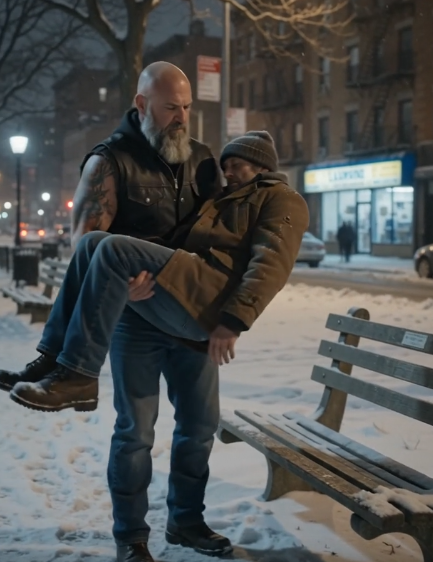
At 11:43 on the coldest night Akron had seen in six years, I lifted a motionless homeless man from a park bench while three strangers filmed me—and every one of them believed they were witnessing an abduction.
My name is Caleb Hayes, although most riders around northern Ohio call me Grinder because I spent twenty-two years shaping steel parts in a transmission plant before the company shut its doors.
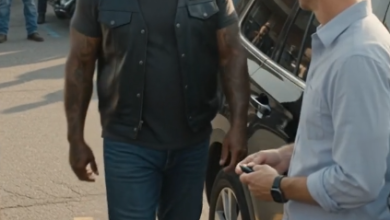
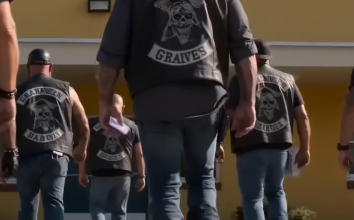
I was fifty-one that winter, six-foot-four, nearly 280 pounds, with a shaved head, a gray beard reaching my chest, and faded tattoos running from both wrists beneath a plain black leather vest. Under the yellow park lights, I probably looked like the last man anyone would trust with an unconscious stranger.
The man on the bench looked about forty-five.
His thin brown coat was buttoned incorrectly, one sneaker had been wrapped in silver tape, and a wool cap covered most of his dark hair. A canvas backpack rested beneath his head like a pillow.
From ten feet away, he appeared to be sleeping.
Up close, something was wrong.
“Sir?”
I touched his shoulder with the back of two fingers.
Nothing.
I shook him a little more firmly and called again, but his body moved without resistance while his head remained tilted against the wooden slats. His eyelids fluttered once, then stopped.
That was when a woman behind me shouted.
“Leave him alone!”
She stood near the bus shelter wearing a red coat, one hand holding a grocery bag and the other already lifting her phone. Beside her, a young couple turned toward us, their faces tightening as they noticed my motorcycle boots, tattoos, and leather.
I ignored them and pressed two fingers against the man’s neck.
His pulse was there.
Slow.
Too slow.
I placed my bare hand against his cheek, then beneath the edge of his coat. His skin felt nothing like normal winter cold. It felt hard, waxy, and frighteningly still.
He was not shivering.
That scared me more than anything.
I pulled off my gloves and loosened his coat enough to check whether his chest was moving. His breaths came so faintly that I had to watch for several seconds before I saw one.
The woman started walking toward us.
“I said get away from him.”
“He needs help.”
“He was sleeping until you started bothering him.”
“No,” I said. “He wasn’t.”
The young man beside her began recording. His girlfriend whispered that they should call the police, while another passerby stopped near the corner and stared toward my Harley parked beside the curb.
I took out my phone.
The screen had died in the cold.
I had been riding home from our club garage when the engine began coughing near Lock 3 Park, and I had pulled over to check a loose battery cable. My phone had been sitting in the outer pocket of my vest for almost an hour, exposed to temperatures well below freezing.
The nearest open building was a twenty-four-hour laundromat across the road.
Its windows glowed through the blowing snow.
Warmth was less than a hundred yards away.
I slid one arm beneath the stranger’s knees and the other behind his shoulders. His coat creaked with ice as I lifted him from the bench.
The woman screamed.
“Put him down!”
The young man moved between me and the sidewalk, holding his phone toward my face.
“You can’t take him anywhere.”
“He’ll die if I leave him here.”
“You don’t know that.”
I looked at the unconscious man in my arms. His lips had turned pale blue, and one hand hung loosely against my vest.
“I know enough.”
The young man stepped aside only when I continued walking. The woman followed us across the park, shouting for someone to stop me as the couple recorded every step.
Drivers slowed.
A horn sounded.
From their angle, a huge tattooed biker had found a defenseless homeless man, lifted him from a bench, and begun carrying him toward an unknown building.
They could not feel the cold skin against my arm.
They could not hear the long spaces between his breaths.
They did not understand why he had stopped shivering.
At the laundromat door, the woman grabbed my shoulder.
I turned slowly, careful not to lose my hold on the man.
“He isn’t asleep,” I told her. “He’s freezing to death. I’m taking him somewhere warm.”
Then the unconscious man made a small sound against my chest.
It was not a word.
It sounded like a name.
And it was the same name tattooed beneath the leather covering my left forearm.
The name was “Danny.”
I almost dropped him.
Sixteen years earlier, my younger brother Daniel had died behind an abandoned warehouse during a January cold snap. He had been sober for eleven months, relapsed after losing his construction job, and disappeared before anyone in our family understood how badly he was spiraling.
A sanitation worker found him the following morning.
For years, I told people the cold killed him because that explanation was easier than admitting he had called me three times the night before and I had ignored every call.
I was angry with him.
He had borrowed money, lied about rehab, and stolen our mother’s wedding ring. I wanted him to spend one night facing the consequences of his choices.
That night became the rest of his life.
After his funeral, I had the date tattooed beneath his name on my forearm. Most people assumed it was military ink or the name of an old riding brother, and I rarely corrected them.
The man in my arms whispered it again.
“Danny.”
Then his head rolled against my shoulder.
I pushed through the laundromat door.
Warm air carrying the smell of detergent and damp clothing met us immediately. Four people inside turned toward the entrance, and every machine seemed to become quieter despite continuing to spin.
The attendant was a small Black woman in her sixties named Denise. I knew her because our club used that laundromat to clean blankets before delivering them to a winter shelter.
She stared at the man in my arms.
“Caleb, what happened?”
“Call 911. Possible hypothermia. He’s barely breathing.”
Denise reached for the landline beneath the counter.
The woman in the red coat entered behind me, still filming.
“He took that man from the park,” she announced. “We don’t know what he’s doing.”
Denise looked from her phone to me.
“He told you what he’s doing.”
“You know him?”
“I know he brings blankets every December.”
That did not satisfy the woman. Her name, I later learned, was Linda Carver. She had not been trying to cause trouble; she had seen a frightening scene and believed she was protecting someone who could not protect himself.
But fear had already decided which one of us was dangerous.
I lowered the man onto the clean tile beside a row of industrial dryers, moving him as gently as my arms allowed. Denise brought folded towels while the dispatcher spoke through the receiver.
I stopped her before she placed one beneath his head.
“Not too much movement.”
Linda frowned.
“Why?”
“Cold hearts can become unstable. We handle him gently.”
The young man who had filmed us was named Marcus. He remained near the doorway with his girlfriend, his phone still aimed at my back.
“You a doctor?” he asked.
“No.”
“Then how do you know?”
I did not answer immediately.
Before the transmission plant, before the prison sentence, before Danny’s death and the years I spent trying to drown it, I had served six years as a volunteer firefighter in Wayne County. I never became a full paramedic, but I completed emergency medical training and responded to enough winter calls to remember what severe hypothermia looked like.
Confusion.
Slow pulse.
Faint breathing.
No shivering.
The last sign was the one people misunderstood. Shivering meant the body was still fighting. When it stopped in brutal cold, the danger had not passed.
The body was losing.
I removed the man’s damp outer coat without twisting him, then covered his torso with dry towels and several blankets Denise kept for shelter donations. I did not rub his hands or try to force him upright.
Linda lowered her phone slightly.
“Why aren’t you giving him hot coffee?”
“He could choke.”
“What about putting him beside the heater?”
“Warm him gradually. Help is coming.”
The stranger’s eyelids moved.
I leaned close enough to smell stale coffee and cold fabric.
“Stay with me, brother.”
His mouth opened.
No sound came out.
The laundromat’s front door swung wide again, carrying a blast of snow into the room. Two patrol officers entered first, hands near their belts as they looked directly at me.
Linda pointed.
“That’s him.”
One officer ordered me to step away.
I raised both hands and moved back from the unconscious man.
Then the second officer saw his face.
She knelt, touched his neck, and immediately reached for her radio.
“Expedite medical. Altered male, severe cold exposure, respirations shallow.”
The first officer glanced at the wet coat on the floor, the blankets, and Denise’s phone still connected to dispatch.
“What happened?”
Linda began explaining that I had carried the man away from a bench.
The officer looked at me.
“Why?”
I pointed toward the motionless body between us.
“He wasn’t sleeping.”
Sirens approached outside.
“He was dying.”
The paramedics arrived less than four minutes later, although the waiting made those minutes feel much longer.
A stretcher rolled through the door, its wheels rattling across the metal threshold. The lead paramedic, a Latino man named Javier Morales, knelt beside the stranger while his partner prepared monitoring equipment.
Javier asked what I had observed.
I gave him the details in order: prolonged cold exposure, unresponsive to voice, minimal response to touch, slow pulse, shallow breathing, no visible shivering, wet clothing, unknown medical history.
He looked up sharply.
“You have training?”
“Old training.”
“You did the right things.”
Those five words changed the room.
Marcus lowered his phone. Linda’s face lost some of its certainty, although she still watched me as if one wrong movement might confirm her first impression.
Javier attached sensors to the man’s chest, checked his temperature using equipment from the ambulance, then spoke quietly to his partner.
I could not hear the number.
I heard the response.
“That low?”
They worked with deliberate care, adding insulated coverings and heat packs designed for controlled rewarming. Nobody slapped the man’s face. Nobody forced a drink between his lips. Nobody treated him like someone who merely needed to wake up.
The officer questioned Denise while the young couple replayed their video.
It showed me leaning over the bench, touching the stranger, then lifting him away while Linda shouted. Without the sound of my explanation and without the medical signs visible, it looked exactly as bad as they had believed.
Marcus turned the screen toward me.
“You understand how this looked, right?”
“I do.”
“You could have told us.”
“I did.”
That silenced him.
The paramedics lifted the stretcher. One of the stranger’s hands slipped from beneath the blanket, and I saw a red thread tied around his wrist.
A small brass key hung from it.
The key struck the stretcher frame with a faint metallic tap.
Something about it felt familiar, but I could not place why.
As the paramedics rolled him toward the ambulance, Javier stopped beside me.
“If you had left him on that bench, he might not have made it until morning.”
Linda heard him.
Her phone lowered completely.
The ambulance doors closed, but no one moved away. Snow blew beneath the parking lot lights while the emergency vehicle idled, its red glow passing over our faces again and again.
One officer asked for my identification.
I gave it to him.
His partner ran my name and found what I knew she would find: a felony conviction from twenty-one years earlier, an assault charge, three arrests related to alcohol, and a suspended license from a life I had spent two decades rebuilding.
The first officer’s posture changed when she read the information on her screen.
“Were you acquainted with the victim?”
“No.”
“Why did you approach him?”
“My bike stalled.”
“And you happened to notice he was in distress?”
“I noticed he wasn’t moving when the snow landed on his face.”
That was the detail I had not told anyone.
Snowflakes had gathered along his eyebrow and beneath the edge of his wool cap. A sleeping person would normally turn away, wipe their face, or shift deeper into a collar.
He did nothing.
The officer asked why I had carried him instead of waiting beside the bench.
“My phone was dead, the wind was getting worse, and the laundromat was warm.”
“You understand moving him carried risks.”
“So did leaving him.”
She held my gaze for a few seconds, then returned my license.
“No complaint has been made. You’re free to go.”
The ambulance pulled away before she finished speaking.
I watched its lights disappear at the intersection.
Marcus approached me after the police left.
“I stopped you from crossing the street,” he said.
“You moved.”
“Eventually.”
“That was enough.”
He looked toward the empty bench in the park.
“What did he say when you picked him up?”
“Danny.”
“Who’s Danny?”
I pulled my glove over the tattoo on my forearm.
“Someone I didn’t carry soon enough.”
I went outside to repair the battery cable on my Harley, but my fingers shook too badly to hold the wrench.
That was when three more motorcycles turned into the parking lot.
Atlas had received Denise’s message.
And he had brought the brothers.
Jonah “Atlas” Reed was fifty-five, Black, six-foot-five, and broad enough to block most of the laundromat doorway when he entered. A salt-and-pepper beard framed his face, and his leather vest had no readable club markings because we removed them before shelter work.
Behind him came Rook and Preacher, both carrying winter gloves and the expressions men wear when they have been summoned without an explanation.
Atlas found me beside the dryer, staring at my dead phone.
“What happened?”
I told them.
Nobody interrupted.
When I reached the part about the name the stranger whispered, Preacher sat on the edge of a plastic chair and looked toward the tiled floor.
All three men knew about Danny.
They also knew what usually happened to me near the anniversary of his death. I stopped answering calls, kept the garage open late, and found reasons to ride until my hands became numb.
Twenty-one years earlier, Atlas had been the officer who arrested me.
I had been drunk outside a bar, furious at the world and swinging at anyone close enough to receive the blame. Atlas was an off-duty deputy then. I hit him hard enough to split his lip before he put me on the pavement.
He could have allowed the system to swallow me.
Instead, he visited after sentencing.
I still remember him sitting behind the scratched glass in county jail, the healing cut visible on his mouth while I refused to look him in the eye.
“You’re not evil,” he told me. “But you’re becoming useless.”
I hated him for that sentence because it was true.
After I was released, Atlas found me work cleaning parts at the transmission plant. He introduced me to a group of sober riders who met in a church basement, then helped me buy a battered Harley-Davidson Road King from a retired mail carrier.
The motorcycle did not save me.
The men did.
They gave me somewhere to be at six in the morning. They noticed when I missed work. They made me carry boxes, repair roofs, and deliver food until usefulness became a habit.
Danny died five years after I got sober.
That loss almost broke the habit.
Atlas stood in my garage for three nights while I raged, blamed everyone, and considered throwing away everything I had rebuilt. He never told me to forgive myself.
He only removed the bottle from my hand and stayed.
Now he sat beside me in the laundromat.
“You couldn’t save Danny tonight,” he said.
“I know.”
“You saved the man in front of you.”
“We don’t know that yet.”
“Then we wait until we do.”
Denise made coffee while snow buried the motorcycles outside. Linda had left, but Marcus and his girlfriend remained near the front windows, perhaps because walking away would have meant admitting they no longer knew which version of the night to believe.
Preacher called the hospital.
Privacy rules meant the nurse could not tell us much, but she accepted our number in case the patient woke and needed someone. We did not know his name, his family, or whether anybody would come looking for him.
At 2:18 a.m., the laundromat phone rang.
Denise answered, listened, then held the receiver toward me.
“It’s the hospital.”
A nurse asked if I was the person who had found the patient.
“Yes.”
“He’s alive, but he remains in critical condition. The physician believes the short time between discovery and controlled rewarming was significant.”
I gripped the receiver harder.
“Did he wake up?”
“Briefly.”
“Did he say his name?”
There was a pause.
“Owen Bell.”
The brass key flashed through my memory.
Bell Machine Works had once occupied an old brick building beside the transmission plant. Its employees wore red threads around their wrists during safety week, each carrying a small brass key used to open personal tool cabinets.
The factory had closed twelve years earlier.
I knew dozens of men named Bell.
But only one had worked beside my brother.
Owen Bell had been Danny’s closest friend.
And on the night Danny died, Owen was the man who had tried to call me first.
I reached the hospital shortly before three.
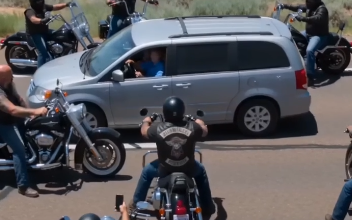
Atlas rode beside me while Rook and Preacher followed. The roads had become slick, so we moved slowly, four V-twins rumbling through snow that swallowed most other sounds.
We left our motorcycles beneath the emergency entrance canopy. Water dripped from our boots as we entered the waiting area, bringing the smell of leather, gasoline, and winter air into a room full of tired families.
Linda was already there.
She sat with Marcus near the vending machines.
Her red coat lay folded across her lap, and without it she looked smaller than she had in the park. When she saw me, she stood but did not approach immediately.
“How did you know where he was?” I asked.
“The police told us where the ambulance went,” she said. “I needed to know whether he lived.”
The answer was honest enough.
A physician named Dr. Patel spoke with us after Owen was transferred to intensive care. She explained that his core temperature had fallen dangerously low and that the lack of shivering had indicated severe hypothermia, not comfort.
“He was close,” she said.
“How close?”
Her expression answered before her words did.
“Another hour outside could have been fatal. Possibly less.”
Linda covered her mouth.
Marcus looked down at the phone that had recorded everything.
Dr. Patel told us Owen had no identification, only a shelter meal card, the brass key, and a folded photograph sealed inside his backpack. Staff had found an emergency contact written on the back.
The number belonged to me.
I had not used it in fourteen years.
Owen woke late the following afternoon.
His voice remained weak, and a clear oxygen tube rested beneath his nose. Nurses allowed me inside for only a few minutes because he needed quiet and continued monitoring.
He recognized me immediately.
“Grinder.”
Nobody outside the old plant had called me that before I joined the riders.
I pulled a chair beside the bed.
“You scared half of Akron.”
A faint smile moved across his face.
“You always were dramatic.”
I wanted to ask a hundred questions, but only one reached my mouth.
“Why did you have my number?”
Owen looked toward the window.
“Your brother gave it to me.”
The room became smaller.
He explained that he and Danny had stayed close after Bell Machine Works cut its second shift. They attended recovery meetings together, found temporary construction work, and sometimes slept in Owen’s truck when neither had enough money for rent.
On the night Danny died, they had argued.
Danny wanted to buy alcohol. Owen took his money and tried to stop him. Danny walked away, furious, while Owen called me from a pay phone.
I never answered.
Owen searched for him for nearly two hours.
He found Danny behind the warehouse, still alive but barely conscious, then ran to a gas station because neither man owned a working phone. By the time help arrived, Danny’s heart had stopped.
“I should have stayed with him,” Owen whispered.
“You went for help.”
“I left him alone.”
His guilt had used the same words as mine.
For sixteen years, I had imagined Danny dying with nobody looking for him. I had believed my ignored calls were the last chance anyone received.
Owen had carried a different version of that night.
He believed he had abandoned my brother.
I believed I had abandoned them both.
After Danny’s funeral, Owen tried to speak with me, but I was too angry to listen. I saw him as another man from my brother’s broken life, another reminder of promises that had failed.
He left Ohio several months later.
For a while, he found work in Kentucky. Then came a back injury, prescription painkillers, a divorce, and years of unstable housing. He returned to Akron after learning his daughter had moved nearby, although shame kept him from contacting her.
The photograph in his backpack showed a little girl sitting on Danny’s shoulders at a county fair.
“That’s my daughter, Grace,” Owen said. “Danny loved her like family.”
The picture had been taken three weeks before my brother died.
On its back, Danny had written two telephone numbers.
Mine was one of them.
“I kept thinking I’d call you,” Owen said. “Tell you what happened.”
“Why didn’t you?”
“Same reason you didn’t answer.”
He looked at me.
“Pride.”
Neither of us spoke for a while.
Machines hummed around the bed. Footsteps passed in the corridor, and somewhere beyond the window, snowplows scraped the hospital parking lot.
Finally, Owen touched the blanket covering his chest.
“Why’d you carry me?”
I rolled up my left sleeve and exposed Danny’s name.
“Because you weren’t asleep.”
Owen stared at the tattoo.
“You were freezing to death,” I said. “I carried you somewhere warm.”
His eyes closed.
For a second, I thought he had drifted back to sleep.
Then he whispered, “You came this time.”
The words landed harder than any fist ever had.
Marcus uploaded seventeen seconds of footage before he learned the truth.
The clip showed me lifting Owen from the bench while Linda shouted and bystanders followed. Its caption asked whether anyone recognized the biker “taking a homeless man from Lock 3 Park.”
By morning, thousands of people had watched it.
Some called me a kidnapper. Others demanded my arrest. A few claimed the motorcycles proved our group was trafficking homeless people.
Truth moves more slowly than fear.
Marcus wanted to delete the video, but Atlas suggested something better. He told Marcus to post the full recording, including my warning that Owen was freezing and the moment the paramedics confirmed the emergency.
Marcus did.
He also recorded himself explaining what had happened.
“I thought I was protecting a sleeping man from a dangerous stranger,” he said. “The stranger was the only person who realized that man was dying.”
The correction never reached everyone who saw the first clip, but it reached enough.
Linda visited Owen two days later.
She stood awkwardly beside his hospital bed holding a paper bag containing gloves, thermal socks, and a new wool cap. She apologized for shouting at me, then apologized to Owen for assuming that homelessness made his condition easy to explain away.
“I saw you on that bench before the biker stopped,” she admitted. “I thought you were sleeping, so I kept walking.”
Owen looked at her for a long moment.
“So did everybody.”
He accepted the wool cap.
That was enough.
When doctors discharged him nine days later, he had nowhere safe to recover. The emergency shelter was full, and temperatures were expected to remain below freezing.
Our riding club operated a converted repair garage behind an old church. Half the building held motorcycles and tools; the other half contained donated furniture, canned food, and six temporary beds used during winter outreach.
Rook objected when Atlas suggested Owen stay there.
Not because Owen was homeless.
Because Owen was using pain medication again.
Rook had lost his son to an overdose and believed bringing an unstable stranger into the garage could endanger every sober rider who used the building for meetings.
He was not wrong.
Brotherhood is easy when everyone agrees. It becomes real when two good men see different dangers and must choose whether trust can survive the difference.
“We can’t rescue someone by risking everyone else,” Rook said.
“We’re not leaving him outside,” I answered.
“I didn’t say leave him outside.”
“You said no.”
“I said we need rules.”
The argument grew loud enough to silence the entire garage. Leather creaked as men shifted away from us, uncertain whether to intervene.
Owen stood near the entrance holding a plastic hospital bag. He heard every word.
“I’ll go,” he said.
I turned toward him.
“You just got here.”
“I know when somebody doesn’t want me.”
Rook removed a key from his pocket and placed it on the workbench.
“That isn’t what I said.”
He established the conditions himself: medication secured by the shelter nurse, no alcohol, daily check-ins, counseling appointments, and no disappearing without telling someone where he was going.
Then Rook carried Owen’s bag to the bed nearest the heater.
Trust did not arrive as a speech.
It arrived as rules, a clean blanket, and a man making room despite his fear.
Owen stayed three weeks.
During the first, he slept almost constantly. During the second, he began sweeping the garage before anyone asked. During the third, he repaired a broken drill press that had defeated every mechanic in the club.
Bell Machine Works had trained him well.
Grace came to see him on a Sunday afternoon.
She was twenty-seven, married, and working as an elementary school counselor outside Canton. Owen had not spoken to her in eight years.
He asked me to remain in the room when she arrived, but I stepped into the garage and left the door partly open.
Their first conversation lasted eleven minutes.
The second lasted two hours.
No miracle erased the years between them. Grace did not invite him home, promise forgiveness, or pretend one hospital stay had repaired everything.
She returned the following Sunday.
That was a beginning.
One year later, Owen and I returned to Lock 3 Park on the anniversary of the night I found him.
The temperature was twenty-eight degrees, warmer than before but still cold enough to turn every breath white. He wore a heavy green coat donated by Linda, insulated boots, and the same brass key tied around his wrist.
The bench had been moved closer to a lamppost.
A weatherproof metal box now stood beside it, filled with emergency blankets, hand warmers, shelter information, and cards describing the warning signs of hypothermia.
Marcus had raised money for the box after his corrected video spread across the city. Linda refilled it every Friday before work.
Neither of them asked to have their names printed on it.
Owen sat on the bench while I remained beside my Harley. The V-twin ticked as it cooled, its sound mingling with traffic beyond the park.
“You ever think about how strange this is?” he asked.
“Every day.”
“You carried me away before asking my name.”
“You weren’t answering questions.”
“You terrified that poor woman.”
“You terrified the paramedics.”
He smiled.
Then his expression grew serious.
“I meant what I said in the hospital.”
I knew which words he meant.
You came this time.
For a year, that sentence had followed me into the garage, onto highways, and through the quiet moments before sleep. At first, it felt like forgiveness.
Eventually, I understood it was something smaller and more useful.
It was permission to stop living inside one unanswered phone call.
Owen had not replaced Danny. Saving one man did not cancel losing another, and carrying him across a frozen street could not rewrite what happened behind that warehouse sixteen years earlier.
But guilt had always told me the story ended when I failed.
Owen was living proof that sometimes another page appeared.
He found part-time work repairing equipment for the church. He moved into a small studio apartment above a bakery and attended recovery meetings with Rook twice each week.
Grace still guarded her trust carefully.
She also called him Dad again.
Before we left the park, Owen opened the emergency box and checked the supplies. One blanket was missing.
Somebody had needed it.
He replaced it with another from his backpack, closed the lid, and looked across the street toward the laundromat.
“Ready?” I asked.
He nodded.
I started the Harley. The engine’s low pulse rolled across the frozen pavement, loud enough to make two pigeons rise from the roof of the bus shelter.
Owen did not climb onto the passenger seat.
Beside my motorcycle stood a used blue Road King the club had rebuilt from donated parts. The paint was scratched, the chrome was imperfect, and the right saddlebag needed a new latch.
It ran.
That was what mattered.
Owen pulled on his gloves and mounted the bike. The brass key moved against his wrist as he closed one hand around the handlebar.
We rode away from the bench together.
Two motorcycles.
Two men who had once left someone in the cold.
This time, nobody was left behind.
Follow our page for more unforgettable biker stories about rough-looking riders whose quiet acts of courage reveal the humanity hidden beneath leather and scars.