Part 2: A Biker Gave Me His Leather Jacket — Fifteen Years Later, I Still Fill the Left Pocket
I am thirty-nine years old now.
I have a wife, a seven-year-old daughter, a mortgage, a job that requires me to answer emails using words like “deliverables” and “quarterly projections,” and a closet containing more coats than my mother and I owned clothes during that entire winter.
But I still remember the weight of that jacket.
Not just the physical weight.
Though it was heavy.
The leather was thick and softened by years of use. The collar smelled faintly of tobacco even though I never saw the biker smoke. One sleeve had a repaired seam near the elbow. The zipper caught halfway up unless I pulled it slightly to the left.
Inside the lining, near the hem, someone had stitched a small patch by hand.
It was crooked.
Blue thread on brown fabric.
A square no bigger than a postage stamp.
I noticed it the first night because my fingers kept finding it while I tried to sleep.
My mother and I had secured two beds at a winter shelter a few blocks from the diner. The room was crowded. Metal frames. Thin mattresses. Fluorescent lights that buzzed even after most people had stopped talking.
I slept wearing the jacket.
The next morning, I refused to take it off.
My mother laughed for the first time in weeks.
“You look like a tiny detective.”
“I look tough.”
“You look like a tiny detective wearing a sofa.”
She was right.
The jacket swallowed me.
But it was warm.
For the first time that winter, I stopped thinking about the cold every minute of the day.
The staff at the shelter knew the biker.
Not his real name.
His road name.
Bear.
That was what a caseworker named Dana told my mother when she saw the jacket.
“Big guy? Gray in his beard? Knuckles look like he argued with a toolbox?”
My mother nodded.
Dana smiled.
“Bear.”
She said he rode with a local group called the Mesa Lantern Riders. They were not a club that made speeches or took photographs beside donation boxes. Every winter, they collected blankets, boots, and old coats. They delivered coffee during the shelter’s overnight shifts. They kept a small emergency fund for families who needed bus tickets or a motel room when the shelter was full.
They did not put their patches on any of it.
Bear rarely came inside.
Crowded rooms made him uncomfortable.
Dana said he preferred unloading boxes near the back entrance and leaving before anyone thanked him.
That detail stayed with me.
So did another.
A week after I received the jacket, I saw Bear again.
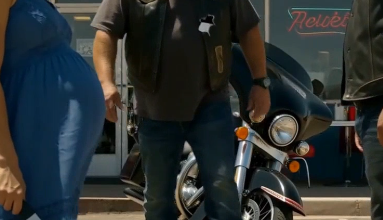
My mother and I were waiting outside a food pantry on Central Avenue when the low pulse of a Harley rolled down the street. Bear parked near the curb, removed two grocery bags from a saddlebag, and carried them toward an older man sitting beside a shopping cart.
Bear did not hug him.
Did not shake his hand.
He set the bags down.
“Soup cans got pull tabs,” he said. “You said your opener broke.”
The older man looked inside.
“You remembered?”
Bear shrugged.
“Was listening.”
Then he noticed me.
His eyes dropped to the jacket.
“Zipper giving you trouble?”
I nodded.
“Pull left.”
I tried it.
The zipper moved smoothly.
Bear gave one short nod, as if we had completed an important business transaction.
Then he walked back toward his Harley.
I called after him.
“Why’d you give me your jacket?”
He paused.
For a moment, the only sound was the clicking of the cooling engine and a bus groaning to a stop at the corner.
Bear did not turn around.
“Had it a long time,” he said.
Then he added, “Long enough.”
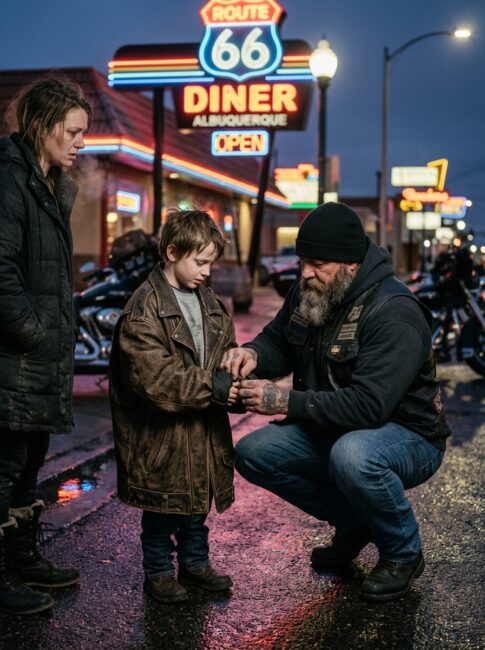
The jacket became part of me.
I wore it to breakfast at the shelter.
I wore it while my mother filled out job applications at the public library.
I wore it while we waited in line outside housing offices where adults spoke in quiet voices and handed my mother forms she could barely complete because her fingers shook from exhaustion.
I wore it to school.
That was the hardest part.
My mother fought to keep me enrolled after we lost our apartment. She insisted that one ordinary thing had to survive.
“School stays,” she said.
So every morning, we took two buses across Albuquerque.
The jacket made me noticeable.
Kids notice everything.
The sleeves were folded back so far they formed thick cuffs around my wrists. The hem hung close to my shins. The shoulders rose around my neck whenever I sat down.
One boy called it my “garbage coat.”
Another asked whether I stole it from a dead man.
I punched him.
Not hard.
Hard enough.
The principal called my mother.
She arrived wearing the same diner uniform she had started using three days earlier, her name tag crooked and her hair pinned back too quickly. She looked tired, angry, and proud in exactly the wrong proportions.
On the bus afterward, she said, “You don’t get to hit people.”
“He said—”
“I know what he said.”
“He doesn’t know anything.”
“No.”
She looked through the window at the old Route 66 storefronts sliding past us.
“He doesn’t.”
I waited for her to tell me to leave the jacket at the shelter.
She did not.
Instead, she unfolded one sleeve where it had slipped down over my fingers.
“Wear it,” she said. “Just don’t become mean inside it.”
That winter lasted forever.
At least that is how I remember it.
Cold mornings. Shelter rules. The smell of industrial laundry detergent. My mother’s diner shoes squeaking on linoleum when she returned after late shifts. The scrape of plastic hangers against metal rails. The constant fear that one small problem could push us backward.
Then, in February, the shelter director called my mother into her office.
I assumed we had done something wrong.
Children who live without stable homes become experts at preparing for bad news.
We learn to read adult faces.
We notice when voices drop.
We count bags.
If our mother starts packing quickly, we do not ask questions until we are already moving.
That afternoon, my mother stepped out of the office holding a key.
For a moment, she simply stared at it.
Dana, the caseworker, stood beside her.
“There’s a transitional unit available,” Dana said. “Small place. One bedroom. Six months while we work on the next step.”
My mother covered her mouth.
I had seen her cry before.
Quietly.
Usually when she thought I was asleep.
This was different.
She crouched and held the key in front of me.
“We got a door,” she said.
I did not understand why that sentence made her laugh and cry at the same time.
A door.
Not a house.
Not yet.
A door we could lock.
A room where my backpack could stay in the same corner overnight.
A refrigerator with nothing in it except a carton of milk, three yogurts, and a bottle of mustard Dana gave us as a joke.
A narrow bed my mother let me have while she slept on a pullout couch.
The first night, I still wore Bear’s jacket.
My mother stood in the doorway.
“You know you can take it off now.”
I pulled the collar closer around my neck.
“I know.”
She turned off the light.
I slept in it anyway.
I thought reaching that apartment was the ending.
It felt like one.
But Bear had placed something inside that jacket before he handed it to me.
Something none of us knew was there.
Spring arrived slowly.
One afternoon in late March, sunlight warmed the small living-room window of our transitional apartment. I came home from school sweating beneath the leather jacket.
My mother was working a double shift.
I dropped my backpack on the floor and took the coat off.
For the first time in months, I really looked at it.
The leather had collected scratches. One cuff was darker from rubbing against bus seats. The lining had started to loosen near the left side.
I reached inside to find the crooked blue-thread patch.
My fingers touched something stiff.
Not the regular side pocket.
A hidden inner pocket sewn into the lining near the left side of the chest.
I had felt the edge of it a hundred times without understanding what it was.
The opening was narrow.
My hand barely fit inside.
I pulled out a folded piece of paper.
Then an envelope.
The envelope had softened from months of being pressed against my body while I slept.
Inside were five one-hundred-dollar bills.
Five hundred dollars.
To a child, it might as well have been five million.
I unfolded the paper.
The handwriting was rough. Block letters. Written in black ink.
DON’T EVER THINK NOBODY CARES ABOUT YOU.
I CARE.
AND I USED TO BE YOU.
There was no name.
No phone number.
No request to be thanked.
Nothing else.
I read the note three times.
Then I sat on the floor with the jacket in my lap and waited for my mother.
When she came home, she saw the bills before she removed her shoes.
Her face changed.
“Where did you get that?”
I told her.
She sat beside me.
I handed her the note.
My mother read it silently.
Then she pressed the paper against her mouth and closed her eyes.
We needed that money.
Badly.
The transitional program gave us time, but not enough. My mother had started saving every dollar she could. The diner paid minimum wage plus tips. Some nights were good. Some nights she came home with less than the cost of our bus fares and groceries.
Five hundred dollars was not a miracle.
It did not erase everything.
But two months later, when my mother found a small apartment near her job, that money became most of the security deposit.
The day we moved, she placed the key in my palm.
“A real one this time,” she said.
I wore the leather jacket even though the weather had turned warm.
Dana helped us carry boxes upstairs.
Before leaving, she looked at the coat and asked, “You ever find Bear again?”
I shook my head.
The Mesa Lantern Riders had not seen him in weeks.
One brother said Bear had left town.
Another said he sometimes disappeared when winter ended.
Nobody seemed to know where he went.
Dana looked toward the left side of my chest.
For half a second, I wondered whether she knew.
Then she said, “Keep that jacket.”
I did.
But I kept the note closer.
I searched for Bear for years.
At first, my mother helped.
We asked at the shelter.
We stopped at the diner parking lot whenever Harley engines rolled in from Central Avenue.
We spoke to the Mesa Lantern Riders at their winter donation drives. Brick, an older rider with a white mustache and a voice like worn sandpaper, remembered Bear well. So did Mercy, a former nurse who rode a burgundy touring bike and wore a long braid down the back of her leather cut.
They knew pieces of his story.
Not the whole thing.
Bear had grown up moving between relatives, shelters, and cheap motel rooms somewhere in northern New Mexico.
His mother had struggled with addiction.
His father had disappeared early.
At eleven, Bear slept behind a truck stop for several weeks after running away from a home where nobody noticed when he left.
An older mechanic eventually gave him work sweeping floors.
Later, the same mechanic taught him how to repair motorcycles.
That was the beginning of the road beneath Bear’s boots.
Not escape.
Not some polished story about finding himself.
Work.
One small task after another.
Sweep the floor.
Clean the wrench.
Change the oil.
Come back tomorrow.
Brick said Bear could be difficult.
“He wasn’t a saint,” he told me.
“He got angry. Vanished sometimes. Didn’t trust easy. Took years before he could sit with his back to a door.”
Mercy added, “But he noticed cold kids.”
That sentence landed harder than anything else.
Bear noticed cold kids.
I asked whether the jacket had belonged to him when he was young.
Brick looked toward Mercy.
Mercy looked at the ground.
Then Brick said, “Probably.”
He did not know for certain.
Or he did not want to tell me.
The blue-thread patch inside the lining became my clue.
I studied it often.
Someone had repaired that jacket by hand.
Someone without much skill.
The stitches were uneven.
The thread had doubled back in places.
The leather around the patch had darkened with age.
I started imagining Bear as a boy my age, wearing the same coat through a different winter.
I imagined him folding the same sleeves.
Sleeping inside the same weight.
Learning the same trick with the zipper.
Pull left.
Maybe that was why he noticed me so quickly.
Maybe he did not see a homeless child outside a diner.
Maybe he saw himself.
The club brothers told me something else years later.
The night Bear handed me the jacket, they had argued with him.
Not about the coat.
About the money.
The Mesa Lantern Riders kept a small emergency envelope for shelter outreach. They had planned to give it directly to Dana so she could use it where needed most.
Bear asked for five hundred dollars from the fund.
Rooster, the club treasurer, pushed back.
“That’s most of what we got left.”
Bear did not raise his voice.
“Kid needs it.”
“What if the cash disappears?”
“It won’t.”
“How do you know?”
Bear looked at the jacket folded over his arm.
“Because he ain’t ready to find it yet.”
That was the detail that made the whole thing clear.
Bear did not slip money into my hand while my mother and I were still sleeping in shelters.
He understood what immediate cash might attract. Questions. Fear. The risk of losing it. The possibility that desperate circumstances would swallow it before we reached stable ground.
So he hid it where I would carry it safely without knowing.
Near my heart.
The left chest pocket.
He expected me to discover it when winter ended.
When I no longer needed the coat every minute.
When, with some luck, my mother and I would be somewhere safe enough to take it off.
That was not random kindness.
It was the planning of someone who understood instability from the inside.
The Mesa Lantern Riders gave him the money.
Even though it emptied most of their winter fund.
Then, without telling Bear, the brothers replaced it.
Brick covered one hundred.
Mercy added another.
Rooster complained louder than anyone and contributed two hundred dollars the next morning.
Three other riders filled the rest.
Brotherhood did not look like men posing beside motorcycles.
It looked like an envelope quietly becoming full again.
I carried Bear’s note in my wallet for fifteen years.
Through middle school.
Through high school.
Through community college classes taken at night while I worked weekends unloading delivery trucks.
Through the university scholarship I almost did not apply for because I assumed people like me were supposed to be grateful for survival and stop asking for more.
Through my first office job.
Through the day I proposed to the woman who became my wife.
Through our wedding.
The paper softened along the folds.
The ink faded slightly.
But the words remained readable.
DON’T EVER THINK NOBODY CARES ABOUT YOU.
I CARE.
AND I USED TO BE YOU.
My mother kept the jacket.
She stored it in a garment bag in the back of her closet after I finally outgrew it.
Years later, when I bought my first home, she brought the jacket over in a cardboard box.
“You should have this,” she said.
I lifted it out carefully.
The leather was still heavy.
The zipper still caught halfway unless I pulled left.
The blue-thread patch was still crooked.
I slid my fingers into the hidden left chest pocket.
Empty.
But not really.
That winter, I took the jacket to a coat drive organized near Central Avenue.
The Mesa Lantern Riders still helped.
Brick was older. Mercy had retired from riding long distances but still arrived in boots and a leather vest. Rooster’s beard had gone almost completely white.
I told them what I planned to do.
Brick nodded once.
Mercy smiled.
Rooster handed me a stack of envelopes.
“Make sure the cash sits flat,” he said. “Kids notice lumps.”
I started with one coat.
A warm canvas jacket donated by a coworker.
Inside the left chest pocket, I placed fifty dollars and a folded note.
I used Bear’s words.
Every one of them.
The next winter, my wife helped.
Then my mother.
Then our daughter, once she was old enough to write legibly.
We never put money into every coat.
We could not.
But each winter, we chose as many as we could afford.
The amounts varied.
Twenty dollars.
Fifty.
Sometimes one hundred.
Enough for groceries.
A bus pass.
A phone bill.
A small piece of ground beneath someone’s feet.
Always the left chest pocket.
Always the same note.
I never found Bear.
I searched online.
I asked old riders.
I checked obituaries when someone mentioned a possible last name.
Nothing.
Maybe he left New Mexico.
Maybe he still rides somewhere beyond the reach of the questions I wanted to ask.
Maybe he preferred it that way.
Every December, my family returns to the same part of Albuquerque.
Central Avenue still carries the bones of Route 66 through the city. Neon signs still glow above wet pavement on cold nights. Buses still groan at the curb. The wind still finds people who do not have enough layers.
The Mesa Lantern Riders arrive near the shelter on their Harleys.
The V-twins shake the windows before the engines cut off one by one.
Then the boots hit pavement.
Boxes come out.
Blankets.
Gloves.
Boots.
Old jackets.
My daughter helps fold the coats now.
She knows the rule.
Left chest pocket.
She slides an envelope inside a heavy green jacket and flattens the lining with both hands.
“Like this?” she asks.
“Exactly like that.”
My mother stands nearby holding a cup of coffee. Her hair is gray now. She watches my daughter work, then looks toward me.
Neither of us says Bear’s name.
We do not need to.
A teenager approaches the table wearing a sweatshirt too thin for the weather.
He looks at the jackets but hesitates.
I lift the green one.
“Try this.”
He puts it on.
The sleeves are too long.
I fold the cuffs back twice.
“Better,” I say.
He nods.
The jacket hangs almost to his knees.
Behind us, a Harley engine starts.
The sound rolls beneath the Route 66 signs and disappears into the winter traffic.
The teenager zips the coat.
He does not know what is waiting inside.
Not yet.
Some kindness needs time to be found.
Follow our page for more stories about the people behind the leather cuts.