Part 2: A Biker Grabbed the Graduation Mic — Then Gave His Daughter One Last Promise
My name is Laura Bennett, and I taught Sarah Mitchell senior English.
That means I knew her essays before I knew her family.
Quiet girl. Careful handwriting. Never turned anything in late. Sat near the window, always with one earbud tucked away before class started, like she was used to being corrected before she was caught. She smiled when spoken to, but she never took up more space than she had to.
The first essay she wrote for me was about Route 66.
Most students wrote about neon signs, diners, old cars, postcards, easy things. Sarah wrote about a gas station on the west side of Gallup where she used to sit on a curb when she was eight, waiting for a man on a motorcycle who sometimes came and sometimes didn’t.
She never named him.
Just “my father.”
I learned pieces after that.
Her father’s name was Jack Rourke.
Her mother, Denise Mitchell, had divorced him ten years earlier. Denise was not a villain. Grief and fear can make hard people harder. She worked two jobs, raised Sarah, went to every parent meeting, and guarded her daughter like the world had teeth.
And Jack had given her reasons.
He had been a drinker when Sarah was little. A fighter. A man who loved big and failed bigger. He had one arrest from a bar fight outside a truck stop near Grants. No long prison stretch, but enough holding cells, court dates, and broken promises to make Denise decide love was not a safe place for a child.
Jack joined a riding club after he got sober.
The Desert Saints.
Not a famous club. Not a clean one either. Welders, veterans, mechanics, one retired rodeo man, and a Black American road captain named Marcus “Book” Freeman who carried a small Bible in one saddlebag and a socket set in the other. They rode Harley touring bikes and old cruisers, but they never talked much about the bikes. Mostly they fixed roofs, delivered groceries during snowstorms, and stood outside funerals for veterans nobody came to bury.
Jack had the look that made school administrators nervous.
Big white American man, mid-40s, tattooed forearms, faded knuckle ink, thick beard, cut with road dust in the seams, boots that sounded too loud in hallways. But once, two months before graduation, I saw him outside the campus fence.
Not trespassing.
Just standing across the street by his parked Harley, helmet under one arm, watching the senior banner being hung.
He did not wave.
He did not call out.
He just watched.
Then he took something from his vest pocket and turned it over in his hand.
A small black velvet box.
I noticed one strange thing that day.
His fingernails were clean.
For a man who looked like he rebuilt engines with his bare hands, that tiny detail stayed with me. His hands were scarred and rough, but the nails were trimmed neat, like he had prepared them for something delicate.
When Sarah came out after practice, she saw him across the street.
She stopped.
He lifted two fingers.
She almost lifted hers back.
Then Denise’s car pulled up, and Sarah dropped her hand.
Jack put the box away.
The Harley started with one low cough, then settled into a steady rumble. He rode off toward Route 66 without making her choose.
That was the first time I understood the story was not simple.
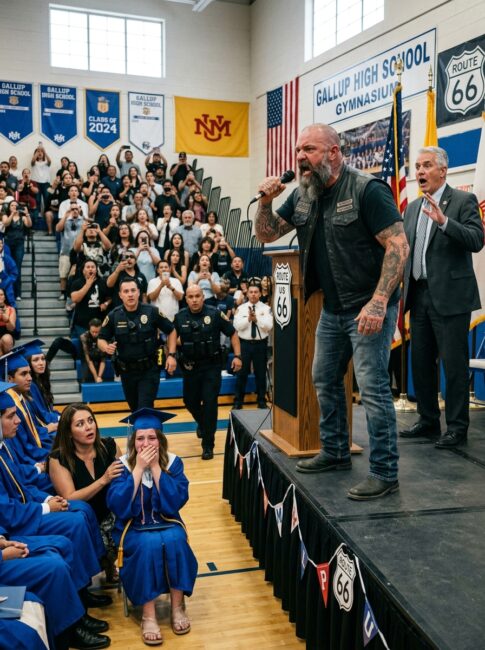
Graduation day was already tense before Jack arrived.
Denise came early.
Too early.
She wore a navy dress and the face of someone who had rehearsed every possible disaster. She spoke to the principal in a low voice near the equipment table. I heard only pieces.
“He may show up.”
“Please don’t let him near her.”
“He knows today matters.”
The principal nodded in the professional way men nod when they want a problem to sound managed. The school resource officers were told. Not dramatically. No lockdown. No panic. Just awareness.
Sarah did not know that conversation happened.
Or maybe she did.
Children always know more than adults think.
She stood with the other seniors in the hallway, twisting her class ring around her finger. Her cap was pinned badly, so I fixed it for her. She smelled faintly like vanilla lotion and hairspray.
“You okay?” I asked.
She nodded.
Then she said, “Do you think people can keep promises late?”
I looked at her.
“What do you mean?”
She shrugged, eyes fixed on the gym doors.
“Nothing.”
The ceremony began with the usual things. Band music. Applause. Phones lifted high. The squeak of sneakers on hardwood. The principal’s voice bouncing off the cinderblock walls.
I watched Sarah walk in.
She searched the crowd once.
Found her mother.
Smiled.
Then searched again.
Found no one.
Something in her face closed.
The principal started speaking about endurance. About families. About sacrifice. About the road ahead. His words were fine words, but they floated above the room.
Then the Harley came.
You could hear it through the walls before anyone saw him.
Not loud enough to be rude. Loud enough to be impossible to ignore.
The engine cut off outside.
For one second, the gym went strangely quiet, like the whole building had inhaled.
Then came the boots.
Heavy.
Measured.
The double doors opened.
Jack Rourke stepped inside.
Denise stood immediately.
Her face went white, then red.
The officers moved.
Jack did not look at them.
He looked at the stage.
His leather cut creaked when he walked. His boots hit the gym floor with slow, dull thuds. Parents stared. Some whispered. A few phones rose, because people record before they understand.
I moved toward the aisle without knowing why.
Jack climbed the stage steps.
The principal turned, stunned.
“Sir, you can’t—”
Jack took the microphone.
Not violently.
He did not shove him.
He just took it with one big scarred hand, held it close, and looked out over four hundred people like every one of them had the right to hate him.
The officers were at the foot of the stage now.
Denise whispered, “No.”
Sarah stood from her chair.
Jack found her.
His hand shook.
That was what the videos barely show.
Not his tattoos. Not his size. Not the leather.
His hand shaking around the microphone.
“Sarah,” he said. “Baby girl. I’m not allowed to be here.”
A murmur moved through the gym.
“But I promised you ten years ago I’d see you graduate. I saw you.”
His jaw tightened.
“I’m proud of you.”
Sarah covered her mouth.
“This is your day. I’m leaving now.”
That was it.
No blame.
No accusation.
No scene.
He put the mic back on the stand and stepped down.
For a second, I thought the whole story had already reached its ending.
A broken father had broken one more rule, said one good thing, and would be escorted out.
Then he stopped in front of Sarah.
The officers stopped too.
Jack reached into the inside pocket of his vest and took out the black velvet box.
Denise took one step forward.
“Jack, don’t.”
He did not answer her.
He held the box out to Sarah.
“Your grandma told me to keep it safe,” he said.
Then he walked away.
Sarah did not open the box right away.
She held it like it might burn her.
Jack walked down the center aisle toward the gym doors. Nobody touched him. Nobody clapped. Nobody spoke. The only sound was leather shifting, boots on hardwood, and the faint buzz from the sound system.
One officer followed him at a careful distance.
The other stayed near the stage.
The principal looked at me, lost.
Denise stared at the box in Sarah’s hands.
Her face had changed.
Not anger now.
Fear.
Old fear.
Sarah slowly lifted the lid.
Inside was a ring.
Small. Gold. Old-fashioned. A tiny blue stone in the center, worn soft at the edges. Not expensive in the way jewelry stores mean expensive. Expensive in the way a thing becomes when it has lived on hands that held babies, signed checks, washed dishes, buried husbands, and kept going.
Sarah made a sound I will never forget.
“Grandma Ruth’s ring.”
Denise sat down like her knees had been cut.
That was the first twist.
This was not some dramatic gift bought to win attention.
It was an heirloom.
Jack’s mother, Ruth Rourke, had died when Sarah was a baby. Before she passed, she had asked Jack to save her ring for Sarah’s graduation. Not birthday. Not wedding. Graduation.
Because Ruth had been the first woman in their family to finish high school.
Sarah knew the story.
Denise knew it too.
Jack had not sold the ring during his drinking years.
Not when he lost his job.
Not when he slept in a rented room behind a tire shop.
Not when his bike was nearly repossessed.
Not when the Desert Saints had to bring him groceries because pride does not feed a man.
He had kept it.
Ten years.
Through divorce.
Through court papers.
Through missed birthdays.
Through letters returned unopened.
Through every reason a weaker man might have pawned it and told himself life made him do it.
Sarah snapped the box shut, then stood so fast her cap fell off.
“Sarah,” Denise said.
But Sarah was already moving.
She ran down the aisle in her graduation gown, blue fabric whipping behind her, honor cords bouncing, the little black box gripped in one hand.
The gym doors were still closing.
She pushed through them.
The sound system was still live.
Nobody realized the microphone on the stage had picked up the doors, the running footsteps, and then something outside.
A Harley starting.
Then Sarah’s voice.
“Dad!”
The engine stopped.
Not faded.
Stopped.
Dead silence followed.
Then Jack’s voice, far from the mic but somehow carried through the open gym doors and the cheap speakers above the bleachers.
“Go back inside, Sarah.”
“No.”
“Baby, this is your day.”
“You promised you’d see me graduate.”
“I did.”
“You didn’t promise you’d leave.”
The gym went still.
Nobody breathed.
Then we heard her crying.
Not pretty crying. Not movie crying. The kind that comes from ten years of swallowing one question.
“Why didn’t you fight harder?”
That was the second twist.
She had not run after him for the ring.
She ran after him for the answer.
I followed them outside with the principal, Denise, and half the gym trying not to look like they were following too.
Jack stood beside his Harley near the curb, helmet hanging from one hand. The bike gave off heat in waves. The pipes ticked as they cooled. The air smelled like sunburned asphalt, gasoline, and fresh-cut grass from the football field.
Sarah stood in front of him, crying, holding the ring box against her chest.
Jack looked bigger outside.
And smaller.
That is hard to explain unless you have seen a man built like a wall trying not to fall on his own child.
He did not reach for her.
He kept both hands visible, like he was afraid any sudden movement might prove everyone right about him.
“I did fight,” he said.
His voice was rough, low.
“I fought wrong.”
Sarah wiped her face with her sleeve.
“That doesn’t answer me.”
Jack nodded.
“No. It don’t.”
Denise came through the doors then.
“Sarah, come back inside.”
Sarah did not turn.
Jack looked at Denise.
There was history there. Not the soft kind. The kind with broken dishes, slammed doors, apology texts, courtrooms, unpaid bills, and one little girl listening from a hallway.
“I’m leaving,” Jack said to Denise. “I said what I came to say.”
Denise’s eyes moved to the box.
“You kept it.”
Jack’s jaw shifted.
“Your mother-in-law asked me to.”
“I thought you sold it.”
“So did I, some nights.”
That line landed harder than blame would have.
Book Freeman arrived then, though none of us had seen him pull up. He was a tall Black American man in his 50s with a gray beard, a Desert Saints cut, and a calm face. He stood a few yards behind Jack, not interfering, not crowding.
Brotherhood.
Not rescuing Jack from consequences.
Just making sure he did not run from them.
Book looked at Sarah and said, “Your dad had us check on that ring every Christmas.”
Sarah blinked at him.
“What?”
Book nodded toward Jack’s vest.
“Inside pocket. Left side. Every year, Christmas Eve, he’d open that box at the clubhouse, make sure it was still there, then close it like it was church.”
Jack shot him a tired look.
“Book.”
“No,” Book said. “Girl asked why.”
That was the third twist.
Jack had not just remembered the promise on graduation day.
He had lived around it.
Sarah opened the box again.
Inside the lid was a folded slip of paper, yellowed and soft.
She pulled it out.
The handwriting was old.
To my Sarah, when you finish school. Wear this and know the women before you were stubborn enough to survive. Love, Grandma Ruth.
Sarah pressed the note to her mouth.
Jack looked away.
His eyes were wet, but he did not cry. Bikers like Jack know how to bleed, curse, ride through hail, and sit beside hospital beds. Crying in front of a crowd was a harder road.
Sarah stepped forward.
He stepped back once.
“Don’t,” she said.
He stopped.
Then she hugged him.
Not a quick hug.
Not a polite one.
She slammed into his chest with ten years of hurt, and Jack dropped his helmet to the pavement so he could hold her without thinking.
His tattooed hands spread across the back of her graduation gown, careful, almost scared. His face folded, but he kept his eyes open, staring over her shoulder like he was afraid she might disappear if he closed them.
Inside the gym, people began clapping.
At first, just a few.
Then more.
Then the whole place.
The sound came through the doors and the speakers, rolling out into the parking lot where a biker held his daughter beside a Harley he had almost used as an escape.
Denise stood ten feet away.
Her face was unreadable.
Then she covered her mouth.
Not to stop anger.
To stop herself from falling apart.
The principal picked up the stage microphone inside. His voice crackled through the speakers.
“Folks,” he said, clearing his throat, “this is a moment we will not forget. Graduation will continue. But today is about family too.”
Nobody laughed.
Nobody objected.
Sarah held Jack for thirty minutes.
I know because I watched the clock on the school sign change.
Twelve seventeen.
Twelve forty-seven.
Thirty minutes of a daughter not letting her father leave.
Sarah went back inside.
But not alone.
Jack tried to stay outside.
He really did.
He picked up his helmet, wiped it with the edge of his shirt, and said, “Go get your diploma, kid.”
Sarah took his hand.
“You can stand in the back.”
Denise said nothing.
That silence was not forgiveness.
Not yet.
But it was a door unlocked.
Jack walked into the gym behind his daughter, not down the center aisle this time, but along the wall, head lowered, shoulders tight. He stood by the exit under the red “EXIT” sign with Book beside him, both men holding their helmets against their stomachs like they were in church.
When Sarah’s name was called, the whole gym rose.
She crossed the stage with Grandma Ruth’s ring on her finger.
The principal shook her hand. He leaned close and said something that made her cry again, but softly this time.
Sarah looked to the back.
Jack lifted two fingers.
This time, she lifted hers back.
After that day, a small ritual began.
Every May, Jack rode past Gallup High on graduation morning. Not into the lot unless invited. Not loud. He would slow near the fence, touch the inside pocket of his cut where the ring had lived for ten years, and keep going toward Route 66.
The next year, Sarah invited him.
Denise did not stop her.
They sat three rows apart at first. Then two. Then, by Sarah’s college orientation, the same row.
Not together.
Not fixed.
Just closer.
That is how real life works. It does not tie everything with a ribbon. It moves one chair at a time.
Jack never missed another ceremony.
Community college orientation.
Scholarship night.
Nursing school acceptance.
He always arrived early, parked far from the doors, and stood until Sarah saw him.
He still looked scary.
Still had the tattoos, the beard, the scarred hands, the cut, the boots, the old road smell of leather, coffee, and engine heat.
But kids from Gallup High stopped seeing only that.
They saw the man who took a mic, said one promise, and tried to leave before his daughter had to pay for his presence.
The Desert Saints teased him for months.
Book called him “Commencement Jack.”
Jack hated it.
He also never told them to stop.
Three summers later, I saw Jack and Sarah at the diner near the old Route 66 sign.
She was wearing scrubs, exhausted, smiling into a cup of coffee.
He sat across from her, both hands wrapped around his mug, listening more than talking. Grandma Ruth’s ring caught the morning light every time Sarah moved her hand.
Outside, his Harley waited beside her little used car.
Two different lives.
Same parking space.
When they got up to leave, Sarah hugged him first.
No hesitation.
No checking to see who watched.
Jack closed his eyes that time.
Just for one second.
Then they walked outside. The Harley started with that low, steady rumble, and Sarah’s car followed him out toward Route 66, her blinker clicking behind his taillight.
At the red light, he looked back.
She lifted two fingers.
He lifted his.
Then the light changed.
And they went on.
Follow the page for more biker stories about the hearts behind the leather, the scars, and the road.