A Biker Left a Christmas Gift at My Door for Twenty-Two Years—The First Year He Never Came, I Finally Learned Who the Gifts Were Really For
For twenty-two Christmases, the same tattooed biker left a wrapped gift on my porch, stood beneath the broken streetlamp for exactly one minute, and rode away without knocking.
I always knew it was Eli.
I never opened the door.
At twenty-three, Elias “Rook” Mercer had been the man I planned to marry. At sixty-one, he had become the man parents pulled their children away from in parking lots—a six-foot-five wall of leather, gray beard, scarred knuckles, and tattoos rising from both sleeves to his neck.
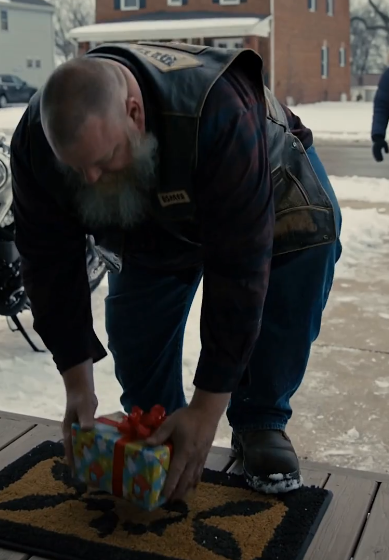
Every December 24, just before midnight, I heard his Harley turn onto Sycamore Street in Beckford, Ohio. The V-twin would settle into a rough idle outside my house. Heavy boots would cross the porch. A box would touch the boards.
Then silence.
Eli never rang the bell. He never called my name. He never tried the handle.
For one minute, he waited.
For one minute, I stood on the opposite side of the door with my hand above the lock, refusing to turn it.
Then his boots retreated, the Harley started, and its taillight disappeared toward Route 33.
The gifts changed each year. A wooden train. A baseball glove. A red bicycle helmet. A beginner’s guitar. A high-school class ring with no school crest. A tool set. A leather-bound road atlas.
They were strange gifts for a woman growing older alone.
I never returned them.
I never thanked him either.
Each Christmas morning, I carried the package into the spare bedroom, placed it beside the others, and shut the door. Twenty-one unopened presents eventually formed a careful row beneath the window.
My sister called it cruel.
Eli’s club called it penance.
I called it the only arrangement that allowed both of us to keep breathing after what happened to our infant son, Jamie, on Christmas Eve twenty-two years earlier.
That night destroyed us. I believed Eli chose a motorcycle run over his sick child. By the time he returned, Jamie was gone, and the explanation Eli offered was too small for the grief filling our house.
“I tried,” he said.
I told him never to come inside again.
He obeyed.
But every Christmas, he came as far as the porch.
Then, on the twenty-second year, I waited behind the door as midnight approached. Snow covered the road. The porch light burned. My hand hovered above the same lock.
Eleven fifty-five.
Nothing.
Midnight.
No engine.
At twelve fifteen, I opened the door for the first time.
The porch was empty.
There were no boot prints in the snow, no box beside the mat, and no red taillight fading toward the highway. Only a small brass key hung from the doorknob on a piece of black string.
At dawn, forty-seven Harleys rolled slowly onto Sycamore Street.
Their president removed his helmet, looked at the twenty-one unopened gifts visible through my window, and said the seven words that broke the story I had believed for half my life.
“Those presents were never meant for you.”
I met Elias Mercer in 1983, behind a bowling alley where I had gone to smoke a cigarette I was not supposed to possess. I was seventeen. He was nineteen and crouched beside a motorcycle held together by mismatched bolts, black tape, and optimism.
Eli looked dangerous even then. He had broad shoulders, dark hair touching his collar, and a tattoo of a black bird across his left forearm. His jeans carried grease at both knees, and one knuckle was split from work at his uncle’s repair shop.
He looked up and asked for my cigarette.
“You’re already smoking one.”
“Need another for the carburetor.”
I knew nothing about engines, so the sentence sounded plausible. I handed it over. He tucked it behind his ear, finished adjusting the motorcycle, and offered me a ride home.
I said no.
Then it started raining.
The motorcycle was an old Harley-Davidson Shovelhead with a seat patched in three places. Eli gave me his only helmet and rode bareheaded through the storm, squinting into the rain while I gripped his jacket and pretended not to be terrified.
My father saw us arrive.
He opened the front door, looked at the motorcycle, and told Eli never to return. Eli nodded politely. The following evening, he parked one house away.
That was Eli’s particular form of obedience.
He respected the exact border and tested everything around it.
For the next six years, he became part of every version of my future. I attended nursing school in Columbus while he worked as a mechanic and rode with a loose group of veterans, factory workers, and men recovering from lives they did not discuss. They eventually became the Iron Crows Motorcycle Club.
People assumed the worst about them. Some assumptions were earned. The club drank too much, fought too quickly, and once spent an entire night in county lockup after a bar dispute involving a broken jukebox.
Eli was complicated inside that world. He had been arrested twice before turning twenty-one, once for fighting and once for carrying stolen motorcycle parts he claimed he had not known were stolen. He drank until his hands became reckless, then quit after wrapping the Shovelhead around a fence post.
He was not a bad man who magically became good.
He was a damaged man who grew tired of damaging things.
By the time I finished nursing school, Eli had built a stable repair business behind his uncle’s garage. He did not make much money, but he never let a stranded rider leave without help. If someone could not pay, he accepted groceries, labor, or the promise that they would stop for the next person.
His club brothers called him Rook because he moved in straight lines and refused to retreat.
With me, he was gentler.
He remembered that I hated onions but forgot my birthday twice. He could rebuild a transmission yet burned canned soup. He never bought flowers because they died too quickly, so he brought me potted herbs that took over the kitchen window.
When he proposed, he placed a ring inside a clean spark-plug box.
“Best container I had,” he said.
We planned to marry in the summer of 1991.
Then I became pregnant.
The pregnancy was difficult from the beginning. I developed high blood pressure, missed work, and spent weeks afraid to move too quickly. Eli responded by trying to control every object around me. He tightened stair rails, replaced floorboards, checked the car each morning, and slept lightly enough to hear whenever I entered the bathroom.
Our son arrived six weeks early on November 18, 1990.
We named him James Elias Mercer, though everyone called him Jamie. He weighed less than five pounds and possessed a cry too large for his chest. Doctors kept him in the neonatal unit for twelve days before allowing us to bring him home with medication, instructions, and enough fear to fill every room.
Eli changed instantly.
The man who had once slept beside roaring motorcycles began walking through our house on the edges of his boots. He warmed bottles against his wrist, learned every dosage, and could quiet Jamie by resting the baby against the tattooed bird on his forearm.
I took photographs.
In every one, Eli looked startled by happiness.
The Iron Crows became ridiculous around the child. Men with prison records argued over pacifiers. Preacher Boone, the club president, built a cradle from oak. Luis Ortega bought a tiny leather jacket that Jamie could not have worn for years.
Eli placed it in the closet anyway.
“He’ll grow.”
That sentence became a promise none of us understood we were making.
December came hard that year. Snow arrived early, and Jamie developed a cough. The pediatrician adjusted his medication and warned us to watch his breathing. I counted every rise of his chest until numbers stopped meaning anything.
On December 23, the pharmacy called.
A winter delivery carrying Jamie’s medication had been delayed outside Lancaster. The pharmacy had enough for one more dose. Roads were deteriorating, and state police were closing sections of Route 33.
Eli stood beside the phone, listening.
“I’ll get it.”
The pharmacist told him not to try.
I told him to stay home.
Eli called Preacher.
Within twenty minutes, six motorcycles and a pickup truck gathered outside our house. The plan was simple on paper and terrible in reality: the pickup would travel as far as the road remained passable, while riders familiar with the back routes would meet the delivery vehicle coming from the other direction.
I blocked the front door.
“You are not choosing that club tonight.”
“I’m choosing Jamie.”
“He needs you here.”
“He needs the medicine.”
“We have one dose.”
“And after that?”
I had no answer.
Eli kissed Jamie’s forehead, pulled on his leather jacket, and told me he would return before midnight.
I watched the motorcycles disappear into snow.
For years, that was the only part of the night I allowed myself to remember clearly.
The storm worsened after nine. Snow erased the street within minutes of every plow. Wind pushed against the windows, and the power flickered twice before stabilizing.
Jamie slept in the cradle beside the couch.
At ten thirty, I gave him the final dose.
At eleven, his breathing changed.
Nurses learn to distrust subtle changes because subtle changes often arrive first. Jamie’s nostrils widened. His chest pulled inward beneath the ribs. I lifted him, counted, listened, and called the hospital.
The dispatcher warned that emergency vehicles were delayed.
I called Eli’s clubhouse.
No answer.
I called the repair shop.
Nothing.
By eleven twenty, fear had stripped every professional instinct from me. I became only a mother holding a child whose body seemed too tired for the work being demanded of it.
My neighbor drove us toward the hospital in her station wagon. We traveled six blocks before becoming trapped behind a jackknifed delivery truck. An ambulance approaching from the other side took us the remaining distance.
Doctors worked on Jamie for nearly an hour.
At 12:17 on Christmas morning, a physician I knew placed both hands around mine and stopped speaking in medical language.
Our son was gone.
Eli arrived at 1:03.
His beard was crusted with ice. Blood marked one cheek where flying gravel had cut him. His leather jacket was torn at the shoulder, and a small insulated case remained chained across his chest.
He entered the room carrying the medication.
Too late.
I remember him looking at the empty hospital bassinet. I remember the case sliding from his hands. I remember six bikers standing in the corridor behind him, covered with snow and road salt.
Eli took one step toward me.
I told him not to touch me.
“Nora—”
“You left.”
“For the medicine.”
“You left him.”
“I tried.”
Those words became unforgivable because they were all he could produce.
I struck his chest with both hands. Eli did not defend himself. I hit leather, ice, and the metal zipper beneath it until two nurses pulled me back.
“You chose them,” I screamed. “You chose that motorcycle and those men over your own son.”
Nobody corrected me.
Not Preacher. Not Luis. Not the hospital staff who had seen the medication case.
They believed grief had made me irrational, and perhaps it had. But grief also made everyone else timid. People thought truth could wait until I was calmer.
Calm never came.
Jamie’s funeral took place three days later. Eli stood at the back with the Iron Crows. He did not approach the coffin until everyone else had left.
I watched from the hallway.
He placed the tiny leather jacket beside our son.
Then he lowered his forehead to the coffin and remained there without moving. Preacher eventually guided him away.
I ended our engagement the following week.
Eli did not argue. He packed his clothes, tools, and motorcycle parts into the club’s pickup. Before leaving, he placed the spark-plug box containing my engagement ring on the kitchen table.
“What really happened on that road?” I asked.
He looked at me.
“We were late.”
“Because of the storm?”
“Yes.”
“Or because the club stopped somewhere?”
His jaw tightened. “Doesn’t matter.”
It mattered to me.
Rumors had already spread. Someone claimed the Iron Crows stopped at a bar while waiting for the medicine shipment. Another said two riders fought at a gas station. A deputy reported seeing motorcycles outside a closed tavern near midnight.
I asked Eli directly whether he had been drinking.
“No.”
“Did you stop at that bar?”
“Yes.”
“Why?”
“Road was blocked.”
“You could have come home.”
“Not without the medicine.”
I heard only the first answer.
For years, I believed six bikers had wasted precious time inside a tavern while our child died. Eli allowed that belief to settle. He carried the blame without offering details, as though my hatred were another weight his shoulders had been built to hold.
I moved out of our rented house and bought the small place on Sycamore Street with help from my mother. I returned to nursing, working extra shifts because the hospital felt less haunted than home.
The following Christmas Eve, I heard a Harley outside at 11:55.
I looked through the curtain.
Eli stood beneath the porch light holding a wrapped box.
He placed it beside the door.
For one minute, he waited.
I did not move.
When he rode away, I carried the box inside. A simple card was taped to the top.
Christmas Year One.
No signature.
I knew the blocky handwriting.
Inside was a hand-carved wooden train suitable for a one-year-old child.
I sat on the kitchen floor until dawn.
The next year, Eli brought a set of wooden blocks marked for age two. The third year, a red tricycle bell. Then a picture book, a small baseball glove, a child’s fishing rod, a school lunch box, and a model motorcycle assembled from metal pieces.
Each present matched the age Jamie would have been.
That was why I never threw them away.
It was also why I never opened the door.
The gifts felt like apologies, accusations, and gravestones disguised in bright paper. If I let Eli speak, he might ask forgiveness I could not give. Worse, he might tell me something that loosened the anger holding my grief together.
So our ritual hardened.
He arrived.
I waited.
He left.
For twenty-two years, neither of us crossed the door.
The Iron Crows remained part of Beckford even after I removed Eli from my life. Their clubhouse sat near the old paper mill, beside a stretch of road where businesses rarely survived. People complained about the motorcycles, yet called the club when a family needed a wheelchair ramp, a veteran required a ride to treatment, or a winter storm stranded cars outside town.
Eli’s repair shop expanded. He hired young men leaving prison, veterans who struggled in crowded workplaces, and recovering addicts nobody else trusted near expensive machines.
Some disappointed him.
He hired them again when they returned sober.
From a distance, I watched his beard turn gray. His shoulders remained broad, but his gait stiffened. New tattoos filled the empty spaces on his arms while the black bird from our youth faded into blue-gray lines.
He never married.
I learned this through other people, not because I asked.
I built another life. Eight years after Jamie’s death, I married a kind high-school teacher named David Reed. I told him about Eli before our first date ended and about the Christmas gifts before our engagement.
David did not demand that I stop accepting them.
The first Christmas after our wedding, he stood beside me behind the closed door while Eli waited outside. The Harley idled near the curb. Snow melted across Eli’s shoulders.
“Do you want me to make him leave?” David asked.
“No.”
“Do you want to let him in?”
“No.”
David nodded. “Then I’ll stand here.”
Eli left a youth baseball cap that year.
David carried it to the spare room.
He was not threatened by a man I refused to see, perhaps because he understood Eli and I were not having an affair with each other. We were having an affair with grief—secretive, possessive, and unwilling to release either of us.
David and I shared twelve good years. He made coffee too weak, sang badly while grading papers, and loved me without trying to compete with a dead child. Cancer took him in 2010.
Eli attended the funeral.
He stood across the cemetery with his club, far enough away that David’s family would not wonder why an imposing biker watched me mourn. Before leaving, he placed one hand against his chest.
I almost walked toward him.
Almost.
That Christmas, he brought a boxed set of mechanic’s tools. Jamie would have been twenty.
Eli waited beneath the porch light.
My hand touched the lock.
Then I remembered the hospital, the medication case on the floor, and the words I tried.
I stayed inside.
The Iron Crows’ loyalty to Eli became harder as the years passed. Luis believed I deserved to know exactly what happened during the storm. Preacher argued that the truth belonged to Eli, and Eli had chosen silence.
Their dispute nearly divided the club.
I learned the details only after Eli’s final Christmas, when Preacher gave me a bundle of maps, receipts, and statements kept inside a sealed metal box.
The tavern where deputies saw the motorcycles had not been operating that night. Its owner had opened the building as an emergency shelter. A snowplow had overturned near the intersection, trapping a family inside their car. The Iron Crows stopped because the road was impassable and helped free them.
That delay cost twenty-three minutes.
Afterward, Eli could have turned home.
He continued.
The medication delivery vehicle had become stranded eight miles east. Eli left the club’s pickup and rode the Harley along an unplowed service road because two wheels could pass between abandoned cars. Luis and Preacher followed.
A fallen branch knocked Luis down. Eli stopped and lifted the motorcycle off him.
That cost nine minutes.
At the delivery vehicle, the pharmacist refused to release the medication because Eli’s identification did not match the prescription address. The club called the hospital. Lines failed twice.
That cost seventeen minutes.
Every delay had a reason.
Every reason sounded like an excuse beside a dead infant.
Eli reached the hospital forty-six minutes after Jamie died. The physician told him something he never repeated to me: the missing dose had not caused our son’s death. Jamie had suffered an aggressive respiratory infection complicated by his premature lungs. Even if the medicine had arrived hours earlier, the outcome probably would not have changed.
Eli asked the physician never to tell me.
Not because he wanted me to keep blaming him.
Because the next sentence I spoke after striking his chest was, “If I had taken him in sooner, he would still be alive.”
Eli heard what I was preparing to do to myself.
He interrupted.
“No,” he said. “This is on me.”
I did not remember that sentence.
Preacher did.
Eli took the blame before guilt could fasten itself around my throat. He allowed me to believe he had failed because anger gave me somewhere to stand, while self-blame might have dragged me beneath the floor.
His brothers knew.
They hated the lie.
They kept it anyway.
On the tenth anniversary of Jamie’s death, Luis confronted Eli behind the clubhouse.
“She married someone else,” Luis said. “She built a life. Tell her.”
“Why?”
“Because she hates you.”
“Better me than herself.”
“That choice isn’t yours.”
“Already made it.”
Preacher sided with Luis at first. The argument became physical enough for a table to overturn, though no punches were thrown. Eli removed his leather cut and placed it on the bar.
“If the patch means I have to clear my conscience by breaking hers, keep it.”
Then he walked out.
For four months, he did not ride with the club.
The Iron Crows continued helping him deliver the Christmas gift. They followed from a distance because Eli’s night vision had begun deteriorating, but they did not wear their cuts.
Brotherhood had been tested.
It chose the man over the patch.
In spring, Preacher returned Eli’s vest. Nothing was said. Nothing needed saying.
Still, Luis created the metal box. He gathered the hospital report, pharmacy records, maps, and statements from everyone involved. He told Eli that silence might be mercy while a wound was fresh, but it became theft if carried into the grave.
Eli accepted the box.
He hid it beneath the seat of his touring Harley.
The brass key would eventually hang from my doorknob.
During the autumn before the final Christmas, Eli began losing weight. People who saw him regularly did not notice at first because his leather vest concealed the change. His belt moved inward by two holes. His beard appeared larger against a face becoming narrow.
Cancer had entered his pancreas and spread before symptoms became impossible to ignore.
The doctor estimated months.
Eli asked whether one of them included Christmas.
The doctor said probably.
That was enough for him.
He told only three people: Preacher, Luis, and his niece Hannah, who managed the repair shop. He refused chemotherapy that might have given him slightly more time at the cost of strength he needed to remain independent.
His friends called that stubbornness.
Eli called it scheduling.
He made lists. He transferred the shop to Hannah. He gave specialized tools to mechanics who had earned them. He arranged for his Harley to be sold, then canceled the sale because the thought of another rider starting it before Christmas made him furious.
Most importantly, he began building the twenty-second gift.
The previous presents had traced the life Jamie might have lived: childhood toys, school items, a guitar at thirteen, a watch at sixteen, tools at twenty, and a road atlas at twenty-one. The final gift needed to represent adulthood.
Eli chose a house key.
Not mine.
The key belonged to a small renovated property beside the Iron Crows’ clubhouse. For years, the building had served as storage. Eli quietly converted it into temporary housing for parents whose premature babies were receiving treatment at Beckford Regional Hospital.
He named it Jamie’s Stop.
No sign had been installed. Eli did not want the name visible until I approved it.
The house contained four bedrooms, a kitchen, laundry facilities, and a garage where volunteers could repair cars for families traveling between work and the neonatal unit. The club had raised money through charity rides, but Eli paid the remaining balance by selling his share in the repair shop.
The twenty-second gift was not ownership of the building. He knew I would refuse that.
It was the choice of whether Jamie’s name stayed.
He placed the house key inside the same spark-plug box that had once held my engagement ring. Beneath it lay a note.
You told me never to come inside again.
Maybe they need somewhere to come inside.
Eli planned to leave it on my porch at 11:55, wait one minute, and ride away.
He could no longer safely control the Harley.
Preacher offered to ride while Eli sat behind him. Eli refused. Luis suggested arriving in the pickup. Eli said I would not recognize the sound.
“Then let us deliver it,” Preacher said.
“She’ll think I got scared.”
“You’re dying, brother.”
“Same thing if you let it be.”
Two days before Christmas, Eli collapsed in his garage. Hannah found him on the concrete beside the wrapped gift. His tattooed hand remained curled around the black ribbon.
At the hospital, he drifted between sleep and lucidity. The Iron Crows filled the corridor, their boots lining both walls. A nurse tried to enforce the two-visitor rule, took one look at forty frightened bikers, and compromised at six.
Eli asked the time every hour.
On Christmas Eve morning, Preacher brought his leather cut. Luis carried the gift. They planned to take him by wheelchair to the hospital entrance at 11:55 so he could hear his Harley running outside while another rider delivered the box.
The physician refused.
The cold could kill him.
Eli stared at the doctor. “Working on that already.”
Nobody laughed.
By evening, his breathing became shallow. Hannah asked whether they should call me. Eli said no.
Luis exploded.
“Twenty-two years you decide what she can survive. You took her choice then, and you’re taking it now.”
Eli turned his head slowly. “You want her Christmas to be another hospital room?”
“I want her to know you’re in it.”
“She knows enough hospitals.”
Preacher stood between them, one hand pressed to each man’s shoulder. Brotherhood had reached its impossible point: honor Eli’s last request or betray him before silence became permanent.
Preacher chose betrayal.
At 10:40 p.m., he called my house.
I did not answer because I was standing behind the front door waiting for an engine.
He called again.
My phone remained in the kitchen.
Eli died at 11:48.
Preacher started Eli’s Harley outside the hospital at 11:55. The V-twin filled the ambulance bay with a low, uneven thunder. Nurses paused behind the glass. Forty-seven bikers stood without helmets beneath falling snow.
For one minute, the engine ran.
Then Preacher shut it off.
Across town, I heard nothing.
At midnight, I opened my door. Snow lay untouched across the porch. A brass key hung from the knob because Hannah had placed it there earlier, before returning to the hospital.
I took it inside.
For the first time in twenty-two years, I did not have a gift to carry into the spare bedroom.
I entered that room anyway.
Twenty-one packages waited beneath the window, arranged from smallest to largest. Their paper had faded at different rates. Tape had yellowed. The earliest boxes carried my old address, crossed out and replaced with Sycamore Street.
I sat among them until dawn.
At 8:12 on Christmas morning, I heard motorcycles.
Not one.
Forty-seven.
They turned onto my street slowly, two by two, black tires cutting parallel lines through fresh snow. Riders parked along both curbs and shut down their engines in sequence.
Preacher walked toward my porch carrying Eli’s folded leather cut.
Luis carried the missing gift.
Before either man spoke, I knew.
My knees weakened. I gripped the doorframe and asked the only question that mattered in that moment.
“Was he alone?”
Preacher shook his head.
“No, ma’am.”
That mercy reached me first.
Then Luis looked through the doorway toward the twenty-one boxes.
“Those presents were never meant for you,” he said.
I thought he was accusing me.
He was inviting me to open them.
We carried every package into the living room. Forty-seven bikers could not fit inside, so most remained on the lawn and sidewalk, holding paper cups of coffee my neighbors began bringing without being asked.
Preacher, Luis, Hannah, and my sister stayed with me.
I opened the first box.
The wooden train remained bright beneath brittle tissue paper. Eli had carved the engine himself. On the bottom, burned into the wood, were the words Year One—Keep Moving.
The second box held blocks. Year Two—Build Again.
The third held the tricycle bell. Year Three—Make Noise.
Each gift carried a small instruction suited to the age Jamie would have reached. The baseball glove said Learn What Comes Back. The fishing rod said Wait Without Giving Up. The guitar said Some Things Need More Than Words.
I stopped several times.
Nobody hurried me.
At year eight, I found a school photograph envelope containing no photograph. Inside was a receipt for eight backpacks donated anonymously to the county foster-care program.
Year ten contained a model airplane and a receipt showing ten winter coats delivered to a children’s shelter. Year fifteen held a beginner’s tool kit alongside documentation for fifteen paid apprenticeships at Eli’s repair shop.
The gifts on my porch had been symbols.
Their twins had entered the world.
Every year, Eli bought or built one gift for the child we lost, then donated as many related items as Jamie’s imagined age. One bicycle helmet became eleven helmets for local children. One guitar became thirteen months of music lessons for a boy whose father was incarcerated.
At eighteen, Eli funded a trade-school scholarship.
At twenty, he paid for repairs on twenty cars belonging to single parents.
At twenty-one, he bought road atlases for every teenager aging out of a nearby foster home and included prepaid gas cards inside them.
He had not spent twenty-two years asking me to forgive him.
He had spent them giving Jamie birthdays.
The room blurred.
“Why didn’t he tell me?”
Preacher lowered his gaze. “Said telling you would turn gifts into bargaining.”
“For what?”
“Your door.”
I opened the nineteenth package again and touched the watch inside. Eli had engraved Jamie’s initials on the back. It had never been worn.
My anger returned, old and sharp.
“He let me believe he abandoned our son.”
Nobody answered.
“Did he stop at that tavern?”
“Yes,” Luis said.
I stood so quickly that wrapping paper slid from my lap. “Then I was right.”
“No.”
Luis brought the metal box from outside. The brass key opened it.
Inside lay the records of Christmas Eve 1990. Road maps. Pharmacy statements. A copy of the emergency call. The physician’s report. A handwritten account from every rider who had accompanied Eli.
I read them in the order they were arranged.
The stranded family.
Luis’s fall.
The service road.
The delayed medication.
The doctor’s conclusion.
Then I reached Preacher’s statement describing what happened outside Jamie’s hospital room.
Nora said she should have taken the baby sooner. Eli interrupted and claimed responsibility. Later, he told us anger would keep her standing until grief loosened. He made us promise not to remove the one thing holding her upright.
I dropped the page.
For twenty-two years, I had believed Eli’s silence proved guilt.
It had been protection twisted by shame.
That did not make it right. He had decided which truth I was allowed to carry. He had denied me the chance to grieve beside the only person who understood exactly what we lost.
Love had guided him.
Fear had steered.
Both could be true.
I asked why the doctor had never contacted me. Hannah produced a sealed letter written years later by the physician, who had retired to Arizona. Eli had requested it but never delivered it.
Mrs. Hale, the physician wrote, your son’s death was not caused by your delay or Mr. Mercer’s absence. Two grieving parents searched for a moment they could change because accepting that no such moment existed was unbearable.
I read the sentence aloud.
Outside, one Harley engine started accidentally and shut down at once.
The sudden rumble shook the windows.
I began crying then—not quietly, not gracefully. I cried for Jamie, for David, for Eli, for the twenty-two winters I stood six inches from a door handle and called immobility strength.
My sister held me.
Preacher looked away.
Luis covered his face with both hands.
When the storm passed through me, the final package remained unopened.
The wrapping paper was black, tied with a narrow silver ribbon. Inside was the old spark-plug box. My engagement ring no longer rested there.
A key did.
I unfolded Eli’s note.
You told me never to come inside again.
Maybe they need somewhere to come inside.
Below those words was the address of the renovated house beside the clubhouse.
Hannah drove us there.
A dozen riders cleared snow from the walkway before I arrived. The small brick house glowed with warm light. Four bedrooms waited inside, each containing a crib, clean sheets, and a chair wide enough for an exhausted parent to sleep beside a child.
The kitchen cabinets were stocked.
A laundry basket held donated clothes.
In the garage, tools hung in careful rows above a workbench built at Eli’s height.
A temporary paper sign stood on the mantel.
JAMIE’S STOP
Below it:
For families traveling a road they never chose.
Preacher gave me a folder. The building was fully funded for two years. Eli had left the naming decision to me.
“If you say no,” Preacher said, “we remove it.”
I looked around the room.
Twenty-two Christmases had led there.
“Keep the name.”
Nobody cheered.
The bikers simply lowered their heads.
That was how they honored serious things.
Eli’s funeral took place three days after Christmas, on the same date we had buried Jamie twenty-two years earlier. I believed the coincidence would crush me.
Instead, it felt like two roads finally meeting.
More than a hundred motorcycles gathered outside the Iron Crows’ clubhouse. Eli’s Harley stood at the front with no rider. His gloves rested on the grips, and the final black ribbon from my gift had been tied around the headlight.
I wore the engagement ring.
Not because death had transformed Eli into the husband he never became. David had been my husband, and loving Eli’s memory did not erase the life David and I shared. I wore it because the ring belonged to the young woman I had been before grief taught her to close every door.
She deserved to attend.
Preacher asked whether I wanted to ride in a car.
I pointed toward his motorcycle.
“Got room?”
He handed me a helmet.
The procession passed my house on Sycamore Street. Twenty-one empty boxes sat on the porch, protected beneath clear plastic. On each one, I had written the name of a local organization that would receive a Christmas donation the following year.
The road carried us past the hospital, the old pharmacy, and the tavern that had sheltered stranded families during the storm. It continued onto Route 33, where winter sunlight flashed across wet pavement.
At the cemetery, Eli was buried beside Jamie.
The club had arranged it years earlier with my permission, though I had not known when the permission would matter. Jamie’s small headstone stood weathered and low. Eli’s grave beside it appeared raw against the snow.
I placed the wooden train between them.
“Your father was late,” I told Jamie.
Then I looked toward Eli’s coffin.
“But he kept coming.”
That was the closest I came to forgiveness that day.
Real forgiveness did not arrive as one clean decision. It came in fragments: when I found a photograph of Eli building the shelter’s cribs, when the first frightened mother slept at Jamie’s Stop, when a premature baby’s father used Eli’s garage to repair the car carrying them to the hospital.
Sometimes anger returned.
I let it.
Eli’s last note had not asked me to make him innocent. He had built a door and left me the key. What crossed the threshold afterward belonged to me.
Jamie’s Stop opened officially the following spring. We removed the word temporary from the sign. The Iron Crows manage repairs and transportation. I coordinate with the hospital and meet the families when they arrive.
Every Christmas Eve, we place one gift outside the front door.
It matches the age of a child currently staying in the house. At midnight, the family opens it together. Nobody waits alone on the other side.
The first year, the gift was a yellow baby blanket.
The second, a toy ambulance.
The third, a pair of tiny boots.
Preacher still rides Eli’s Christmas route before joining us. He turns onto Sycamore Street at 11:55, circles my block, and passes the house without stopping.
I stand on the porch.
The sound approaches, fills the street, and fades toward Route 33.
For years, I thought Eli’s motorcycle was asking me to open the door.
Now I understand.
He was only telling me he had returned.
If this story stayed with you, follow our page for more unforgettable biker stories about love, loss, brotherhood, and the quiet promises carried across long roads.
This Christmas, the door stays open.