Part 2: A Biker Left Gifts at Her Door — Then His Club Kept Coming for 30 Years
I do not remember my father’s funeral as a day.
I remember pieces.
Black leather in the rain. My mother’s hand too cold around mine. The low, uneven rumble of motorcycles moving slow behind the hearse. Men with gray beards standing stiff at the cemetery, staring at the ground like if they looked up, something inside them would split open. The smell of wet leather, gasoline, lilies, and coffee someone had spilled near the chapel door.
My father’s club was called the Iron Mile.
Thirty men and women, mostly from northern California. Mechanics, tow-truck drivers, loggers, nurses, a retired firefighter, one school bus driver, and one old woman named June who rode a Harley older than most of them and scared everybody into behaving at charity breakfasts.
People saw their cuts and assumed things.
They saw tattoos, big shoulders, scars, chains on wallets, boots in church aisles, and engines that shook windows. They did not see them rebuilding a veteran’s ramp for free. They did not see them delivering groceries to widows after snowstorms. They did not see the way my father kept a notebook in his saddlebag with names of people who needed help and dates he had promised to show up.
After he died, the club came around for a while.
Too much, at first.
Men knocked on the door with food my mother didn’t eat. Women folded laundry she hadn’t asked anyone to touch. Someone fixed the fence. Someone changed the oil in her car. Someone left cash in an envelope inside the mailbox.
My mother hated all of it.
Not because she was ungrateful. Because grief had made kindness feel like pressure. Every knock reminded her my father was not the one walking in. Every leather vest in the doorway looked like half of him and none of him. She started telling people we needed space.
The Iron Mile listened.
That was the part outsiders never understand about real brotherhood. It is not always loud. Sometimes it is stepping back when your whole body wants to help.
But one man did not step back completely.
Steel.
His real name was Martin Harlan. I learned that much later. He was thirty-eight then, my father’s closest friend in the club, a huge white American man with a square jaw, a dark beard, and tattoos running from his wrists to his collar. One knuckle said HOLD. The other said FAST. He had been to prison once in his twenties, not for anything glamorous, just a bad fight, bad temper, bad night, bad choices. My father was the one who picked him up when he got out.
Steel never forgot that.
He had no wife. No kids. No family that answered calls. The club was his blood, and my father was the brother who had made him believe he was still worth saving.
I didn’t know any of that at six.
I only knew the sound of his Harley.
Saturday at 9:00.
Always 9:00.
The first gift was the helmet. Pink, because my father had once joked that if he ever had a daughter who loved motorcycles, he’d have to “make peace with sparkles.” My mother touched the helmet when she brought it inside and cried for the first time in front of me.
The second gift was the vest.
The third was the bicycle.
Then came other things.
A children’s book about motorcycles. A tiny pair of gloves. A stuffed bear wearing a bandana. A set of crayons shaped like wrenches. A framed photo of my father laughing at a diner booth. A toy tool kit. A patch that said DAD’S SHADOW. A little wooden box with my father’s old keychain inside.
Every week, one thing.
Every week, no explanation.
My mother opened the door once before he could leave.
Steel was already halfway down the porch steps.
“Wait,” she called.
He stopped but did not turn around.
“Who are you?”
His shoulders lifted once with a breath.
“Somebody who owed him,” he said.
Then he got on the Harley and rode away.
That was all she got.
It made her angry at first. Then curious. Then dependent in a way she never admitted.
By month four, she was brushing my hair by 8:55 every Saturday. By month five, she stood behind the curtain with one hand over her mouth. By month six, I was sitting on the porch waiting.
I never saw Steel’s face clearly.
Only the back of his leather cut.
Only the boots.
Only the tattooed hands setting something down carefully, like each gift might break.
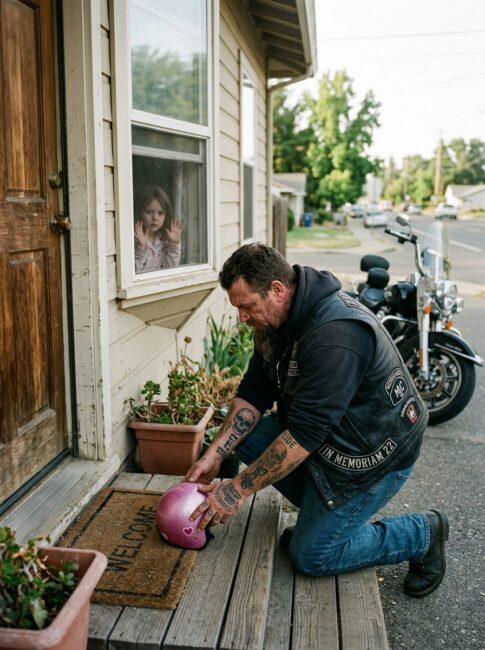
The Saturday he did not come felt louder than all the Saturdays he had.
I was wearing the little leather vest. My mother had made pancakes because the night before I had asked if the biker liked pancakes. She said she didn’t know. Then she made extra anyway.
At 8:57, I sat on the top porch step.
At 9:00, no engine.
At 9:10, I stood up.
At 9:30, my mother said maybe he was late.
At 10:15, she said maybe the bike broke down.
At noon, she stopped giving reasons.
I stayed outside until the California heat made the porch boards warm under my legs. Neighbors came and went. A delivery truck passed. Somewhere down the street, someone mowed a lawn. No Harley.
By dark, my mother carried me inside.
I remember asking, “Did I do something wrong?”
That broke her.
She sat on the hallway floor with me in her lap and rocked me like I was little again, even though I was already too big to be rocked that way.
“No, baby,” she whispered. “No. Men leave for lots of reasons. Not because little girls did something wrong.”
She was talking to me.
She was talking to herself.
A week passed.
Then another.
No biker.
My mother grew quiet again, but it was a different quiet. The first grief had been frozen. This one was angry. She hated him for giving us a ritual and taking it away. I hated him too in the simple way children hate absence. I wore the vest less. The bicycle stayed in the garage.
Then one month after the missed Saturday, thunder came back.
Not the same thunder.
This Harley had a lower cough. Rougher idle. My mother and I both moved to the window at the same time.
A different biker parked at the curb.
He was older, maybe fifty, a Black American man with a gray beard, broad shoulders, tattooed hands, and a leather cut that read IRON MILE. He took off his helmet and held it against his side before walking to our door. Unlike Steel, he knocked.
My mother opened it with me hiding behind her leg.
The biker looked at her, then at me.
His eyes were red.
“Ma’am,” he said. “My name’s Bishop. I rode with Caleb. And with Steel.”
My mother’s hand tightened on the door.
“With?”
Bishop swallowed.
“Steel went down last week outside Red Bluff.”
The hallway tilted.
I didn’t understand death fully yet, but I understood my mother’s face.
Bishop looked at me again.
“He left something for your girl.”
He held out a brown envelope and a small box wrapped in plain paper.
My mother did not take it at first.
“Why?” she asked. “Why didn’t he just knock? Why do all this and never talk to her?”
Bishop looked down at his boots.
“Letter explains it better than I can.”
My mother’s hands shook when she opened the envelope.
Inside were three pages written in blocky handwriting.
The first line said:
Little Wren, if you’re hearing this, I missed a Saturday. I’m sorry.
Little Wren.
That was what my father called me because I used to sing nonsense songs from the back seat.
My mother sat on the couch like her legs had stopped working.
I climbed beside her.
She read out loud.
Steel wrote that he was my father’s brother, not by blood, “by road and stupid choices survived.” He wrote that before I was born, he and my father had made a promise after another club brother died young.
If one of them went first, the other would watch the family.
Not for a week.
Not until the funeral flowers died.
For as long as needed.
Steel wrote that when my father died, he tried to help, but my mother’s grief was a locked door and he was a man who had broken too many things in his life to force another one open.
So he left gifts.
Quiet ones.
He said he didn’t knock because he was afraid my mother would say no.
Then came the sentence that made her stop reading.
I didn’t show my face to the kid because I didn’t want her to miss me too. She already lost one biker. I wanted the gifts to point back to Caleb, not me.
My mother covered her mouth.
I remember touching the paper because I wanted her to keep reading.
The last paragraph said:
I don’t know how many Saturdays I got. None of us do. If mine run out, the club knows. Thirty brothers and sisters. One will come every week. A flower, a patch, a picture, a toy, a wave. Something. She will know she wasn’t forgotten. That was the promise. Hold fast. — Steel
The false climax was that letter.
We thought it explained everything.
It did not.
It only opened a door.
The next Saturday, Bishop came back.
He did not bring a gift in secret. He walked up the porch steps while my mother and I watched from the open doorway. He was wearing his leather cut, polished boots, and a white flower tucked into one hand.
He stopped at the welcome mat.
For a second, none of us moved.
Then he bent down, placed the flower where Steel used to leave the gifts, and lifted two fingers in a small wave.
I lifted two fingers back.
Bishop’s face folded.
Not much. Bikers don’t like falling apart in front of children. But enough.
Then he walked away.
No speech.
The week after that, June came.
She was sixty-something, white-haired, mean-eyed, and five feet tall on a good day. She left a patch shaped like a tiny wrench and said, “Your daddy once fixed my carburetor with a hairpin and bad language. Don’t let anyone tell you nice men don’t cuss.”
My mother laughed for the first time in months.
The week after that came Marcus, a Latino American biker with kind eyes and a limp. He left a photo of my father holding me as a baby, one I had never seen.
Then Rooster brought a toy motorcycle.
Doc brought a first-aid kit and taught me how to use bandages on my teddy bear.
Tiny, who was not tiny, brought a cupcake and cried harder than I did when I dropped it frosting-side down.
Every Saturday, one biker.
One object.
One wave.
Sometimes they stayed thirty seconds. Sometimes five minutes. Sometimes just long enough to show the promise was still breathing.
The twist was not that the club kept Steel’s promise for a few weeks.
The twist was that they never stopped.
At first, my mother expected it to fade.
People move on. They get sick. They fight. They divorce. They lose jobs. Bikes break down. Life swallows good intentions whole.
But the Iron Mile built a calendar.
A real one.
Names. Dates. Backups. Weather plans. Emergency swaps. If someone got sick, someone else rode. If smoke from wildfires made riding unsafe, they drove trucks. If Christmas fell on Saturday, they came on Christmas. If I had the flu, they left soup and waved through the window.
At seven, I got patches.
At eight, books.
At nine, postcards from rides my father had once taken.
At ten, the club took turns teaching me to fix a bicycle tire.
At eleven, Bishop sat on our porch and helped me build a school project about “community helpers.” I put bikers between firefighters and nurses. My teacher gave me an A and a concerned look.
At twelve, my mother started talking again. Not all at once. Not magically. Grief doesn’t work like movie rain. But she began answering the door. Then asking the riders in for coffee. Then laughing at old stories about my father. Then crying without disappearing inside it.
At thirteen, I realized Steel had become a ghost I loved.
That scared me.
I had never seen his face clearly, but I knew his handwriting, his promise, the shape of what he left behind. The club helped with that too. They told me stories.
Steel once rode three hours to bring my father a part he didn’t need because Dad had said he sounded lonely on the phone.
Steel hated peas.
Steel kept dog treats in his saddlebag for strays.
Steel once slept on Bishop’s porch because he was too proud to ask for a couch and too tired to ride home.
Steel was not a saint.
That mattered to me.
He had a temper. A record. Bad years. A mouth that got him in trouble. He had hurt people and spent a long time learning how not to. My father had helped him. Then Steel helped us. That was the shape of grace in our world. Not clean. Not easy. Passed hand to hand like a tool.
The second twist came when I turned sixteen.
Bishop arrived with a sealed envelope from Steel I had not known existed.
On the front, it said:
When Little Wren gets old enough to hate us for coming.
I had been rude for three months.
Teenage rude. Grief rude. Embarrassed-by-everything rude. I hated the attention. Hated bikers waving while my friends were over. Hated being the girl with thirty leather uncles. Hated that my father was still dead and everyone kept acting like patches could fill a grave.
The letter said:
You’re allowed to be mad. You’re allowed to outgrow gifts. You’re allowed to roll your eyes at old men with bad knees. But don’t mistake showing up for pity. Pity leaves when it gets bored. Promise stays even when you’re a brat. Hold fast. — Steel
I cried in the bathroom for twenty minutes.
Then I came out and apologized to Bishop.
He shrugged.
“Steel called it.”
By the time I was eighteen, the Saturday visits were part of the house.
Not an event.
A beam in the walls.
My mother remarried when I was nineteen. A gentle man named Aaron who taught history at Shasta College and had no idea what he was marrying into until thirty bikers showed up to “inspect his handshake.” He passed. Barely. June said he looked “too ironed,” but she let him live.
At my wedding, the Iron Mile lined the road outside the church.
No threats. No showboating. Just leather cuts, gray beards, tattooed hands, and engines idling low as I walked out in my dress. Bishop stood where my father might have stood if the world had been kinder. My mother cried into Aaron’s shoulder.
On the gift table was a small framed note in Steel’s handwriting.
She will know she wasn’t forgotten.
My husband understood by then.
You don’t marry a woman raised by a biker promise and expect a normal guest list.
When I had my first child, a girl, the Saturday rider brought a tiny helmet sticker that said SECOND WREN. My daughter grew up thinking it was normal for a motorcycle to arrive every weekend with flowers, toy cars, picture books, or tomatoes from someone’s garden.
When my son was born, Tiny brought a stuffed bear in a leather vest and said, “Boy needs standards.”
Years passed.
The gifts changed.
Coffee when I became a tired mother. Diapers. Groceries during layoffs. A new mailbox after a storm. A photo album of my father I had never seen. A Christmas ornament made from one of his old spark plugs. A letter from June about how my father once sang badly at a roadside bar and refused to admit he knew every word.
Some Saturdays, the rider brought nothing but a wave.
That was enough.
By thirty, I had stopped asking how long it would last.
By thirty-five, I finally asked why it still did.
It was October. The air smelled like woodsmoke and dry leaves. My daughter was nine, my son six, the same age I had been when the first helmet appeared. My mother was gray now but alive in a way I once thought she never would be again.
The Harley that came that Saturday belonged to Bishop.
He was seventy by then. Slower getting off the bike. Beard white. Hands swollen at the knuckles. Still broad. Still intimidating if you didn’t see the way he carried a paper bag full of homemade cookies my kids liked.
He set the bag on the porch.
He waved.
And something in me broke open.
“Bishop,” I said.
He stopped.
“Thirty years,” I said. “It’s been thirty years.”
He looked at me.
The porch light caught the lines in his face.
“Close enough,” he said.
“Why are you still coming?”
He looked uncomfortable.
Bikers hate questions with feelings in them.
I stepped onto the porch.
“No, really. I’m grown. I have kids. I have a husband. Mom’s okay. You guys kept the promise. You did. So why?”
Bishop looked down at his boots for a long time.
Then he said, “Because Steel didn’t put an end date on it.”
My throat tightened.
He added, “He said, ‘When she don’t need us no more, stop.’”
I almost laughed, but it came out wrong.
“How would you know?”
Bishop looked at me then.
Really looked.
“When you tell us.”
The street was quiet. Somewhere down the block, a dog barked. My daughter pressed her face to the window behind me. My son held the stuffed bear Tiny had given him years before.
I thought about the pink helmet. The vest. The bicycle. My mother on the floor. Steel hiding his face because he did not want a child to lose another biker. The letters. The waves. The flowers. The club calendar. The old men showing up through marriages, births, storms, teenage cruelty, holidays, and ordinary Saturdays when nothing happened except the promise.
I started crying.
Not pretty.
Not controlled.
Bishop took one step forward, then stopped, because he still respected doors.
“I still need you,” I said.
His eyes went wet.
I said it again, for Steel, for my father, for my mother, for the six-year-old on the porch.
“I think I always will.”
Bishop nodded once.
“Then we’ll be here.”
After that, the visits changed again.
Not bigger.
Deeper.
My children started waiting on the porch the way I once did. My daughter wore the old ROAD KID vest until it was too small, then hung it in her room beside photos of a grandfather she never met and a man named Steel whose face she knew only from one faded club picture Bishop finally gave me.
Steel looked rougher than I expected.
Younger too.
Thick beard. Dark eyes. Arms crossed. Trying hard not to smile while my father stood beside him laughing at something outside the frame. On the back, someone had written: Caleb and Steel, Highway 299, before the rain.
Before the rain.
That phrase got me.
Every November, near the anniversary of Steel’s last ride, the Iron Mile gathered at our house before heading to the cemetery. Not all thirty anymore. Time had done what time does. Some had died. Some couldn’t ride. Some sent children or grandchildren in their place.
But somebody always came.
June rode until she was seventy-six, then arrived in a pickup and insulted everyone’s parking. Marcus brought his grandson. Tiny used a cane but still claimed it was “temporary,” despite ten years of evidence. Doc’s daughter took his spot after he passed, leaving a first-aid kit on our porch every year like a family joke.
The promise had outlived the original hands.
That was the final twist I didn’t see coming.
Steel had promised the club.
The club had promised him.
Then their families inherited the promise too.
It became less about my father alone, less about Steel alone, and more about a kind of road none of us planned to build. A road from grief to ritual. From ritual to family. From family to something stubborn enough to survive the people who started it.
Every Saturday, the sound is different now.
Sometimes a Harley.
Sometimes a truck.
Sometimes my daughter’s bicycle bell because she likes to ride down the driveway before the biker arrives and pretend she is “escorting the club.”
But the shape is the same.
A person comes.
They leave something.
They wave.
They go.
No performance. No speeches. No viral camera moment. Just the sound of boots on my porch and a promise breathing one more week.
My mother says the first year saved her life.
She does not say that lightly.
She says grief had made the house airless, and every Saturday cracked a window. At first, she resented the gifts. Then she waited for them. Then she built enough strength to open the door. Then one day she realized she had spoken three whole sentences without crying.
That was Steel’s work.
A man too scared to show his face to a little girl still taught her mother how to return to the world.
I keep his letters in a fireproof box.
The first letter.
The teenage brat letter.
One more I received at twenty-five, when my first child was born.
It said:
If you’re a mama now, you know. Fear don’t mean stop. It means hold tighter and walk slower. Tell the kid about Caleb. Tell the kid about you. Don’t make ghosts out of people who loved loud. Hold fast. — Steel
My daughter knows those words.
So does my son.
Hold fast.
We say it before hard things.
Dentist appointments. School plays. First bike rides. Hospital tests. Funerals.
Two words from a dead biker who didn’t think he mattered.
Last Saturday, the rider was a young woman I had never met.
She was maybe twenty-two, Black American, with braids tucked under her helmet, a leather jacket too new to have stories yet, and Doc’s old patch sewn on her sleeve. She parked a small Harley at the curb and sat for a second before getting off, like she wanted to do it right.
My daughter opened the door before I could.
The young rider smiled nervously.
“I’m Maya,” she said. “Doc was my grandpa.”
She held out a little package wrapped in brown paper.
Inside was a tiny wrench necklace for my daughter and a toy motorcycle for my son.
Then she lifted two fingers.
The same wave.
My daughter lifted two fingers back.
Thirty years folded in on itself.
I saw the porch as it had been when I was six. The pink helmet on the mat. My mother silent behind me. Steel’s boots on the steps. A man leaving before he could be loved because he thought leaving unseen would hurt less.
He was wrong about that.
But he was right about the promise.
Maya walked back to her bike. The engine turned over, small but steady. My children stood beside me in the doorway. My mother came from the kitchen, wiping her hands on a towel, and leaned against the wall.
The Harley rolled away toward Highway 299.
My daughter looked up at me.
“Will they come next week?”
I watched the tail light turn the corner.
“Yes,” I said.
She smiled.
“Good.”
The street went quiet again.
But the porch didn’t feel empty.
Hold fast.
Follow the page for more biker stories about promises that keep showing up long after goodbye.