Part 2: A biker made my daughter a balloon — then I saw his bare hand on Route 66
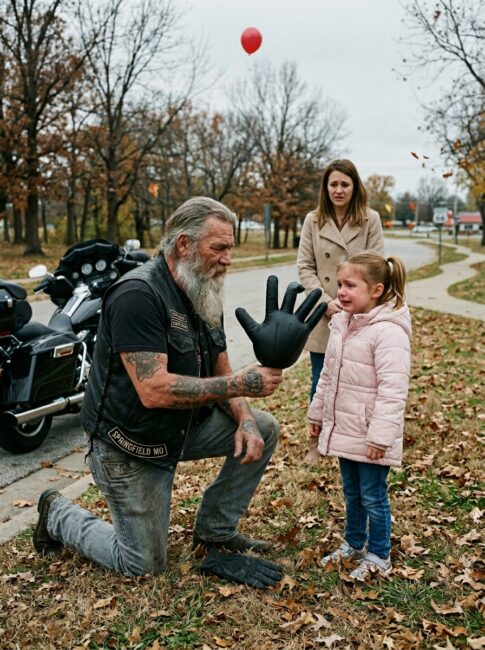
For the rest of the afternoon, Sophie carried the glove balloon everywhere.
She took it down the slide twice. She sat it beside her on the swing. She insisted that it needed a name, then chose “Mr. Hand” because four-year-olds are not interested in subtlety.
By the time we walked home, the cold air had begun leaking from the seams. The fingers sagged in different directions, but Sophie refused to let me untie the cuff.
“He gave it to me,” she said.
“I know.”
“He was nice.”
“Yes.”
“He looked scary.”
I paused.
“Sometimes people look different from how they act.”
She considered that carefully, then squeezed the leather glove against her coat.
“Mr. Hand is scary too,” she said. “But he’s nice.”
Our apartment was above a laundromat on Commercial Street, a few blocks from the old road. At night, the vibration of the industrial dryers traveled through the floorboards. During the day, the neighborhood sounded like delivery trucks, train horns, and motorcycles passing toward the interstate.
I worked mornings at a dental office and picked up evening shifts at a grocery store when my mother could watch Sophie. Her father had been gone since before her third birthday. Not dead. Not missing. Just unreliable in the quiet, ordinary way that leaves fewer dramatic stories and more unpaid bills.
I did not have time to become curious about strangers.
But the biker stayed in my mind.
It was not only the glove. It was the way he had looked at Sophie before he crossed the park. He had not reacted like a man amused by a crying child. He looked like someone who recognized the sound.
Three days later, I stopped at the Route 66 diner after my morning shift because my car battery had died in the parking lot and I needed somewhere warm to wait for my mother.
The diner sat beside a faded service station sign and a row of cottonwood trees nearly stripped bare. Inside, the air smelled like coffee, grilled onions, and old vinyl booths warmed by decades of truckers sliding across them.
I saw the biker’s Harley before I saw him.
It was parked near the side entrance.
Inside, he sat alone in a corner booth with a ceramic coffee mug in front of him and his left hand wrapped around it. The skin across his knuckles looked red and cracked. One finger had a small bandage near the nail.
The waitress noticed me looking.
“That’s Ray Callahan,” she said.
Her name tag read DARLENE.
“Road name’s Bear. Everybody calls him that unless they’re asking him to sign paperwork.”
I glanced toward the booth.
“Does he come here a lot?”
“Every Tuesday and Thursday. Same coffee. Same eggs. Leaves too much tip.”
Darlene poured coffee into my cup and lowered her voice.
“He bothering you?”
“No. He helped my daughter at the park.”
I explained the balloon. The glove. The ride home.
Darlene stopped pouring.
“He gave her one of those gloves?”
“Yes.”
For a moment, she stared at the coffee pot as if checking that she had heard correctly.
Then she looked back toward Ray.
“Well,” she said quietly. “That sounds like him.”
She told me Ray had been riding with a small club called the Iron Lanterns for more than twenty years. They were mechanics, welders, veterans, roofers, one retired firefighter, and a former middle-school custodian who still carried dog treats in his saddlebags.
Ray was their road captain.
He planned routes. Watched fuel stops. Counted headlights at intersections. If a brother’s bike broke down on a county road, Ray stayed until the tow truck came, even if it took three hours and a cold rain.
“He doesn’t leave people stranded,” Darlene said.
Then she nodded toward the small red patch inside his cut, barely visible where the leather had folded open beside him.
“You noticed that balloon?”
I nodded.
“His daughter stitched it there.”
Ray’s daughter had been named Emily.
Darlene did not tell me everything that morning. Some stories do not belong to the first person willing to ask a question, and she respected Ray enough to understand that.
She told me only that Emily had died years earlier and that Ray did not talk about it much.
That should have been enough.
But life has a way of bringing people back into the same room when one unfinished detail remains between them.
Sophie wanted to return the glove.
Not immediately. At first, she treated it like treasure. She placed it beside her pillow at night, even after most of the air leaked out. She showed it to my mother. She brought it to preschool for show-and-tell and explained that “a giant motorcycle grandpa” had made it for her.
After a week, though, she began worrying.
“What if his hand is still cold?” she asked.
I told her he probably owned another pair.
She did not look convinced.
“What if he doesn’t?”
The next Saturday, we walked to the park carrying the deflated glove inside a paper lunch bag. Sophie had drawn a picture on the bag with crayons: a red balloon, a black motorcycle, and two people whose arms came directly out of their heads.
Ray did not appear.
We returned the following weekend.
Still nothing.
The temperature dropped. November settled over Springfield with damp mornings and an early darkness that made five o’clock feel like midnight. Sophie kept the bag near the door.
Then, one Thursday afternoon, I saw Ray’s Harley outside the diner again.
Sophie was with me because preschool had closed early for a plumbing repair. She spotted the motorcycle first.
“That’s him,” she said.
Before I could stop her, she pushed through the diner door with the paper bag held against her chest.
The bell above the entrance rang.
Every head near the counter turned.
Ray sat in his usual booth with three other bikers. One was a lean Black man around sixty wearing a Navy cap beneath his gray hair. Another was a white man with a red beard, a heavy canvas work jacket, and a patch that said TREASURER. The third was younger, perhaps thirty-five, with tattooed hands and the alert posture of someone still earning his place in the club.
Sophie stopped when she saw them.
The men stopped talking.
Four large bikers at a diner table can create a silence without trying.
Then Ray recognized her.
“Well,” he said. “Balloon boss.”
Sophie walked toward the table and held out the paper bag.
“Your hand was cold.”
Ray looked at the bag but did not take it.
“I got another glove.”
She frowned. “Where?”
“At home.”
“Why didn’t you wear it?”
Ray glanced at me.
There was no good answer that would satisfy a four-year-old.
“Didn’t have it with me,” he said.
Sophie pushed the bag closer.
“You can have this one back.”
Ray unfolded the top of the bag and removed the glove. The leather had gone soft and wrinkled. One finger still held a pocket of air.
He turned it over in his hands.
That was when his expression changed.
On the inside of the cuff, beneath the faded black leather, a line of red embroidery had become visible where Sophie’s balloon knot had loosened.
Three words.
RIDE HOME, DAD.
Ray stared at them.
His right thumb passed once over the stitching.
The red-bearded biker looked down at his coffee. The man in the Navy cap leaned back slowly, his face tightening at the jaw. Even the younger rider stopped moving.
Sophie had no idea what she had returned.
Neither did I.
Ray cleared his throat.
“Your drawing on the bag,” he said. “That me?”
Sophie nodded.
“You made my beard too big.”
“It is big.”
The younger biker coughed into his fist to hide a laugh.
Ray slid the glove back into the bag and pushed it gently toward Sophie.
“You keep it,” he said.
“But your hand.”
“I got another pair now.”
She hesitated.
“Promise?”
Ray looked at her with the seriousness adults rarely give children.
“Promise.”
That should have ended it.
Then the diner door opened again.
A woman in her fifties stepped inside carrying a cardboard box against her coat. She had silver threaded through her dark hair and the tired, careful face of someone who had spent years surviving a loss without pretending it became easier.
When she saw Sophie holding the paper bag, she stopped.
When she saw the glove, she covered her mouth.
Ray stood slowly.
“Dana,” he said.
The woman looked at the red embroidery.
Then she looked at my daughter.
“That was Emily’s,” she whispered.
Dana was Ray’s former wife.
She did not sit with us at first. She placed her cardboard box on the counter and stood beside Ray’s booth as though deciding whether the past had enough room for one more chair.
Darlene brought coffee without asking.
Sophie leaned against my side, sensing that something had shifted even though she did not understand why.
Dana touched the glove cuff with two fingers.
“She stitched this when she was thirteen,” she said.
Ray nodded.
Dana looked at him.
“You still had them?”
“Still do.”
The diner went quiet around us in small, respectful ways. Silverware continued touching plates. Coffee continued pouring. But the people closest to the booth lowered their voices.
Ray finally told the story.
Not cleanly. Not in one smooth confession.
The truth arrived in pieces.
Emily had been four years old when Ray first realized he was failing her.
He had been drinking heavily then, working construction during the week and disappearing into bars on weekends. He was not cruel every day. That would have been easier for people to name. He was worse in the confusing way. He could be funny in the morning, angry by dinner, apologetic at midnight, and absent when apologies required actual work.
One winter evening, Dana called him because Emily had a fever and needed medicine.
Ray said he would stop at the pharmacy.
He did not.
He was sitting in a bar off Glenstone Avenue with two men he barely remembered the next day. Dana borrowed a neighbor’s car and took Emily to urgent care herself.
Nothing catastrophic happened.
Emily recovered.
But Ray came home after midnight and found his daughter asleep on the couch beneath a blanket, one small hand resting against her flushed cheek.
Dana stood in the kitchen and said, “She waited for you.”
Ray remembered that sentence longer than he remembered most fights.
He entered treatment two months later.
Sobriety did not turn him into a perfect man. It made him a man forced to notice the damage without numbing himself against it. He missed birthdays before he stopped missing them. He broke promises before learning that a promise was not a sentence spoken aloud. It was a pattern.
Emily watched him try.
At thirteen, she saved money from babysitting and bought him a pair of black leather riding gloves for his birthday. Ray had recently started riding with the men who later formed the Iron Lanterns. Dana worried about the motorcycle. Emily worried too, but in her own way.
She embroidered three words inside each cuff with red thread.
RIDE HOME, DAD.
“She said both gloves needed it,” Ray told us. “In case I forgot which hand to listen to.”
Dana smiled despite herself.
Emily grew older.
She became a high-school art teacher in Joplin. She married a quiet man named Chris who restored old radios. She called Ray every Sunday, sometimes only for five minutes. She sent him pictures of terrible student pottery and complained about school-board meetings. She forgave him carefully, with boundaries. Ray respected those boundaries because he had learned that forgiveness was not a door he got to push open from his side.
Then, six years earlier, Emily was killed by a drunk driver on Interstate 44.
The man who hit her survived.
Ray did not drink.
That detail mattered.
He went to a meeting the same night because the urge terrified him. Boone, the red-bearded treasurer, sat outside the meeting hall with him until sunrise. Malcolm, the Navy veteran, took Ray’s motorcycle keys for a week. The club rotated meals through his apartment because grief had made ordinary tasks feel absurd.
Brotherhood was not loud then.
It was coffee. Keys. Silence.
Months later, Dana gave Ray a small patch shaped like a crooked red balloon. Emily had sewn it years earlier for a school play costume and left it inside a box of fabric scraps.
“When she was little, balloons made her laugh harder than anything,” Dana said.
Ray stitched the patch inside his cut where it would not become a public announcement.
He kept riding.
Not to escape Emily.
To carry the instruction she had left inside both gloves.
Ride home.
When Ray finished speaking, Sophie looked at the glove inside the paper bag.
“She made it for you?” she asked.
Ray nodded.
“Your girl?”
“Yeah.”
“Where is she?”
The question landed softly and terribly.
Adults often circle grief because we think children need edited language. Sophie did not know how to circle anything.
Ray looked at Dana once before answering.
“She died.”
Sophie considered this with the solemn focus of a child assembling a truth too large for her vocabulary.
“Do you miss her?”
“Every day.”
Sophie looked down at the glove again.
Then she lifted it from the bag and placed it on the table in front of Ray.
“You should keep it,” she said.
Ray did not reach for it.
“You liked your balloon.”
“I can get another balloon.”
Her voice was small, but certain.
Ray’s hand rested beside the glove. The knuckles were still rough and red from the cold ride home after the park. A narrow scar ran across his index finger. His nails were clean and cut short, the practical hands of a man who repaired things for a living.
Finally, he picked up the glove.
“Thank you, boss,” he said.
Sophie brightened slightly.
“Can you still make ugly balloons?”
Ray looked toward Boone.
Boone shook his head. “Don’t drag me into this.”
Malcolm laughed into his coffee.
Dana sat down at last.
The cardboard box she had carried into the diner contained old photographs, fabric scraps, and a few things she had found while clearing shelves in her garage. She had planned to drop them at Ray’s apartment because some belonged to Emily and felt too heavy to throw away.
Near the bottom lay a second crooked balloon patch.
Its red fabric had faded to a soft rust color. One edge was unfinished. A loose thread hung from the side.
Dana held it toward Sophie.
“Emily made two,” she said. “I think you should have this one.”
Ray looked at Dana, surprised.
Then he nodded.
Sophie took the patch with both hands.
That became the second twist of the story.
The glove returned to Ray.
The balloon patch went home with us.
I sewed it onto the inside of Sophie’s winter coat that evening, near the zipper, where only she would know it was there. My stitches were uneven. The patch leaned slightly sideways.
Sophie loved it immediately.
For the next several weeks, Ray became part of our neighborhood in small, unplanned ways. He did not suddenly appear every day. He was not searching for a replacement child, and Sophie was not placed into the uncomfortable role of healing a grown man.
That would have been too neat.
Instead, we saw him sometimes at the diner. Sometimes at the gas station near Route 66. Once at the grocery store, where Sophie shouted “Balloon Man” across the produce aisle and Ray nearly dropped a bag of oranges.
He repaired the broken chain on my mother’s porch swing after hearing me mention it to Darlene. He refused payment. When I tried to insist, he pointed toward the diner pie case.
“Buy the kid pie,” he said.
The Iron Lanterns held a toy drive in December, and Sophie insisted on donating a package of red balloons. Boone read the label and sighed.
“You know what this means,” he told Ray. “We’re gonna have thirty kids asking for ugly glove animals.”
Ray looked at his brothers.
“Bring cheap gloves.”
The club did.
On the morning of the toy drive, a line of children stood beside folding tables while tattooed men attempted to inflate work gloves, winter gloves, and one pair of dishwashing gloves Malcolm had bought as a joke.
Most of the creations looked terrible.
The children loved them.
Ray stood at the end of the table wearing his original riding gloves again.
Both of them.
Inside each cuff, hidden from view, the red thread still said the same thing.
RIDE HOME, DAD.
The ritual began the following spring.
Every first Saturday in April, the Iron Lanterns stopped at Grant Beach Park during their morning ride. They never made it into an event. There were no banners, no speeches, and no donation jar beside the motorcycles.
They parked near the same curb where Ray had stopped for Sophie.
Engines shut down one by one.
The men removed their gloves.
Then they made balloons.
By the second year, they had learned that thin work gloves inflated more easily than leather riding gloves. Caleb, the youngest rider from the diner, discovered that tying colored ribbon around the cuffs made the creations look slightly less like swollen hands found at a crime scene.
Boone refused to use ribbon.
“Ruins the dignity,” he said.
“You are blowing into a rubber glove beside a swing set,” Malcolm replied. “Dignity left twenty minutes ago.”
Sophie came every year.
At five, she handed out crayons.
At six, she supervised the ribbon table with the ruthless efficiency of a small foreman.
At seven, she learned how to inflate the gloves herself, although she still asked Ray to make one leather balloon at the end of the morning. His version remained misshapen and difficult. One finger always leaned sideways.
“That’s the important part,” Sophie said.
Ray understood.
He kept the original glove pair for riding. The leather grew softer and more worn each year. The red stitching faded but did not disappear.
On cold mornings, I watched him pull the gloves onto his hands slowly, pressing each finger into place. His left hand had begun to stiffen with arthritis. He never complained about it.
Before starting the Harley, he always checked both cuffs.
Then he rode home.
Years have passed since the afternoon my daughter lost a red balloon over Grant Beach Park.
Sophie is older now. She no longer cries when balloons escape into the sky. She knows some things cannot be chased once the wind takes them. She knows other things return in different forms.
The crooked patch still exists.
It moved from her winter coat to a small denim jacket, then into a wooden box where she keeps items too important to throw away. Beside it lies a photograph from the toy drive: Ray on one knee, beard gray beneath his smile, holding a terrible leather balloon while Sophie laughs beside him.
Ray still rides with the Iron Lanterns.
His Harley sounds the same when it turns off Commercial Street toward the old Route 66 diner, a low uneven rhythm that reaches the windows before the motorcycle appears.
Sometimes Sophie and I are already inside when he arrives.
The bell above the door rings. His boots strike the tile. His leather cut creaks when he lowers himself into the corner booth. Darlene brings coffee without asking, although she retired twice and returned both times because retirement bored her.
On the coldest mornings, Ray places both gloved hands around the mug.
Both hands.
Before he leaves, Sophie sometimes asks whether he remembers the balloon.
Ray looks at her as though the answer is obvious.
“Ugliest thing I ever made,” he says.
Then he steps outside, pulls on his helmet, and starts the engine.
The sound rolls toward Route 66.
Two black gloves close around the handlebars.
And Ray rides home.
Follow the page for more stories about the people behind the leather cuts.