Part 2: A Biker Pinned a Man to the Sidewalk — Then Pointed at My Missing Wallet
My name is Eleanor Whitaker, though most people in Baxter Springs call me Ellie. I have lived in that little corner of Kansas long enough to know which sidewalks crack after the first freeze, which church ladies water down the lemonade at fundraisers, and which men are harmless even when they look like storms walking upright.
But I did not know him.
Not then.
To me, he was just another rider passing through on old Route 66, maybe heading west, maybe running from something, maybe chasing something he would never catch. We get a few of those. Men with sunburned necks and quiet eyes. Women with black leather gloves and wedding rings on chains. Clubs riding together in staggered formation, their engines shaking the windows of the diner while the regulars pretend not to stare.
This one rode alone.
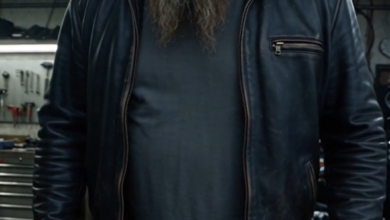
His Harley was a black touring bike with saddlebags worn soft at the corners. Not shiny. Not for showing off. The windshield had bug marks baked into it. A tiny strip of purple yarn was tied near the left mirror, faded almost white from sun and weather.
That yarn bothered me later.
At the time, it only looked strange.
A man like that, with skull ink crawling up his neck and old prison-blue tattoos across both hands, should not have had purple yarn on his motorcycle. It looked like something a child would tie there after making a promise.
He had walked into Hank’s Diner about fifteen minutes before everything happened. I was at the counter, arguing with Mary Lou about whether eggs had any business costing what they cost now, when the bell over the door rang and the whole place tightened up.
You could feel it.
Forks slowed.
Conversation thinned.
A young mother pulled her little boy closer in the booth. Two college kids by the jukebox stopped laughing. Even Hank, who had served truckers and oilmen and drunks for forty years, looked up from the grill.
The biker knew.
Of course he knew.
Men like that always know when a room decides what they are before they speak.
He took off his gloves slowly and laid them on the counter, palms down. His hands were huge, the skin split and rough around the knuckles, but his nails were trimmed clean. There was a scar running from the base of his thumb to his wrist, pale and raised like a piece of string under the skin.
Mary Lou whispered, “Lord, look at him.”
He heard her. I know he did.
He did not turn around.
He ordered black coffee and a slice of apple pie. His voice was low, gravelly, polite.
“Yes, ma’am.”
That was all.
When the pie came, he did something I still think about. He broke off the crust first and slid it onto a napkin. Then he pushed the napkin toward the little boy in the booth behind him, the one who had been staring with big scared eyes.
“Best part,” he said.
The boy looked at his mother. His mother looked terrified but nodded.
The child took the crust.
The biker went back to his coffee.
No smile. No performance. No “see, I’m harmless.” Just the crust, given away like it was normal.
Later, after the police report and the Facebook post and the town gossip, people started filling in pieces. His name might have been Marcus. Or Mack. Or maybe neither. One trucker swore he had seen him years before at a veterans’ benefit ride in Joplin. A nurse from Pittsburg said a biker matching that description used to sit in the hospital chapel every Wednesday night while chemo patients came and went. A waitress in Galena claimed he once fixed her dead battery in a storm and left before she could buy him coffee.
Nobody knew for sure.
That was part of what made him feel less like a man and more like one of those road ghosts people talk about in small towns. There, then gone. Engine fading down the highway before you can ask what just happened.
But I knew two things.
He watched hands.
And he watched old women.
Not in a creepy way. In a careful way.
The first time I noticed it, I thought maybe I was being judged. I had taken out my wallet at the register to pay for my bread and eggs, and my fingers fumbled because arthritis makes small things cruel. My wallet slipped. Before it hit the floor, his hand came out and caught it.
Fast.
Gentle.
He held it with two fingers, like it was something fragile.
“Ma’am,” he said, handing it back.
I thanked him, embarrassed.
His eyes flicked to the bills inside before I snapped it shut. Not greedy. Counting. Measuring. Understanding.
Then he looked toward the front window.
Outside, the young man in the gray hoodie had just stopped under the awning.
The biker’s jaw tightened.
That was the first warning I missed.
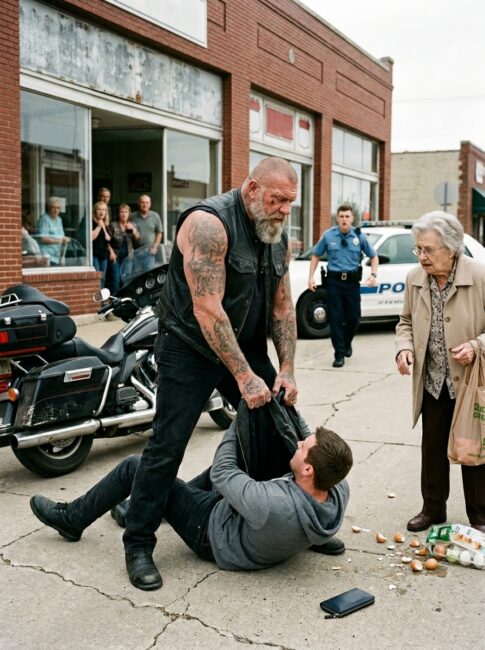
I left the diner with my groceries tucked against my hip and my purse strap looped twice around my wrist. The wind was dry that day, carrying the smell of diesel from the highway and fryer grease from Hank’s exhaust fan. Somewhere down the block, a loose sign tapped metal against brick. Tap. Tap. Tap.
The young man in the gray hoodie stepped out after me.
I remember thinking he looked cold.
He was maybe twenty-five, thin, clean-shaven, with nervous eyes and tennis shoes too white for someone walking that stretch of road. He had a phone in one hand and kept glancing at it like he was waiting for a message that would decide his life.
I do not like thinking the worst of people. At seventy-five, you learn that everybody is carrying something. Grief. Rent. Shame. Hunger. Sometimes all four.
So when he moved close behind me, I only shifted my groceries to make room.
“Sorry, ma’am,” he said.
His shoulder brushed mine.
It was quick. Soft. Almost polite.
Then the world exploded.
The biker came off the curb with a sound like leather tearing and boots cracking down on pavement. The gray hoodie spun halfway around, eyes wide, and the biker drove him to the sidewalk.
Not a punch. Not a beating.
But it looked terrible.
The young man hit the concrete with a breathless grunt. My eggs dropped. The carton split. Yellow yolk spread across the sidewalk like a small, ugly sunrise.
The biker planted himself over him, one knee on the concrete, one hand clamped around the young man’s left wrist. His other hand pressed between the shoulder blades, holding him down.
“Stay,” the biker said.
The word was flat.
The young man twisted. “Get off me, man! Help! He’s crazy!”
That is when everyone believed the wrong story.
Mary Lou came running out of the diner with a coffee pot still in her hand. Hank followed with a spatula. A couple of men at the gas station across the street turned and started moving toward us. Someone shouted, “He attacked him!” Someone else yelled, “That biker’s killing that kid!”
I stood frozen beside my broken eggs.
I wish I could say I defended him. I wish I saw the truth right away.
I didn’t.
I saw a huge tattooed man pinning a smaller man to the ground, and my body went cold with fear.
Then the patrol car rolled by.
Officer Daniel Reeves was young enough that I still remembered him as Danny Reeves, the boy who used to shovel my driveway for five dollars and a glass of iced tea. He hit the brakes, jumped out, and took in the scene like any cop would: big biker on top, young man screaming underneath, old woman standing shocked beside spilled groceries.
“Sir!” Danny shouted. “Hands where I can see them!”
The biker did not let go of the wrist.
“Left hand,” he said.
“Get off him now!”
“Left hand,” the biker repeated, louder this time.
Danny unclipped his taser.
The click of that little plastic holster sounded louder to me than the Harley had.
The crowd pulled back.
The young man under the biker started crying, or pretending to. “Please, officer, please. He jumped me. I didn’t do anything.”
The biker’s face did not change, but I saw his hand tremble once.
Not from fear.
From holding back.
There are men who shake before they hurt someone. This was different. This was a man using every ounce of himself not to become what everybody already thought he was.
“Brother,” he said to Danny, voice low and rough, “look before you light me up.”
Danny’s eyes narrowed.
“Don’t call me brother.”
The biker nodded once, like he deserved that.
Then he turned his head toward me.
“Ma’am,” he said. “Your purse.”
I looked down.
My purse was open.
The zipper hung wide.
My wallet was gone.
For a second my mind refused to understand it. I touched the empty pocket inside my purse. Once. Twice. My fingers scraped lining.
“No,” I whispered.
The biker finally shifted his weight just enough for everyone to see the young man’s left hand.
My brown leather wallet was clenched in it.
The whole sidewalk went quiet.
Even the loose sign stopped tapping, or maybe I just stopped hearing it.
Danny lowered the taser.
The young man stopped crying.
And the biker, still holding that wrist against the concrete, said, “That’s her grocery money.”
Nobody had told him that.
The arrest should have been the end of the story.
That is what everyone thought.
Danny cuffed the young man while another unit pulled up. The backup officer searched him and found three more wallets, two gift cards, and an envelope of cash with a church logo on it. The gray hoodie had been working the block all morning, moving between the diner, the pharmacy, and the gas station, choosing people who looked slow enough, tired enough, kind enough.
People like me.
My wallet was returned with the hundred dollars still inside. Four twenties, one ten, one five, and five ones. I had counted them that morning, and I counted them again with shaking hands while Mary Lou cried harder than I did.
The crowd changed fast.
That is another thing people do.
One minute they were afraid of the biker. The next, they wanted to slap him on the back, shake his hand, buy him pie, take his picture, post him online, make him into proof that they were the kind of people who recognized goodness.
But he did not want any of it.
Danny asked for his license.
The biker gave it.
Danny looked at it, and something passed over his face. Not surprise exactly. Recognition maybe. Pain, too.
“You’re him,” Danny said quietly.
The biker looked away toward the highway.
“Used to be.”
I heard it because I was close enough.
Danny lowered his voice. “You don’t have to run from a thank-you.”
The biker gave a small shrug. Leather creaked at his shoulders.
“Not running.”
“What do I put in the report?”
“The truth.”
“Name?”
The biker looked at me then, and for the first time his eyes softened all the way through.
“No name needed.”
Danny stared at him for a long second. Then, against every rule I imagine police have, he looked down at the license one more time and handed it back without saying the name out loud.
That was the second thing I missed.
The third came when the biker picked up my broken grocery bag.
He gathered what could be saved. Bread. Coffee. A little pack of sandwich meat. The eggs were ruined, spread across the pavement. He looked at them, then looked toward the small market next to the diner.
“Wait here,” he said.
I thought he meant me.
Maybe he meant himself.
He walked into the market. People parted for him like he was carrying weather. Two minutes later, he came back with a carton of eggs, a half gallon of milk, and a small sack of potatoes. He set them in my bag.
I started to protest.
He shook his head once.
“No debt.”
“Sir,” I said, “please tell me your name.”
His mouth tightened.
For a second, he looked older than seventy-five. Older than the road. Older than whatever had put those scars on him.
“My mother was robbed outside a grocery store,” he said.
That was all.
Then he reached up and touched the faded purple yarn tied near his Harley’s mirror.
“She was seventy-four.”
Nobody spoke.
He put on his gloves.
The engine turned over with a deep, chest-rattling growl that made the diner windows buzz. He backed the Harley away from the curb, nodded once to Danny, once to me, and rolled toward the highway.
The last thing I saw was that purple yarn trembling in the wind.
It took three days for the town to start finding pieces of him.
Not his real name. Not exactly.
Danny would not give it to anyone. He said police reports were not Facebook entertainment, and for once the town respected that. Mostly.
But people talk. Small towns are built out of talk.
The first piece came from Hank, who remembered the biker from six years earlier. He had stopped at the diner on a winter night when a snowstorm shut down Route 66 and a young waitress named Carrie was stranded after closing. Her car would not start. Her boyfriend would not answer. She had a toddler at home with a fever.
The biker had pushed her car under the awning, opened the hood, and worked in the freezing dark until his hands bled around the nails. When the engine finally caught, she offered him money.
He told her, “Spend it on the kid.”
Then he rode away in sleet.
The second piece came from a woman at the Methodist church. She said the purple yarn was from a scarf-making group that donated winter clothes to shelters. Years back, a biker’s mother had come every Tuesday, making purple scarves because purple had been her favorite color since high school. After she was robbed outside a discount grocery in Tulsa, she stopped coming. Not because of the money, the woman said. Because the thief shoved her down and she broke her hip.
She died before Christmas.
The biker showed up at the church the following January. He did not sit through service. He stood in the back, holding a bundle of purple yarn his mother had left unfinished. He asked one of the ladies to tie a piece of it to his motorcycle.
“So I see it before I see red,” he told her.
That sentence made my hands go numb when I heard it.
So I see it before I see red.
That explained the tremble in his hand while he pinned the thief down. He was not struggling to hurt him. He was struggling not to. He was holding that young man still with the exact amount of force needed and not one ounce more, while the whole sidewalk accused him of being a monster.
The third piece came from Danny.
He came by my house on Thursday with my formal statement for me to review. He stood in my kitchen, hat in his hands, looking at the same table where I had counted my grocery money before all this began.
“You knew him,” I said.
Danny looked out the window.
“When I was fifteen, my dad left and I got stupid. Real stupid. Started stealing from cars behind the bowling alley. One night I broke into the wrong truck.”
“His?”
Danny nodded.
“What did he do?”
“Made me put everything back. Then he drove me home.”
“That’s all?”
“No.” Danny smiled a little, but it hurt him. “He came back the next morning. Made me apologize to every person whose car I touched. Then he got me washing bikes at a charity ride for the summer. Paid me twenty dollars every Saturday and told me if I stole again, he’d know.”
“Did you?”
“No, ma’am.”
Danny looked down at his badge.
“He never told me he was proud when I became a cop. He just mailed me a pair of boot laces.”
“Boot laces?”
“Black. Heavy ones. Note said, ‘Tie them right. Stand straight.’”
That sounded like him.
Few words. Weight in every one.
I asked Danny why the biker would not let anyone thank him.
Danny took a long breath.
“Some men don’t trust praise. They only trust work.”
That night I sat at my kitchen table and emptied my wallet.
Four twenties. One ten. One five. Five ones.
The same hundred dollars.
But there was something else tucked behind my library card.
A folded receipt from the market.
Eggs. Milk. Potatoes.
Paid cash.
On the back, in blocky handwriting, were five words.
“Eat first. Thank me never.”
I cried then.
Not pretty crying. Old lady crying. The kind that makes your chest ache and your nose run and your tea go cold.
I cried because he had known.
He knew that hundred dollars was not just money. It was bread, soup, oatmeal, coffee, medicine split in half to stretch the week, pride swallowed at the checkout counter, and the quiet terror of being old in a country where everything costs more every time you blink.
He saw all of that in the few seconds my wallet was open.
And then he watched my back.
I posted about him on Facebook because I did not know what else to do.
I did not post his picture. I did not have one. I did not post his license plate. I would not have, even if I had remembered it. I only wrote what happened.
A biker pinned a man to the sidewalk outside Hank’s Diner. I thought he was hurting him. He was saving me. The man had my wallet. I didn’t even know it was gone.
By morning, the post had been shared all over Cherokee County. By lunch, it had reached Joplin, Tulsa, Springfield, Wichita. People started commenting with stories.
“He fixed my tire outside Vinita.”
“He paid for my son’s insulin when my card declined.”
“He sat with my husband at the VA clinic.”
“He rides alone but never leaves people alone.”
Nobody agreed on his name.
Some said Mack. Some said Preacher. Some said Ghost. One man called him “the guy you don’t notice until you need him.”
That one felt right.
A week later, I wrote the letter.
I did it by hand because some things should not be typed.
I used my best stationery, the cream-colored kind my daughter bought me two Christmases ago. My fingers cramped after the first paragraph, but I kept going. I told him I was sorry for being afraid. I told him I was sorry for believing the worst for even a second. I told him I had bought chicken, rice, apples, and coffee with the money he saved.
Then I wrote the line people keep repeating.
I don’t know your name. But I am seventy-five years old, and you saved the last hundred dollars I had. That was my food for the week. Thank you.
I gave copies to Hank, the church, the gas station, the pharmacy, and the little market where he had bought my eggs.
For two months, nothing happened.
No message.
No call.
No biker walking into the diner to accept pie and applause.
But every other Thursday, just after sunrise, I began hearing a Harley roll through town.
Not loud. Not showing off.
Just that low V-twin pulse moving along Route 66 while the sky was still pink over the grain elevators. It would slow near Hank’s. Pause at the light. Then continue west.
Once, I was standing by the window with my coffee when it passed.
Black touring bike.
Weathered saddlebags.
Purple yarn on the mirror.
He did not stop.
He did not look over.
But tied to the diner door that morning was a small paper sack.
Inside were a dozen eggs.
No note.
People still ask me if I ever found out his real name.
I tell them no.
That is almost true.
I know names people have given him. Mack. Ghost. Preacher. Guardian. Trouble. Brother. I know the name his mother probably used when she called him in for supper as a boy. Danny knows the name printed on his license. The police report has one tucked away somewhere in a drawer.
But the name is not the part that matters to me.
What matters is the sound of boots on concrete when everyone else only watched.
What matters is a tattooed hand holding a thief’s wrist still, not crushing it, not breaking it, just holding it long enough for the truth to catch up.
What matters is a strip of purple yarn tied to a Harley mirror so one man remembers who he promised not to become.
Last month, I saw him again.
I was outside Hank’s with my grocery bag, standing in the same place where my eggs had broken. The Harley rolled to the light. He wore the same leather cut. Same gray beard. Same tired eyes.
This time, I was not afraid.
I lifted my hand.
He gave one small nod.
The light changed.
The engine rose, deep and steady, and he headed west on Route 66 with the purple yarn fluttering like a tiny flag.
No name.
Just thunder.
Follow the page for more true-feeling biker stories about the people the road teaches us to see differently.