Part 2: A Biker Threw Me to the Diner Floor — Then the Camera Showed Why
I need to tell you what I thought about bikers before that day.
Nothing kind.
I grew up in a house where loud engines meant trouble had arrived. My father drank cheap beer, fixed cars badly, and blamed everyone else for the sound of his life falling apart. When motorcycles came down our street, my mother locked the front door. She called them “road wolves.”
So when I saw Hank Rourke walk into Mae’s Route 66 Diner that Thursday afternoon, I did what most people do.
I judged fast.
The bell over the door gave one weak jingle. Then his boots hit the floor.
Heavy.
Slow.
Not drunk slow. Not old slow. Controlled slow.
Every step sounded like a threat.
The diner was one of those old roadside places that smelled like burnt coffee, bacon grease, wet jackets, and pie crust. Red vinyl booths. Chrome napkin holders. A faded photograph of Route 66 on the wall. Truckers at the counter. Two college girls sharing fries. A mother cutting pancakes for a little boy in a dinosaur shirt.
Then Hank walked in, and the whole place changed temperature.
He didn’t look around like he wanted attention. That somehow made him worse. Men who want attention perform. Hank looked like he had survived attention and didn’t care for more of it.
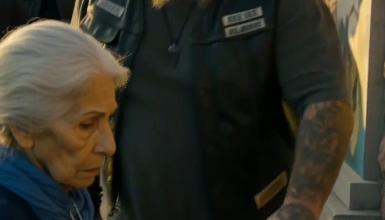
His cut was old black leather, cracked at the shoulders. The back patch read IRON PILGRIMS MC. Under it, smaller letters: WEST TEXAS CHAPTER. His arms were roped with muscle and old ink. A snake. A cross. A woman’s name scratched over so many times it had become a bruise. Across the knuckles of his right hand were four letters: HOLD.
Not HATE.
Not KILL.
HOLD.
That should have struck me as strange.
It didn’t.
He sat in the booth across from mine, facing the door. He ordered black coffee and toast.
The waitress, Darlene, was nervous. I knew Darlene because I stopped there twice a month for work. I sold insurance across western Oklahoma, which meant I spent too many afternoons eating pie alone in places where everyone else seemed to know one another.
Darlene set down his coffee without meeting his eyes.
Hank said, “Thank you, ma’am.”
Softly.
That was the first thing that didn’t fit.
The second was what happened with the little boy in the dinosaur shirt.
The boy dropped his red crayon. It rolled under Hank’s booth. His mother stiffened when Hank bent down. I saw it. Everyone saw it.
Hank picked up the crayon with two fingers, wiped it on a napkin, and set it at the edge of the table.
“Red ones are fastest,” he said.
The boy stared at him.
Then he smiled.
Hank went back to his toast like nothing had happened.
A few minutes later, two more bikers rolled up outside. Their engines rumbled against the diner windows. Men in cuts. Older. One Black American man with a white beard and a limp. One white American man with a shaved head and glasses. They looked through the window, saw Hank, and stayed outside.
That seemed strange too.
Brotherhood, I thought, meant they’d come in together.
But they didn’t.
They stood beside their Harleys in the parking lot, watching the highway, watching the gas pumps, watching the diner doors.
Like they were waiting for him.
Or guarding him.
Hank never waved.
He only lifted two fingers from his coffee cup.
The man with the white beard nodded once.
I remember thinking they looked like trouble arranged in a row.
Now I know they looked like men who had learned where to place themselves when the world might break.
The last thing I noticed before everything happened was the inside of Hank’s vest.
When he reached for his coffee, the leather opened just enough for me to see a small strip of blue fabric sewn near the heart.
Not a club patch.
Not a skull.
A child’s hospital bracelet.
Faded almost white.
One name printed on it.
Lucy.
Then he closed the vest.
And I looked away because I thought grief on a man like that was none of my business.
I was right about one thing.
It was grief.
I was wrong about everything else.
At 3:42 p.m., I stood up.
That tiny detail became important later.
I had finished my chicken salad sandwich, left half the fries, and checked my phone. One missed call from my ex-husband. Two emails from clients. A weather alert for storms moving in from the west.
Normal things.
Boring things.
The kind of things that make you believe the next minute will also be normal.
I picked up my purse and slid out of the booth.
Across from me, Hank’s eyes moved.
Not to me.
Past me.
To the glass door.
The bell had not chimed yet.
But his body changed.
His shoulders dropped half an inch. His right hand left the coffee cup. His left boot shifted under the table.
I know because I watched the footage later until I hated myself for missing it in real life.
At the time, I only saw a scary man staring.
I thought he was staring at me.
I pulled my cardigan tighter and took one step toward the restroom hallway.
Then the bell chimed.
A man came in wearing a gray hoodie and sunglasses, even though the sky outside was cloudy. White American man. Maybe thirty. Thin face. Nervous mouth. One hand in the front pocket of the hoodie.
The diner barely noticed him.
Darlene looked up.
“Sit anywhere, hon.”
He didn’t sit.
He went straight to the register.
Hank saw it first.
He saw the hand in the pocket. The angle of the elbow. The way the man’s jaw moved like he was chewing fear. He saw Darlene’s face shift from customer-service tired to animal scared.
I saw none of that.
I was standing in the open aisle.
Tall enough to block his line of sight.
Close enough to become the first body between panic and escape.
Later, Hank told the police, “She stood up into the bad place.”
That was his phrase.
The bad place.
The gray-hooded man said something to Darlene.
She opened the register.
The cook shouted from the kitchen, “Everything okay?”
That was when the man’s pocket lifted.
Just a little.
Enough.
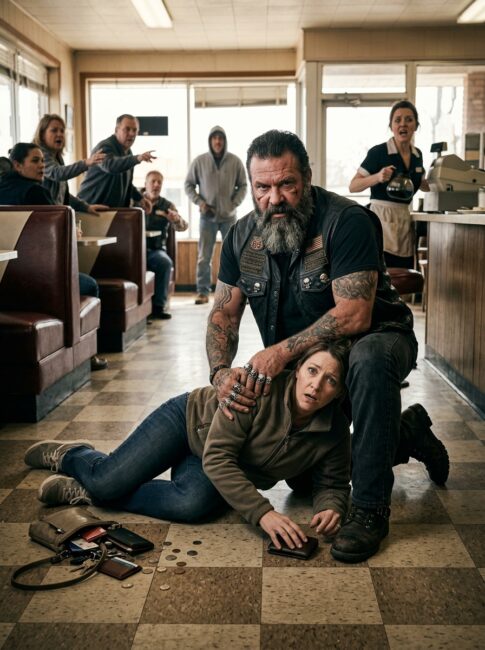
Hank moved.
He didn’t leap across the room like some hero in a movie. He didn’t tackle the robber. He didn’t pull a weapon. He didn’t make the situation bigger.
He came low and fast from his booth.
I felt a forearm across my waist, hard but not cruel. I felt his other hand go behind my head. I felt his boot slide to keep his balance.
Then I was on the floor.
The sound my body made hitting tile was ugly.
A hard slap.
My purse flew open. Lipstick rolled under a booth. My phone skidded into spilled coffee.
I screamed.
Everyone turned.
That was the false climax.
Not the robbery.
Me screaming under a biker.
Because that was the picture the room understood.
Darlene was frozen behind the counter, both hands up. The robber had the register bag now. His pocket still pointed at the room. His eyes jerked toward us, then away. He didn’t want a fight. He wanted out.
Hank stayed over me, making himself broad, ugly, obvious.
A wall again.
But from the floor, I didn’t know that.
I kicked.
“Get off!”
His hand pressed lightly on the back of my head, keeping my face down.
“Don’t stand up,” he said.
The calm made me furious.
A trucker shouted, “Hey!”
The cook came out with the skillet. Another man started forward. The robber yelled, “Stay back!”
That voice stopped everyone.
Sharp.
High.
Desperate.
The little boy in the dinosaur shirt started crying.
Hank’s body went still above me.
Not scared still.
Measured still.
His breath moved slow. I could smell leather, black coffee, road dust, and something metallic, like old tools left in rain.
The robber backed toward the door.
The bell chimed when he hit it with his shoulder.
Then he was gone.
Tires squealed outside.
Only after the sound faded did Hank lift his hand from my head.
He moved backward immediately, both palms up.
I scrambled away from him so fast my shoulder hit a chair.
“You attacked me,” I said.
My voice cracked.
He looked at me once.
His eyes were wet.
Not crying.
Just carrying water they refused to drop.
“No, ma’am,” he said. “I covered you.”
But nobody believed him yet.
Not even me.
The police arrived with lights bouncing red and blue across the pie case.
Two officers came through the door with hands near their holsters, eyes sweeping, voices sharp.
Everyone talked at once.
“He threw her down.”
“There was a robbery.”
“He was on top of her.”
“The guy had something in his pocket.”
“I saw the biker move first.”
Darlene was shaking so badly she couldn’t hold the receipt tape she had ripped from the register. I sat in a booth with a napkin pressed to my scraped elbow, trying not to cry in front of strangers.
Hank stood near the counter.
Still.
Huge.
Hands visible.
He did not argue when the younger officer told him to turn around.
He did not resist when cuffs closed around his wrists.
The sound of metal on metal made his jaw tighten.
Outside, the two bikers who had waited by the Harleys took one step toward the door.
Hank saw them through the glass.
He shook his head once.
They stopped.
That was brotherhood being tested.
Not by a bar fight.
Not by some loud road fantasy.
By restraint.
By watching their brother get handcuffed for doing the right thing and trusting the truth to move slower than anger.
The Black biker with the white beard put both hands on top of his head and turned away like it hurt to obey.
But he obeyed.
Hank looked at the officer.
“Camera’s over the pie case,” he said.
That was all.
The older officer glanced up.
There it was. A small black dome in the corner, aimed at the register and most of the dining room.
Mae, the owner, came out from the back office pale as flour. Her hands shook while she opened the security app on an old desktop computer. Everyone crowded near the counter except me. I stayed in the booth because my legs didn’t want the job yet.
The footage loaded.
No sound.
Just grainy color.
There I was, sitting in my booth.
There was Hank across from me, coffee untouched.
There was the gray-hooded man outside the door, pausing before he entered.
Hank’s head turned before anyone else reacted.
The bell hadn’t even moved yet.
Frame by frame, we watched his body read the room.
His hand left the mug.
His boot shifted.
My booth moved as I stood up.
I stepped into the aisle.
The robber entered.
He went to the register.
Darlene opened her mouth.
The pocket lifted.
And there I was, standing straight in the line between him and the exit.
The officer slowed the video.
Hank moved on frame 1128.
The robber’s pocket rose on frame 1126.
Two frames.
That was the whole distance between my life as I knew it and whatever might have happened if panic chose me.
Hank reached me before the robber looked over.
He didn’t strike me.
He turned his own body sideways, caught my waist, covered my head, and drove me down below counter height.
Not violently.
Precisely.
The robber’s eyes snapped toward the movement.
But because Hank was broad and low, because I was no longer standing, because the aisle cleared, the man backed out instead of grabbing, shooting, or taking a hostage.
The room went silent.
The younger officer unlocked the cuffs.
The click sounded louder than the robbery.
I looked at Hank.
For the first time, I actually saw him.
Not the tattoos.
Not the leather.
Not the old scars.
The calculation.
The shaking hands.
The grief folded behind his eyes.
Darlene started crying first.
Then I did.
“I thought you were hurting me,” I said.
Hank rubbed one wrist where the cuff had marked him.
“I know.”
No anger.
No lecture.
Just two words.
Like he had expected to be misunderstood.
Like it had happened before.
The officers asked Hank how he knew what to do.
He gave them the short version.
“Old training.”
That was all he wanted to say.
But the older officer, a woman named Sergeant Polk, looked at him longer than the others did.
“You military?”
Hank nodded once.
“Army. Convoy security. Iraq.”
The diner shifted around that word.
People changed how they stood.
Hank hated it.
You could see that. He didn’t want respect to arrive only after a war got named. He had been the same man five minutes earlier when everyone wanted him on the floor.
Sergeant Polk asked, “Combat medic?”
His jaw worked.
“For a while.”
That explained his hands.
That explained the word HOLD across his knuckles.
Not violence.
Instruction.
Hold pressure.
Hold position.
Hold still.
Hold on.
The seed from his hand came back all at once.
Then Darlene, still wiping her eyes, pointed gently toward his vest.
“Hank,” she said. “Show her.”
He looked at her.
A warning.
She didn’t back down.
“She deserves to know.”
Hank was quiet for a long time.
Then he opened the left side of his cut.
Inside, sewn near the heart, was the faded blue hospital bracelet I had seen earlier.
Lucy Rourke.
DOB: 04-17.
Under it was a small photograph, laminated badly, edges cracked. A girl around twelve years old with brown hair, braces, and a gap-toothed smile, holding up a school spelling bee ribbon.
“My daughter,” Hank said.
His voice had changed.
Not softer.
Thinner.
The diner did not move.
“She was in a gas station outside Amarillo with her mother. Man came in with a gun. Everybody froze. Lucy stood up because she thought her mama was behind her.”
He swallowed once.
His hands stayed open at his sides.
“The man panicked.”
He didn’t say the rest.
He didn’t need to.
The room understood.
He had watched security footage before.
Not this diner’s.
That gas station’s.
He had watched his daughter stand too tall in the wrong place. Watched a scared man with a weapon choose the brightest target. Watched two seconds become the rest of his life.
That was twist one under the main twist.
He did not throw me down because he was reckless.
He did it because once, years earlier, nobody had pulled Lucy down.
The two bikers outside came in then.
The Black man with the white beard was named Moses. The shaved-head man with glasses was Tuck. They didn’t crowd Hank. They stood nearby, giving him space.
Moses looked at me and said, “He sits facing doors because of her.”
Tuck added, “Every diner. Every gas station. Every motel lobby. Man hasn’t put his back to a door in nine years.”
Hank shot him a look.
Tuck shut up.
That was brotherhood too. Saying what your brother cannot. Then stopping before you shame him.
Sergeant Polk asked why the other riders stayed outside.
Moses answered.
“We saw the hoodie circling the pumps. Hank clocked him too. We stayed out in case he had a driver.”
A second twist.
This had not been random awareness.
They had noticed danger before the door opened.
They had positioned themselves around it without making a scene.
No chest-thumping. No hero pose. Just old men with ruined knees placing themselves where fear might run.
The police later confirmed the robber had circled the gas station next door twice before entering the diner. He had no confirmed accomplice. He did have a weapon. He was caught that night outside Weatherford after trying the same thing again.
I asked Hank why he didn’t tackle him.
He looked at me like the answer hurt.
“Gun in a scared hand don’t need help going off.”
That was the whole philosophy.
Not fight.
Not win.
Reduce harm.
Get low.
Keep people breathing.
And me?
I had been standing in the bad place.
Tall. Visible. Female. Moving.
An easy hostage.
An easy shield.
An easy tragedy.
Hank saw all that in less time than it takes to blink twice.
Then he let everyone hate him for saving me.
I tried to thank him before he left.
That sounds simple.
It wasn’t.
How do you thank a stranger for changing the shape of your future in two seconds? How do you look at a man you accused, a man you feared, and tell him your fear was too small for the truth?
Hank didn’t want my number.
He didn’t want my name.
He didn’t want a picture, a post, a hug, or a free meal.
Mae tried to comp his coffee and toast.
He left ten dollars under the mug.
Darlene told him, “You saved us.”
He shook his head.
“Robber left. That’s all.”
Moses snorted.
“Man, take the thank-you.”
Hank ignored him.
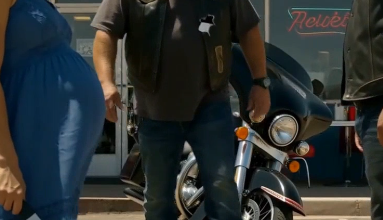
Outside, rain had started. Soft at first, turning the dust in the parking lot dark. The Harleys shone under the gray Oklahoma sky. Water ticked on chrome. The engines were quiet.
Hank stood beside his Street Glide and pulled on his gloves. His hands shook once when he tightened the strap.
I saw it.
He saw me see it.
Neither of us mentioned it.
That became our little agreement.
Once a month after that, I stopped at Mae’s on my way through Clinton. At first, I told myself it was for the coconut cream pie. Then I admitted I was looking for him.
Sometimes he was there.
Always in the same booth.
Always facing the door.
Sometimes alone. Sometimes with Moses and Tuck. Sometimes with younger riders who listened more than they talked.
The first time I saw him again, I walked over with two coffees.
“I still don’t know what to say,” I told him.
He took one coffee.
“Don’t stand in aisles during robberies.”
I laughed because I didn’t know what else to do.
He almost smiled.
Almost.
Over time, I learned his ritual.
Every April 17, he rode from Clinton to Amarillo. Same route. Same gas station. He parked by pump three, engine off, and sat there for nine minutes.
One minute for every year Lucy lived.
Then he rode back roads until dark and came home with dust on his boots and no words left.
The Iron Pilgrims never let him ride that day alone.
They did not talk about healing.
They just filled their tanks and followed.
No speeches.
No matching shirts.
Just engines behind him, steady as a pulse.
The year after the diner, I went too.
Not on a bike. In my little blue Honda, three cars back, feeling ridiculous and grateful and strangely honored.
At the gas station, Hank stood by pump three with his vest open just enough for the bracelet to show.
A teenage cashier inside watched the bikers through the window, nervous.
Moses bought a pack of gum he didn’t need.
Tuck cleaned the coffee station.
Hank picked up a red crayon from under a display rack and set it on the counter.
“Red ones are fastest,” he told nobody in particular.
Then we all left.
I saw the security footage one last time before Mae replaced the system.
She asked if I wanted a copy.
I said no.
Some things don’t need to live in your phone to stay with you.
I remember enough.
The bell.
The pocket.
The two frames.
The biker everyone feared moving faster than everyone’s judgment.
Hank still rides through Clinton. He still sits with his back to the wall. His Harley still sounds like thunder dragging chains across the highway. People still look up when he enters a room.
Some are scared.
Some stare.
Some see the beard, the tattoos, the cut, the scar.
I see the hand over my head.
I see a man making himself hated because hated was better than late.
Last Thursday, a young waitress at Mae’s dropped a tray when Hank walked in. Plates shattered. The room jumped.
Hank bent down slowly, picked up the broken pieces, and stacked them in his palm.
The waitress whispered, “I’m sorry.”
Hank looked at her.
“For what?”
“For being scared.”
He set the broken pieces on the counter.
“Fear’s just your body trying to keep you alive,” he said. “Don’t be ashamed of it.”
Then he went to his booth.
Facing the door.
Outside, rain tapped the Harley seat. Inside, coffee steamed between his hands. His vest creaked when he reached for the mug, and for one second I saw the blue bracelet near his heart.
Lucy.
Still riding with him.
Still making him watch the door.
Follow the page for more biker stories about the people behind the leather, the scars, and the sound of the highway.