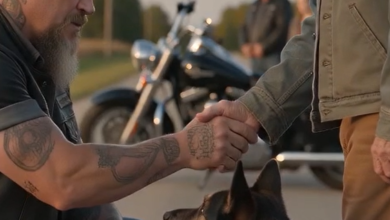
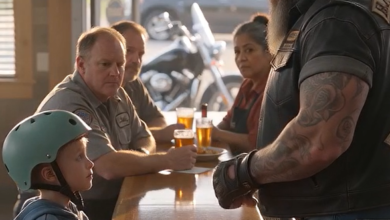
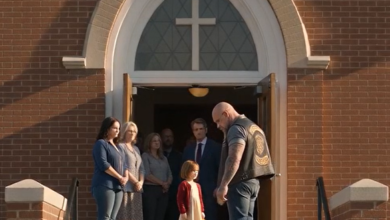
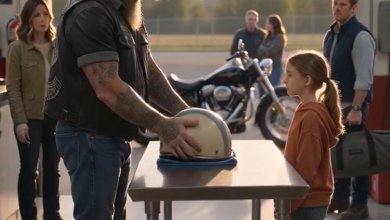
A CEMETERY MANAGER RIPPED THE BLANKET OFF A BIKER SLEEPING ON A CHILD’S BED BESIDE A GRAVE—THEN A LITTLE BOY IN PAJAMAS RAN UP AND SAID, “THAT’S MY BED!”
Part 2
Owen’s fingers were cold, and they wrapped around two of Bear’s like the boy was afraid someone would pry them loose.
“Is it okay?” Owen whispered, looking up at the headstone. “Did he see it?”
Bear crouched down beside the bed until his knees cracked. The leather of his jacket creaked. Up close he smelled like he always did, of sawdust, gasoline, and wood stain.
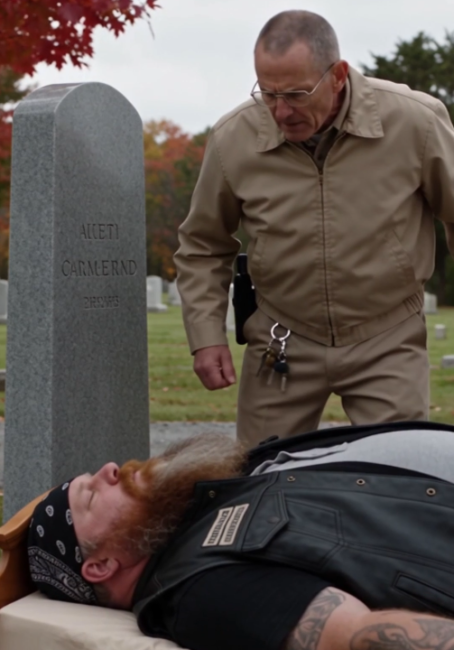
“He’s seeing it right now, buddy.”
The name on the stone was DANIEL J. CALLAHAN. Below it was a fire department emblem and two dates thirty-eight years apart.
Danny Callahan had been a lieutenant with the Cedar Bluff Fire Department, Engine 7. Seven months earlier, on a February night, a warehouse fire on River Road went to three alarms. A teenage night watchman was trapped on the second floor. Danny went in after him. The kid came out, and Danny didn’t.
He left behind a wife, a firehouse that still set his coffee mug out every morning, and an eight-year-old boy who had stopped sleeping.
It wasn’t that Owen didn’t get tired. He got so tired his teachers sent notes home. But every night since the funeral, when Kara tucked him into bed, he lay there rigid in the dark with his eyes open. Sometime after midnight, he would end up on the floor of her room curled in a blanket, or on the couch with every light on, or not asleep at all.
Danny used to work twenty-four-hour shifts. On the nights he was home, he did the same thing every time. He lay down on the floor beside Owen’s bed, put one hand up on the mattress, and said the same four words until his son drifted off.
“I’m right here, buddy.”
Nobody had said those words since February.
Bear had heard about it the way he heard about most things, sideways. Kara mentioned it at the firehouse fish fry in August with dark circles under her eyes. Owen won’t sleep in his room. The counselor says give it time. I don’t know what else to do.
Bear went home that night and stood in his woodshop for a long time.
Then he started building.
For three weeks he worked until two or three every morning in the shop behind his house on Mill Creek Road. He used honey oak, planed smooth and joined by hand without a single nail. It was a twin bed, low to the ground, with a second mattress on a rolling frame that slid out underneath.
The trundle, he called it. It was for whoever stayed until Owen fell asleep.
Owen had seen it once, finished, two days ago. He’d run his hands along the headboard for a long time. Then he’d looked up at Bear and said something that made the big man go outside and stand by his bike until he could breathe again.
“Can Daddy see it first? Before I sleep in it?”
So here they were.
Behind him, Leonard Voss found his voice again.
“This is completely inappropriate. Cemetery regulations prohibit furniture, structures, and unattended personal items on any plot. I want it removed. Today. Right now.”
Kara reached them, out of breath. “Leonard, it’s ten minutes. He just wants to—”
“Mrs. Callahan.” Leonard tucked the clipboard under his arm and drew a folded paper from inside his jacket. His voice dropped into something cold and careful. “I’ve been meaning to speak to you about your son. And about this man.”
Part 3
He unfolded the paper. It was an incident report on Pine Hill letterhead, two pages long.
“On September fourteenth at approximately two-fifteen a.m.,” Leonard read, “I discovered a juvenile asleep on this plot. The child had entered the grounds after hours by squeezing through the north gate. I contacted the sheriff, who returned the child to his residence.”
Kara nodded stiffly. “I know. I was there when they brought him home. I’ve had the window locks changed since.”
“Then perhaps you don’t know about the second time.”
Kara went very still.
“On October second, at approximately one-forty a.m.,” Leonard continued, “I discovered the same juvenile on this plot again. I escorted him outside the gate and went to my residence to contact the sheriff. When I returned, the child was sitting outside the gate with an adult male.” He looked up from the paper and pointedly at Bear. “This adult male. He remained with the child until dawn. Neither of them was there when the deputy arrived.”
The mourners from the nearby service had stopped pretending not to listen.
Kara turned slowly toward Bear. “Is that true?”
Bear didn’t look away from her. “Yes, ma’am.”
“You knew? He snuck out again, and you sat with him all night, and you didn’t tell me?”
Owen sat up on the bed, face crumpling. “I made him promise! It’s not his fault! I called him on Daddy’s old phone, and he came.”
“Owen—”
“He came in his truck in like nine minutes, and he didn’t even have a jacket. He sat on the ground by the gate with me, and he didn’t make me go home. He just stayed till the sun came up.” Owen’s voice broke. “And then he drove me home, and I climbed back in the window, and I made him promise not to tell you because you cry every time.”
Kara pressed a hand to her mouth.
Leonard folded the report with a crisp snap. “I’m sure you can understand my concern, Mrs. Callahan. A grown man, a stranger to most, lingering in the middle of the night with a vulnerable child. Outside a cemetery. Without the parent’s knowledge.”
He said it reasonably, almost kindly. Several of the mourners exchanged looks. Somebody murmured, That’s not right.
Bear felt the words land on him like wet cement.
He could have explained. He could have told them about the eleven years he’d known Danny Callahan, and about holding Owen at his christening. He could have told them that he hadn’t taken the boy home that night because Owen was shaking too hard to stand, and because he’d promised himself he’d never leave Danny’s son alone in the dark.
Instead, he looked at Kara.
She wasn’t looking at him. She was looking at the ground, arms wrapped around herself, and he could see the doubt working in her. It wasn’t doubt about him exactly. It was about everything. Seven months of not sleeping will do that to anybody.
“I’ll take it back to the shop,” Bear said quietly.
“No!” Owen grabbed the headboard with both hands. “Bear, no!”
“Just for now, buddy. Your mom needs to think.”
It took him ten minutes to carry the bed back to the trailer. Owen sobbed the whole time with his face buried in Kara’s cardigan. Leonard watched every step with his arms crossed.
Bear was strapping down the quilt when his phone buzzed. A second later, Kara’s phone buzzed too.
It was the same email from Pine Hill Cemetery management to both of them. Effective immediately: all unauthorized items would be removed from Plot 14-C, including a fire helmet, drawings, and toy trucks. And Mason Dunlap was barred from the cemetery grounds pending a trespass review.
The removal was scheduled for 8 a.m. tomorrow.
Part 4
Kara didn’t sleep that night. Neither did Owen, which wasn’t new, but it was worse. He cried until eleven, then lay on her bedroom floor staring at the ceiling, holding his stuffed dog so tight its seams were splitting.
At 11:40, he whispered into the dark.
“Bear’s not bad, Mom.”
“I know, baby.”
“Then why did you let him leave?”
She had no answer for that.
At midnight she got her keys, put Owen in the back seat in his pajamas, and drove out Mill Creek Road.
The lights were on in Bear’s shop. They always were.
He opened the big sliding door before she could knock. He was still in his jeans and a sawdust-covered T-shirt, and his eyes were red at the rims, from wood dust or something else. Behind him, in the middle of the concrete floor under a hanging work light, stood the bed.
Owen ran to it and climbed straight in.
Kara walked to the headboard. In the cemetery, she hadn’t gotten close enough to see the carving. Now she did.
Across the top rail, hand-cut into the oak in slightly uneven letters, were four words.
I’m right here, buddy.
But they weren’t in Bear’s blocky print. The letters leaned to the right, with a big loopy y that trailed off the end.
It was Danny’s handwriting.
Kara put her fingers on it and couldn’t speak.
“Lunchbox note,” Bear said behind her. “The morning of the fire. Owen kept it. He let me borrow it for a day. I traced it onto the wood and cut it with a detail knife.” He scratched the back of his neck. “Took about forty tries on scrap before I got the y right.”
Kara sat down on the edge of the trundle.
“Why?” she whispered. “Why would you do all this?”
Bear was quiet for a long moment. Then he pushed up the sleeve of his right arm.
There was a tattoo she’d seen a hundred times without really looking: a firefighter’s axe crossed with a mechanic’s wrench, under a small flame. It was the same emblem on the back of his jacket and on every patch his club wore.
“Twelve years ago I laid my bike down on Route 31 doing about seventy,” he said. “Drunk. Three in the morning. Ended up pinned under it in a ditch with the tank leaking. The first guy down that ditch was a rookie firefighter on his second week. Danny.”
Kara stared at him.
“He held my head still for forty minutes while they cut the bike off me. Kept talking the whole time so I wouldn’t pass out. Then he came to see me in the hospital every day for a month. Told me if he was going to save my life, I better do something with it.” Bear tapped the tattoo. “Axe and wrench. His job and mine. We started the club together two years later. Every guy in it got sober and stayed sober. That was Danny’s rule.”
“I never knew any of this,” Kara said.
“He didn’t like telling it.”
Bear looked down at the headboard.
“About a year before the fire, we were out on a ride, and he got quiet at a gas stop. Said, If anything ever happens to me, you look after my boy. I said nothing’s going to happen. He said, Just promise.” His voice roughened. “So I promised.”
In the bed, Owen had gone very still. Kara looked over.
Her son was asleep, curled under the headboard with one hand resting against the carved letters.
It was 12:31 a.m. It was the first time in seven months.
Kara was still sitting there, afraid to breathe and wake him, when headlights swung across the shop windows. An old pickup pulled into the gravel drive.
A young man in a Pine Hill groundskeeper’s jacket climbed out and walked to the door. He was carrying something in both arms.
It was a scorched, battered firefighter’s helmet.
“Mr. Dunlap?” he said. “My name’s Javier. They didn’t wait for eight a.m. And there’s something else you need to see.”
Part 5
Javier Ortiz was twenty-three and had mowed the grass at Pine Hill for three summers. He set the helmet down gently on Bear’s workbench, as if it might still be hot.
“Mr. Voss had us clear the plot at ten tonight,” he said. “Me and the other guy. He said the board wanted it done before the morning. Everything went in the dumpster. The drawings, the trucks.” He swallowed. “I went back for the helmet after he left. I couldn’t let it sit in the trash.”
Kara picked it up. It was Danny’s first helmet, the one from his rookie year, with his old engine number still on the side. The firehouse had placed it on his grave the day of the funeral.
“Thank you,” she managed.
“That’s not why I came.” Javier pulled out his phone. “We have cameras on all the gates. Mr. Voss doesn’t know I can get into the system. My cousin installed it.” He held up the screen. “This is October second. The night Owen called you.”
The footage was grainy and black-and-white, from a camera mounted over the north gate.
At 1:42 a.m., Leonard Voss came walking up the path in a bathrobe and boots. Owen walked a few feet ahead of him in his pajamas, carrying his stuffed dog. At the gate, Leonard unlocked it and pointed through it. Owen stopped and said something, looking back toward the graves.
The camera had audio.
“I just want to stay with my dad.”
Leonard’s voice was flat and impatient.
“Your dad’s dead, son. He can’t hear you. Go home.”
He nudged Owen through the gate by the shoulder of his hoodie, locked it behind him, and walked back toward the caretaker’s house without looking back.
For eleven minutes, an eight-year-old boy sat alone on the curb outside a cemetery at two in the morning. He hugged his knees and rocked.
Then he pulled an old phone out of his hoodie pocket.
Nine minutes later, headlights came. A huge man got out of a truck in a T-shirt in the forty-degree cold, sat down on the curb beside the boy, and didn’t move again until the sky turned gray.
Kara watched it with both hands over her mouth. Bear didn’t watch it at all. He had been there.
“He didn’t call you,” Kara whispered. “He left my son out there and didn’t even call me.”
“There’s more,” Javier said quietly. “Why he’s like this now. Why he’s cleaning out everything so fast.”
He scrolled to an email, a screenshot from the office computer.
“Pine Hill’s being sold. Some company called Evergreen Legacy Partners buys up small cemeteries and turns them into, like, corporate memorial parks. The sale closes Saturday. And there’s a clause.” He pointed to the highlighted part. “Full grounds compliance at the time of closing. No personal items. No unauthorized visitors. No pending disputes. If he delivers it clean, Mr. Voss gets a forty-thousand-dollar retention bonus to stay on as regional manager.”
Bear read it twice.
“So my bed was a dispute,” he said slowly. “And Owen was a dispute.”
“Everything with a name on it is a dispute to him right now,” Javier said. “He’s cleared nineteen plots this month. Your grave was the last big one.”
Kara looked at the helmet in her lap, then at her son asleep under his father’s handwriting.
“There’s a dedication ceremony Saturday,” Javier added. “At the Fallen Heroes gazebo, right before the signing. The Evergreen people are coming. The whole cemetery board. Mr. Voss is giving a speech about ‘honoring our heroes with dignity.’”
He hesitated, then looked at Bear.
“You know who built that gazebo, don’t you?”
Part 6
Bear did know. He had just never told anybody.
Ten years earlier, after two Cedar Bluff deputies and a volunteer firefighter died in the same terrible year, the town wanted a memorial and couldn’t afford one. A local carpenter offered to build it for free on one condition: that his name never went on it.
He spent four months on it. It was white oak with cedar shingles, and eight posts, one for every first responder buried at Pine Hill. Leonard Voss put a photo of it on the cover of every brochure.
The plaque underneath just said Built with gratitude by a friend of Cedar Bluff.
“Doesn’t matter,” Bear said, when Kara asked why he’d never said anything. “Wasn’t about me.”
“It matters now,” Kara said.
Bear didn’t argue. But he didn’t say yes either.
He went to the clubhouse Thursday night. The club was called the Axe and Wrench, twenty-two members, every one of them sober because of a rule a dead firefighter made. He told them all of it: the bed, the footage, the bonus, and the dumpster.
They listened without interrupting. When he finished, Rusty Kolb, the oldest of them, a retired welder with a white braid down his back, spoke first.
“So what do you want to do, Bear?”
“Nothing loud,” Bear said. “Danny wouldn’t want a fight at his grave.”
“Then what?”
Bear looked down at his hands.
“Saturday, during visiting hours, I’m taking that bed back to Pine Hill. I’m putting it next to Danny, and Owen’s going to lie down in it in the daylight like he asked. If they want to stop me, they can stop me in front of everybody.”
Rusty nodded slowly. “We’ll be there.”
“Rusty, I’m not asking—”
“Wasn’t a question.”
Friday morning, Kara made a call of her own, to Engine 7.
Captain Marcus Whitley had been Danny’s partner for nine years. When she told him about the helmet in the dumpster, he was silent for so long she thought the line had dropped.
“What time Saturday?” he finally said.
“Ten a.m.”
“We’ll be in dress blues.”
Owen spent Friday night sleeping in the bed at Bear’s shop again, with Bear stretched out on the trundle below. He fell asleep in eleven minutes, holding his stuffed dog under the carved letters. At some point in the night his small hand drifted down off the mattress until it found Bear’s shoulder, and it stayed there till morning.
Saturday dawned cold and bright.
At 9:40 a.m., Bear’s cruiser rolled up to the Pine Hill gate pulling the little trailer, the honey-oak bed strapped on top under its patchwork quilt. Kara’s car was behind him with Owen in the back seat wearing his dad’s helmet, which fell down over his eyes.
A Cedar Bluff sheriff’s cruiser was parked across the entrance.
Leonard Voss stood beside it in a pressed suit, holding a fresh trespass order.
“Deputy,” he said, pointing straight at Bear. “That’s the man.”
Part 7
Deputy Janelle Brooks looked at the paper, at Bear, at the bed on the trailer, and at the small boy in the oversized fire helmet climbing out of the car behind him.
“Sir,” she said to Leonard, “you want me to arrest a man for bringing a bed to a grave?”
“I want you to enforce the order. He’s barred from these grounds.”
Then the sound reached them from down the road.
It wasn’t loud. Twenty-two motorcycles came in at a low idle, two by two, pulling up quietly along the shoulder behind Bear’s bike. Behind them came a red fire engine with no lights and no siren, and behind that, fourteen firefighters from Engine 7 on foot in full dress blues.
They lined both sides of the gravel lane without a word.
Leonard’s face changed.
Up the hill at the Fallen Heroes gazebo, the dedication ceremony had just begun. Three people in matching navy blazers from Evergreen Legacy Partners stood beside the cemetery board chairman, Harold Beck, a gray-haired retired banker. They had all turned to watch.
Harold Beck came down the hill. “Leonard, what on earth is going on?”
“A trespass situation, Harold. I’m handling it.”
“It doesn’t look handled.”
Javier stepped out from behind the fire engine, holding his phone.
“Mr. Beck,” he said. His voice shook, but he kept going. “I work for you. I’m a groundskeeper. And there’s something you should see before you sign anything.”
He played it right there on the gravel, with fifty people crowded around: the north gate camera, 1:42 a.m. A man in a bathrobe pushed an eight-year-old outside and locked the gate. Your dad’s dead, son. He can’t hear you. Go home. A little boy sat alone on the curb. Then a giant man in a T-shirt sat down beside him and stayed until dawn.
Nobody spoke when it ended.
One of the Evergreen representatives, a woman in her fifties, took off her sunglasses and looked at Leonard.
“Is that you?”
Leonard straightened his tie. “Context matters. The child was trespassing. I followed procedure.”
“Procedure,” Captain Whitley said quietly from the line of firefighters. “That boy’s father ran into a burning building for a stranger’s kid. That was procedure too.”
Javier held up the battered helmet. “And this was in the dumpster at ten o’clock Thursday night. On his orders.”
Harold Beck went pale.
Then Owen spoke. He had pushed the oversized helmet back off his eyes and was standing beside Bear, holding his hand.
“He said Daddy can’t hear me,” Owen said. His voice was small but very clear. “But Bear said Daddy can hear me anywhere. Bear sat with me all night so I wouldn’t be scared. And he made me a bed with Daddy’s words on it.”
Kara put her hand on her son’s shoulder. She didn’t need to say anything.
Harold Beck turned to look up the hill at the white oak gazebo, then back at Bear.
“Mr. Dunlap,” he said slowly. “Ten years ago, an anonymous carpenter built that memorial for free. I was on the board. I wrote him a thank-you letter and mailed it to a post office box on Mill Creek Road.” He paused. “That was your box, wasn’t it?”
Bear didn’t answer. He didn’t have to.
The board voted right there on the gravel lane, five members who had driven out for a ribbon-cutting. Leonard Voss was removed as cemetery manager, effective immediately. The trespass order was voided. Every item taken from the nineteen plots would be recovered and returned at the cemetery’s expense. The Evergreen representative quietly told Harold Beck that the retention bonus clause was withdrawn. So was the offer to keep Leonard on.
Leonard Voss walked to his car without speaking to anyone and drove away.
Owen tugged Bear’s sleeve.
“Can we put it next to Daddy now?”
Part 8
They carried it up together.
Bear took the headboard, Captain Whitley took the footboard, and Rusty and Javier carried the trundle between them. Twenty-two bikers and fourteen firefighters followed up the hill in silence, past the maples, and stopped at Plot 14-C.
Kara laid the patchwork quilt back on.
Owen climbed in, pulled the quilt up to his chin, and turned on his side to face his father’s name. Bear sat down on the grass beside the bed and put one hand flat on the mattress.
“I’m right here, buddy,” he said.
Owen was asleep in four minutes.
Nobody moved. Fifty people stood on that hillside in the cold October sunshine and listened to an eight-year-old boy breathe. Captain Whitley took off his dress cap. Rusty wiped his face with his bandana and pretended it was the wind. Kara sat on the edge of the trundle with her hand resting on her son’s back.
He slept for an hour and twenty minutes.
When he woke up, he sat up and looked at the headstone for a long time. Then he turned to Bear.
“He saw it,” Owen said, very sure. “We can take it home now.”
That night, the honey-oak bed went into Owen Callahan’s room on Birch Street. Bear stayed on the trundle the first night, and the second. Kara took the third. By the second week, Bear was sitting in a chair by the door instead. By the third week he was in the hallway.
At the end of the month, Owen looked up from his pillow one night and said, “Bear? You can go home. I’m okay.”
Bear went out to his bike in the driveway and sat on it for twenty minutes before he could ride.
Pine Hill Cemetery is still Pine Hill. Evergreen Legacy Partners never closed the sale; the board decided the town didn’t want what they were selling. Javier Ortiz is the new grounds manager. One of the first things he did was write a new rule into the cemetery handbook. Families may leave toys, drawings, and personal tokens on any grave. Anyone found on the grounds after hours who is under eighteen is to be walked home or sat with, and their parent called. The handbook calls it the Callahan Rule.
Leonard Voss moved to Ohio. The last anyone heard, he was working for a parking garage company.
Danny’s helmet is back on his grave. Next to it, every few weeks, there’s a new drawing in crayon. Usually it’s a fire engine. Sometimes it’s a motorcycle.
And the plaque under the Fallen Heroes gazebo has changed. Harold Beck had it recast in bronze. It still doesn’t use Bear’s name, because Bear made them promise. It says: Built with gratitude by a friend of Cedar Bluff, who keeps his promises.
There’s one more thing, and Bear only found it by accident.
In December, Kara called him over to tighten a loose bed rail. He got down on his back with a wrench under the footboard and saw something on the underside of the bottom rail that hadn’t been there before. It was carved shallow and crooked, the way an eight-year-old carves with a pocketknife he isn’t technically supposed to have.
RIGHT HERE, BEAR.
He lay there on the floor under the bed for a good long while before he came out.
“He wouldn’t sleep alone after his father died,” Bear says, when people ask him about the bed that once stood in a cemetery. “So I built him one with his dad’s words on the headboard and took it to the grave so his dad could see it first. A man tried to throw us out. Didn’t matter. The boy slept. That’s all I wanted.”
People will always see the beard, the tattoos, and the leather jacket and decide what kind of man is lying on a child’s bed beside a grave. Most of them will never stop to ask why.
The man in the pressed suit followed every rule in the book. The man in the dirty boots kept a promise, which is harder.
If this story stayed with you, follow our page. We’ll keep sharing stories like this, about the people the world gets wrong.