A Cop Rammed His Cruiser Into A Biker Stopped At A Red Light And A Woman Screamed It Was On Purpose—Then A Pickup Roared Through And Everyone Froze.
Part 2
Sergeant Ben Castillo’s hand stayed pressed flat against Webb’s chest while the truck’s horn screamed down the road.
“Don’t move,” Castillo said again, quieter now, breathing hard. “You hear me, Curtis? Don’t move. Let me look at that arm.”
Webb heard his own name, his real name, the one almost nobody used anymore.
Castillo was already running his hands along Webb’s left forearm, careful and quick. Webb hissed through his teeth.
“Broken wrist,” Castillo said. “Maybe two bones. Anything else? Neck? Back?”
“I’m good.” Webb turned his head on the cold concrete and looked down the road.
The pickup was wrapped around the light pole fifty yards away. Its hood was folded up like paper and steam was pouring out of the engine. Glass glittered across both lanes.
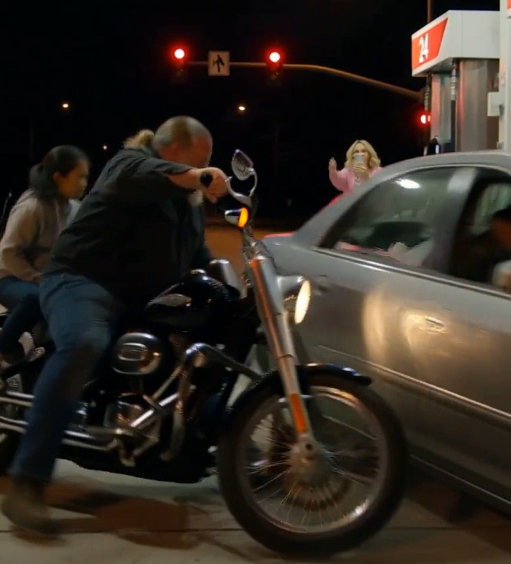
Then he looked at the spot right beside the curb where his motorcycle had been sitting at the red light. Skid marks from the cruiser’s tires curved across it. There were no skid marks from the pickup at all.
“He never braked,” Webb said slowly.
“No,” Castillo said. “He never did.”
The sergeant keyed his shoulder radio. “Dispatch, unit 12, Route 30 and Main. Single-vehicle collision into a light pole, possible DUI, driver still inside. One motorcyclist injured, wrist fracture, conscious and talking. Need two ambulances and fire.” He stood up. “Stay put, Curtis. I mean it.”
He sprinted toward the wrecked truck.
Webb lay on the sidewalk, his bike on its side next to him with its front fender crumpled and the mirror snapped off. He stared up at the red traffic light still glowing over the empty intersection.
He was thinking about another night ten years earlier, on this same road.
In March of 2016, Curtis Webb had been forty-one years old and drunk almost every night. He’d come home from the Army in 2004 with a medal, a bad back, and a thirst he couldn’t fill. By 2016, his wife had left and taken their son. He’d lost two jobs. He was riding home from a bar at two in the morning, doing seventy down Route 30, weaving between the lines.
A young deputy named Ben Castillo pulled him over a mile from this intersection.
Webb blew a 0.19, more than twice the legal limit. He’d cursed at the deputy, called him every name he could think of, and swung at the air when they cuffed him. He spent the night in a cell.
Three months later, at his sentencing, Webb asked the judge if he could say something to the arresting officer.
He’d stood up in a borrowed suit, ninety days sober, and looked at Deputy Castillo across the courtroom.
“That night you pulled me over,” Webb had said, “I wasn’t going home. I was going to the bridge over the Wabash. I’d already decided.” He swallowed. “You saved my life. I don’t know how to thank you for that.”
Castillo hadn’t said anything. He’d just nodded once, with his jaw tight.
Webb hadn’t had a drink since. That was ten years ago this month. These days he led the Thursday night meeting of the Second Gear Riders at First Methodist, forty bikers in recovery helping each other stay on the road sober. He’d been riding home from that meeting tonight.
Now Castillo came jogging back from the wrecked truck, his face grim and pale.
“Driver’s alive,” he said. “Kid’s maybe twenty-five. He reeks. Couldn’t even tell me his own name.” He crouched down beside Webb again. “I saw him in my mirror, Curtis. Coming up from behind at seventy-five, maybe eighty. Dead straight at you. No brake lights, nothing. I didn’t have time to hit the siren. I didn’t have time for anything.”
“So you hit me first,” Webb said quietly.
“So I hit you first.”
Across the street, the woman in the pink hoodie was still standing at the gas pumps, staring at her phone and typing fast.
Webb didn’t think anything of it until 3:20 a.m. He was in a curtained bay in the emergency room, with his wrist in a temporary splint, when the night nurse came in, glanced at him, and froze.
“Oh,” she said. “You’re the guy.”
She turned her phone toward him. On the screen was a video, already shared four hundred thousand times.
The headline said: COP DELIBERATELY RAMS BIKER AT RED LIGHT.
Part 3
The video was fourteen seconds long.
It showed the cruiser swerving into the motorcycle and Webb spilling onto the curb. It showed a woman screaming that he’d done it on purpose, and the officer jumping out and pinning Webb to the ground.
Then it ended.
It cut off one second before the pickup came into the frame.
By morning, it had six million views. It had been reposted by a dozen national accounts, a celebrity, and two activist groups. By noon, a protest was being organized outside the Harmon Ridge sheriff’s office for Saturday afternoon. People were posting Ben Castillo’s name, his badge number, and a photo of his house.
The original upload came from an account called TruthOnWheels. It had been created that night.
Webb watched the comments scroll past on the nurse’s phone, then on his own when they finally brought it to him. Psycho cop. Lock him up. This is attempted murder. Look how he holds him down.
At 9 a.m., the sheriff’s department announced that Sergeant Benjamin Castillo had been placed on administrative leave pending an internal investigation.
At 10 a.m., a TV crew from Indianapolis found Webb’s room. A young reporter with perfect hair asked him, gently, how it felt to be the victim of police brutality.
“I wasn’t a victim of anything,” Webb said. “He saved my life. There was a drunk in a pickup—”
The reporter nodded sympathetically and turned to her cameraman.
On the noon news, they ran four seconds of it: I wasn’t a victim of anything. Then the anchor added, The motorcyclist, still visibly shaken, appeared to be in shock.
Webb threw the remote across the room with his good hand.
That afternoon, the sheriff released a short statement. The department is aware of the video circulating online. The patrol vehicle’s dashcam footage is under review and will not be released at this time due to the ongoing investigation.
Webb read it three times.
“Why the hell not?” he muttered. “Release it. It shows everything.”
Nobody answered him.
Four of the Second Gear Riders came by that evening: Tommy Ruiz, a welder with nine years sober, and three others. They stood around his bed with their helmets under their arms and shook their heads at the TV.
“They’re saying the pickup swerved to avoid the cop,” Tommy said. “That the cop caused the whole wreck.”
“That’s a lie.”
“I know it’s a lie, Deacon. But it’s the lie with six million views.”
At 7:40 p.m., Webb’s phone rang. The number was blocked.
“Mr. Webb?” said a smooth, warm man’s voice. “My name is Grant Whitley. I’m an attorney. I represent the family of the young man who was driving the pickup truck last night.” He paused. “We’d like to help you with your lawsuit.”
Part 4
Grant Whitley came to the hospital the next morning in a charcoal suit with a leather portfolio and a box of pastries nobody touched.
He was friendly and patient, and he talked to Webb as if they were old friends.
“The young man driving that truck is Brayden Cole,” Whitley said. “He’s twenty-four. His father is Richard Cole. You may know the name.”
Webb did. Everybody in the county knew it. Cole Motors had three car dealerships off Route 30, a billboard on every highway exit, and Richard Cole’s smiling face on all of them. He’d also been a county commissioner for eight years, and he chaired the committee that set the sheriff’s department budget.
“Brayden made a terrible mistake,” Whitley said. “He’s devastated. But the family believes, and frankly so do I, that the officer’s reckless maneuver caused this entire incident. Brayden swerved to avoid the cruiser and lost control.”
“Brayden,” Webb said evenly, “never touched his brakes.”
Whitley smiled patiently and opened his portfolio.
“The Cole family is prepared to cover all your medical expenses. And to offer you two hundred and fifty thousand dollars to support a civil claim against the sheriff’s department for excessive force. All we need is a statement from you describing what you experienced: an officer swerving into you without warning while you were stopped legally at a red light.”
He slid a typed statement across the tray table. It was already written, with Webb’s name at the bottom.
Webb read it. Every word was technically true, and the whole thing was a lie.
He slid it back.
“No.”
Whitley’s smile didn’t move. “Mr. Webb, think carefully. Brayden blew a 0.32 at the hospital, four times the limit. If the officer is cleared, Brayden faces aggravated DUI and possibly much worse. If the officer is found at fault, the case looks very different.” He leaned in. “You’d be helping a young man who’s made one mistake avoid ruining his life.”
“I made that mistake once,” Webb said. “A cop arrested me. Best thing that ever happened to me.”
Whitley’s smile finally slipped.
“I’d encourage you to reconsider,” he said, standing and closing the portfolio. “Because if you’re going to be a witness for the officer, we’ll have to look at your credibility. And you have a DUI history yourself, don’t you, Mr. Webb?”
He left the pastries.
The next morning, a local news site ran a new story: Biker in Viral Police Video Has Prior DUI Arrest — By Same Officer. Below it was a quote from an anonymous source close to the investigation. It suggested the incident might have been the result of a long-standing personal grudge between Castillo and Webb.
Webb’s ex-wife texted him for the first time in three years. Are you drinking again?
Three Second Gear Riders called asking if they should skip Thursday’s meeting so the group wouldn’t get dragged in. The church pastor called to say some congregation members were uncomfortable.
Webb sat alone in his hospital room with his arm in a fresh cast. For the first time in a long time, he could almost taste whiskey.
He was staring at the ceiling, counting ceiling tiles to keep his mind off it, when someone knocked softly on the door.
It was a small Asian-American woman in a raincoat. A skinny twelve-year-old girl in an oversized gray hoodie stood beside her, clutching a phone in both hands.
“Mr. Webb?” the woman said. “My name is Mei Chen. We were in the car behind you at the light.” She put a hand on the girl’s shoulder. “My daughter has something you need to see.”
Part 5
Riley Chen was twelve, wore glasses with purple frames, and had the serious face of a kid who has rehearsed what she’s going to say.
“I wasn’t supposed to be filming,” she said. “I was just bored. Mom was driving us home from the airport, and I was taking a time-lapse of the traffic light because it looked cool.”
She held out her phone.
Webb took it with his good hand and pressed play.
The video was shot through the windshield of the Chens’ sedan, from directly behind the intersection. Webb saw himself at the red light from behind, boots down on the bike. He saw the cruiser roll up on his right.
Then, in the upper corner of the frame, far behind them all, he saw a pair of headlights. They were growing fast.
He saw the cruiser jerk sideways and his own bike go over. Two seconds later, the pickup filled the whole screen. It screamed past the Chens’ car so close the camera shook, blew through the red light right where the motorcycle had been, and disappeared down the road toward the pole.
You could hear Riley scream on the recording. You could hear the crash.
It was forty-one seconds, unbroken and uncut.
Webb watched it twice and then handed the phone back very carefully, as if it might break.
“Why didn’t you post this?” he asked quietly.
“Mom said we shouldn’t get involved,” Riley said, glancing at her mother. “But then I saw the news say you guys hated each other and the police officer did it on purpose. That’s not what happened.” Her chin went up. “I watched him save you. I saw his face.”
Mei Chen nodded. “We called the sheriff’s office twice. They said they’d note it. Nobody called back.”
“There’s something else,” Riley said. She swiped to a still photo she’d zoomed in on, grainy but clear. It showed the gas station a few seconds after the crash. A woman in a pink hoodie was holding up her phone. Beside her stood a man who’d been filming from the next pump. He wore a navy polo shirt with a small embroidered logo on the chest.
“That’s the guy who uploaded the short video,” Riley said. “The TruthOnWheels one. You can see in his video that it’s shot from the next pump over. And look at his shirt.”
Webb squinted. The embroidered logo was small, but he’d seen it on a hundred billboards.
Cole Motors.
“That’s Nick Price,” Mei said quietly. “He’s the sales manager at the Route 30 dealership. He sold my sister a car last year.”
Webb sat back slowly against the pillows.
So that was how it had gone. Brayden Cole’s own father’s employee had been at the gas station by sheer coincidence, or maybe not. Within minutes, he’d seen whose truck was wrapped around that pole. He’d cut his video one second before the pickup appeared and posted it from a brand-new account before the ambulances even arrived.
“We need the dashcam,” Webb said. “Castillo’s dashcam shows the mirror. Shows everything.”
Mei frowned. “Who has it?”
At that moment Webb’s phone buzzed. It was a number he’d saved ten years ago and never once called.
Ben Castillo.
“Curtis.” The sergeant’s voice was low and exhausted. “I’m not supposed to be calling you. But you should know something. The sheriff’s sitting on my dashcam. Won’t release it. Richard Cole controls the department’s budget.”
Part 6
Castillo lived in a small brick ranch house on the west side of town, with a basketball hoop over the garage and a Little League schedule stuck to the refrigerator with a magnet. Webb drove over that night in Tommy’s truck with his arm in a sling.
Somebody had spray-painted a word on Castillo’s mailbox. His wife had tried to scrub it off.
Castillo opened the door in a gray T-shirt and sweatpants. He looked ten years older than he had at the intersection.
They sat at his kitchen table. His two kids were asleep down the hall. His wife, Sofia, made coffee without saying a word and then left them alone.
“I’m sorry about your bike,” Castillo said finally.
“Bike’ll get fixed.”
“I’m sorry about the wrist.”
“Wrist’ll heal.” Webb turned his coffee mug in his good hand. “You did right, Ben.”
Castillo rubbed his face with both hands. “Six million people say I tried to kill you.”
“Six million people saw fourteen seconds.”
Castillo got up without a word and went down the hall. When he came back, he had his wallet. He opened it, slid something out from behind his driver’s license, and laid it on the table.
It was a small square of lined notebook paper, soft and yellow with age and folded into quarters. Webb unfolded it.
It was in his own handwriting, shakier than it was now. He’d written it in a holding room at the county courthouse ten years ago, with the stub of a pencil a bailiff had lent him.
Deputy Castillo — You saved my life. I’m going to make it worth it. — C. Webb
“You kept this,” Webb said.
“Ten years. Every shift.” Castillo’s voice was rough. “Some nights in this job, you think nothing you do matters. That you’re just cleaning up messes that’ll happen again tomorrow. On those nights I take it out and read it.”
Webb didn’t say anything. He reached across with his good hand and pushed up the left sleeve of his henley, past the cast.
On the inside of his forearm was a small, neat tattoo: a number and a date.
417 — 3·14·16.
Castillo stared at it.
“That’s my badge number,” he said slowly.
“Got it the day I hit one year sober. 3-14-16 is the night you pulled me over.” Webb rolled his sleeve back down. “Every guy in Second Gear knows what it means. I tell the new ones at every meeting. Somebody stopped me once. That’s why I’m still here.”
They sat there for a long time in Castillo’s small kitchen. The refrigerator hummed.
Then Castillo’s phone buzzed on the table. He looked at the screen and frowned.
“Deputy Chief Vaughn,” he said. He put it on speaker.
“Ben.” Teresa Vaughn’s voice was clipped and quiet, the voice of someone calling from her car. “I’m going to say this once. The sheriff’s been ordered by Commissioner Cole’s office to keep the dashcam sealed until after the county board meets Thursday night. Cole is introducing a resolution demanding your termination for cause.” She paused. “I’ve watched that footage four times. I’m done sitting on it.”
Castillo closed his eyes.
“Thursday night,” Vaughn said. “Seven o’clock, county building. I’ll bring the drive.”
Part 7
The Harmon Ridge County Board chambers held a hundred and twenty people. By 6:45 on Thursday night, there were nearly four hundred, crowding the aisles and the hallway and spilling onto the front steps.
Half of them had come to see a dirty cop fired. Some were carrying signs.
Commissioner Richard Cole stood at the podium in a navy suit and a flag pin. He was silver-haired and tanned, the face from the billboards. Behind him, his attorney Grant Whitley sat at a table with a stack of folders.
“Our community saw something last week that shook every one of us,” Cole said gravely. “An officer of the law used his vehicle as a weapon against a citizen stopped peacefully at a red light. My own son was gravely injured in the chaos that followed. Tonight, I’m asking this board for a resolution demanding Sergeant Castillo’s immediate termination for cause.”
Applause rippled through part of the room.
That was when the back doors opened.
Forty men and women in black leather filed in silently: the Second Gear Riders. Every one of them had a small patch of a gear with a sunrise on the front of their jackets. They lined the back wall shoulder to shoulder and stood there without a word.
Curtis Webb walked in last with his arm in a sling.
Beside him was a twelve-year-old girl in an oversized gray hoodie, holding her mother’s hand.
The board chair, an older woman named Marjorie Ellison, peered over her glasses. “Mr. Webb. You’re the motorcyclist. Do you wish to speak?”
“Yes, ma’am. But I think she should go first.”
Riley Chen walked to the podium on shaking legs. She plugged her phone into the chamber’s screen.
“I was in the car right behind him,” she said into the microphone, her voice small. “I didn’t cut anything.”
The room watched it: forty-one seconds. The red light, the headlights growing in the corner, the cruiser’s swerve. Then the pickup filled the screen, blowing through the light where the motorcycle had been, and the crash.
Somebody in the crowd said oh my God out loud. A woman holding a sign slowly lowered it.
Then Deputy Chief Teresa Vaughn stood up from the front row in uniform and walked to the clerk’s table with a small black hard drive.
“This is unit 12’s dashcam,” she said. “It records forward and rear-facing. I’m releasing it tonight under my own authority, and I’ll answer to the sheriff for it.”
The rear camera showed the empty road behind the cruiser, and the headlights coming fast. The speed overlay from the cruiser’s radar was clear in the corner: 77 MPH. You could hear Castillo’s voice on the audio, sharp and panicked: No — no, no, no — Then came the hard swerve, and then the truck screaming past where Webb had been.
The room was silent.
Grant Whitley stood up quickly. “That footage is subject to interpretation. My client’s son swerved to avoid—”
“His truck’s event data recorder says otherwise, counselor.” Vaughn held up a printout. “Seventy-seven miles per hour. Zero brake application. Zero steering input. He never even saw the light.”
Then Riley spoke again into the microphone, quieter.
“The man who posted the short video works at Mr. Cole’s car dealership.”
She put up the still from her phone. It showed the man at the gas pump with the logo on his chest. Somebody in the crowd recognized him and said his name out loud.
Richard Cole’s tan face had gone gray. “I had no knowledge of any of that,” he said. “None whatsoever.”
But the room had already turned.
The resolution was withdrawn. Before the meeting ended, Marjorie Ellison read a motion from the floor. It referred Nick Price and Grant Whitley’s conduct to the county prosecutor and called for Commissioner Cole to step down from the budget committee pending an ethics review. It passed nine to zero, with one abstention: Cole himself.
The sheriff, who’d been sitting silently in the second row all night, stood up. He walked to the podium and announced that Sergeant Benjamin Castillo was reinstated to full duty, effective immediately.
The room exploded.
Through all of it, Webb stood quietly at the back wall with his sober riders. When the noise finally died down, he walked up the center aisle to the podium. He didn’t need a speech. He looked out across the room until he found Ben Castillo standing in the corner in plain clothes, his wife’s hand in his.
“Ten years ago, that man arrested me for drunk driving,” Webb said. “I was on my way to end my life. That was the first time he saved me.”
He held up his cast.
“Last Friday was the second.”
Part 8
Richard Cole resigned from the county board two weeks later. In June, he sold the dealerships. Brayden Cole pleaded guilty to aggravated drunk driving and was sentenced to three years. Nick Price was fired and charged with filing a false police report after his own text messages surfaced: Cutting it before the truck. Mr. C will take care of me. Grant Whitley faced a bar complaint and quietly left the state.
The woman in the pink hoodie, a dental assistant named Donna Pierce, called Ben Castillo personally. She apologized and cried on the phone for ten minutes. He told her she’d been trying to protect a stranger and that it was a good instinct. He just asked her to wait two more seconds next time.
The sheriff’s department gave Riley Chen a certificate of commendation and a junior deputy badge. She wears it on her backpack.
Webb’s bike was rebuilt by the Second Gear Riders over three Saturdays in Tommy Ruiz’s garage. They straightened the frame, replaced the fork, and put on a new front fender. But Webb asked them to leave one thing: the long, deep dent in the right side of the gas tank, where a sheriff’s cruiser had hit it at midnight in March.
The county replaced the cruiser’s fender. Castillo asked them to leave the scrape on the door.
In April, Webb and Castillo filmed a video together, standing side by side at the intersection of Route 30 and Main. The dented motorcycle stood behind them on one side, and the scraped cruiser on the other. Webb wore his leather jacket with his arm still in a brace. Castillo wore his uniform.
They didn’t make a speech. Webb looked into the camera and said one sentence.
“This is the second time he’s saved my life.”
Then Castillo looked into the camera.
“The first time, I arrested him for drunk driving. The second time, a drunk driver almost killed him. Don’t make either of us do this again.”
The video was viewed forty-one million times in two weeks, far more than the fourteen-second clip.
Now there’s a billboard on Route 30, on the same exit where Cole Motors used to be. It shows a photograph of a dented black motorcycle and a scraped sheriff’s cruiser parked side by side under a red traffic light. Underneath, in plain white letters, it says: TWO MACHINES. ONE DRUNK DRIVER. DON’T MAKE HIM SAVE YOU. Webb and Castillo have taken the campaign to forty-two high schools across Indiana.
There’s one more thing, and it happened on a Thursday night in October.
The Second Gear Riders were setting up folding chairs in the basement at First Methodist. The coffee was brewing, and Webb was at the front table with the sign-in sheet. Then the basement door creaked open.
A thin young man stood at the bottom of the stairs in a gray sweatshirt with an ankle monitor showing under his jeans. He’d been released to a supervised recovery program while he served his sentence. He looked terrified.
It was Brayden Cole.
The whole room went still. Forty bikers turned to look at him. Tommy Ruiz half stood.
Webb set down his pen. He picked up a paper cup, filled it with coffee, and walked across the basement. He handed it to the young man whose truck had almost killed him seven months earlier.
“First night’s the hardest,” Webb said. “Sit wherever you want.”
Brayden took the cup in shaking hands. He sat down in the back row. He came back the next Thursday too.
At the end of that meeting, after everyone else had gone, Webb drove across town to a small brick ranch house with a basketball hoop over the garage and knocked on the door.
When Ben Castillo opened it, Webb held out his hand. In his palm was a small bronze coin, worn smooth. It was his ten-year sobriety chip.
“Got this last month,” Webb said. “Figured half of it’s yours.”
Castillo stared at it. Then he took it and closed his fist around it, and neither of them said anything for a long time.
He carries it in his wallet now, behind his driver’s license, next to a yellowed square of notebook paper.
“The whole internet said a cop rammed a biker on purpose,” Webb says, when people ask about the dent in his tank. “Behind me was a drunk doing seventy-seven with no brakes. Ten years ago, that same cop arrested me for driving drunk. That was the first time he saved my life.”
Six million people saw a big tattooed biker on the ground under a cop’s hand, and they decided they knew the story. The edited clip spread a lot faster than the full forty-one seconds.
The truth came from a twelve-year-old who didn’t cut anything and from a man in leather who refused a quarter of a million dollars. It came from two old scars, a dented tank and a scraped door, sitting side by side.
If this story meant something to you, follow our page for more stories like this. And if you’ve been drinking, hand somebody your keys tonight.