Part 2: A Developer Mocked The Biker Who Showed Up To An Old Widow’s Farm Auction—Then 50 Motorcycles Rolled In Behind Him And Every Bidder Walked Away.
Part 2
One by one, the paddles went down.
Mabel watched them from the porch, gripping her cane so tight her knuckles ached. A banker from Ames was first. Then came the Brandt brothers, who had wanted her north pasture for twenty years. Then a soybean company man in a fancy truck. They didn’t argue or make a scene. They just looked at the silent wall of men in black leather standing in the snow, lowered their paddles, and walked away.
Only Garrett Stanton’s paddle was still up.
Mabel saw her nephew Darren lean close and whisper something urgently into Stanton’s ear. Stanton’s jaw tightened. He glared at the gray-bearded biker for a long moment.
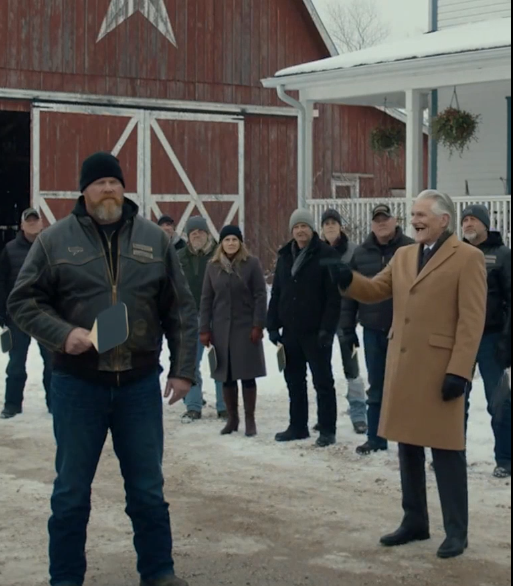
Then he slowly lowered his paddle too.
“Forty-eight thousand six hundred, going once,” the auctioneer called into the cold. His voice had gone a little uncertain. “Going twice.” He looked around the nearly empty yard. “Sold. To bidder twenty-two.”
The gavel came down on the hay wagon with a dull wooden thunk.
Mabel felt her knees go weak. She sat down on the porch bench before they gave out.
It was done. Sixty years were gone in less than ten minutes, and her farm belonged to a stranger with a gray beard.
She had come to the Hutchins place in 1966 as a twenty-year-old bride. Her husband, Walter, had been a quiet man with big hands who grew corn and soybeans and raised Holsteins. They never had children of their own. It was just the two of them, the farm, and the big red barn Walter’s grandfather built in 1908. In 1971, Mabel had painted a quilt-pattern star above the loft door, red and white and blue, because she thought the barn looked lonely.
Walter died in the winter of 2003. Mabel ran the farm alone after that. She leased out the fields, kept a few chickens, and paid her taxes every spring, until the stroke three years ago.
After the stroke, her nephew Darren had taken over her finances. He said it was easier. He handled the bank, the bills, and the property taxes. Mabel signed the power of attorney papers from her hospital bed without reading them.
Two months ago, a letter came from the county. Three years of unpaid property taxes, plus penalties, totaled $48,600. The farm would be auctioned on January 18th.
Mabel didn’t understand. She had called Darren. He said he must have missed a few payments, and he was so sorry, Aunt Mabel. There was nothing he could do. Maybe it was time she went to the nice care home in Ames anyway.
Now Mabel sat on her porch in the snow and watched the gray-bearded stranger walk slowly toward her house.
The fifty men in leather stayed where they were in the yard, silent. The man came up the porch steps alone. He took off his black knit cap and held it against his chest.
Up close, he was enormous. His beard was red going gray, and there were old faded tattoos on his thick forearms. His eyes were pale blue and tired.
“Mrs. Hutchins,” he said quietly. “My name’s Ben Sorensen.”
Mabel stared at him. The name meant nothing to her.
He reached into the inside pocket of his leather jacket and pulled out a long envelope. He held it out to her.
“I bought this farm,” he said. “I’d like to give it back to you.”
Part 3
Mabel didn’t take the envelope.
She looked at it, then at him, then out at the fifty silent men in her yard.
“I don’t understand,” she said. “Do I know you, young man?”
“Twenty years ago, you did,” Ben said. “For about three days.”
She searched his face and found nothing. She was eighty years old, and since the stroke, some things came back and some things didn’t.
Ben didn’t seem surprised. He just nodded gently.
“Would you walk out to the barn with me, ma’am? It won’t take long.”
Darren had come halfway up the porch steps, his face red. “Aunt Mabel, don’t go anywhere with this man. You don’t know who he is.”
Ben didn’t look at Darren. He just held out his arm to Mabel, the way a grandson might.
After a long moment, she took it.
They walked across the snowy yard together, slowly, because of her cane. The fifty bikers parted to let them pass and closed behind them. Ben swung open the big barn door. Inside, it smelled the way it always had, of hay and old wood and cold. Winter light came through the gaps in the walls.
Ben led her to the center of the barn and stopped beneath the thick oak crossbeam that ran the width of the loft.
“Look up, ma’am.”
Mabel looked up.
There, carved into the old dark wood above her head, were words she had seen nearly every morning for twenty years. She had looked at them every time she came in to feed the chickens or fetch a bucket, and she had never known who put them there.
The letters were deep and uneven, cut with a pocketknife.
BEN SORENSEN — JAN 2006
SOMEDAY I’LL REPAY YOU
Mabel stood very still.
“I always wondered,” she whispered. “I thought maybe Walter’s father carved it. Or some hired hand. I used to make up stories about who it was.”
She turned and looked at the big man beside her. She really looked at him this time.
Then something shifted in her eyes, like a door opening.
“The blizzard,” she said slowly. “The boy in the ditch.”
Ben’s jaw tightened. He nodded.
It had been January of 2006, the worst blizzard in western Iowa in thirty years. Ben Sorensen was twenty-six years old, broke, and riding a worn-out motorcycle from Denver to Omaha in winter. He was trying to get to his mother’s funeral. He hadn’t been home in six years. He’d left after a bad fight with his father and never called.
The snow came sideways out of nowhere. Around ten p.m., two miles outside Crane Falls, his bike slid off County Road 9 into a ditch.
He walked through the drifts toward the only light he could see. It was a farmhouse with a red barn and a star painted over the loft door.
A sixty-year-old widow answered the door in her nightgown with a flashlight. She took one look at the half-frozen kid in leather on her porch. She didn’t ask his name or where he was going, or whether he was dangerous.
She said, “You’ll freeze. Barn’s warmer than the truck. I’ll bring you blankets and soup.”
She made him a bed in the hay with three quilts and brought out a pot of beef barley soup. The next morning, she pulled his motorcycle out of the ditch with her late husband’s old tractor.
He saw that her barn roof was failing, with whole sections of tin peeling back in the wind. So he stayed three days and fixed it.
On the last night, alone in the barn, he took out his pocketknife and carved those words into the beam.
Then he rode away and never came back.
“Why didn’t you ever come back?” Mabel whispered.
Ben looked up at the carving for a long time.
“Because I didn’t have anything to repay you with, ma’am,” he said. “Not for a long time.”
Part 4
They sat in Mabel’s kitchen while the fifty bikers stood outside in the snow. Ben had told them they could go, but they wouldn’t. Mabel made coffee with shaking hands, and Ben told her the rest.
He’d made it to Omaha a day late and missed his mother’s funeral. He stood at her grave in the snow and realized he had nothing to show for twenty-six years. He had no job, no money, and a father who wouldn’t speak to him. He had a drinking problem he hadn’t admitted to anyone.
“You didn’t ask me who I was,” Ben said. “Didn’t ask what I’d done or where I’d been. You just brought me soup. Nobody’d done anything like that for me in a long time.”
He’d gone to a meeting in a church basement in Omaha the following week. He’d been sober ever since.
He learned to weld at a community college. He slept on a friend’s couch and saved every dime. Ten years ago he opened his own fabrication shop in Sioux City. Now it had eleven employees and contracts across three states. He joined a riding club, the Prairie Wolves, mostly veterans and tradesmen.
“I meant to come back every year,” he said. “But first I was ashamed, and then I was busy, and then it seemed like too much time had gone by.” He looked down at his coffee. “Then two weeks ago a guy at my shop showed me a public notice in the paper. Tax auction. Hutchins farm, Crane Falls.”
He’d recognized the address immediately.
He made one phone call to the president of the Prairie Wolves. Fifty riders said yes.
“We didn’t come to scare anybody,” Ben said quietly. “We came so the folks bidding would understand this farm already had somebody looking out for it.”
He pushed the envelope across the table. It was the deed in Mabel’s name, signed and transferred, along with a receipt from the county treasurer for every dollar of back taxes and penalties.
Mabel couldn’t speak.
She reached across the table and covered Ben’s big scarred hand with her small wrinkled one.
That night, after the bikers rode home and Ben drove back to his motel in town, Mabel sat alone in her quiet kitchen. For the first time in two months, she slept.
Three days later, a sheriff’s deputy knocked on her door.
He was polite and young and visibly uncomfortable. He handed her a thick packet of papers.
Darren had filed an emergency petition in Pottawattamie County District Court. He asked the court to declare Mabel Hutchins mentally incompetent due to her stroke and to void the farm auction sale. His petition claimed that Ben Sorensen and members of a motorcycle gang had used intimidation and coercion to manipulate a vulnerable, confused elderly woman. It said they had scared off legitimate bidders, and that the transfer of the deed back to Mabel was part of a scheme to gain control of her property.
He asked the court to appoint him as her legal guardian.
Mabel read it at her kitchen table three times. Her hands shook so badly she could barely hold the pages.
Then she called the number Ben had left on her refrigerator.
“He says I’m confused,” she whispered into the phone. “He says I don’t know what I’m doing. Ben, what if he’s right?”
Part 5
Ben was at her farmhouse by nine the next morning.
He brought a lawyer: Margaret Olsen, a sharp-eyed sixty-year-old attorney from Council Bluffs who handled elder law cases. Her own mother had lost a house to a son-in-law years ago, and she didn’t charge Mabel a cent.
Margaret spread Darren’s petition across Mabel’s kitchen table and read it twice with a red pen.
“He’s going to argue you can’t manage your own affairs,” she said. “That you didn’t understand the deed transfer and that these bikers took advantage of you.” She looked up. “But here’s what I want to know. Mrs. Hutchins, why did your taxes go unpaid for three years?”
Mabel shook her head helplessly. “Darren handled it. He said he paid them.”
“Did you ever see a tax bill? A notice? Anything from the county?”
“No,” Mabel said slowly. “Nothing. Not one letter in three years.” She frowned. “I thought it was strange. I used to get so much mail. And then I didn’t get much of anything.”
Margaret and Ben exchanged a look.
That afternoon, an old green pickup truck came rattling up the lane. A gray-haired woman in a postal service jacket climbed out with a bundle of mail. It was Ruby Jensen, sixty-four, the rural mail carrier who had driven Route 3 out of Crane Falls for thirty-one years.
She stopped at the porch when she saw the lawyer and the big biker.
“Mabel, honey,” Ruby said, “is everything all right? I heard about the auction. I’ve been sick about it.”
“Ruby,” Margaret said carefully, “has anything unusual happened with Mrs. Hutchins’s mail in the last few years?”
Ruby’s face changed.
“I’ve been wanting to say something for a long time,” she said. “Three years ago, right after Mabel’s stroke, a mail forwarding order came through. Everything from the county treasurer, the bank, and the assessor’s office was to be forwarded to a P.O. box in Council Bluffs.” She shook her head. “It was signed by Darren Hutchins, under the power of attorney. I thought it was odd. But it was legal, so I did it.”
Mabel went pale.
“He took my mail,” she whispered.
“He took your tax bills,” Margaret said quietly. “So you’d never know they weren’t being paid.”
That night, Margaret subpoenaed the bank records for the account Darren controlled under the power of attorney. They came back in two days.
Mabel’s lease income from her fields came to about sixteen thousand dollars a year. It had all been deposited into the account Darren managed. And for three years, every dollar earmarked for property taxes had been withdrawn in cash.
The withdrawals matched almost exactly with deposits Darren made into his own account at a casino in Council Bluffs.
There was one more thing.
In Darren’s phone records, which Margaret obtained through the court, there were forty-three calls and texts over the past year to one number. It belonged to Garrett Stanton, the land developer from Des Moines.
The last text was sent the morning of the auction, from Darren to Stanton.
Bikers or no bikers, I’ll void it in court. She’s senile, I’ve got POA. You’ll get the land, I’ll get my 150. Same deal.
Margaret Olsen set the printout down on Mabel’s kitchen table.
“Your nephew didn’t just forget to pay your taxes, Mrs. Hutchins,” she said gently. “He sold you out.”
Part 6
Mabel didn’t cry when she read the text. She sat at her kitchen table looking at it for a long time with her hands folded. Then she got up, walked to the window, and looked out at the red barn under the snow.
“Walter always said that boy would come to no good,” she said quietly. “I told him he was too hard on him. I paid for Darren’s braces. His truck when he turned sixteen. I paid his rent the year he lost his job.” She turned around. “He was going to put me in a home and sell my husband’s land for a hundred and fifty thousand dollars.”
Ben said nothing.
“And he’s telling a judge that you are the one taking advantage of me.”
“Yes, ma’am.”
Mabel looked at him for a long moment.
“Ben,” she said. “That tattoo on your arm. The star. I noticed it in the barn. Is that what I think it is?”
Ben looked down at his left forearm. He pushed up the sleeve of his thermal shirt.
On the inside of his arm, faded with time, was a small tattoo of an eight-pointed quilt star, red and white and blue. It matched the star Mabel had painted above her barn loft door in 1971 exactly.
“Got it in Omaha a month after the blizzard,” Ben said. “Week after my first meeting. Didn’t have a picture of you. Didn’t even know your name for sure, just Mrs. Hutchins from the mailbox.” He touched the faded star. “So I got the barn star. Figured I’d always know where I was headed if I ever lost my way.”
Mabel sat back down. She reached out and touched the tattoo with one trembling finger.
“Twenty years,” she whispered. “You carried my barn on your arm for twenty years.”
“Yes, ma’am.”
She was quiet for a while. Then her chin came up, and something steely came into her eyes that Ben hadn’t seen before.
“When’s the hearing?” she asked Margaret.
“Next Thursday. Pottawattamie County Courthouse, ten a.m.”
“Then I’ll be there,” Mabel said. “I’m going to tell that judge exactly how confused I am.”
Ben stood up from the table and walked out onto the porch. He pulled out his phone and made a call.
Inside, Mabel heard him say only one sentence before he hung up.
“Thursday morning. Council Bluffs. Everybody.”
Part 7
The Pottawattamie County Courthouse was a gray stone building in Council Bluffs. Courtroom 2B usually held a handful of people for a guardianship hearing.
On Thursday morning, it was full.
The Prairie Wolves came first: fifty riders in leather, every one with a wolf-and-star patch on the back of their jacket. They filled the back three rows of the courtroom and stood along the walls, silent, arms folded. Behind them came neighbors from Crane Falls. There were farmers who’d known Mabel for sixty years, the pastor from First Lutheran, the Brandt brothers, and Ruby Jensen in her postal jacket.
Darren Hutchins sat at the petitioner’s table in a borrowed suit beside his attorney. Garrett Stanton sat in the front row behind him in his camel overcoat.
Judge Helen Marsh, gray-haired and unhurried, looked out over the packed courtroom over her reading glasses.
“Well,” she said dryly. “This is more people than I usually see for a guardianship petition.”
Darren’s attorney stood. “Your Honor, this is a tragic case. Mrs. Hutchins is eighty years old and suffered a stroke three years ago. She has significant memory deficits. Last month, a group of bikers led by a stranger named Benjamin Sorensen used intimidation to drive away legitimate bidders and take control of her property. My client, her only living relative, simply wants to protect her.”
Judge Marsh turned to the respondent’s table.
“Mrs. Hutchins. Would you like to respond?”
Mabel stood up slowly with her cane, refusing Margaret’s hand.
“Yes, Your Honor, I would.”
She told it plainly: the blizzard, the boy in the ditch, the soup, the barn roof, the carving on the beam. She told the judge she’d seen those words every morning for twenty years without knowing whose they were.
“The man my nephew calls a stranger,” Mabel said, “is the only person in twenty years who ever came back to say thank you.”
Then Margaret Olsen stood and laid out the evidence, one piece at a time.
She showed the mail forwarding order signed by Darren Hutchins, rerouting every tax bill to a P.O. box in Council Bluffs. Ruby Jensen testified to it in her postal jacket, her voice shaking but clear. Margaret showed three years of bank records with every tax dollar withdrawn in cash, and matching deposits at a casino.
Then she handed the judge a printout of the text message from Darren’s phone, sent the morning of the auction.
Bikers or no bikers, I’ll void it in court. She’s senile, I’ve got POA. You’ll get the land, I’ll get my 150. Same deal.
The courtroom was dead silent.
Judge Marsh read the text twice. Then she slowly lifted her eyes to Garrett Stanton in the front row.
“Mr. Stanton,” she said. “Are you the recipient of this message?”
Stanton’s attorney, seated beside him, leaned over and whispered urgently. Stanton said nothing.
Darren had gone gray. “That’s… that’s out of context. She doesn’t remember things, she—”
“Mr. Hutchins,” Mabel said from across the courtroom, quietly. “I remember the braces I paid for. I remember the truck. I remember your rent in 2014.” She looked at him. “I remember everything, Darren. That’s what you didn’t count on.”
Judge Marsh took off her glasses.
“The petition is denied,” she said. “Mrs. Hutchins is clearly competent to manage her own affairs. Mr. Hutchins’s power of attorney is revoked, effective immediately. The deed transfer to Mrs. Hutchins stands. And I’m referring this matter to the county attorney for investigation of elder financial exploitation and theft.” She turned her gaze to the front row. “And possibly conspiracy.”
Two sheriff’s deputies were already moving toward the petitioner’s table.
Darren Hutchins was led out of Courtroom 2B in handcuffs. Garrett Stanton walked out quickly behind his attorney without looking at anyone.
When the courtroom finally emptied into the hallway, Mabel stood at the top of the courthouse steps in the cold wind. She looked out at fifty motorcycles lined up along the curb.
She turned to Ben.
“I need to go home,” she said. “There’s something I have to do in the barn.”
Part 8
Ben drove her home in his truck. Fifty motorcycles followed them the forty miles back to Crane Falls in a long, rumbling line through the snowy countryside.
At the farm, Mabel asked Ben to bring the stepladder from the shed.
She climbed it slowly, one rung at a time, with Ben’s huge hand steadying her back. When she reached the old oak crossbeam, she took a pocketknife from her coat. It was Walter’s old knife, which she’d kept in the kitchen drawer since 2003.
Right underneath the twenty-year-old carving, she began to cut.
It took her nearly half an hour. Her hands shook. Ben didn’t offer to help, and she didn’t ask.
When she finally climbed down, she pointed up.
Under SOMEDAY I’LL REPAY YOU were two new words, shallow and crooked, in an eighty-year-old woman’s hand:
PAID IN FULL.
Ben stood there in the barn and looked at it for a long time.
Darren Hutchins pleaded guilty to elder financial exploitation and theft that spring. He was sentenced to four years in state prison and ordered to repay every dollar. Garrett Stanton was never charged, but the story made the Des Moines papers. Three county boards canceled his development contracts within the month.
The Prairie Wolves set up a trust fund that winter, the Hutchins Farm Fund, to cover Mabel’s property taxes for the rest of her life. Every member puts in twenty dollars a month. It has never once come up short.
Every October after that, fifty bikers came to the Hutchins farm for harvest weekend. They baled hay, mended fences, and patched the barn roof. They ate Mabel’s beef barley soup at long folding tables in the yard. Ben came more often than that. He drove down from Sioux City almost every Sunday and fixed whatever was broken.
Mabel Hutchins lived on her farm for six more years. She died peacefully in her own bed in the spring of her eighty-sixth year, with Ben sitting beside her, holding her hand.
At the reading of her will, the lawyer read one paragraph twice because the room had gone so quiet.
I leave the Hutchins farm, the house, the land, and the barn to the Prairie Wolves Riding Club. My only condition is that the barn be kept open, always, as a place where anyone stranded on the road can find a warm bed and a bowl of soup. They should not be asked who they are.
The Prairie Wolves spent that summer renovating the old barn. They insulated the walls and put in a woodstove, a small kitchen, and a bathroom. They built twelve beds along the walls out of oak.
The old crossbeam is still there in the center, never touched. On one side hangs a framed photograph of an old woman on her porch with fifty bikers in leather standing behind her. On the other hangs a hand-lettered wooden sign:
MABEL’S BARN. NO QUESTIONS ASKED.
In the last four years, more than three hundred stranded travelers have slept there. There have been truckers caught in blizzards, families whose cars broke down, a runaway teenager, and a young soldier on leave. And there have been more than a few young bikers who slid off County Road 9 into a ditch on a snowy night.
Ben manages the barn now. Every winter, when the first big storm rolls in, he drives down from Sioux City. He sits up through the night by the woodstove in case anybody comes knocking.
Last January, somebody did. It was a young man about twenty-five, half frozen, in a thin leather jacket. His motorcycle was stuck in the ditch two miles down the road. He was riding home to a family he hadn’t spoken to in years.
Ben made him a bed by the woodstove. He brought him a bowl of beef barley soup and didn’t ask him a single question.
In the morning, after Ben pulled his bike out of the ditch with Walter’s old tractor, the kid stood in the barn doorway for a long time, looking up at the crossbeam.
Then he asked Ben if he could borrow a pocketknife.
“She let me sleep in her barn in a blizzard and brought me soup without asking who I was,” Ben says, when people ask about the carving. “I carved on that beam that someday I’d repay her. It took me twenty years. I showed up to that auction with fifty brothers so nobody would dare raise a paddle.”
A developer in a camel coat looked at a gray-bearded biker in the snow and saw a joke, a man who couldn’t afford a hay bale. A nephew in a puffy vest looked at his aunt and saw a payday.
The man in the leather jacket looked at an old red barn and remembered a widow who had once looked at a half-frozen stranger and seen someone worth saving.
If this story moved you, follow our page for more stories like this. And the next time someone knocks on your door on a cold night, remember Mabel.