Part 2: A Foster Boy Asked Santa to Be a Biker — The Club Answered Differently
My name is Mara Collins, and I worked nights at St. Agnes Foster Home, a brick building outside Lancaster, Pennsylvania, not far from Route 30, where trucks ran all night and the winter wind came across the fields hard enough to rattle the old windows.
I knew Caleb Turner before I knew Bear Mercer.
Caleb came to us in October with two garbage bags, one backpack, and a court file thicker than any twelve-year-old boy should have. He was quiet in the way kids get quiet when noise has never helped them. He did not slam doors. He did not steal. He did not pick fights. He studied rooms. He watched exits. He folded his socks like someone might inspect them.
He had been in six placements in four years.
Every time he started to believe a bedroom was his, somebody changed the plan.
Caleb loved motorcycles because they looked like leaving on purpose.
That was what he told me once.
I had found him at the hallway window after midnight, watching headlights move along Route 30.
“You like bikes?” I asked.
He shrugged.
“They don’t wait for people to throw them away,” he said.
That is how foster kids talk when they do not want you to hear the wound directly.
The Santa letters were supposed to be harmless. We had the kids write wishes for coats, toys, art supplies, headphones, gift cards. Donors loved that stuff. It made people feel good. Most kids knew the rules and asked for things under fifty dollars.
Caleb asked to be a biker.
Not to own a motorcycle. Not to keep one. Just to sit behind somebody for one ride and wear a vest long enough to know what it felt like to belong somewhere.
The volunteer who saw me reading the letter was a woman named Denise, a retired nurse with silver hair and a mouth that could scare paperwork into behaving. She read it over my shoulder and said, “I know somebody.”
That somebody was Bear.
I had seen the Iron Shepherds around town. You could not miss them. They filled diners with leather and engine heat. They parked outside gas stations in clumps, boots down, gloves on tanks, heads turning as one. Men like Bear did not enter places quietly. Even when they tried, the room noticed.
People said Bear had done time years ago.
They said he used to run with worse men.
They said his club had rules outsiders did not understand.
They said a lot.
What they did not say was that every December, the Iron Shepherds bought coats for kids whose foster payments did not stretch far enough. They did not say Bear kept emergency gas cards in his saddlebag for stranded single mothers. They did not say one of his brothers, Preacher, had slept in a hospital parking lot for three nights because a former club member’s grandson was having surgery and the family had nobody else.
Bikers do not advertise the soft parts.
Maybe because softness draws flies.
Maybe because some men can only survive tenderness if they hide it under leather.
When Bear came to St. Agnes the first time, two days before the ride, he did not ask to see Caleb. He asked to see the driveway, the exits, the van schedule, and the permission paperwork. He stood in our lobby with snow melting off his boots while our director tried to decide whether this was the best idea or the worst lawsuit in Pennsylvania.
Bear listened. Said little.
“Hundred miles?” she asked.
“Loop,” Bear said. “Lancaster to Columbia, down along the river, diner stop, back by four.”
“He’s twelve.”
“Then we ride like we got a twelve-year-old.”
That shut the room up.
Before he left, Bear glanced at Caleb’s letter on my desk. His face changed for half a second. Not much. Just the jaw tightening, the eyes going somewhere older.
On his left wrist, under the edge of his glove, I saw a faded hospital bracelet braided into leather.
It did not belong there.
Nothing about Bear looked like hospital bracelets.
When I looked closer, he pulled his sleeve down.
“Ride or don’t,” he said. “But don’t let the kid pack hope twice.”
That was the first time I understood the ride mattered to him too.
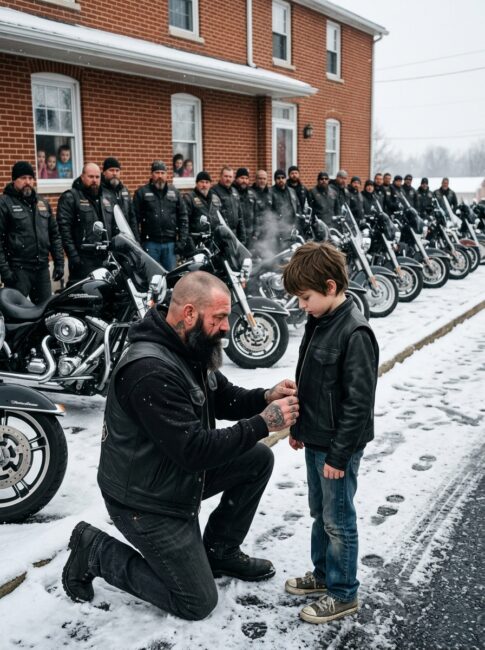
The morning of the ride, Caleb was ready before sunrise.
He had slept in jeans.
His hair was wet from the sink. His shoes were tied too tight. He stood by the lobby window wearing the child-sized black vest Bear had brought, touching the blank patch on the back every few seconds like he was checking whether it was still real.
At 8:03, the sound came over the fields.
Not one engine.
Many.
The windows trembled. Somewhere upstairs, a little boy shouted, “Thunder!” Another kid started crying. The kitchen staff stepped into the hallway. Our director looked at me like she had aged five years since breakfast.
The Iron Shepherds rolled in slow.
Nineteen Harleys and one trike for safety. No stunts. No showing off. Just a low V-twin rumble moving through the cold, exhaust fogging white, headlights cutting through thin snow.
Bear was first.
He parked, killed the engine, and after that the loudest sound was cooling metal ticking under the gray sky.
Caleb walked out with me beside him.
He stopped on the top step.
The bikers looked terrifying. I will not soften that. They were big men and hard women in black leather, with tattoos on necks and hands, old scars, patches, chains, boots, winter breath, and eyes that made you wonder what they had survived.
Caleb whispered, “They came.”
Bear heard him.
“Letter had an address,” he said.
Simple. Heavy.
A woman rider named June stepped forward. She was white American, early fifties, short gray hair, tattooed arms, and a voice like a diner waitress who had seen everything and still refilled coffee. She held out a helmet.
“Rules,” she said. “You wear this. You tap Bear twice if you need to stop. You don’t act tough. Tough gets people hurt.”
Caleb nodded so hard the helmet wobbled.
The ride began clean.
Bear put Caleb behind him, checked the boy’s gloves, checked his foot position, then checked again. His scarred hand pressed Caleb’s knee once, not affectionate exactly. More like an anchor.
“You fall asleep, I pull over,” he said.
“I won’t.”
“You might.”
“I won’t.”
Bear looked back.
“Kids lie when they’re scared.”
Caleb went quiet.
Bear added, “Men too.”
Then they rode.
I followed in the home van with June’s trike behind me and the rest of the club ahead, a line of black leather and red taillights moving west along Route 30. They rode slower than traffic wanted. Cars passed irritated. A man in a pickup honked.
Dutch, one of the older riders, lifted one hand like he was blessing the idiot and cursing him at the same time.
The first stop was a gas station outside Columbia. Caleb climbed off stiff-legged, smiling so hard it looked painful. He tried not to show how much his hands shook.
Bear saw.
He bought him hot chocolate without asking.
The second stop was a diner near the Susquehanna River, one of those places with fogged windows, vinyl booths, pie spinning in a glass case, and waitresses who call everyone hon. When the bikers walked in, conversation died.
A father pulled his teenage daughter closer.
The cashier’s hand hovered near the phone.
Bear noticed.
He always noticed.
He took the booth closest to the door and made sure Caleb sat with his back to the wall.
That was when everything went sideways.
A man in a brown coat entered the diner.
Caleb saw him and turned white.
Not pale.
White.
The hot chocolate cup slipped from his hand. It hit the table, rolled, spilled across the napkins.
Bear’s head turned.
The man in the brown coat froze too.
I knew that look. Recognition. Panic. History.
Caleb whispered, “That’s him.”
I felt the room shrink.
The man was not his father. Not exactly. His name was Martin Vale, one of Caleb’s former foster parents, a man who had looked good in home studies and bad in the memories Caleb never fully spoke out loud.
Bear stood.
Every biker in the diner shifted with him.
Leather creaked.
Boots scraped.
Chairs went silent.
For one terrible second, I thought Bear was going to cross the room and do something that would turn this Christmas ride into a headline.
His hands flexed.
His eyes went flat.
Caleb grabbed the back of Bear’s vest with both fists.
“Don’t,” the boy whispered.
And Bear stopped.
That was the false ending people would have expected: scary biker protects kid from bad man.
But that was not what happened.
Bear looked down at Caleb’s hands gripping his cut.
Then he sat back down.
Slowly.
Like sitting cost him more strength than standing.
He looked at Martin Vale and said only one thing.
“Leave.”
The man left.
Nobody followed him.
Nobody cheered.
Caleb shook so hard his teeth clicked.
Bear took the napkins, wiped the spilled chocolate, and put a fresh cup in front of him.
“Still your day,” he said.
But his own hands were trembling now.
And when his sleeve slid back, I saw that braided hospital bracelet again.
This time, Caleb saw it too.
We made it almost sixty miles before Caleb asked.
The club had stopped at an overlook above the Susquehanna, where the river moved dark and cold under a white sky. The Harleys were parked in a row, engines ticking, exhaust fading, the smell of gasoline and wet leather hanging in the air.
Caleb stood beside Bear’s bike, helmet under one arm.
“What’s that bracelet?” he asked.
Nobody spoke.
Bear looked at his wrist.
Then at June.
Then at the river.
“Old thing,” he said.
Caleb did not back off.
“From a hospital?”
Bear’s jaw worked.
“Yeah.”
“Yours?”
“No.”
The answer dropped hard.
June looked away. Dutch stared at his boots. Preacher wiped snow off his seat that did not need wiping.
Bear pulled off his glove. The bracelet was yellowed with age, cracked at the edges, braided carefully into a strip of black leather so it would not fall apart.
Printed on it was a name.
ELI MERCER.
Caleb read it.
“Who’s Eli?”
For a long time, there was only the river and the cooling pipes.
Then Bear said, “My boy.”
I thought that was the twist.
It wasn’t.
Bear had a son. Eli. Twelve years old when he died. Same age as Caleb.
The story came out in pieces because Bear did not know how to bleed in a straight line.
Eli had been in foster care.
Not because Bear did not love him.
Because Bear had been locked up.
Six years earlier, Bear was not the president of the Iron Shepherds. He was a drunk, angry mechanic with a record and a club jacket he used like armor. He got into a fight outside a bar in York. A man hit the pavement wrong. Bear went to prison.
His wife had already left. Eli went into care.
Bear wrote letters. Some came back. Some didn’t. He got sober inside, or as sober as a man can get staring at concrete and counting birthdays he missed. When he got out, he tried to find Eli.
Too late.
Eli had died of pneumonia after a foster placement failed to get him medical care in time. The facts were cleaner than the grief. Missed symptoms. Overloaded system. Nobody malicious enough for prison. Nobody innocent enough for peace.
Bear kept the hospital bracelet because it was the last proof the boy had belonged to anyone.
The club almost broke after that.
Bear wanted to burn the world down. Not poetically. Literally enough that June hid his keys and Dutch slept outside his garage for two nights. Some brothers said let him go. Some said hold him down. One prospect quit because he said the grief in that clubhouse scared him worse than violence.
Brotherhood got tested the way it always does.
Not with patches.
With ugly nights.
June finally put a stack of foster wish letters in front of Bear and said, “Pick one kid or bury yourself with him.”
Bear picked Caleb’s.
Not because it was cute.
Because Caleb was twelve.
Because Caleb wanted one day not to be moved.
Because Caleb’s letter had one line Bear could not survive reading twice:
“I don’t want presents. I want to feel like somebody would notice if I disappeared.”
Bear looked at Caleb at that overlook and said, “I noticed.”
Caleb stared at the bracelet.
Then he did something no adult had done all day.
He reached out and touched Bear’s wrist.
Not the leather.
Not the tattoo.
The bracelet.
“I’m sorry about Eli,” Caleb said.
Bear’s eyes shone.
He did not cry.
He just put his glove back on and said, “Mount up.”
But his voice cracked on the last word.
After the overlook, the ride changed.
Not on the road. The bikes still moved in formation. Bear still checked Caleb’s helmet strap. June still counted heads at every stop. Dutch still glared at every driver who came too close.
But something had shifted.
Caleb stopped pretending he wasn’t scared.
Bear stopped pretending the day was only for Caleb.
At a small gas station near Wrightsville, Caleb asked if he could buy beef jerky with the five-dollar bill he had folded in his sock. Bear said no.
Caleb’s face fell.
Then Bear walked inside and came out with two packs.
“One for you,” he said. “One for your bad decisions.”
Caleb laughed.
It startled everyone.
I don’t think any of us had heard that sound from him before. Not a polite laugh. Not a careful laugh. A real one. Short and rusty, but real.
At the diner stop on the way back, the waitress who had been scared of the bikers earlier brought out a slice of pie with a candle in it.
“It’s not his birthday,” I said.
June shrugged. “Kid asked Santa for a day. Day gets dessert.”
Caleb blew out the candle.
Bear did not sing. None of the bikers did. They just tapped the table with their knuckles until the silverware rattled like distant engines.
The blank patch on Caleb’s vest drew attention everywhere we went.
At first I thought Bear had left it blank because the boy was only visiting their world for a day.
I was wrong.
That blank patch was the seed.
Back at St. Agnes, the sun was dropping behind the bare trees. The kids crowded the windows again. Staff gathered near the door. The ride had gone a little over a hundred miles, and Caleb looked exhausted in the way children look after holding joy too tightly.
Bear helped him off the bike.
Caleb did not remove the vest.
He stood in the parking lot while the Harleys idled low around him, uncertain now that the magic was ending.
I saw it happen.
The old fear returning.
The garbage bags.
The moved bedrooms.
The adults who said “soon” and meant “maybe.”
Caleb reached for the zipper.
Bear caught his hand.
“Don’t.”
Caleb blinked.
“I have to give it back.”
“No.”
“It’s yours.”
Bear shook his head.
“Was Eli’s.”
The parking lot went silent.
Even the engines seemed lower.
Bear turned Caleb gently so we could see the back of the vest. The blank patch was not blank anymore. Sometime during the diner stop, while Caleb was in the restroom, June had sewn something onto it by hand.
Not the club’s full patch.
Not the Iron Shepherds name.
Something smaller.
A black patch with white thread:
LITTLE BROTHER
Under it, in smaller letters:
RIDE OR STAY
Caleb stared over his shoulder, trying to read it.
His mouth opened.
Nothing came out.
Bear reached into his cut and pulled out Caleb’s Santa letter. The same folded paper from the morning. He handed it to me first, maybe because he knew my hands were steadier than his.
On the back, written in black marker, were the words Bear had added.
You don’t have to ask twice.
That was the sentence.
That was what he had carried all day.
The vest. The route. The diner. The hospital bracelet. The brothers who rode not to perform kindness but to keep their president from drowning in December.
It all made sense then.
Bear had not shown up because a foster boy wanted to play biker.
He had shown up because a dead son had never gotten picked up.
Because one twelve-year-old boy had disappeared into a system, and another twelve-year-old boy had written Santa to ask if anybody would notice him at all.
Bear crouched in front of Caleb. His knees cracked. His leather cut creaked. The big scar on his cheek pulled tight when he swallowed.
“You asked for one day,” Bear said.
Caleb nodded, crying now and trying hard not to.
Bear put one heavy hand on the boy’s shoulder.
“You don’t need to ask,” he said. “You’re already a brother.”
Caleb broke.
Not loud. Not dramatic.
He just folded forward into Bear’s chest like a kid who had been standing too long.
Bear froze for half a second.
Then his arms closed around him.
The bikers looked away.
That is what rough men do when something sacred happens. They give it room.
After that day, the Iron Shepherds did not vanish from Caleb’s life.
That was the part nobody expected.
Charity shows up once. Brotherhood keeps a calendar.
Every second Saturday, two bikes pulled into St. Agnes. Sometimes Bear. Sometimes June. Sometimes Dutch with his stiff knees and terrible jokes. They brought nothing fancy. Gloves when Caleb lost his. A math workbook when he started failing fractions. A used toolbox when he told Bear he wanted to learn how engines worked.
Bear never promised adoption.
He knew better than to make promises the courts could break.
He did smaller things.
He showed up.
He took Caleb to breakfast at a truck stop off Route 30 where the coffee was burnt and the pancakes were too big. He taught him how to shake hands without crushing or hiding. He taught him the difference between being quiet and disappearing.
“Quiet’s a choice,” Bear told him one morning. “Disappearing gets done to you.”
Caleb kept the vest on a hook beside his bed.
The younger kids touched it when they thought he wasn’t looking. Not because it was leather or cool, but because it seemed to prove something impossible.
A boy could leave and come back.
A man could look frightening and still be safe.
A club could be rough around the edges and gentle at the center.
The Iron Shepherds kept riding every December too.
Not for cameras. Not for toy drives with banners. Just one letter at a time.
A girl who wanted cowboy boots.
A boy who wanted someone at his school play.
Two brothers who asked to visit their mother’s grave because no foster parent had time to drive them.
Bear kept Eli’s hospital bracelet on his wrist until the leather finally cracked. Then Caleb, fifteen by then and taller, learned to braid a new strip for it in the clubhouse while June watched over his shoulder.
His hands were clumsy.
Bear said, “Again.”
Caleb groaned.
Bear said, “Brother, I said again.”
So he did it again.
And the bracelet held.
Caleb aged out of care at eighteen.
That morning, the Iron Shepherds arrived before sunrise.
Not nineteen bikes this time.
Thirty-one.
The sound rolled across the St. Agnes parking lot, low and steady, shaking frost from the chain-link fence. Staff came outside in coats. Kids pressed to the windows like they had years before.
Caleb walked out carrying one duffel bag.
No garbage bags.
Never again.
He wore the black vest with the LITTLE BROTHER patch on the back. It was tight across his shoulders now. He had grown into the space grief once left around him.
Bear stood beside his Harley, older, heavier in the knees, beard gone mostly white. Still big. Still scary. Still the kind of man strangers judged before he spoke.
Caleb stopped in front of him.
“I got into trade school,” he said.
Bear nodded.
“I know.”
“I start Monday.”
“I know.”
Caleb looked down at his boots.
“I’m scared.”
Bear grunted.
“Good.”
Caleb laughed.
Then Bear reached inside his cut and pulled out a new patch. Small. Black. White letters.
STILL HERE
He pressed it into Caleb’s hand.
“Don’t sew it on unless you mean it,” Bear said.
Caleb looked at the patch for a long time.
Then he looked at the line of bikes. June wiping her eyes and pretending she wasn’t. Dutch clearing his throat. Preacher staring at the sky.
Caleb put the patch in his pocket.
“I mean it.”
Bear handed him a helmet.
Caleb climbed on behind him one last time as a kid.
The engines started one by one, V-twins waking the cold morning. Leather creaked. Boots lifted. Red taillights glowed against the gray road.
They pulled onto Route 30 and headed east.
No parade.
No speech.
Just thunder carrying a boy home.
Follow the page for more biker stories about the people you might fear at first glance — until they show up.