Part 2: A Girl Was Mocked for Her Old Phone — What She Did When a Classmate Was in Danger Shamed the Whole Room
The strangest part was not that Emily threw the phone.
It was what she did right after.
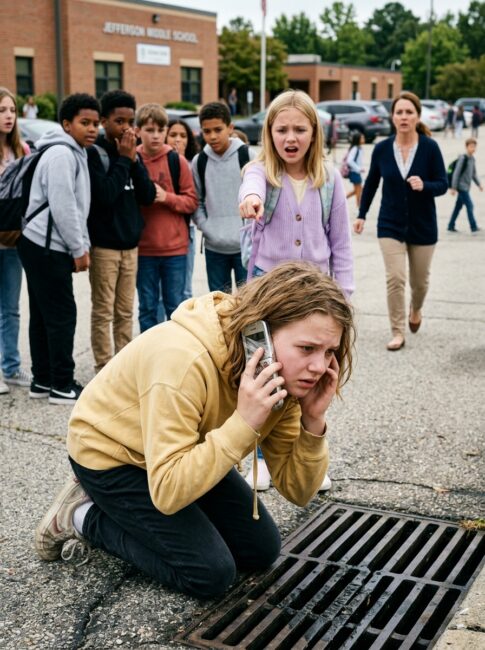
While Madison cried beside her friends, Emily dropped to her knees on the wet pavement and pressed one ear close to the grate. The cold metal left a dark line against her cheek. Her fingers gripped the curb so hard her knuckles whitened.
“Get up,” Mrs. Lang said. “Now.”
Emily shook her head once.
Not disrespectfully. Not dramatically. Just enough to make the teacher pause.
The school parking lot was noisy with dismissal. Buses coughed by the fence. Parents leaned on horns. A football bounced somewhere near the gym doors. Under all of it, Emily seemed to be listening for something no one else could hear.
Madison wiped her face with the sleeve of her lavender cardigan.
“She’s pretending,” she said. “She always acts strange.”
A few kids nodded, because it was easier to believe the familiar version of Emily.
Emily Carter was the girl who still wrote homework in pencil because she did not like wasting pens. She was the girl who brought lunch in the same plastic grocery bag every day. She was the girl who never joined group chats, never sent selfies, never knew when the class made plans without her.
Her old flip phone had become proof of everything students thought they knew.
Madison had started calling it “the dinosaur.” Others picked up the name because cruelty is often easier when it sounds like a joke.
“Does it even have internet?” one boy had asked during homeroom.
Emily had smiled politely, as if the question were harmless.
“No,” she had said.
Madison had tilted her head. “Then what is it for?”
Emily’s answer had been quiet.
“For emergencies.”
That had made them laugh harder.
Now, on the curb behind the school, she pulled that same battered phone from her pocket and flipped it open. The hinge gave a tired little click. Her thumb moved over the worn keys.
Mrs. Lang reached for it.
“Emily, give me the phone.”
Emily turned away just enough to keep the phone in her hand.
That made everything worse.
“She’s calling someone?” Madison said. “After what she did?”
The teacher’s face hardened. “Emily, this is not helping you.”
But Emily was not calling anyone.
She was staring at the tiny screen, where no one nearby could see the words. Her lips moved silently as if she were counting.
Then she looked at the grate again.
“Madison,” she said, without turning around, “did your phone have a blue charm on it?”
Madison froze.
The glitter case had been pink, but attached to it was a blue plastic charm shaped like a tiny ballet slipper. It had been a gift from her older sister, who was away at college.
“You saw it before you threw it,” Madison snapped.
Emily swallowed.
“It’s not in the water.”
That sentence made no sense.
There was a shallow drainage channel under the grate. Everyone knew rainwater ran through it toward the older part of campus, where the maintenance building sat near the soccer field.
Mrs. Lang frowned. “How could you know that?”
Emily did not answer.
Instead, she stood and walked along the curb, following the line of the drain. She moved carefully, not like a guilty girl trying to escape, but like someone tracing a sound through a wall.
The crowd followed because judgment loves an audience.
Near the back corner of the gym, Emily stopped at another grate. She knelt again. This time she held her old phone close to the metal bars, not to call, but to shine the tiny light from its screen downward.
“Do you hear that?” she asked.
Nobody answered.
Then Mrs. Lang’s expression changed.
It was small at first. A blink. A tilt of the head.
Under the traffic, under the buses, under the chatter of children who had already chosen a villain, there was a faint sound coming from beneath the school.
Not a ringtone.
Not water.
A thin, broken voice.
“Help.”
Madison stopped crying.
Emily gripped the grate with both hands.
Mrs. Lang crouched beside her.
The voice came again, weaker this time.
“Please.”
A boy near the back whispered, “Who is that?”
Emily’s face twisted for the first time, not with anger, but fear.
She looked at Madison, then at the storm drain, then down the long concrete path toward the soccer field.
“It’s Tyler,” she said.
The name moved through the crowd like a hand touching every shoulder.
Tyler Blake was Madison’s little brother.
He was in fourth grade.
And he had not gotten on his bus.
At first, Madison did not move.
She just stared at Emily, as if her mind refused to place the person she mocked beside the name she loved.
“What do you mean it’s Tyler?” she asked.
Emily was already standing.
“He was near the maintenance gate after school,” she said. “He had your phone.”
Madison’s face flushed. “No, he didn’t.”
“He did,” Emily said. “He said he was going to surprise you by recording your cheer practice.”
A few students looked away.
They had seen Tyler that afternoon. Small, freckled, always running to keep up with older kids, wearing a red backpack too big for his shoulders.
Madison’s mouth opened, but nothing came out.
Mrs. Lang pulled out her smartphone and dialed the office. Her voice changed from disciplinary to urgent.
“We need the custodian at the west drainage line now,” she said. “Possible child trapped underground.”
The word trapped broke something in the crowd.
Phones came out immediately. Students who had laughed at Emily began calling parents, recording, texting, doing all the things their devices made easy.
None of it helped find Tyler faster.
Emily’s old flip phone buzzed in her hand.
Everyone turned toward the small sound.
She looked down. The cracked little screen showed a message made of broken spelling and missing letters.
“dark. scared. hear u.”
Madison covered her mouth.
Mrs. Lang stared at the phone. “How is he texting you?”
Emily took a breath.
“Because my phone can still receive basic texts in places smartphones lose signal,” she said. “My dad works maintenance at the hospital. He gave it to me because the battery lasts for days.”
It was not a speech. She did not say it to shame anyone.
She said it like a fact she wished did not matter.
Then another message came through.
“water coming.”
The teacher’s face went white.
There had been rain all morning. More clouds were gathering west of the school, low and gray, the kind that turned drainage tunnels from empty concrete into moving traps.
Madison stepped closer to Emily.
“Can you text him back?”
Emily nodded. Her thumb trembled over the keys.
“Stay where you are. Make noise. We are coming.”
A second later, Tyler’s answer appeared.
“phone low. cold.”
Madison began to cry differently then. Not loudly. Not for attention. It was the quiet kind that made even the meanest girl in the group look down.
Mrs. Lang sent two students to the office. Another teacher came running from the gym. Mr. Alvarez, the custodian, arrived in a green work shirt with keys jangling from his belt and a crowbar in one hand.
“What happened?” he asked.
Mrs. Lang pointed. “A child may be inside the drainage tunnel.”
Mr. Alvarez looked at the grate, then at the sky.
“We have to move fast.”
He tried the first grate. It did not budge.
Years of rust held it tight.
Madison turned on Emily then, desperate for somewhere to put her fear.
“Why didn’t you just say something?” she cried. “Why did you throw my phone?”
Emily flinched.
For the first time, her eyes filled.
“Because Tyler had it,” she said. “He dropped it through the grate when he climbed down to reach the charm.”
Madison shook her head. “No.”
Emily’s voice cracked. “He told me he could get it before you noticed. I told him not to go down there.”
The pieces began to fit in a terrible order.
Madison had left her phone on the bleachers during cheer practice. Tyler had taken it, not to steal, but to film her and make her smile. The blue charm had slipped off near the drain. He had climbed down through an older access opening behind the maintenance shed, small enough for a child, hidden behind weeds.
Emily had seen him.
She had run after him.
But by the time she reached the opening, Tyler was already inside the tunnel. He had panicked, wandered toward Madison’s ringing phone, and dropped it deeper into the drainage line.
“So you threw my phone in?” Madison whispered.
Emily nodded, tears sliding down her face now.
“It was still connected to him,” she said. “He could see its light. I thought if it landed near him, he might follow it back toward the grate.”
A silence fell so heavy that even the buses seemed far away.
The act that had looked cruel had been a desperate attempt to send light into a dark place.
Madison’s friends looked at one another. Their polished phones hung useless in their hands.
Mrs. Lang put one hand over her mouth.
Mr. Alvarez moved to the second grate and jammed the crowbar beneath the edge. Another teacher helped him. The metal screamed, but it would not lift.
Emily knelt again.
“Tyler!” she shouted through the bars. “Can you see Madison’s phone?”
A faint answer came back.
“No.”
Emily texted him again.
“Bang on the wall.”
For a moment, there was nothing.
Then, from beneath the concrete, three tiny knocks answered.
Mr. Alvarez looked up sharply.
“He’s not under this grate,” he said. “He’s farther down. Toward the soccer field.”
They ran.
Not as a class now. Not as a crowd waiting for drama.
They ran as people pulled by the same fear.
Madison stumbled once, and Emily caught her elbow.
Madison looked at her hand as if it hurt to be helped by someone she had hurt.
The third grate sat near the edge of the soccer field, half covered by leaves. Water gurgled beneath it, louder than before.
Mr. Alvarez dropped to his knees and worked the crowbar under the frame.
“Tyler!” Madison screamed.
A small voice answered, closer now.
“Maddie?”
Madison folded over the grate. “I’m here. I’m right here.”
Emily held her old phone against the metal and turned on its tiny flashlight again. It was weak, bluish, almost ridiculous in daylight.
But below the grate, something moved.
A small hand appeared in the darkness.
The crowd gasped.
Mr. Alvarez pulled harder. The grate shifted one inch, then two. A male parent from the parking lot jumped in to help. Then a coach. Then the principal, Mr. Donnelly, who had arrived out of breath with his tie hanging loose.
Together, they lifted the grate just enough.
Mr. Alvarez reached down first.
“Easy, buddy,” he said. “Grab my wrist.”
Tyler’s fingers slipped once.
Madison sobbed.
Emily did not move. She held the phone light steady with both hands, though her arms shook.
“Follow the light,” she whispered.
Tyler grabbed Mr. Alvarez’s wrist.
A moment later, the little boy came up from the drain soaked, muddy, shivering, but alive. His red backpack was gone. His knees were scraped. His face was gray with fear.
Madison wrapped herself around him so tightly he squeaked.
Mrs. Lang called 911 again, this time with a different voice.
“We have him,” she said. “He’s breathing. He’s conscious.”
Then Tyler looked past his sister.
His eyes found Emily.
He lifted one shaking hand and pointed at her old flip phone.
“She stayed,” he whispered.
No one understood at first.
Tyler swallowed.
“I texted Madison,” he said, barely audible. “But it didn’t send.”
Madison pulled back. “What?”
“My phone died,” he said. “Then I remembered Emily gave me her number once.”
The air shifted again.
Months earlier, during a school safety lesson, Emily had written her number on a scrap of paper for Tyler after he got lost waiting for Madison. Madison had laughed when she found out.
“Why would he need your number?” she had said.
Emily had not answered then.
Now Tyler did.
“She said if I ever got scared and nobody answered, try hers,” he whispered. “She said old phones sometimes work when fancy ones don’t.”
Madison looked at Emily as if seeing her from across a great distance.
Emily stepped back from the crowd, suddenly aware of everyone watching. Her cheeks burned. The cracked phone dangled from her hand.
The principal walked toward her.
For a second, she looked afraid he would punish her.
Instead, Mr. Donnelly lowered his voice.
“Emily,” he said, “you may have saved his life.”
That was when the class finally became quiet.
Not classroom quiet.
Not teacher-is-talking quiet.
The kind of quiet that arrives when people realize their laughter had been standing on the wrong side of a story.
Madison looked down at her empty hands, where the expensive phone was no longer the thing she cared about most.
“I called it trash,” she said.
Emily wiped her face with her sleeve.
Madison’s voice broke.
“I called your phone trash.”
Emily did not say it was okay.
Because it had not been okay.
She only looked at Tyler, who was wrapped in a teacher’s jacket now, and said, “He answered.”
The ambulance arrived seven minutes later.
By then, rain had started again, soft at first, then steady enough to darken the sidewalk. Paramedics checked Tyler’s breathing, wrapped him in a silver blanket, and asked him questions while Madison sat beside him on the curb.
Their mother arrived in a rush of headlights and panic, leaving her car door open in the bus lane. She reached Tyler and made a sound no one in the class had ever heard from an adult before.
It was not a word.
It was relief breaking apart.
Emily stood under the awning by the gym, half hidden behind a brick column. No one had told her to go there. She had simply moved away when the grown-ups arrived, as if her part in the story ended once the boy was safe.
Her old phone sat open in her palm.
The battery bar was almost empty.
Mrs. Lang found her there.
For a while, the teacher said nothing. Rain tapped on the metal awning. Across the lot, Madison’s mother held Tyler’s face in both hands, touching his cheeks again and again as if proving he was real.
“I’m sorry I thought the worst,” Mrs. Lang said.
Emily looked down.
“You were supposed to,” she said softly. “It looked bad.”
The teacher’s eyes filled, but she did not argue.
Sometimes children make room for adult mistakes with a grace adults have not earned.
The next Monday, Jefferson Middle School felt different, though no one announced it.
Madison came to homeroom without her usual circle around her. She carried a small paper bag folded at the top. Her eyes were red, and her hair was pulled back without a ribbon.
Before the bell, she walked to Emily’s desk.
The room went still.
Emily looked up carefully.
Madison placed the bag on her desk.
Inside was the blue ballet slipper charm. Mr. Alvarez had found it caught on a piece of wire near the maintenance tunnel. The pink phone had been ruined, of course. It sat somewhere in a bowl of rice at Madison’s house, silent and useless.
“I thought you might want to give it to Tyler,” Madison said.
Emily touched the little charm but did not pick it up.
Madison swallowed.
“I also wanted to say I’m sorry in front of everyone,” she said. “Not because a teacher told me to. Because I made people laugh at you, and then you still helped my brother.”
No one moved.
Emily’s fingers closed around the charm.
“You can give it to him,” she said. “He was trying to give it back to you.”
Madison nodded, but tears slipped down her face anyway.
At lunch, something else happened.
Emily opened her plastic grocery bag and found a note folded beside her sandwich. It was written in Tyler’s uneven fourth-grade handwriting.
Thank you for the light.
Under the words, he had drawn a tiny flip phone with yellow lines coming out of it like sunshine.
Emily stared at the drawing for a long time.
Across the cafeteria, Madison sat with her tray untouched. She did not wave. She did not perform regret for an audience. She only looked at Emily, then gently set her own phone face down on the table.
One by one, other students did the same.
Not all of them. Not even most.
But enough.
Enough for the cafeteria to feel less like a place where every difference could become a joke.
Weeks later, Emily’s flip phone still had tape across the screen. The number five button still stuck. The sunflower sticker still peeled at the edge. Her father offered to replace it after hearing what happened, but Emily shook her head.
“Maybe later,” she said.
On the last day of school, Tyler waited by the front steps with Madison and their mother. He held something in his hand, wrapped in notebook paper.
When Emily came out, he ran to her.
It was a small keychain made from the blue ballet slipper charm and a yellow plastic sunflower.
“My mom helped,” he said. “So your phone has something too.”
Emily clipped it carefully to the hinge of the old flip phone.
The charm looked too pretty for it.
Or maybe the phone had never been ugly at all.
Madison stood a few feet away, hands clasped in front of her, waiting for Emily to decide whether forgiveness could be rushed.
Emily looked at her, then at Tyler, then at the little sunflower swinging against scratched silver plastic.
“It fits,” she said.
And for the first time in months, Madison smiled without needing anyone to laugh with her.
If this story stayed with you, follow the page for more emotional stories about kindness, judgment, and the quiet people we often misunderstand.