Part 2: A Laundry Worker Was Looked Down On by Her Wealthy Relatives at Thanksgiving — Her Daughter’s Thank-You Left the Entire Table Speechless
Rosa did not look up immediately.
She kept blotting the stain from the outside edge toward the center, preventing the wine from spreading further into the embroidered fabric.
“Emily,” she said softly, “this is not the time.”
Her daughter remained standing.
Emily was twenty-two and home from nursing school for the holiday. She had inherited Rosa’s dark hair and quiet manner, but not her mother’s instinct to disappear whenever a room became uncomfortable.
Across the table, Diane reached for the bottle of sparkling water.
“Let us not turn a small accident into something larger,” she said.
Rosa nodded.
“She is right.”
Emily looked toward her mother’s hands.
The skin around Rosa’s knuckles had cracked again. A narrow bandage covered one finger where a laundry cart had caught it earlier that week.
Rosa had tried to hide the injury beneath a thin gold ring.
It was not her wedding ring.
That one had disappeared years earlier.
Emily knew where it had gone.
Most of the family did not.
Diane handed Rosa a clean towel.
“You always were good with stains,” she said. “Some people simply have a gift for practical things.”
The sentence sounded almost kind.
That made it worse.
Rosa rose carefully and carried the damp cloth toward the kitchen sink.
Diane’s husband, Richard, changed the subject.
He asked Bradley about his promotion.
Bradley described the downtown office, the travel allowance, and the company retreat his team had attended in Colorado.
Emily sat down again, but she did not unfold her paper.
She watched Rosa rinse the cloth beneath cold water.
The kitchen stood only a few feet from the dining room, separated by a wide archway. Rosa remained visible beneath the bright pendant lights, rubbing the fabric gently between her fingers.
It was a familiar image.
When Emily was a child, she often fell asleep inside Delgado Family Laundry, the narrow laundromat Rosa operated near the bus station.
The business had once belonged to Rosa and her husband, Miguel.
After Miguel died from a heart condition when Emily was nine, Rosa kept the laundromat open alone.
The machines were old.
The roof leaked near the folding tables.
During winter, Rosa sometimes wore two sweaters behind the counter because the heating system failed more often than it worked.
Still, she arrived before sunrise and locked the doors after dark.
She washed restaurant aprons, motel sheets, mechanics’ uniforms, and table linens from private events she was rarely invited to attend.
Emily learned to do homework beside the humming dryers.
She learned the difference between rust, coffee, ink, and blood before she learned algebra.
She also learned that Rosa never complained while someone could hear her.
Back in the dining room, Diane unfolded her napkin.
“We should take the photographs before dessert,” she said. “The light near the fireplace is better earlier.”
Her eyes moved toward Rosa’s faded blouse again.
“I have a cardigan upstairs that might photograph nicely on you.”
Rosa returned from the sink holding the damp towel.
“That is thoughtful, but I am comfortable.”
Diane smiled.
“It would only take a minute.”
Emily’s younger cousin, Lauren, glanced toward her mother.
“Mom, leave Aunt Rosa alone.”
The room became quiet for a second.
Diane looked surprised.
Lauren stared at her plate.
She was seventeen, usually talkative, and had barely touched her food.
Rosa noticed.
“Are you feeling all right, sweetheart?”
Lauren nodded too quickly.
“I am fine.”
Rosa did not press.
Instead, she returned to the tablecloth and examined the stain.
“It should come out,” she said. “But do not put it near heat until I treat it properly.”
Diane sighed with relief.
“Thank goodness. I almost used the disposable linens tonight, but this one has sentimental value.”
Rosa’s hands stopped moving.
Emily noticed.
“So sentimental that you nearly threw it away last spring?” she asked.
Diane looked toward her.
“What?”
Emily pointed to the tablecloth.
“You put it in a donation box after Grandma died.”
Diane frowned.
“How would you know?”
Rosa closed her eyes briefly.
Emily answered anyway.
“Because Mom found it at the bottom of a bag of old linens you dropped off at the laundromat.”
Diane looked down at the embroidered cloth.
One corner had been repaired with nearly invisible white thread.
A small cluster of flowers had been restitched near the hem.
Rosa folded the damp towel carefully.
“The fabric was still good,” she said. “It only needed time.”
Emily looked toward the folded paper beside her plate.
“That is what Mom says about almost everything.”
Bradley lowered his wineglass.
For the first time that evening, nobody seemed eager to continue dinner.
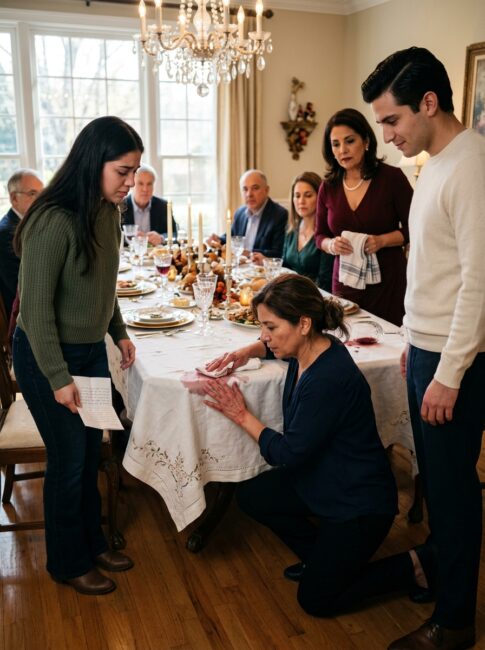
Rosa asked Emily to sit down.
Her voice remained gentle, but a warning lived beneath it.
Emily understood the warning.
Her mother did not want gratitude if it came at the cost of humiliating anyone else.
That had always been Rosa’s way.
She protected people even from the truth when the truth might embarrass them.
But Emily had spent too many years watching relatives describe Rosa as unfortunate, hardworking, and simple.
They praised her endurance while quietly assuming that her life had never contained a choice.
Emily unfolded the paper.
“This is for one of my classes,” she said. “We were asked to write about the person who taught us what care actually looks like.”
Rosa looked toward the kitchen.
“Emily.”
“I am not trying to make anyone feel bad.”
Her daughter’s voice softened.
“I only want them to see you.”
Snow pressed gently against the dining room windows.
Emily began reading.
My mother works in a laundromat. People bring her the evidence of their hardest days without realizing it. Hospital gowns, restaurant uniforms, baby blankets, funeral clothes, school shirts, and sheets from houses where somebody has been sick for a long time.
Rosa remained beside the table, holding the damp cloth.
She knows when a family is struggling because their laundry changes before their words do. She notices when a child’s winter coat appears too often because it is the only warm thing he owns. She notices when an elderly customer brings fewer shirts because he has stopped leaving the house.
Diane shifted in her chair.
Emily continued.
My mother never calls what she does charity. She says people deserve clean clothes without having to explain why they cannot pay that week.
Bradley looked toward Rosa.
“You wash people’s clothes for free?”
Rosa shrugged slightly.
“Sometimes people settle their bills later.”
Emily met her mother’s eyes.
“Sometimes they do not.”
Rosa did not answer.
The laundromat ledger sat inside a drawer beneath the register. Emily had seen the notes written beside unpaid balances.
WAIT UNTIL JANUARY.
NEW BABY. DO NOT CALL.
HUSBAND IN HOSPITAL.
SCHOOL UNIFORMS — COVERED.
Rosa kept the notes private because dignity mattered more to her than credit.
Emily returned to the paper.
When my grandmother became ill, my mother worked all day and spent evenings at her house. Grandma wanted to remain at home. Everyone in our family helped when they could, but my mother handled the things people rarely discuss.
Diane stared at the tablecloth.
Their mother, Evelyn, had spent the final eight months of her life inside the small brick house where she raised her children.
Diane coordinated medical appointments.
Richard installed a safer handrail in the bathroom.
Bradley brought groceries on Sundays when he remembered.
The family hired a nurse for several mornings each week.
Everyone knew Rosa visited frequently.
Nobody knew what those visits contained.
Emily continued.
Mom changed sheets at midnight. She washed blankets after difficult nights. She cleaned the towels Grandma was embarrassed for anyone else to see. Then she returned before sunrise with everything folded and warm.
Diane covered her mouth with one hand.
Rosa looked down.
“She was my mother too,” she said.
Emily nodded.
“I know.”
The tablecloth stretched between them.
Rosa had found it inside the last bag Diane delivered to the laundromat after Evelyn’s house was cleared.
At first, the heirloom looked ruined.
A large stain covered one corner. Several embroidered flowers had come loose. One edge had torn where the fabric caught on a drawer.
Rosa worked on it during quiet hours at the laundromat.
She soaked it overnight.
She repaired the hem one stitch at a time.
Then she returned it to Diane without mentioning the repairs.
Diane assumed the tablecloth had always looked that way.
Emily placed one hand against the paper.
“That is not the part I planned to read tonight,” she said.
Rosa looked toward her.
Emily swallowed.
“The part I wanted to read was about nursing school.”
Bradley leaned back in his chair.
Everyone in the family knew Emily had earned a scholarship.
They mentioned it often because it offered an easy explanation for how Rosa’s daughter attended a respected program without family money.
Emily’s scholarship covered tuition.
It did not cover housing, textbooks, transportation, uniforms, or the unpaid clinical hours she completed each semester.
Rosa covered those.
She did it by opening the laundromat one hour earlier and accepting linen contracts from two small restaurants after closing time.
For nearly three years, she worked from 5:00 in the morning until almost midnight on Thursdays.
Emily discovered the schedule only when she returned home unexpectedly during spring break and found Rosa asleep beside a dryer with a pile of folded aprons in her lap.
“You told us the scholarship covered everything,” Diane said.
Rosa looked toward Emily.
“It covered the important part.”
“Your rent is important,” Emily replied.
“So are your books.”
Rosa smiled faintly.
“You were studying. That was your job.”
Emily’s eyes filled.
“My mother sold her wedding ring during my first semester.”
Rosa tightened her grip on the cloth.
“Emily, please.”
“I thought she sold it for my textbooks. That is what she told me.”
Emily looked toward Lauren.
The teenage girl had begun crying quietly beside her mother.
“Last month, I found out the truth.”
Lauren stared at Rosa.
Diane turned toward her daughter.
“What truth?”
Lauren wiped her cheek.
Rosa placed the towel on the table.
“There is no reason to discuss this tonight.”
Lauren answered before anyone could stop her.
“I called Aunt Rosa in September.”
Her voice shook.
She explained that one of her closest friends had noticed the bruises on her arm.
Lauren’s boyfriend had become controlling during the summer. At first, he checked her messages. Later, he isolated her from friends and frightened her whenever she tried to leave.
Lauren did not call her parents.
She feared disappointing them.
She called Rosa.
Rosa picked her up from a gas station after midnight.
She took Lauren to a counseling center the following morning and paid for the first appointments before insurance paperwork was settled.
The wedding ring had covered the cost.
Diane stared at her sister.
“You never told me.”
“It was Lauren’s story to tell,” Rosa said.
Lauren began crying harder.
Rosa walked around the table and placed one hand gently on her shoulder.
“You do not need to explain anything else.”
Emily folded her paper.
Her planned thank-you no longer seemed necessary.
The room understood.
Still, she looked toward her mother and spoke without reading.
“Mom, I used to think you spent your life washing things other people did not want to touch.”
Rosa stood quietly beside Lauren.
Emily’s voice broke.
“Now I know you were making sure nobody had to carry the stain of their hardest day forever.”
No one reached for a serving dish.
No one tried to change the subject.
Around the table, polished glasses reflected the candlelight while the repaired embroidery rested beneath everyone’s hands.
Diane rose slowly from her chair.
She walked toward Rosa and stopped near the corner of the tablecloth Rosa had repaired.
“I am sorry,” she whispered.
Rosa looked at her sister.
“For what?”
Diane glanced toward Rosa’s faded cuffs, then toward Lauren.
“For noticing the wrong things.”
Rosa reached for her hand.
“Then notice something different tomorrow.”
Dessert remained in the kitchen longer than planned.
Nobody seemed ready for photographs.
Richard cleared the plates without being asked. Bradley carried the serving dishes toward the sink and returned with a bowl of cold water for the stained corner of the tablecloth.
He looked toward Rosa.
“What should I do?”
She showed him how to blot the fabric gently.
“Do not scrub,” she said. “You will push the stain deeper.”
Bradley nodded and followed her instructions carefully.
Lauren sat beside Emily near the fireplace. They spoke quietly while snow gathered along the windowsill.
Diane went upstairs and returned carrying the cardigan she had intended to offer Rosa for the family photograph.
She held it for a second, then placed it over the back of an empty chair.
Rosa noticed but said nothing.
When the family finally gathered near the fireplace, Rosa stood beside Diane wearing her own navy blouse.
The cuffs were still faded.
Her hands remained dry and reddened.
Nobody asked her to hide them.
Before Richard set the camera timer, Lauren moved closer and placed one arm around Rosa’s waist.
Emily stood on her mother’s other side.
The photograph captured something imperfect.
Bradley looked slightly distracted because he was checking the tablecloth behind him. Diane’s eyes were swollen. Rosa appeared tired from her early shift.
Still, everyone kept the picture.
The wine stain disappeared after two days of careful treatment at the laundromat.
Rosa returned the tablecloth inside a plain paper bag.
Diane unfolded it across her dining table and searched for the damaged area.
A faint shadow remained beneath the embroidery.
She called Rosa.
“I can still see a little of it,” Diane said.
Rosa waited.
“Should I bring it back?”
“No,” Diane replied.
She ran one hand over the repaired flowers.
“I think I want to remember where it was.”
The following Thursday, Diane arrived at Delgado Family Laundry shortly before closing.
She carried two cups of coffee and a box of sandwiches.
Rosa stood behind the folding table, sorting restaurant aprons into neat stacks.
Diane placed the food beside her.
“Show me what to do.”
Rosa raised an eyebrow.
“You are wearing an expensive sweater.”
Diane removed it, folded it carefully, and placed it on a chair.
Underneath, she wore a plain cotton shirt.
“Then start me with something that does not stain easily.”
Rosa smiled.
She handed her sister a basket of clean towels.
Across the laundromat, dryers turned slowly behind round glass doors.
Warm air carried the familiar scent of detergent and fabric softener. A radio played quietly near the register.
Diane folded the first towel unevenly.
Rosa unfolded it and showed her again.
Neither woman mentioned the Thanksgiving dinner.
They did not need to.
Near the register, a small photograph had been taped to the wall.
It showed Rosa, Emily, Lauren, and the rest of the family standing beside the fireplace.
Rosa’s faded cuffs were visible.
So were her hands.
Months later, Emily kept a copy of the photograph inside her nursing-school binder.
Whenever a difficult clinical shift left her exhausted, she looked at her mother standing in the middle of the frame.
Then she remembered something Rosa often said while repairing clothes at the folding table.
Some marks disappear completely.
Others become lighter with patience.
Either way, you do not throw away something valuable merely because it has carried someone through a difficult day.
Follow our page for more heartfelt stories about the quiet people whose love is often hidden in the smallest acts of care.