Part 2: A Little Girl Waited Outside the Police Station — Then a Biker Took Her In
His real name was Jonah Rusk, though nobody on the road called him that anymore.
They called him Graveyard because he had buried more brothers than most men had kept friends. At least that was the story people told when his club rolled through northern Arizona on charity rides, toy runs, funeral escorts, and the kind of quiet errands nobody posted online.
I had seen Iron Shepherds MC twice before that day.
They were not the kind of men people moved toward.
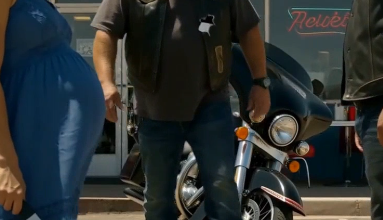
They arrived in thunder. Big Harley-Davidson touring bikes. Black leather cuts. Gray beards. Tattoos faded by sun and years. Boots that sounded like doors closing. They smelled like gas station coffee, engine oil, sweat, and old rain baked into leather. The whole room changed when they entered. Conversations got smaller. Mothers pulled kids closer. Men pretended not to stare.
Graveyard was the one they watched most.
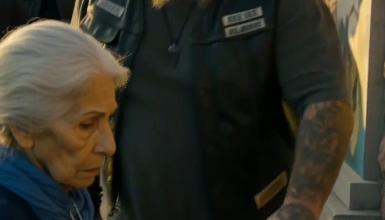
He had a face that looked carved with a dull blade. His left eye sat slightly lower than the right from an old fracture. His hands were thick, scarred, and permanently dark under the nails from working on engines. A tattoo of a broken hourglass ran from his wrist to his thumb. Across his knuckles were the words STAY GONE.
That was not a friendly message.
But there were things that did not fit.
He always tipped in exact folded bills. Always faced the door but never blocked an exit. Always held his coffee cup with both hands like he was warming something in himself. And stitched inside the front flap of his vest, almost hidden unless the leather opened just right, was a small patch shaped like a bluebird.
A child’s patch.
Soft blue thread. Yellow beak. One wing missing.
I noticed it that day when he knelt on the station steps.
The little girl noticed something else.
“You’re big,” she said.
Graveyard nodded. “Been accused of that.”
“You look scary.”
“Been accused of that too.”
She studied him with the honest cruelty only children have. “Are you bad?”
Two officers near the smoking area laughed under their breath.
Graveyard did not.
He looked down at his hands. The tattoos. The scars. The words STAY GONE.
“Sometimes I was,” he said. “Not today.”
That answer did something to me.
Most adults lie to children to make themselves comfortable. He did not. He gave her the truth in a size she could carry.
Her name was Lily Mercer.
She told him that after he asked twice and offered her a bottle of water from his saddlebag. She would not take it until he set it on the step and backed away. Smart girl. Tired girl. Six years old and already measuring danger like an adult.
Her mother had dropped her off, Lily said. Told her to wait until “the lady with the desk” came out. That meant me, though I had never seen either of them before. Her mother had not parked. Had not come inside. Had not left a note.
Just a child on concrete in 102-degree heat.
Graveyard looked through the glass doors at us.
I felt my stomach tighten.
Behind me, Sergeant Bill Hanley was talking to Officer Dunn about a stolen generator report. Hanley was a white man in his early fifties with a square jaw, a badge polished too bright, and a habit of deciding things before facts interrupted him.
“Somebody handle that,” he said without looking up.
Nobody moved fast enough.
So the biker did.
He stood slowly and held out one hand, palm up, not grabbing, not rushing.
“Lily,” he said, “we’re going inside.”
She looked at the police station doors.
Then at him.
“My mommy said not to.”
Graveyard’s jaw shifted.
“Your mommy scared?”
Lily nodded.
“Then we’re gonna be brave for her.”
She did not take his hand.
She took the edge of his leather vest.
And the scary man let a six-year-old lead him into a police station.
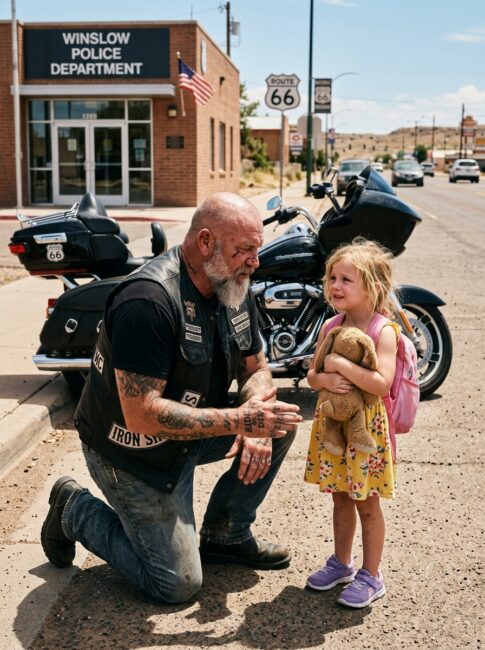
Every head turned when Graveyard walked in with Lily holding his cut.
The station lobby was small. Plastic chairs. Bulletin board. Vending machine. A framed flag. The kind of place meant to feel official and safe but mostly smelled like old paper, floor cleaner, and microwaved burritos.
Lily stepped inside and stopped.
The air conditioning hit her face. She shivered once. Not from cold. From finally being somewhere she did not know how to trust.
I came around the desk too fast, nearly tripping over the trash can.
“Hi, sweetheart,” I said. “I’m Claire.”
Lily hid behind Graveyard’s leg.
That told me plenty.
Hanley came out from behind the interior door, his belt creaking with the weight of keys, cuffs, radio, and authority. He looked at Graveyard first. Not the child. The biker.
“What’s this?”
Graveyard’s voice stayed flat. “Little girl was outside almost an hour.”
Hanley looked toward me.
I hated how quickly I felt guilty.
“I thought someone had called it in,” I said.
Hanley’s mouth tightened. “Did someone call it in?”
No one answered.
Lily clutched the stuffed rabbit under her chin.
Officer Dunn, young and nervous, crouched near her but too close. Lily flinched. Graveyard took one step sideways, placing himself between them without making it obvious.
Dunn stood again, embarrassed.
Hanley noticed.
“You can step back,” he told Graveyard.
“No.”
One word.
The lobby changed.
Not loud. Not violent. But every officer in that room heard the weight behind it. The prospect of trouble arrived like storm pressure.
Hanley squared his shoulders. “This is a police matter.”
Graveyard looked at the child. “Then police it.”
The words landed hard.
Lily whispered into the rabbit’s ear.
I bent down near the desk, keeping distance. “Lily, do you know your mom’s phone number?”
She shook her head.
“Her name?”
“Cassie.”
“Last name?”
“Mercer.”
I wrote it down.
Hanley’s hand paused over his radio.
I saw it.
So did Graveyard.
“Problem?” the biker asked.
Hanley’s face went blank. “No.”
But his eyes had changed.
He knew the name.
That was the first false ending. We thought we had the mother. We thought this was just a scared woman dropping her child somewhere she believed might be safe. Tragic, yes. Neglectful, yes. But simple.
Nothing about that day was simple.
Dispatch ran the name.
Cassie Mercer. White American woman. Twenty-nine. Last known address outside Holbrook. Prior calls. Domestic disturbances. One restraining order that had expired. One missing persons report filed by her sister two weeks earlier and closed after a phone check.
Hanley said the words like he was reading weather.
Graveyard’s hands started shaking.
Not much. Just enough that the chain on his belt clicked once.
“You know her?” I asked.
He didn’t answer.
Hanley did.
“Cassie Mercer’s got a history,” he said. “Drugs. Bad crowd. Probably dumped the kid and ran.”
Lily heard enough to understand tone if not detail.
Her face crumpled.
“My mommy’s good,” she said.
Hanley looked annoyed. “Nobody said—”
Graveyard turned on him.
The silence got sharp.
Hanley stopped talking.
Then a call came through from dispatch. A convenience store camera near the highway had picked up Cassie’s old blue sedan twenty minutes earlier. It was headed east on I-40. A patrol unit found the vehicle behind an abandoned motel.
Empty.
Driver’s door open.
Blood on the steering wheel.
Lily made a small sound.
Not a cry.
Something smaller.
Graveyard closed his eyes.
His face did not break. Bikers like him do not break in public. But his right hand went to the inside of his vest again, pressing against that cracked silver badge.
And for the first time, I saw fear on a man everyone else was afraid of.
Hanley moved fast after that.
Too fast in the wrong direction.
He ordered Dunn to keep Lily in the lobby with me and told dispatch to notify child services. He called Cassie “unstable” twice in three minutes. He said “possible abandonment” before anyone had found her.
Graveyard heard every word.
“She brought the child here,” he said. “That ain’t abandonment. That’s a warning.”
Hanley turned. “You don’t know that.”
Graveyard pulled the cracked silver badge from inside his vest.
The room froze.
It was old. Smaller than modern badges. Split through the center like it had been stepped on or shot. The name was scratched, but I could still read part of it.
RUSK.
Hanley’s face drained.
Officer Dunn whispered, “What is that?”
Graveyard looked at the badge like it had bitten him years ago and never let go.
“My brother’s,” he said.
Nobody spoke.
“Deputy Aaron Rusk,” he continued. “Coconino County. Killed outside Flagstaff nineteen years ago after answering a domestic call nobody took serious.”
Hanley swallowed.
That was when I understood this was not just a biker angry at a lazy police response.
This was old blood.
Graveyard looked at Lily, then back at Hanley.
“Woman had a baby boy in the house that night. Dispatcher wrote it as a noise complaint. My brother went alone. Everybody figured she was dramatic too.”
Hanley’s jaw worked. “Jonah—”
Graveyard’s eyes snapped to him.
So they did know each other.
That was the twist under the twist.
Hanley had known Graveyard before the tattoos, before the cut, before the road name. He had known Deputy Aaron Rusk too.
“You were there,” Graveyard said.
Hanley said nothing.
“You were supposed to be backup.”
Dunn looked from one man to the other.
The old air in that lobby changed. History had walked in with the child, and none of us had recognized it.
Hanley’s voice dropped. “That was a long time ago.”
“Not to him,” Graveyard said, touching the badge. “Not to me.”
Lily whispered, “Is my mommy dead?”
The question cut through everything.
Graveyard turned instantly. No more Hanley. No more old fight. He lowered himself in front of her.
“We don’t know that,” he said.
“Grown-ups say that when it’s bad.”
He looked at her for a long second.
Then he said, “Yeah. Sometimes.”
That honesty again.
She stared at him.
“But not today,” he added. “Today we look.”
Outside, the sound came first.
More Harleys.
One. Then three. Then so many the station windows began to hum.
Hanley stepped toward the glass doors. “What did you do?”
Graveyard stood.
“Called my brothers.”
The parking lot filled with Iron Shepherds MC. Big men. Old men. A Black American biker with a white beard and one missing hand. A Latino American rider in his forties with a medic patch on his vest. A white American woman biker in her fifties with silver braids and a face like weathered stone.
They did not come to fight.
They came with maps.
Flashlights.
Water.
First aid kits.
And a photograph of Cassie Mercer printed from somebody’s phone.
Brotherhood, tested in front of a police station, did not roar.
It organized.
The search should have belonged to the department.
It did, officially.
But the truth is, the bikers found the first real clue.
One of Iron Shepherds, the woman with silver braids, was called Wren. She had been a search-and-rescue volunteer before a drunk driver took her daughter and most of her patience. She looked at the map spread across the station counter and asked why nobody had checked the old service road behind the motel.
Hanley said it was blocked off.
Wren said, “For cars.”
Graveyard looked at her.
She tapped the map with two fingers. “Not for bikes.”
That was how I ended up in the back of a patrol SUV watching six Harleys roll out behind two police cruisers, the sound of their engines bouncing off the low desert buildings. Not fast. Not reckless. Just steady. Like a promise with exhaust pipes.
Lily stayed at the station with me.
She did not want to let go of Graveyard’s vest.
He removed the bluebird patch from inside it.
I saw him hesitate before doing it. That patch meant something. Maybe more than the badge. He knelt and placed it in Lily’s small hand.
“Hold this,” he said. “I’ll come back for it.”
“Promise?”
Graveyard looked at the cracked badge in his palm.
Then at Hanley.
Then back at her.
“Yeah,” he said. “I know what happens when men don’t.”
After they left, Lily sat behind my desk with her stuffed rabbit and the bluebird patch in her lap.
She told me her mother had cried that morning while packing the pink backpack. She said Mommy kept looking in the mirror. She said there was a man in a red truck who came to their trailer at night and hit the door with his fist. She said Mommy told her, “If I can’t come inside with you, you go in anyway.”
But Lily had not gone in.
Because she was six.
Because police stations are big when your mother is scared of them.
Because nobody opened the door.
That was the part I still carry.
An hour later, the radio cracked.
“Found her.”
Cassie Mercer was alive.
Barely.
She had left the car and tried to cut across the service road toward an old maintenance shed. Her phone was smashed. Her left arm was broken. She had a head wound, dehydration, and bruises around her throat. But she was breathing.
The man in the red truck was found half a mile away after he blew a tire on the service road. He had a warrant out of Texas. He also had Cassie’s phone in his pocket.
The third twist came when they brought Cassie through the back entrance of the station before the ambulance transfer.
She was conscious enough to see Lily.
Lily ran to her.
Cassie tried to lift her broken arm and couldn’t.
So Graveyard lifted Lily onto the stretcher gently, like she was made of glass and thunder.
Cassie looked at him through swollen eyes.
Her lips moved.
“Rusk?”
Graveyard went still.
“You knew my brother?” he asked.
Cassie nodded weakly.
“My dad was the baby,” she whispered. “The one Aaron saved.”
The lobby disappeared under silence.
Nineteen years ago, Deputy Aaron Rusk had died on a domestic call but not before carrying a baby boy out through a bathroom window. That baby boy grew up, had a daughter named Lily, and died young from an overdose before ever knowing the name of the deputy who had saved him.
Cassie had known.
Her mother had told her.
That was why she drove to that station.
Not because she trusted police.
Because somewhere in the story of her family, one officer had been brave enough to come inside when everyone else hesitated.
And the biker carrying that officer’s broken badge was his brother.
Graveyard did not cry.
His eyes went wet, but he turned his head toward the vending machine like it had suddenly become important.
Cassie reached with two fingers.
He took them.
Not like romance. Not like rescue.
Like two survivors touching the same old wound from opposite sides.
“Thank you,” she whispered.
Graveyard shook his head.
“Thank Aaron.”
Then he took Lily’s stuffed rabbit from the floor, brushed dust off its ear, and tucked it beside Cassie’s shoulder.
That was the moment I stopped seeing a scary biker.
And started seeing a man still answering his brother’s last call.
After that day, Graveyard came back every month.
Not to visit me. Not to shake hands with Hanley. He and Hanley barely spoke, though something changed between them. Not forgiveness. Not friendship. More like two men standing on opposite sides of a grave, finally admitting the grave was there.
Graveyard came for Lily.
Cassie spent months recovering. First at the hospital in Flagstaff, then in a small apartment the county helped her get near Winslow. The red truck man went back to Texas in cuffs. The case took time, the way justice always does when pain needs paperwork before it gets believed.
But every second Saturday, right around noon, the sound would come.
One Harley.
Sometimes two.
A low rumble turning off Route 66, rolling past the old tire shop, slowing near the station without needing to show off. The engine would cut. Boots on pavement. Leather creak. One chain click.
Lily would run out before the door closed.
She was not afraid of him anymore.
She called him Mr. Grave, because Graveyard was too long and Jonah felt too private.
He never corrected her.
The bluebird patch stayed with Lily for three months. She carried it in her backpack, then under her pillow, then pinned it to the stuffed rabbit’s chest. When Cassie was strong enough to walk outside without help, Lily gave it back.
Graveyard took it like she had handed him a living thing.
Inside his vest, he stitched it beside the cracked badge.
After that, he added something new.
A tiny yellow thread around the missing wing.
Wren did the sewing. She pretended to complain the whole time.
“Biggest men always got the smallest patches,” she said.
Graveyard grunted.
That meant thank you.
The Iron Shepherds started a small ride every spring after that. No posters. No sponsors. No speeches. They called it Aaron’s Mile. They rode from Winslow to the old county line where Deputy Aaron Rusk had died, then back to the police station where Lily had waited.
Cassie and Lily stood outside each year.
Hanley stood there too.
The first year, he could not look at Graveyard.
The second year, he brought flowers.
The third year, he apologized.
Not loud. Not public. Just two men beside a row of idling Harleys, the smell of gasoline and desert dust around them.
Graveyard listened.
Then he said, “Be backup next time.”
Hanley nodded.
That was all.
For men like them, sometimes that is a whole chapter.
I left the Winslow Police Department two years later, but I still pass through town when I can.
The station looks the same. Same glass doors. Same cracked sidewalk. Same desert heat rising off Route 66 until the road seems to breathe.
But there is a small bluebird sticker now on the lower corner of the front window.
Most people never notice it.
Lily does.
She is nine now. Taller. Louder. Still carries the stuffed rabbit, though she swears it is only for Cassie. Her mother works at the diner next door, the one with the repaired neon sign. Some days she brings coffee to the officers. Some days she cannot step inside the station yet.
Healing has its own speed.
Graveyard still rides in on the second Saturday.
Still huge. Still scarred. Still tattooed. Still the kind of man strangers misread before he says a word.
But when Lily runs toward him, he drops to one knee every time.
Hot pavement. Bad knees. Heavy leather.
Every time.
She tells him about school. About spelling tests. About how her mom smiled three days in a row. He listens like each word is road direction in bad weather.
Then he taps the inside of his vest.
The cracked badge.
The bluebird patch.
Two pieces of the same promise.
Last time I saw them, the sun was going down behind the old Route 66 sign. Graveyard walked Lily to her mother’s car, one big hand hovering behind her backpack but never pushing. Cassie waved from the driver’s seat.
He stood there until they pulled away.
Then he climbed onto the Harley.
The engine started low.
The taillight turned red.
And the man called Graveyard rode back toward the living.
Follow the page for more biker stories about the hearts hidden under leather.