Part 2: A Man Was Mocked for Wearing Torn Shoes to His Class Reunion — When His Name Was Called, the Entire Ballroom Stood Up
Daniel almost reached the hallway before the waitress caught up with him.
“Please do not leave yet,” she said.
She was young, perhaps twenty-two, with dark hair tied behind her head and tired eyes that looked older than the rest of her face.
Daniel glanced back toward the ballroom.
“I should not have come,” he said quietly.
“Yes, you should have.”
The waitress looked toward his shoes, then quickly looked away.
“My mother said you never attend these events.”
Daniel smiled faintly.
“Your mother talks too much.”
“She talks about you because she remembers.”
Before Daniel could answer, Trevor stepped into the hallway.
“There you are,” he said. “I thought you might have escaped.”
Daniel straightened slightly.
Trevor had changed since high school, but not as much as he seemed to believe. He still carried himself like someone accustomed to being recognized when he entered a room.
His suit fit perfectly. His watch caught the hallway light. A reunion committee ribbon was pinned beneath his name tag.
“Come on,” Trevor said. “At least stay for the announcement. Some of us worked hard to put this night together.”
Daniel nodded politely.
“I can see that.”
Trevor glanced down again.
“You still doing maintenance work?”
Daniel looked at him for a moment.
“Sometimes.”
It was not exactly a lie.
Daniel still fixed leaking faucets whenever he visited his mother. He still replaced loose hinges at the old community center. He still carried a small toolbox in his truck because broken things rarely waited for convenient moments.
Trevor smiled with the satisfaction of someone receiving the answer he expected.
“I always thought you were good with your hands.”
A burst of feedback squealed from the ballroom speakers.
The microphone went silent.
A committee member hurried into the hallway.
“Trevor, the projector is down again. The slideshow will not load.”
Trevor exhaled and looked toward the ceiling.
“We paid for professional equipment.”
Daniel held out one hand.
“May I take a look?”
Trevor hesitated.
Then he stepped aside.
Daniel followed the committee member toward a folding table behind the stage. He crouched beside the projector, adjusted a loose power adapter, and carefully secured a cable someone had bent against a table leg.
The image returned.
Old yearbook photographs appeared on the ballroom wall.
Several people applauded.
Daniel quietly moved away before anyone noticed who had fixed the problem.
At his table, he found a fresh glass of water beside his plate. Beneath the glass was a folded napkin with a handwritten message.
Thank you for helping my daughter stay in nursing school. — Maria
Daniel turned toward the hallway.
The waitress was serving another table. She did not look at him, but her mother’s name tag was pinned to her uniform.
Elena Alvarez
Daniel folded the napkin and slipped it into his jacket pocket.
Across the ballroom, Trevor watched him.
Years earlier, Trevor would not have noticed a waiter’s handwriting or a repaired projector cable. That night, however, he seemed increasingly unsettled by every quiet thing Daniel did.
When dinner began, a former cheerleader named Brooke Lawson joined Daniel’s table because every other chair was taken.
She looked at his badge, then studied his face.
“Daniel Mercer,” she said. “You sat behind me in chemistry.”
Daniel smiled.
“You always borrowed my calculator.”
“I always returned it.”
“Usually.”
She laughed, then glanced toward his shoes.
Unlike Trevor, Brooke did not make a joke.
Instead, she looked closer.
“Did you repair those yourself?”
Daniel rested both feet beneath the table.
“My father taught me how.”
Brooke paused.
Her expression changed.
“Your father was Mr. Mercer?”
Daniel nodded.
For several years, Daniel’s father had been the head custodian at Westbrook High School. Most students remembered him as the quiet man who opened the building before sunrise and pushed a yellow mop bucket through the hallways after everyone else went home.
Brooke looked toward the stage.
“I remember him,” she said. “He fixed my locker before my first debate competition. I was crying because my notes were trapped inside.”
Daniel smiled.
“That sounds like him.”
“Those were his shoes?”
Daniel did not answer immediately.
The leather had been resoled twice. The seams near the toes were uneven. One patch was darker because Daniel had cut it from an old work boot.
“They were,” he said.
Brooke looked down at her dinner plate.
“I am sorry. I did not know.”
“There is nothing to be sorry about.”
Onstage, the principal tapped the microphone again.
This time, it worked.
“We will begin our final presentation in five minutes,” she said. “Please remain seated.”
Daniel’s hand moved instinctively toward his coat.
Brooke noticed.
“You really are trying to leave.”
“I promised my mother I would stay for dinner.”
“That sounds very specific.”
Daniel almost smiled.
Before he could respond, Trevor returned with two glasses in his hands.
He placed one in front of Brooke and remained standing.
“Daniel,” he said. “A few of us are taking pictures near the banner. You should join us.”
Daniel shook his head.
“I am all right here.”
Trevor lowered his voice.
“You know, people would understand if reunions are not your thing. These events can feel uncomfortable when everyone’s lives went in different directions.”
Brooke looked up sharply.
Daniel remained still.
Trevor continued.
“No judgment. I just hope the ticket price was not a burden. We could have arranged something through the committee.”
For the first time that evening, Daniel’s expression hardened.
Not with anger.
With something closer to exhaustion.
“I did not pay for my ticket,” he said.
Trevor’s eyebrows rose.
Daniel looked toward the waitress standing near the kitchen door.
“Someone left it at my mother’s house.”
Trevor followed his gaze.
Then the principal returned to the microphone.
“Please take your seats,” she said. “The person we are honoring did not ask for this recognition. In fact, he requested that we cancel this portion of the evening.”
Daniel closed his eyes briefly.
The ballroom grew quiet.
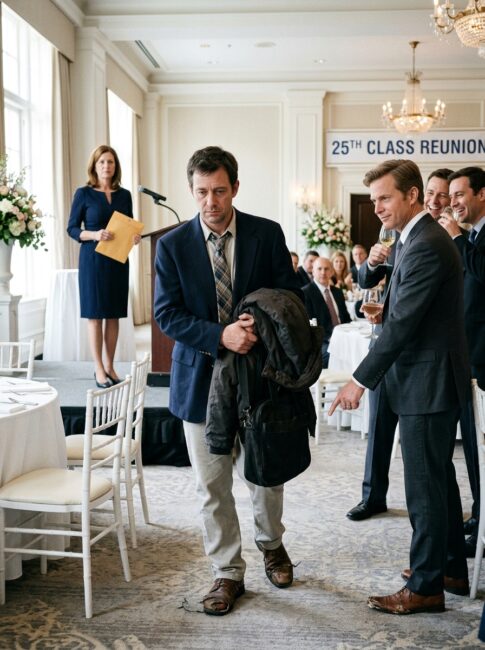
The principal, Margaret Ellis, had worked at Westbrook High School for eleven years.
Most people in the ballroom knew her as a calm woman who rarely spoke longer than necessary. That evening, her hands trembled slightly as she opened the sealed envelope.
“Before I announce a name,” she said, “I need to tell you about a student who almost did not graduate.”
Behind her, the projector showed a faded yearbook photograph.
A thin teenage boy stood near the edge of the school steps wearing a borrowed graduation gown. His dark hair had been cut unevenly. His shoes were hidden behind the front row.
Daniel looked down at his hands.
“In 1999,” Margaret continued, “that student’s father cleaned this school at night. His mother worked mornings at a laundromat. Their family did not have much money, but they rarely asked anyone for help.”
Several heads turned toward Daniel.
Trevor remained standing beside the table.
“The student received an academic scholarship,” Margaret said. “He left Ohio, became a civil engineer, and spent the next two decades working on water systems in rural communities across the Midwest.”
Daniel rubbed one thumb against the worn edge of his father’s old leather shoe.
The ballroom was completely still.
Margaret continued.
“Most of us did not know his name because he made every donation anonymously.”
The projector changed.
A photograph appeared of Westbrook High School’s vocational workshop, reopened after nearly closing seven years earlier.
Then came another photograph: the library computer room.
Then another: the cafeteria breakfast line.
Margaret took a slow breath.
“When the school district cut funding for our weekend meal program, an anonymous donor covered the difference.”
The screen displayed a row of paper bags prepared for students.
“When the nursing scholarship at Hartwell Community College lost its sponsor, the same donor replaced the fund.”
At the service door, Elena pressed one hand against her mouth.
“When our vocational workshop needed new safety equipment, he paid for that too. He insisted that the workshop carry his father’s name, not his own.”
The next photograph showed a simple metal plaque mounted beside a classroom door.
THE SAMUEL MERCER SKILLED TRADES WORKSHOP
Brooke looked down at Daniel’s shoes again.
Trevor’s face had gone pale.
Margaret set the envelope on the lectern.
“For years, we respected his request for privacy. Tonight, we asked permission to thank him because one final gift arrived last month.”
The projector displayed a scanned copy of a letter.
Margaret did not read the amount immediately.
Instead, she looked directly toward Daniel.
“Daniel Mercer has established a permanent scholarship fund for Westbrook students whose parents work hourly jobs, night shifts, service jobs, maintenance jobs, and jobs that are too often overlooked.”
A murmur moved through the ballroom.
Daniel did not stand.
Margaret continued.
“The scholarship does not require students to hide where they come from. It asks them to write about the person who taught them how to keep going.”
Brooke wiped beneath one eye.
Elena stepped away from the kitchen doorway and leaned against the wall.
Trevor slowly lowered himself into an empty chair.
Margaret’s voice softened.
“The fund is called the Samuel Mercer Scholarship.”
On the screen, a new photograph appeared.
Daniel’s father stood in a school hallway beside his yellow mop bucket. He was wearing the same brown shoes Daniel had worn into the ballroom.
The photograph had been taken years before anyone noticed the leather beginning to crack.
Daniel stared at the screen without moving.
His father had died eight months earlier.
For nearly a year, Daniel had declined invitations, speeches, interviews, and ceremonies. He had answered every request with the same sentence:
My father would not have wanted a spotlight.
Margaret looked toward him.
“I know you asked us not to do this,” she said. “But your mother told us something important.”
Daniel’s eyes widened slightly.
A door near the stage opened.
An elderly woman entered slowly with a wooden cane in one hand and a small shoebox in the other.
Daniel stood immediately.
“Mom?”
His mother, Ruth Mercer, smiled at him from across the ballroom.
“I told you to stay for dinner,” she said.
A soft laugh moved through the room, carrying relief and tears at the same time.
Daniel hurried toward her, but she raised one hand.
“Let me finish this once.”
She placed the shoebox on a small table near the stage.
“These shoes belonged to my husband,” Ruth said. “Samuel wore them to work for sixteen years.”
Her voice was thin but steady.
“He had another pair at home. Daniel could have worn those tonight. He could have bought any shoes he wanted.”
Daniel stared at the floor.
Ruth turned toward the ballroom.
“But every year, on the anniversary of the first scholarship, Daniel wears his father’s work shoes. He says it reminds him who the money is supposed to serve.”
No one spoke.
The laughter from earlier seemed impossible now, yet it remained in the room like smoke no window could remove.
Ruth opened the shoebox.
Inside was a new pair of brown leather shoes.
“I bought these for him,” she said. “Because Samuel would have said the old pair had done enough walking.”
Daniel smiled through wet eyes.
“Mom.”
“I know,” Ruth said. “You do not like people making a fuss.”
She reached for his hand.
“But your father spent his life entering rooms after everyone else had gone home. Tonight, you are going to stand in the middle of one.”
Margaret returned to the microphone.
“Daniel Mercer, would you please come forward?”
Daniel hesitated.
Before he could take a step, a chair scraped against the ballroom floor.
Elena was the first person to stand.
Her daughter’s nursing tuition had been covered during a year when their family had nearly lost their apartment.
Brooke stood next.
Then the former debate team members at her table rose.
An older man near the back stood with difficulty. His grandson had learned welding in the Samuel Mercer workshop.
A woman beside the stage stood and pressed both hands together beneath her chin. Her children had received weekend meal bags after her husband lost his job.
Within seconds, every chair in the ballroom had moved.
Some people stood because Daniel had helped their families.
Some stood because the photographs had reminded them of Samuel Mercer pushing his mop bucket through hallways they once treated as their own.
Some stood because they had laughed.
Trevor was among the last.
He rose slowly, without looking toward anyone else.
Daniel stood near his mother, wearing the torn shoes, unable to find a place to rest his eyes.
The applause began quietly.
It grew, then softened again.
Not like a celebration.
More like an apology too large for one person to speak.
Daniel did not give the speech Margaret had prepared space for.
He walked to the microphone, thanked the room, and removed the folded note Elena had left beneath his water glass.
He looked at it for a moment, then placed it gently beside the lectern.
“My father was not a man of many words,” he said. “Whenever someone thanked him for fixing something, he always gave the same answer.”
Daniel looked toward the photograph on the screen.
“He would say, ‘It needed doing.’”
A few people smiled.
Daniel rested one hand against the lectern.
“The scholarship needed doing. The meal program needed doing. The workshop needed doing.”
He paused.
“That is all.”
He stepped away before the applause could begin again.
Later, while the jazz trio played a final song and former classmates exchanged phone numbers they had forgotten to exchange twenty-five years earlier, Trevor found Daniel near the service door.
For once, Trevor did not have a glass in his hand.
“I owe you an apology,” he said.
Daniel studied him quietly.
Trevor glanced down at the repaired shoes.
“I heard what people were saying. I added to it.”
“Yes,” Daniel said.
Trevor swallowed.
“My son was in the vocational program last year. He struggled in regular classes. That workshop gave him something he was proud of.”
Daniel nodded.
“I am glad he found it.”
Trevor looked as though he expected anger or forgiveness. Daniel offered neither. He simply held the door open while Elena passed with a tray of empty glasses.
Before leaving, Trevor stopped beside the photograph of Samuel Mercer.
He stood there alone for several minutes.
Near midnight, the ballroom emptied.
Ruth sat in a chair beside the stage while Daniel carried the unopened shoebox toward the hotel entrance.
“You are supposed to wear the new ones,” she reminded him.
“I will.”
“When?”
Daniel looked down at his father’s shoes.
The left sole had begun to separate again near the heel.
“After I fix these one more time.”
Ruth gave him the look only a mother could give a grown man who was still behaving like a stubborn boy.
“Your father would tell you to let them rest.”
Daniel smiled.
“He would fix them first.”
Outside, rain had started falling across the hotel steps.
Daniel removed his coat and draped it over his mother’s shoulders. Then he walked slowly beside her toward the parking lot, carrying the new shoes beneath one arm.
His father’s shoes made a faint, uneven sound against the wet pavement.
One step landed softly.
The next sounded slightly heavier.
Daniel did not seem embarrassed by the noise anymore.
At the curb, he noticed the hotel custodian struggling to move a trash bin with a damaged wheel.
Daniel handed the shoebox to his mother.
Then he crouched beside the bin in his torn shoes and reached for the loose metal bracket.
The custodian looked down at him.
“Sir, you do not need to do that.”
Daniel examined the wheel and smiled.
“It needed doing.”
Ruth stood beneath the hotel awning, holding the shoebox carefully against her chest.
For a moment, she did not see a successful engineer, a scholarship donor, or the man whose name had brought an entire ballroom to its feet.
She saw her husband kneeling in a school hallway, tightening one more screw before going home.
Daniel repaired the wheel, wiped his hands on a handkerchief, and walked with his mother into the rain.
For more heartfelt stories about the quiet people we almost overlook, follow our page and stay with us for the next one.