Part 2: A Mother Refused to Hold Her Daughter’s Hand on Graduation Day — The Real Reason Was Revealed Minutes Later
The walk to the stage was only twenty-seven steps.
Grace counted them because counting was easier than crying.
She could hear the principal calling names, the soft squeak of shoes on polished gym floor, and the clicking of phones lifted by proud families. Behind her, her mother remained near the front row like someone who had been invited to witness joy but not touch it.
Grace kept her chin high.
She had learned that from Dana, though she hated remembering it at that moment.
When the principal, Dr. Wallace, called her name, the applause rose warmly.
“Grace Ellen Miller, valedictorian.”
The gym stood.
Grace accepted her diploma folder with one hand and the gold honor medal with the other. The medal felt heavier than it should have. Cameras flashed. Teachers smiled. Her English teacher, Mrs. Bennett, pressed a tissue under one eye.
Grace turned toward the audience.
She searched for her mother.
Dana was not clapping.
That was the first thing that did not fit.
She was standing completely still, her right hand pressed against her cardigan pocket, her face turned not toward Grace, but toward the side doors near the nurse’s station.
Grace’s hurt shifted, just slightly, into confusion.
Then Mrs. Bennett leaned close to her and whispered, “Your mother asked me to keep you on stage after your speech.”
Grace looked at her.
“What?”
Mrs. Bennett’s eyes were wet for a different reason now.
“She said it was important.”
Grace turned back toward the microphone. The valedictorian speech waited on a folded sheet inside her sleeve, but the words suddenly felt like they belonged to someone else.
She began anyway.
She thanked her teachers. She thanked her classmates. She thanked the cafeteria worker who always saved extra apples for students who skipped breakfast. The gym laughed softly at the right moments.
Then she reached the last paragraph.
The one about her mother.
Grace had written it at midnight two nights earlier, angry and lonely, then softened it before printing. It still carried a small edge.
“And to my mother,” she read, “who taught me independence, even when I wished I did not have to learn it so early.”
A murmur moved through the front rows.
Dana closed her eyes.
Grace saw it.
Not anger.
Pain.
That was the second thing that did not fit.
Dana had never cried easily. She did not cry when the car was repossessed. She did not cry when she lost the first apartment. She did not cry when Grace was twelve and asked why other mothers came to school plays with flowers.
Now, in front of the whole gym, Dana looked as if one sentence had cut her open.
Grace faltered.
The paper shook in her hand.
Then, from the side door, a nurse in green scrubs stepped in.
Beside her stood a little boy in a wheelchair.
He looked about six years old, with pale skin, a blue blanket over his lap, and a baseball cap pulled low over his forehead. A hospital bracelet circled his wrist. His small hands clutched a cardboard sign.
Grace could not read it yet.
But Dana could.
She took one step toward him, then stopped herself.
The boy lifted the sign.
Grace’s breath caught.
It said:
Thank you for letting your mom save me first.
The gym changed.
Not loudly.
Not all at once.
Just a shift, like every person had leaned toward a door they did not know was opening.
Grace looked at Dana.
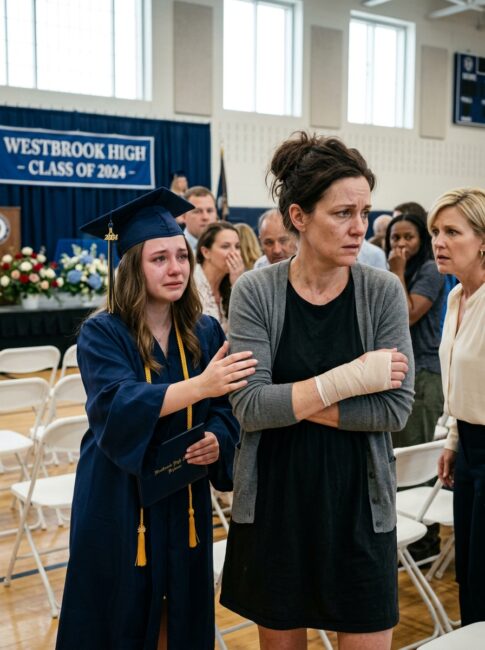
Her mother’s hand slipped from her pocket, and for the first time, Grace saw the bandage wrapped around her wrist and the purple bruise near the vein.
Mrs. Bennett covered her mouth.
Dana looked at her daughter and shook her head once, almost begging her not to misunderstand yet.
But Grace was already understanding one small piece.
Her mother had not refused to hold her hand because she did not care.
Her hand had been hurting.
And somehow, that little boy knew why.
The boy’s name was Noah Reeves.
Grace had heard the name once before, though she had not known it belonged to him.
Three weeks earlier, Dana had come home late from the hospital wearing a paper bracelet tucked under her sleeve. Grace had been studying at the kitchen table, surrounded by scholarship forms, library books, and a half-empty mug of coffee.
“Are you sick?” Grace had asked.
Dana had shaken her head.
“Just tests.”
“What kind of tests?”
“Nothing for you to worry about.”
Grace had snapped then, because she was tired of being protected by silence.
“Everything is nothing for me to worry about until it ruins our life.”
Dana had stood very still.
Then she went to the sink and washed one clean cup that did not need washing.
Grace had taken that as avoidance.
She had not known her mother was being tested as a possible donor for a child she barely knew.
Noah’s mother, Elise Reeves, worked the early shift at the same grocery store where Dana stocked shelves overnight. She was a thirty-one-year-old single mother who packed sandwiches in foil, wore the same winter coat for four years, and never asked coworkers for anything.
But one night in the break room, Elise broke down over a vending machine coffee.
Her son needed a medical match that had not come from family. The registry had found possibilities, but nothing close enough yet. Time was turning into a number doctors said carefully.
Dana listened.
Dana, who had once received a stranger’s help when Grace was a baby and their electricity had been shut off. Dana, who remembered what desperation sounded like when it tried to apologize for existing. Dana, who had no money to give and no powerful people to call.
So she asked a quiet question.
“How do they test?”
Elise thought she was being polite.
Dana was not.
The first screening took place on a Tuesday after a ten-hour shift. The second came after Dana cleaned two office buildings and before she picked up Grace’s graduation gown from the dry cleaner. The third required more blood, more waiting, and a long conversation with doctors who repeated that there were risks, discomfort, and no guarantee.
Dana told no one.
Not because she was ashamed.
Because she knew Grace.
Grace would have begged her not to do it. She would have said they had already lost enough time together. She would have said another family’s emergency did not get to steal her mother from graduation day.
And Grace would have been partly right.
That was what made the silence heavy.
Dana had spent eighteen years choosing between wrong-looking options. Work or school play. Rent or birthday cake. Exhaustion or groceries. Pride or asking for help.
Now she had chosen a boy’s chance at life over looking perfect in her daughter’s eyes.
The procedure happened early that morning, before graduation.
The doctors did not love the timing. Dana did not either. But Noah’s treatment window had narrowed, and the medical team moved when they could. Dana signed the forms at 5:06 a.m., kissed a cross necklace she no longer wore publicly, and asked only one question.
“Will I still make my daughter’s ceremony?”
A nurse told her she should rest.
Dana said, “I have rested enough in all the wrong places.”
By 1:30, she was standing in the Westbrook High gym, pale and dizzy, with instructions not to strain her arm, not to risk the incision, and not to expose the bandage to the crowd’s jostling hands.
Grace did not know that.
She only knew her mother pulled away.
When Grace reached for her near the stage, Dana saw more than a hand.
She saw her daughter’s honor cords, diploma path, and future opening in front of her. She saw the sharp metal pin on the medal ribbon. She saw her own fresh bandage, barely hidden under a thin cardigan. She saw the assistant principal moving students quickly toward the steps.
And she saw Noah’s mother by the side doors, waiting to bring the boy in after the first announcement.
Dana had planned to explain after the ceremony.
Quietly.
Privately.
Without taking a single inch of attention from Grace.
But Noah had begged to come.
“I want to say thank you to the girl,” he had told his mother.
Elise had said, “To Dana?”
Noah shook his head.
“To her daughter. She had to share her mom.”
When Dr. Wallace saw the boy’s sign, he stopped the program.
No principal plans for a moment like that. He simply stepped aside.
Noah’s wheelchair rolled farther into the gym, pushed by Elise, whose face was wet before she reached the stage.
Dana shook her head again, but it was too late.
The truth had entered on small wheels, holding cardboard.
Grace descended the steps slowly.
This time, she did not reach for Dana’s injured hand.
She stood in front of her mother and looked at the bandage, the hospital bracelet, the bruise, the pale lips Dana had tried to hide with drugstore lipstick.
“Why didn’t you tell me?” Grace whispered.
Dana’s answer came barely above breath.
“Because today was yours.”
Grace laughed once, broken and unbelieving.
“You thought I wanted a perfect photo more than I wanted to know you were hurting?”
Dana looked down.
“I thought you had earned one day where my choices didn’t cost you anything.”
That sentence broke the gym more than any announcement could have.
Mrs. Bennett turned away. Dr. Wallace removed his glasses. Noah’s mother pressed both hands against her mouth and sobbed without sound.
Grace’s anger did not vanish.
Real hurt rarely does.
But it changed shape.
She looked at her mother, who had seemed absent for years, and suddenly saw the invisible math behind every absence. Night shifts. Hospital rides for other people. Bills paid late so field trip money could be turned in on time. A donated hand hidden on graduation day.
Grace lifted her diploma folder.
Then she slipped it under her arm, freeing both hands.
Dana noticed and tried to step back.
“No,” Grace said softly.
She wrapped her arms around her mother’s shoulders, careful of the bandage.
Dana stood stiff for one second, as if she still did not believe she was allowed to receive comfort on a day she had failed to look worthy of it.
Then she folded into her daughter.
The gym stayed silent.
No applause.
No music.
Just an eighteen-year-old girl holding the woman who had refused her hand because that hand had already been given away to help keep someone else’s child alive.
Over Grace’s shoulder, Noah lifted his sign again.
The cardboard trembled.
Grace saw it and reached one hand toward him.
Not Dana’s injured hand.
Her own.
Noah smiled.
And in that small distance between a graduate, a mother, and a little boy in a wheelchair, the ceremony became something no one had printed in the program.
The graduation continued, but it no longer felt like a row of names.
It felt like everyone had been invited to look again.
Parents held their children a little longer after photos. Teachers spoke more gently to tired mothers in wrinkled dresses. Students who had once whispered about Grace’s “never-around mom” stood quietly when Dana passed.
Noah stayed near the side doors with Elise, his sign resting across his lap. Dana tried to thank him for coming, but he only looked at her bandaged wrist and asked, “Does it hurt?”
Dana smiled faintly.
“A little.”
“My mom says brave people can still say that.”
Dana looked at Elise, who was crying again.
“She’s right.”
Grace watched from a few feet away, still wearing her cap, her honor cords, and the expression of someone whose life had become larger and more complicated in less than an hour.
After the ceremony, Mrs. Bennett offered to take a picture.
Grace stood between Dana and Noah. Elise stood beside her son. Dana tried to hide her wrist behind her cardigan.
Grace gently uncovered it.
“Leave it,” she said.
Dana looked embarrassed.
“It’s not pretty.”
Grace leaned against her mother’s shoulder.
“It’s part of the day.”
The photo showed no perfect family.
Dana was pale. Grace’s eyes were swollen. Noah’s cardboard sign was crooked. Elise’s mascara had run down one cheek. Behind them, blue graduation banners sagged slightly from the gym wall.
But years later, Grace would keep that picture on her desk.
Not the professional portrait with the diploma.
That one.
That summer, Grace worked at the library before leaving for college. Dana went to follow-up appointments and pretended not to be tired. Some evenings, they sat on the apartment steps with paper cups of lemonade, learning how to speak about hard things before silence could make them heavier.
One night, Grace reached for her mother’s hand.
Dana hesitated.
Not from pain this time.
From memory.
Grace smiled and offered the other one.
They sat like that until the streetlights came on.
A month later, a small envelope arrived from Noah. Inside was a drawing of three hands: one large, one small, and one wearing a graduation ring. Underneath, he had written in careful letters:
Thank you for sharing.
Grace taped it above the kitchen table.
Dana stood beneath it for a long time, one hand resting over her healing wrist.
Then she whispered, “I still should have told you.”
Grace came beside her.
“Yes,” she said.
Dana nodded.
Grace slipped her arm through her mother’s.
“But you showed me.”
Outside, the evening moved softly over their little apartment complex. Somewhere in another part of town, a boy was getting another chance to grow older. Somewhere in Grace’s suitcase, her graduation cap waited beside a folded scholarship letter.
On the refrigerator, the photo from the gym curled slightly at the corner.
Dana did not look like the perfect mother in it.
She looked exhausted, frightened, and human.
Grace loved that version more honestly than any perfect one.
Follow this page for more emotional stories about the quiet moments that change how we see the people we thought we understood.