Part 2: A Mother Tore Up Her Daughter’s Award-Winning Painting — The Real Reason Made the Teacher Cry
By the next morning, Claire Dawson had become the woman every parent at Willow Creek Elementary was talking about.
They called her jealous. Unstable. Bitter. Some said she could not stand seeing her daughter shine because her own life had become too small. Others said a mother who worked double shifts at a grocery store might not understand art, recognition, or childhood dreams.
Ms. Amelia Carter heard all of it.
She did not join in.
She stood alone in her classroom before the first bell, staring at the empty space where Sophie’s painting had been displayed. The blue ribbon still hung from a pushpin on the bulletin board, slightly bent from where Sophie had held it too tightly.
On Ms. Carter’s desk sat the torn canvas.
Claire had not thrown it away.
That was the first strange thing.
After ripping the painting in front of nearly two hundred people, she had carried the pieces backstage, wrapped them in brown paper, and placed them into Ms. Carter’s hands.
“Do not let anyone photograph this again,” Claire had whispered.
Then she left.
At the time, Ms. Carter had been too angry to understand the sentence.
Now, with morning light spreading across the art room, the words sounded different.
Not “destroy it.”
Not “hide my daughter’s talent.”
Do not let anyone photograph this again.
Ms. Carter unfolded the brown paper carefully.
The painting was damaged, but not ruined beyond recognition. The yellow house still glowed beneath the painted sky. The little girl still stood in the doorway. The woman with the red lunchbox remained at the far edge of the yard, her face turned away.
Ms. Carter touched the torn canvas with two fingers.
Sophie had painted with unusual patience. Every window had a curtain. Every brick had a faint line. Even the mailbox had a tiny silver flag raised.
That was when Ms. Carter noticed the corner.
Near the bottom left, behind a row of painted marigolds, Sophie had added something so small most people would have missed it.
A dark blue car.
It was parked halfway behind a maple tree, almost hidden by shadow.
Ms. Carter leaned closer.
The car had one broken headlight.
Her throat tightened, though she did not yet know why.
At 8:12, Sophie arrived at school holding her grandmother’s hand.
She was not crying anymore, which somehow made it worse. Her eyes looked swollen, but quiet. Like she had spent all night learning not to ask questions.
Ms. Carter met them at the classroom door.
“Sophie,” she said gently, “would you like to sit with me before class?”
Sophie looked past her, toward the empty display wall.
“My mom ruined it,” she said.
Ms. Carter did not correct her.
She wanted to. She wanted to say that maybe Claire had a reason, that maybe adults did terrible-looking things for complicated reasons. But Sophie was nine, and the wound was still fresh.
So Ms. Carter only nodded.
“I know it feels that way.”
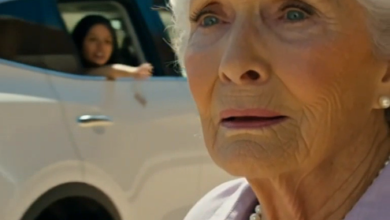
Sophie’s grandmother, Helen, squeezed the girl’s shoulder. She was a small white American woman in her late sixties, with gray curls and a face lined by long years of worry.
“Claire didn’t sleep,” Helen murmured.
Sophie looked down.
“She didn’t say sorry.”
Helen’s mouth moved, then stopped.
That was the second strange thing.
A grandmother who clearly loved Sophie did not defend the mother, but she also did not condemn her.
During class, Sophie did not paint.
She sat with a blank sheet in front of her while the other children worked on watercolor leaves. At recess, she stayed inside to sharpen colored pencils that were already sharp.
Ms. Carter sat beside her.
“Can I ask you something about your painting?”
Sophie shrugged.
“The little blue car in the corner,” Ms. Carter said. “Was that part of the house?”
Sophie’s hand froze on the pencil sharpener.
For the first time that day, fear crossed her face.
Not sadness.
Fear.
“It was just a car,” Sophie whispered.
“Did you see it somewhere?”
Sophie shook her head too quickly.
Then she said, “I’m not supposed to talk about cars.”
Ms. Carter kept her voice steady.
“Who told you that?”
Sophie’s eyes filled, but she did not answer.
At 2:45, Claire arrived early for pickup.
She stood outside the classroom door, still in her grocery uniform, with a name tag crooked over her chest and dark circles beneath her eyes. Parents nearby stepped away from her as if cruelty might be contagious.
Claire noticed.
She accepted it without flinching.
Ms. Carter walked toward her with the brown paper package.
“I need to ask you about the car,” she said softly.
Claire’s face changed.
Not in anger.
In recognition.
She looked toward Sophie, who was packing her backpack with careful little movements.
“Did she tell you?” Claire asked.
“No,” Ms. Carter said. “But she looked scared.”
Claire closed her eyes.
For a moment, she seemed older than thirty-six.
Then she whispered, “That means he saw it too.”
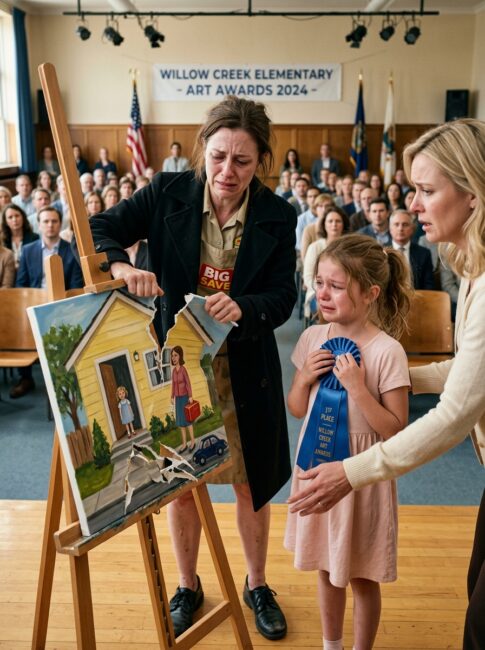
Ms. Carter did not understand until Claire showed her the photograph.
They sat in the empty art room after dismissal, while rain tapped softly against the windows and the smell of tempera paint lingered in the air. Sophie waited with Helen in the library, eating crackers and pretending to read.
Claire took her phone from her coat pocket.
Her hands were shaking.
“I am not trying to excuse what I did,” she said. “I know what it looked like.”
Ms. Carter stayed silent.
Claire opened an old photo and slid the phone across the table.
It showed the same yellow house from Sophie’s painting.
Not a made-up house.
Their house.
The front porch was smaller in real life. The curtains were faded. The maple tree had grown crooked near the driveway. But it was the same house, painted from memory with the kind of accuracy only a child carries.
In the corner of the photo, half hidden behind the tree, was a dark blue car with one broken headlight.
Ms. Carter looked up slowly.
Claire’s eyes were wet now, but she did not wipe them.
“That car belonged to Sophie’s father,” she said.
The room seemed to lose sound.
Claire explained in pieces, the way people speak when memory still has sharp edges.
Sophie’s father, Mark, had left when Sophie was six. At first, he sent birthday cards and small stuffed animals from gas stations. Then the calls changed. He wanted money. He wanted to know where Claire worked. He wanted to know when Sophie was alone with Helen.
Claire had tried to keep things calm.
She changed shifts. Changed locks. Changed routines.
She never told Sophie the worst parts because children should not have to carry adult fear in their lunchboxes.
Then, eight months earlier, Mark appeared outside the house at dawn.
Sophie had been looking through the kitchen window while eating cereal. She saw the dark blue car under the maple tree.
Claire called the police. By the time they arrived, the car was gone.
After that, Claire moved them to Helen’s apartment for six weeks. She filed reports. She saved messages. She spoke to advocates who used careful words like “pattern,” “risk,” and “documentation.”
Sophie knew only one rule.
If you see the blue car, tell Grandma or Mom.
Do not talk about it at school. Do not draw it. Do not point at it in public.
Because Mark still had relatives in town. Because he still had friends who believed Claire was being dramatic. Because one photo online could tell him exactly where they were staying, what Sophie remembered, and what she had seen.
Ms. Carter looked down at the torn painting.
The district art contest had posted every winner on its public page.
The paintings had been photographed in the auditorium before the ceremony.
The little blue car had been clear enough for someone to recognize it.
Claire had learned about the post only fifteen minutes before walking into the auditorium. A coworker had shown her the photo during break.
There it was, bright and innocent.
Sophie’s painting.
Their yellow house.
The maple tree.
The blue car.
And beneath it, Sophie Dawson, Willow Creek Elementary, First Place.
Claire had tried to call the school office from the grocery store, but the ceremony had already started. She drove through rain, parked badly, ran inside still wearing her uniform, and saw parents lifting phones toward the stage.
Sophie stood smiling beside the painting.
And Claire saw the corner.
The car.
The broken headlight.
The one detail her daughter had painted because memory had no idea how to protect itself.
“I couldn’t explain in that room,” Claire said. “I couldn’t say his name with all those phones up. I couldn’t make Sophie afraid in front of everyone.”
“So you tore it,” Ms. Carter whispered.
Claire nodded once.
“I thought if I destroyed the painting, people would stop recording it. They would record me instead.”
Ms. Carter’s eyes filled.
That was the twist that broke her.
Claire had not destroyed her daughter’s moment because she hated it.
She had destroyed herself inside that room so the room would look away from Sophie.
Every phone turned toward the angry mother. Every whisper attached itself to Claire. Every judgment landed on her name, not on the small hidden clue in the painting.
She became the story on purpose.
Ms. Carter covered her mouth.
“I posted the photo,” she said.
Claire shook her head quickly.
“You didn’t know.”
“I should have looked closer.”
“You saw a child’s painting,” Claire said. “That is what it should have been.”
The words sat between them like something fragile.
Then Ms. Carter did what she should have done the night before.
She cried.
Not loudly.
Not dramatically.
Just one hand against her lips, shoulders folding inward, because she had spent twelve years teaching children to express what they could not say, and she had almost missed the most important message Sophie ever painted.
A small blue car.
A broken headlight.
A child trying to put fear into a corner where no one would notice.
The next morning, Ms. Carter requested a private meeting with the principal, the district communications director, and the school counselor. Claire came too, though every step through the front office seemed to cost her.
The principal, Dr. Monroe, began stiffly.
“Mrs. Dawson, we received several parent complaints about your conduct at the ceremony.”
Claire folded her hands in her lap.
“I understand.”
Ms. Carter placed the torn painting on the conference table.
Then she placed the photograph beside it.
Nobody spoke for several seconds.
The communications director removed the contest post from the district page before the meeting ended.
The counselor arranged support for Sophie.
Dr. Monroe apologized in a voice that sounded smaller than usual.
Claire accepted it with a tired nod.
She did not ask for a public correction. She did not demand that parents be told the private truth. She asked only for one thing.
“Please let Sophie still be proud of the parts she meant to paint.”
That afternoon, Ms. Carter invited Sophie into the art room.
The torn canvas lay on the table, but now it was surrounded by soft tape, rice paper, and a small bottle of archival glue Ms. Carter had borrowed from the high school art department.
Sophie stopped at the doorway.
“My mom broke it,” she said.
Ms. Carter crouched to her height.
“Yes,” she said. “And now we are going to repair it together, if you want.”
Sophie stared at the pieces.
“Can we take out the car?”
Claire, standing behind her, went very still.
Ms. Carter waited.
Sophie’s voice dropped.
“I don’t want it in my house anymore.”
Claire’s face crumpled.
For the first time since the ceremony, Sophie turned toward her mother not with accusation, but with a question.
“Were you mad at me?”
Claire knelt so quickly her name tag hit the floor.
“No, baby,” she whispered. “I was scared for you.”
Sophie looked at the torn painting, then back at her mother.
“You scared me too.”
Claire took that sentence without defending herself.
“I know.”
Sophie stepped forward, small and trembling, and placed the blue ribbon in Claire’s hand.
“Hold this while I fix it,” she said.
Claire closed her fingers around the ribbon as if it weighed more than anything she had ever carried.
The repaired painting did not look the same.
The tear down the middle remained visible, even after Ms. Carter and Sophie sealed it carefully from the back. The sky had a pale seam. The yellow house bent slightly where the canvas had stretched. The corner where the blue car had been was covered by a new patch of marigolds, brighter than the others.
Sophie named the new version “The House That Stayed.”
Ms. Carter hung it in the art room, not the hallway.
No photos were posted.
No announcement was made.
Children who came into class asked about the line through the sky, and Sophie answered in the calm way children sometimes do after adults finally tell them enough truth.
“It got hurt,” she said. “But we fixed what we could.”
A week later, Willow Creek held parent-teacher conferences.
Claire arrived at 6:10 in her grocery uniform, carrying a small paper bag of muffins from the clearance rack. The hallway grew quieter when she walked in, though not as cruelly as before.
Mrs. Bennett, the mother of a fourth grader, approached her near the drinking fountain.
Claire braced herself.
“I was there that night,” Mrs. Bennett said.
Claire nodded.
“I said things I should not have said.”
Claire looked down at the muffins.
Mrs. Bennett’s eyes moved toward the art room, where the repaired painting hung in warm light.
“I don’t need to know why,” she added. “I just wanted to say I’m sorry.”
Claire did not answer right away.
Then she offered her the paper bag.
“Take one,” she said. “They’re blueberry.”
It was not forgiveness exactly.
It was something quieter, and perhaps more honest.
Inside the art room, Sophie showed Helen the repaired painting. The grandmother touched the new marigolds with one careful finger and smiled through tears she tried to hide.
“You made the flowers bigger,” Helen said.
Sophie nodded.
“They needed to cover something.”
Claire stood in the doorway, watching her daughter explain color choices to Ms. Carter like nothing in the world had ever interrupted her. The blue ribbon was pinned beside the painting now, but not over the tear.
Sophie had insisted on that.
“The line is part of it,” she said.
Before leaving, Claire walked to Ms. Carter’s desk and placed a folded note beside a jar of paintbrushes.
Ms. Carter opened it after everyone had gone.
Thank you for helping her keep the picture without keeping the fear.
Beneath the note was a tiny sketch Sophie had drawn in pencil.
A yellow house.
A girl in the doorway.
A mother in a grocery uniform walking across the yard with a red lunchbox.
No blue car.
Only marigolds.
That night, after Sophie fell asleep, Claire taped the sketch to their refrigerator. She stood there for a long time in the hum of the kitchen light, one hand resting against the paper.
The house was not perfect.
The family was not untouched.
But in the drawing, the mother was coming home.
And the door was open.
Follow this page for more emotional stories about the moments that change how we see the people we thought we understood.