A Neighbor Screamed That A Kid Was Vandalizing A Biker’s Chrome Motorcycle With Pink Spray Paint—Then The Biker Opened His Saddlebag And Handed Him Another Can.
Part 2
Hound looked down at the boy for a long moment before he answered.
“Not yet,” he said quietly. “Needs another coat. And we haven’t done the fenders.”
Caleb nodded hard, sniffed, pulled his paper mask back up, and went back to spraying.
Behind them, Brad Whitlock was still standing at the fence with his phone pressed to his ear, looking at the giant biker as if he’d lost his mind.
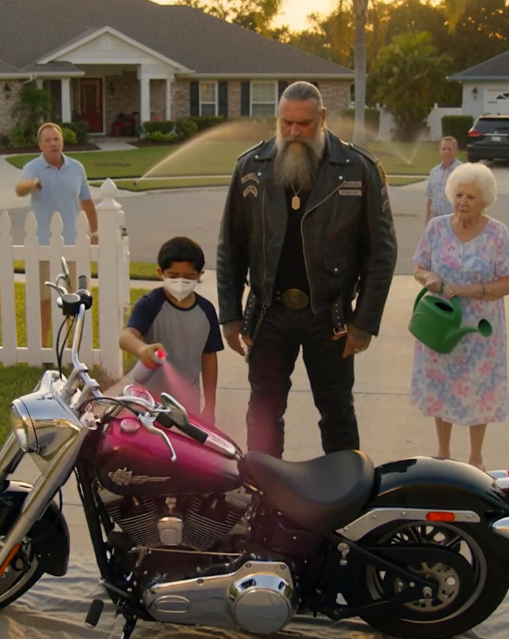
“Sir? Sir, are you still there?” came the dispatcher’s voice.
Brad lowered the phone. “No. I… never mind. Cancel it.”
He hung up and stood there a second longer, staring. Then he turned and walked back to his own perfect lawn without another word.
The neighbors drifted back toward their houses one by one. A few kept glancing back over their shoulders. Old Mrs. Lindqvist stayed by her roses for a long time with her hand on her chest.
Hound kept his eyes on the boy.
Six days earlier, Caleb Ortiz had knocked on his front door.
Hound had been in the garage, as he usually was on weekday evenings, with the radio on and his hands black with grease. He’d heard the doorbell and almost ignored it. When he finally opened the door, there was a skinny twelve-year-old standing on his porch in a faded green T-shirt, holding a spiral notebook against his chest like a shield.
The boy had obviously practiced what he was going to say.
“Mister, my name is Caleb. I live on Pelican Street, by the canal. I’m going to every house in the neighborhood that has a motorcycle.” He swallowed. “Could I please paint yours pink? Just for one day? I’ll clean it all off after. I promise. I saved up for paint remover.”
Hound remembered staring at him.
Behind the boy, he could see the spiral notebook. It was a list of addresses written in careful pencil, every house in Palmetto Ridge with a motorcycle in the driveway. There were fourteen houses.
Thirteen of them had been crossed out.
Some had little notes beside them in the boy’s handwriting. Said no. Said get off his porch. Laughed. Slammed door. Beside one address on Magnolia Court, just across from Hound’s own house, the note read: Said not letting some dying kid scratch his paint.
Hound’s was the last house on the list.
He should have asked why. Anybody would have asked why. Instead, he heard himself say the only thing that came to mind.
“Which pink?”
Caleb had stared at him like he’d grown a second head. Then the boy burst into tears right there on the porch, and Hound didn’t know what to do except put one big hand on his shoulder and wait.
The boy told him the rest through the screen door.
His little sister, Lucia, was seven. The family called her Lulu. She had acute myeloid leukemia, and she’d been in and out of the children’s hospital in Tampa for fourteen months. The chemo had stopped working. The doctors had started using words like palliative and comfort. They were searching for a bone marrow donor, but nobody in the family matched and the registry hadn’t found anyone.
A wish foundation had asked Lulu what she wanted most in the whole world.
She had said she wanted to ride on a pink motorcycle.
The foundation had a waiting list ten months long.
Their mother, Maria, cleaned offices at night and worked at a laundromat during the day. There was no money for anything like that. So Caleb made the list and started knocking on doors.
Now he stood in Hound’s driveway spraying pink paint across nine years of hand-built chrome, crying the whole time.
Hound reached into his jacket pocket and pulled out his phone. He scrolled to a name he hadn’t called in almost a year: Dutch Mahoney, president of the Saltmarsh Riders.
“Dutch,” he said, when the gruff voice answered. “I need everybody. Next Saturday.”
Part 3
They finished the paint job on Sunday afternoon.
It took four cans and two full days. Caleb did the gas tank, the front fender, and the rear fender, and Hound did the hard curves. When it was done, the old chrome-and-black cruiser was a bright, shocking bubblegum pink from front to back. Six glittery unicorn decals were stuck on the tank and fenders, and pink ribbon streamers were tied to the handlebar grips.
Caleb stood back in the driveway and stared at it with his mouth open.
“It looks like a cake,” he whispered.
“Is that good?”
“Lulu loves cake.”
Hound almost smiled.
That evening, after Caleb rode his bicycle home to Pelican Street, Hound stood alone in his garage looking at the pink motorcycle under the fluorescent lights.
He had built that bike himself over nine years. He’d started with a rusted frame from a junkyard in Gainesville and rebuilt every bolt and wire himself, on weeknights and Sundays. He had polished every piece of chrome by hand.
He crouched down and reached under the seat, where nobody ever looked. His fingertips found the small engraving he’d cut into the frame with a hand tool the night he’d finished the bike.
FOR LACEY. WHEN YOU’RE BETTER.
He stayed crouched there a long time.
On Monday morning, the trouble started.
Hound found a bright orange notice tucked under the windshield wiper of his pickup truck. It was from the Palmetto Ridge Homeowners Association.
VIOLATION NOTICE. Section 7.4: All vehicles stored in view of the street must conform to neighborhood aesthetic standards. The pink motorcycle displayed in your driveway constitutes an unapproved exterior color. Fines of $100 per day will accrue until the violation is corrected.
It was signed B. Whitlock, HOA President.
By Tuesday, a second notice arrived. Word had reached the HOA that an unpermitted motorcycle gathering was planned for the neighborhood on Saturday. Large gatherings of motorized vehicles required board approval, which had been denied. Anyone participating would be cited, and the sheriff’s office had been notified.
By Wednesday, Brad Whitlock had posted on the neighborhood app.
Neighbors, I want to be transparent. A local resident with motorcycle gang ties is planning to bring dozens of bikers into our community this weekend. He’s using a sick child to justify it. I’ve personally seen him let a minor handle toxic spray paint without supervision. I’m worried about our property values, and frankly about that child’s family being exploited. Please stand with the HOA.
There were a hundred and forty replies by noon. Some neighbors agreed with Brad. Some called Hound dangerous. One woman wrote that the poor Ortiz family should be ashamed for begging door to door.
Caleb’s mother saw it.
On Wednesday night, Maria Ortiz came to Hound’s door. She was a small, exhausted woman in her thirties, still in her laundromat apron. Caleb stood behind her, looking at his feet.
“Mr. Reese,” Maria said quietly, “I’m so sorry for all this trouble. I didn’t know Caleb was going door to door. I didn’t know he’d painted your motorcycle.” Her eyes filled. “People are saying terrible things. Maybe we should just cancel Saturday. Lulu doesn’t even know about it yet. Maybe it’s better if she never finds out.”
Part 4
Hound stood in his doorway and looked at the woman for a long time.
Then he stepped aside.
“Mrs. Ortiz, would you come in a minute? Both of you.”
He led them through his small, plain house to the garage and turned on the lights.
The pink motorcycle sat in the middle of the floor, glittering with unicorns. Maria put her hand over her mouth.
“Oh my God,” she whispered. “Your beautiful bike.”
“It’s still beautiful,” Hound said. “Just pink now.”
He walked over to the workbench. On the wall above it, half hidden behind a calendar from an auto-parts store, hung a small framed photograph. He took it down and handed it to Maria.
It showed a little girl of about eight with no hair, grinning from a hospital bed. She wore a pink knit cap and held a small toy motorcycle in both hands.
“That’s Lacey,” Hound said. “My daughter.”
Maria looked up at him.
“She had leukemia too,” he said. “Fifteen years ago. All she ever talked about was riding on my motorcycle. Every time I visited the hospital, she’d ask me, Daddy, when can I ride with you?”
He was quiet for a moment.
“I always told her the same thing. When you’re better, baby. When you’re better.”
Caleb looked up at him from the doorway.
“She didn’t get better,” Hound said. “She was eight. They never found a donor.”
The garage was silent except for the hum of the fluorescent lights.
Hound reached down under the seat of the pink motorcycle and showed Maria the engraving he’d cut into the frame: FOR LACEY. WHEN YOU’RE BETTER.
“Built this bike for her,” he said. “Took me nine years. Kept thinking if I finished it, I’d feel like I kept the promise.” He shook his head slowly. “Never did.”
He pushed up his left sleeve. On the inside of his forearm was a small tattoo of a pink motorcycle the size of a quarter, with a single name under it in cursive: Lacey.
“When your boy came to my door with that notebook,” Hound said, “and every house on that list had told him no, I didn’t need to ask why. I already knew why.”
Maria was crying openly now. Caleb had moved closer, staring at the tattoo.
“I don’t care about the HOA, ma’am,” Hound said. “I don’t care about the fines or what anybody’s writing on their phones. Your little girl is going to ride on a pink motorcycle this Saturday, with every biker I can find riding behind her.” His voice roughened. “I broke my promise once. I’m not breaking it twice.”
Maria couldn’t speak. She just nodded.
On Thursday morning, Hound’s phone buzzed with a text from an unknown number.
Mr. Reese, this is Ashley Whitlock, Brad’s daughter. I’m 16. I need to show you something about my dad. Can I come over after school?
Part 5
Ashley Whitlock showed up at 3:40 that afternoon on a bicycle. She was nervous, in a softball jersey, holding her phone with both hands.
She sat on an overturned bucket in Hound’s garage, staring at the pink motorcycle.
“I saw what my dad posted,” she said. “About you. About Caleb. It made me sick.”
She turned her phone around.
It was a clip from the Whitlock family’s front-door camera, the kind with a motion sensor that records anyone who comes onto the porch. The time stamp read the previous Monday, 5:14 p.m.
Caleb Ortiz stood on the Whitlocks’ porch, holding his spiral notebook. Brad opened the door in his polo shirt.
The audio was clear.
“Mr. Whitlock, could I please paint your motorcycle pink? Just for one day? It’s for my little sister. She’s really sick and—”
“Kid, do you know what that bike costs? Forty grand. I’m not letting some dying kid scratch my paint.”
The door closed in Caleb’s face.
The clip showed the boy standing there alone on the porch for a few seconds. Then he slowly opened his notebook, wrote something down, and walked away.
Hound didn’t say anything for a long time.
“He doesn’t know I saved it,” Ashley whispered. “The camera app is on the family account. I watched it the day it happened. I felt so bad I couldn’t sleep.” She looked down. “And then he wrote all that stuff about being worried about the family. Like he cared about them. He told Caleb to his face he wasn’t letting a dying kid touch his bike.”
“Why are you showing me this?” Hound asked quietly.
“Because Caleb’s in my brother’s grade,” Ashley said. “And because my grandma died of cancer last year, and my dad didn’t even visit her in the hospital. He said it was too depressing.” She swallowed. “And because nobody else in this neighborhood said yes to that kid except you.”
She hesitated.
“There’s something else. The HOA. Dad’s been telling the other board members that you’re a gang member and the bikers are going to tear up the neighborhood. He’s calling an emergency board meeting tomorrow night to make the fines permanent and get the sheriff to block the street Saturday morning.”
“Who’s on the board?”
“Five people. Dad, two of his golf friends, Mr. Patel from Heron Lane, and Mrs. Lindqvist.” Ashley glanced across the street. “She’s the swing vote. She’s eighty-three. Dad thinks she’ll go along with whatever he says.”
Hound looked out the garage window across Magnolia Court. Esther Lindqvist was out watering her roses again, slowly, in the evening heat.
He thought about the way she’d stood frozen by her fence on Saturday afternoon with her hand over her heart.
“Ashley,” Hound said, “would you be willing to send that video to someone?”
She looked at him, frightened.
“To my dad?”
“No,” Hound said. “To her.”
Part 6
The Palmetto Ridge Homeowners Association met in the clubhouse by the community pool. It usually drew a dozen people for an emergency session.
On Friday night, it drew a hundred and fifty.
The neighborhood app post had brought them. Some came to support Brad. Some came out of curiosity. And some came because word had spread that a dying seven-year-old girl’s wish was about to be canceled by a homeowners association.
Brad Whitlock sat at the head of the folding table in a crisp button-down, flanked by his two golf friends, Mr. Patel, and Esther Lindqvist in a pale blue cardigan.
At 7:00 p.m. sharp, Brad called the meeting to order.
“Thank you all for coming,” he said smoothly. “Let me be clear. This isn’t about a sick child. We all feel for the Ortiz family. This is about rules, safety, and our property values. One resident has defaced his vehicle in violation of Section 7.4, and he’s planning to bring a large motorcycle gang into our community without a permit.” He looked out at the room. “I’m proposing we make the fines permanent and formally request that the sheriff block entry to Magnolia Court tomorrow morning.”
Some of the crowd applauded.
Then the clubhouse doors opened.
Hound walked in, in his leather jacket. Behind him came Maria Ortiz in her laundromat apron, holding Caleb’s hand.
Behind them came thirty men and women in black leather, every one with a pink ribbon tied around their arm. These were the Saltmarsh Riders. Dutch Mahoney, their president, was a seventy-year-old Vietnam veteran with a white beard to his belt. They lined the back wall of the clubhouse in silence, arms folded.
Brad’s face tightened. “This is a private board meeting for residents.”
“I’m a resident,” Hound said. “I’d like to speak during public comment.”
Brad hesitated, then nodded stiffly.
But it wasn’t Hound who stood up first.
Esther Lindqvist rose slowly from her chair at the board table, holding her phone in a trembling hand.
“Before we vote, I’d like everyone to see something,” she said. “A young lady sent it to me last night.”
She plugged her phone into the projector cable on the table. The front-door camera clip filled the screen on the clubhouse wall.
There was Caleb Ortiz on the Whitlocks’ porch with his notebook, asking very politely. It’s for my little sister. She’s really sick.
Then came Brad Whitlock’s voice, loud and clear in the silent clubhouse.
“I’m not letting some dying kid scratch my paint.”
The door closed in a twelve-year-old boy’s face. The boy stood there alone on the porch, then wrote something in his notebook and walked away.
Nobody in that room made a sound.
Brad had gone white. “That’s… that’s an invasion of my privacy. That’s my home security system—”
“Your daughter sent it to me, Bradley,” Esther said quietly. “She said she couldn’t sleep.”
From the back of the room, a softball jersey moved. Ashley Whitlock stood by the door with her arms wrapped around herself, looking straight at her father.
Brad stared at her.
Esther turned to face the room.
“I’ve lived on Magnolia Court for forty-one years,” she said. “My Harold was on this board for twenty of them. He’d be ashamed of what we’re about to do.” She looked at Brad. “I move that all violation notices against Mr. Reese be withdrawn. I move that the HOA formally approve tomorrow’s ride. And I move that we hold an immediate vote of no confidence in our president.”
Mr. Patel seconded it before she’d finished.
The vote was four to one.
Brad Whitlock gathered his papers and walked out of the clubhouse without speaking to anyone. His daughter didn’t follow him.
When the room finally broke into applause, Caleb tugged at Hound’s jacket sleeve.
“Does this mean Lulu gets to ride?”
Hound looked down at him.
“Tomorrow morning,” he said. “Ten o’clock.”
Part 7
On Saturday morning at 9:45, Lucia Ortiz was sitting in a wheelchair in the driveway of the small rental house on Pelican Street.
She was seven years old and weighed forty-one pounds. She was bald under a pink knit cap. A thin tube ran from her arm to a small IV pump in her mother’s bag. The nurses at the children’s hospital had given her a day pass and a list of instructions three pages long.
She didn’t know why she was there.
Caleb stood beside her, bouncing on his toes.
“What’s happening?” Lulu asked for the fifth time.
“You’ll see,” Caleb said. “Just listen.”
At 9:58, she heard it.
It was a low, deep rumble coming from far away down the canal road, like summer thunder. It got louder, and then louder still, until the windows of the little rental house started to rattle.
The pink motorcycle came around the corner first.
It was bright bubblegum pink from front to back, glittering with six unicorns, its pink ribbon streamers flying from the handlebars. Hound rode it slowly, his gray beard blowing, with a pink ribbon tied around his own arm.
Behind him came the rest.
Hound had asked for every biker he could find. The Saltmarsh Riders came from Marion County. The Gulf Coast Riders came from Citrus County, and the Lake Crossing Brotherhood from Sumter. There were sixty motorcycles riding in a long, slow line two by two down Pelican Street, every rider with a pink ribbon tied somewhere on their bike or their arm.
Neighbors came pouring out of their houses.
Lulu’s mouth fell open. Her small hands came up to her face.
Hound rolled the pink motorcycle to a stop right in front of her wheelchair and cut the engine.
Lulu stared at it.
“It’s pink,” she whispered.
“Your brother painted it,” Hound said gently. “Took him two days.”
Lulu turned and looked at Caleb, who was crying again. She reached out and grabbed his hand.
The nurse who’d come along from the hospital helped them. They strapped Lulu into a small padded child’s seat Hound had bolted onto the pink bike. Then they fitted her with a tiny pink helmet that Dutch Mahoney’s wife had found at a shop in Ocala. They secured her IV pump in a padded bag on Hound’s back. Maria climbed onto the back of Dutch’s bike right behind them so she could watch her daughter the whole way.
Hound turned around in his seat.
“You ready, Lulu?”
“Is it gonna be loud?”
“Real loud.”
“Good,” Lulu said.
He started the engine. Lulu squealed.
They rode slowly, never more than fifteen miles an hour, through every street in Palmetto Ridge. They went down Pelican Street, along the canal, and through Heron Lane. Sixty motorcycles rolled behind them in a long, rumbling line with pink ribbons flapping in the wind.
People lined the sidewalks. Kids ran alongside. Mrs. Lindqvist stood at the end of her driveway on Magnolia Court in her blue cardigan, waving a pink dish towel over her head. Ashley Whitlock stood beside her, waving too.
And all the way through, Lucia Ortiz laughed.
She laughed from the moment the engine started until the moment it stopped, forty-five minutes later. Her small arms were thrown straight up in the air the whole time. The wind made her pink cap flap, and she shrieked with joy at every turn.
Hound kept his eyes on the road and didn’t let himself look back at her very often.
When he did, he had to pull over twice.
Part 8
When the ride was over, the Saltmarsh Riders did one more thing.
Before they rode home, Dutch Mahoney set up a folding table at the end of Pelican Street. It was a bone marrow registry drive. It took a cheek swab and a form, five minutes per person.
Sixty bikers swabbed first. Then the neighbors came: Mr. Patel, Ashley Whitlock’s older cousin, a mail carrier, two firefighters from the Palmetto Ridge station, and a dozen college kids home for the summer. By sundown, a hundred and eighty-four new donors had joined the registry.
Seven weeks later, Maria Ortiz got a phone call from the children’s hospital in Tampa.
They had found a match.
The donor was a twenty-four-year-old named Jesse Navarro. He’d ridden in from Citrus County with the Gulf Coast Riders that Saturday morning, the forty-third bike in line. He had never met Lucia Ortiz before he swabbed his cheek at Dutch’s folding table.
Lulu had her transplant in October.
On a bright morning the following June, the doctors at Tampa General told Maria Ortiz the words she’d been afraid to hope for. There was no evidence of disease. Lulu was cancer-free.
Brad Whitlock never got his HOA presidency back. He put his house on Magnolia Court up for sale that winter and moved to a gated community across town. Ashley stayed with her mother. She volunteers at Dutch’s registry drives every year now.
The pink motorcycle is still pink.
Hound never painted it back. When people at gas stations ask him why a 290-pound biker with a gray beard rides a bubblegum-pink cruiser covered in unicorns, he just tells them his best friend designed it.
Every year on the anniversary of the day Lulu was declared cancer-free, Hound rolls the pink motorcycle into the driveway of the little house on Pelican Street. Lulu climbs into the child’s seat on the back, which isn’t so little anymore, and they ride through Palmetto Ridge again with her arms up in the air.
And every year, the night before, Caleb Ortiz comes over to Hound’s garage with a can of pink spray paint.
He’s fifteen now. He fills in every chip and scratch the pink has collected over the year, very carefully, with his tongue sticking out the corner of his mouth.
This past spring, while Caleb was crouched on the garage floor spraying the rear fender, he noticed something under the seat.
It was a second engraving, newer than the first. It had been cut into the frame just below the old words: FOR LACEY. WHEN YOU’RE BETTER.
The new line said: AND FOR LULU. WHO GOT BETTER.
Caleb stayed crouched there a long time, and neither of them said anything.
“My neighbor thought the kid was trashing my bike,” Hound says, when people ask about the pink motorcycle. “I stood there and watched him spray paint over nine years of my work. And for the first time in fifteen years, I got to keep a promise.”
A man in a polo shirt looked at a crying boy with a spray can and a biker covered in tattoos, and he saw vandalism. He had already told that boy he wasn’t letting a dying kid scratch his paint.
The biker had nine years of chrome and every reason to say no. He asked only one question.
Which pink?
If this story touched you, follow our page for more stories like this. And if you’re between 18 and 40, think about joining the bone marrow registry. A cheek swab takes five minutes. Somewhere, a kid is waiting for a match.