Part 2: A Sergeant Dragged A Biker Out Of A “Stolen” Police Cruiser And Slammed Him On The Hood—Then His Deputy Opened The Passenger Door And Everyone Went Silent.
Part 2
The handcuff hung open from one of Doc’s wrists, the steel cold against his skin.
For three long seconds, nobody at the roadblock moved. Then Doc spoke for the first time, low and level, without lifting his hands from the hood.
“Left clavicle’s broken. Something under it’s bleeding, maybe the subclavian, maybe smaller. I packed it and I’ve had pressure on it for twenty-two minutes.” He turned his head toward Garrett. “He doesn’t have another twenty.”
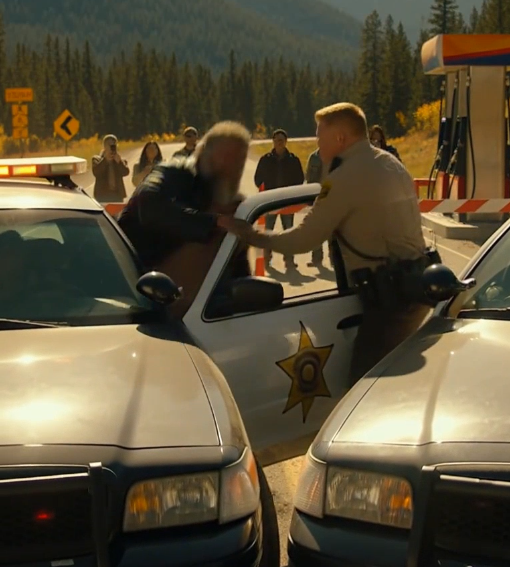
Garrett stared at him.
“Sarge,” Grace said from the passenger door. Her voice cracked. “He’s right. Look at him.”
Garrett looked. Luke’s face had gone the color of old paper. His lips were turning blue at the edges, and his hand had slipped off Garrett’s sleeve and fallen into his lap.
Garrett fumbled with the key and unlocked the cuff.
“We’ll move him to my unit,” he said. “Lin, get the—”
“No,” Doc said.
It was the only word he’d spoken with any heat in it.
“You move him, the packing shifts and he starts bleeding again. He stays in that seat. I drive. You lead.”
Garrett’s jaw worked. Every instinct he had told him not to let a stranger in leather climb back behind the wheel of a sheriff’s cruiser. But Grace was already sprinting for her own car, and Luke’s breathing had gone shallow and wet.
“Fine,” Garrett said. “Stay on my bumper.”
Thirty seconds later, three cruisers tore down the highway toward Pine Hollow with their lights screaming. Garrett’s was in front, Grace’s was behind, and the dusty one in the middle was driven by a bare-chested biker in a leather jacket. His left hand was on the wheel and his right was pressed hard against a deputy’s shoulder.
The hospital was nine miles away. Doc didn’t look at the speedometer.
Luke’s head rolled toward him on the second curve.
“Doc,” he murmured. “Your bike.”
“Don’t worry about the bike.”
“You left it… on the edge.”
“I know where I left it.”
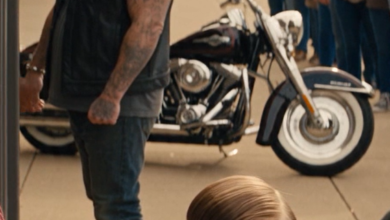
Ninety minutes earlier, Doc had been riding down Elk Pass alone, the way he did every October. On the sharp left-hand curve near mile marker 37, his front tire hit a patch of loose gravel washed across the road by the last rain. The bike went out from under him. He slid thirty feet on his side and stopped against the guardrail, with his old bagger tipped over and half hanging off the shoulder above a two-hundred-foot drop.
He was bruised and scraped, but he was alive.
Ten minutes later, a sheriff’s cruiser came around the bend. Deputy Luke Sandoval pulled over and climbed out with a first-aid kit. He told Doc to sit still while he set out flares so nobody else would come around the blind curve and hit them.
He was bending to light the second flare when the buck came over the guardrail.
It was a big mule deer, maybe three hundred pounds, panicked by the flare. It came straight across the road in one leap and caught Luke square in the chest. He went backward into the steel guardrail with a crack Doc heard from twenty feet away.
Doc had been an Army combat medic for two tours. He knew what that sound was.
There was no cell signal on Elk Pass. There never had been. When Doc grabbed the cruiser radio, it hissed static. The canyon walls swallowed everything.
The nearest ambulance was fifty minutes away, if anyone even knew to send it.
His bike couldn’t carry a man with a broken collarbone and a wound that was pumping blood through his fingers.
So Doc tore his own T-shirt into strips. He packed his leather glove into Luke’s shoulder and tied it down hard. He half-carried, half-dragged a 190-pound deputy into the passenger seat of his own cruiser. Then he left his motorcycle on its side at the edge of the cliff and drove.
The lights of Pine Hollow Regional appeared ahead. Garrett swung into the ambulance bay, and Doc pulled in right behind him.
ER staff were already running out with a gurney.
As they lifted Luke out, Garrett stepped in front of the hospital doors and pointed at Doc.
“Nobody lets that man leave,” he told the security guard. “He’s still under arrest.”
Part 3
They took Luke straight up to surgery. Doc sat in a plastic chair in the ER waiting room with dried blood cracking on his hands, a hospital security guard on one side of him and Sergeant Garrett on the other.
Nobody offered him a shirt. A nurse finally brought him a paper scrub top two sizes too small, and he pulled it on over his tattoos without a word.
Forty minutes later, a surgeon came out still in her cap. She was Dr. Alicia Moreno, gray-haired and brisk, with Luke’s blood on her shoe covers.
“He’s going to make it,” she said. “Clean break of the clavicle. A bone fragment nicked a branch of the subclavian artery. We got it repaired.”
Grace, who had been pacing by the vending machines, sat down hard and put her face in her hands.
“I’ll be honest with you,” Dr. Moreno said. “Thirty more minutes and he’d have lost enough blood that we’d be having a very different conversation.” She looked around the room. “Who packed that wound?”
Nobody answered.
Then Grace pointed at Doc.
Dr. Moreno walked over and studied the big man in the too-small scrubs. “You’re a medic?”
“Was. Army. Two tours.”
“Somebody taught you right.” She held out her hand. Doc looked at his own hand, still stained brown, and shook hers anyway.
Garrett stood up.
“With respect, doctor, that doesn’t change anything. This man drove off in a county vehicle without authorization. And we still don’t know how Deputy Sandoval got hurt.”
“He got hit by a deer,” Doc said quietly.
“So you say.”
Grace stared at her sergeant. “Sarge, Luke told you himself—”
“Luke was half-conscious and in shock. He’d have said anything.” Garrett pulled out his phone. “And I just got off with the sheriff. Sheriff Prentiss wants him held. Grand theft of a law enforcement vehicle. Until we get a clear statement.”
At that moment the ER doors slid open, and a woman ran in, still in her nursing-home scrubs, holding a little boy by the hand. She was Marisol Sandoval, Luke’s wife, and the boy was Benny, seven years old, in a dinosaur T-shirt and light-up sneakers.
Marisol saw Grace first. “Where is he? Is he—”
“He’s out of surgery. He’s okay. He’s going to be okay.”
Marisol broke down. Benny clung to her leg, looking around at all the uniforms.
Then his eyes landed on the big bearded man in the paper scrubs, sitting between a security guard and a sheriff’s sergeant, with dried blood on his hands.
Garrett crouched down to Benny’s level and said something gently. Doc couldn’t hear all of it, only the end.
“…the man who took your daddy’s car.”
Benny’s face went white. He hid behind his mother’s legs and wouldn’t look out again.
Doc looked down at the floor.
Ten minutes later the ER doors opened again. A tall, silver-haired man in a pressed sheriff’s uniform walked in, flanked by a deputy and followed by a local TV reporter and a cameraman with a light already on.
It was Sheriff Dale Prentiss.
Part 4
Sheriff Prentiss was running for reelection in three weeks, and everyone in Alder County knew it.
He gave his statement in the hospital parking lot with the mountains glowing orange behind him. Doc watched it the next morning on a small TV bolted to the wall of a county holding cell.
“Late yesterday, one of our deputies was critically injured on Elk Pass Road. His patrol vehicle was taken and driven at high speed by an individual with no authorization. Thanks to the quick response of my deputies, the vehicle was recovered and a suspect is in custody. We are investigating what role, if any, the suspect played in our deputy’s injuries.”
Then the anchor added: The suspect has been identified as a 49-year-old Pine Hollow man with ties to a local motorcycle club.
Doc closed his eyes.
He knew why Dale Prentiss had said it like that. For two years, the sheriff had been pushing a county ordinance to restrict motorcycle traffic and rallies on Elk Pass. He called it the “Safe Roads Initiative.” He kept telling the commissioners that bikers were the biggest danger on that mountain. The vote was scheduled for that coming Thursday.
A biker stealing a bleeding deputy’s car was the best gift the sheriff could have asked for.
Doc spent that night in a cell with a drunk college kid and a man who snored like a chainsaw. He thought about his bike, still lying on its side at the edge of the drop at mile marker 37. He thought about whether anybody would find it before it rained, or before somebody else hit that gravel.
He thought about Annie.
At the hospital, Marisol didn’t sleep either.
Luke was still under heavy sedation in the ICU with a breathing tube. Everything she knew came from Sergeant Garrett, who’d been kind to her and had brought Benny a juice box. He told her quietly that they didn’t know yet what had really happened up there. A man like that, he said, with that kind of history, they’d find out.
Grace kept telling her the biker had saved Luke’s life.
Marisol didn’t know who to believe. She just knew her husband had a hole in his shoulder, and her son had cried himself to sleep in a waiting room chair because a stranger had taken his daddy’s car.
At 6:15 the next morning, a small gray-haired woman in a cardigan knocked softly on the frame of the ICU family room. She held a plain CD in a paper sleeve.
“Mrs. Sandoval? I’m Margie Quinn. I’ve been a dispatcher with the county for thirty-one years.” She lowered her voice. “I took the call yesterday. I’ve got the radio tape.”
Marisol stared at her.
“And you should know,” Margie said, “Sergeant Garrett told me to log it as a hoax.”
Part 5
Grace found a laptop with a disc drive in the nurses’ station. Marisol, Grace, and Margie Quinn sat around it in the empty family room with the door shut.
Margie pressed play.
First came static, then the crackle of a cruiser radio coming into range at the bottom of the canyon. Then came a man’s voice, steady and deep, with the engine roaring behind it.
“Alder County dispatch, this is a civilian in unit 14. Officer down. Deputy Sandoval was struck by a deer on Elk Pass near mile marker 37. He’s got a broken clavicle and arterial bleeding. I’ve got pressure on it. There’s no signal up there and I couldn’t wait for an ambulance. I’m transporting him to Pine Hollow Regional. Clear the road for me.”
Marisol put her hand over her mouth.
Margie’s own voice came next, clipped and professional: Copy, unit 14. Stand by.
Then Garrett came on the channel.
“Dispatch, disregard. That’s probably the thief playing games. Treat the vehicle as hostile. Setting up a roadblock at the Pass Road gas station.”
Margie stopped the recording.
“I logged it exactly as it came in,” she said. “Officer down, civilian transporting. An hour after the cruiser got to the hospital, Wade came back to dispatch. He told me the sheriff wanted the log changed to unverified, possible hoax.” She folded her hands. “Then he asked me to lose the original audio. Said it’d muddy the story.”
Grace’s face had gone hard.
“There’s more,” she said quietly. “Every cruiser has a dashcam. Luke’s would have recorded the whole stop on Elk Pass: the deer, everything. This morning I went to pull the hard drive from unit 14.” She looked up. “It’s gone. The evidence log says Sergeant Garrett checked it out last night at 11:40 p.m. It hasn’t been logged back in.”
The room was silent except for the beeping of machines down the hall.
“Why would he do this?” Marisol whispered. “Luke’s his own deputy.”
“Because the sheriff told him to make it stick,” Margie said. “Thursday night the commissioners vote on the Safe Roads ordinance. Prentiss has been promising it for two years. He needs it before the election. And now he’s got a biker who stole a cop car.” She shook her head. “If the truth comes out before Thursday, the whole thing falls apart.”
Marisol stood up and walked to the window. Down in the parking lot, she could see the dusty cruiser, unit 14, still parked in the ambulance bay where Doc had left it, its passenger door smeared with her husband’s blood.
Behind her, the door opened.
A nurse leaned in, smiling.
“Mrs. Sandoval? He’s awake. They just took out the breathing tube.” She hesitated. “He’s asking for somebody.”
Marisol was already moving. “Me?”
“No, ma’am,” the nurse said, a little confused. “He keeps asking, ‘Where’s Doc?‘”
Part 6
Luke Sandoval looked terrible and was more awake than anyone expected. He lay propped on pillows with his left arm strapped to his chest and tubes running everywhere. The first thing he did when Marisol came in was cry. The second thing he did was look past her at the door.
“Where is he? The biker. Doc.”
“Luke—”
“Where is he, Mari?”
She told him.
Luke closed his eyes and was silent for a very long time. When he opened them, Grace was standing at the foot of the bed.
“Get your notebook,” he said. “Write all this down.”
He told them everything: the gravel at mile marker 37, the overturned bike, the big man by the guardrail with road rash down one arm. He’d stopped to help and set out the flares.
“Then the deer,” he said. “I didn’t even see it. One second I’m bending over the flare, and the next I’m on my back against the rail, and I can’t breathe, and I can feel the blood just pouring.” His voice thinned. “I thought, this is it. I thought about Benny.”
Marisol held his good hand.
“And then he was right there. He’d been on his side in the dirt thirty seconds before. He took his shirt off and tore it up with his teeth. He shoved his glove in my shoulder so hard I screamed. He kept talking to me the whole time. Stay with me, Deputy. Tell me about your kid. Tell me his name.” Luke swallowed. “He tried the radio. Nothing. Tried his phone. Nothing. Then he looked at his bike and looked at me, and I saw him decide.”
Grace’s pen had stopped moving.
“He picked me up like I weighed nothing,” Luke said. “When he lifted me, his jacket sleeve rode up. I saw a tattoo on his arm, a woman’s name and a number. I remember thinking, why is that number familiar?”
He looked at Grace.
“It said ANNIE — MM 37.”
Grace went very still.
“Mile marker 37,” she said slowly. “Annie Rourke.”
Luke frowned. “You know that name?”
Grace sat down on the edge of the chair.
“Six years ago, before I joined the department, a woman named Annie Rourke went off Elk Pass at mile marker 37 in a winter storm. Her car went through the rail. There was no signal. She was down there almost two hours before a passing trucker saw the broken guardrail and drove twenty miles to call it in.” Grace’s voice dropped. “She died in the ambulance.”
Nobody spoke.
“Her husband was an ex-Army medic,” Grace said. “He came to every county commission meeting for four years after that. He asked for emergency call boxes on Elk Pass, or a cell tower, or anything. They voted it down every time, too expensive. The sheriff called it a waste of taxpayer money.”
Luke stared at the ceiling.
“He drove down that mountain past the place his wife died,” he said. “With me bleeding in the seat next to him. Driving the car of the department that told him no.” He turned his head on the pillow. “When’s the ordinance vote?”
“Thursday night,” Grace said. “Six o’clock. County building.”
Luke tried to sit up and winced so hard Marisol grabbed his arm.
“Then get me a wheelchair,” he said through his teeth. “I’m going to that meeting.”
Part 7
The Alder County commission chambers held about a hundred people. By 5:45 on Thursday evening, it held two hundred, and the hallway was full.
Word had gotten around.
Sheriff Dale Prentiss stood at the podium in his best uniform, with a slideshow behind him. The first slide was a still frame from the gas station roadblock, taken by someone’s phone: a huge man in leather pinned across the hood of a sheriff’s cruiser.
“This is the reality on Elk Pass,” the sheriff said gravely. “Last week, a member of a motorcycle club took a patrol unit while one of my own deputies lay critically injured—”
He stopped.
The back doors had opened.
Deputy Grace Lin came in pushing a wheelchair. In it sat Deputy Luke Sandoval in a hospital gown, his arm strapped to his chest and an IV pole clattering behind him. Marisol walked beside him with Benny holding her hand. Behind them came Dr. Alicia Moreno in her white coat, and Margie Quinn clutching a CD.
Daniel “Doc” Rourke came last. He’d been released that afternoon on his own recognizance after Grace went to the district attorney. He wore his leather jacket over a clean black T-shirt. He walked to the end of the front row and stood there, hands folded, and said nothing.
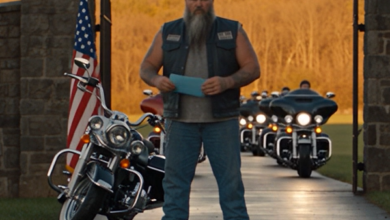
Behind him, thirty men from his riding club filed in silently and lined the back wall.
The board chair, a rancher named Ellen Sharpe, looked over her glasses. “Deputy Sandoval. Do you wish to address the commission?”
“Yes, ma’am.”
Luke told it from the beginning: the gravel, the deer, the glove, the shirt, the drive. When he got to the part about the bike left on the edge of the cliff, people in the audience were wiping their eyes.
Sheriff Prentiss tried to cut in. “Deputy, you’d suffered a severe trauma. Your memory of events is understandably—”
Margie Quinn stood up and played the dispatch tape on the chamber’s speakers.
Two hundred people heard Doc’s steady voice: Officer down. Clear the road for me. Then they heard Sergeant Wade Garrett: That’s probably the thief playing games. Treat the vehicle as hostile.
Grace stepped forward with a small black hard drive in an evidence bag.
“This is the dashcam drive from unit 14,” she said. “It was signed out by Sergeant Garrett on the night of the incident and never returned. I found it this morning in his personal locker.”
She handed it to the county clerk, who plugged it into the chamber’s projector.
It played without sound, grainy but clear. It showed a dark curve on Elk Pass with flares sputtering on the road. A deputy bent to light the second one, and a huge mule deer exploded over the guardrail. Then a big man in leather was running, shirt coming off, kneeling, packing, lifting.
The chamber was completely silent.
Every head turned toward Sergeant Wade Garrett, sitting in the second row in uniform.
Garrett’s face was gray. He looked at the sheriff, who would not look back.
“You told me to make it stick, Dale,” Garrett said, loud enough for everyone to hear. “Your words. Before Thursday.”
The ordinance vote was tabled indefinitely. By the end of the night, the district attorney had dropped every charge against Daniel Rourke. Sergeant Garrett was placed on administrative leave. He resigned within the week. Sheriff Prentiss finished his campaign three weeks later and lost by the widest margin in county history.
When the meeting ended, the crowd surged forward. But a small boy in light-up sneakers got to Doc first.
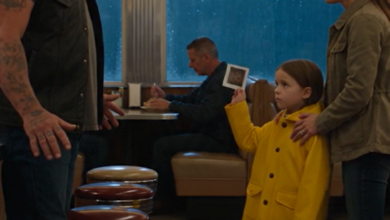
Benny Sandoval stood in front of the big biker, looking up and up and up. He held a folded piece of construction paper.
“I’m sorry I hid from you,” he said. “Daddy says you’re a hero.”
Doc crouched down slowly. Benny unfolded the paper. It showed a crayon drawing of a police car with a giant smiling man driving it, a little man in the passenger seat, and a red heart over both of them.
Behind Benny, Luke cleared his throat from his wheelchair.
“Doc,” he said. “There’s one more thing. Your bike’s still on that mountain.”
Part 8
They went up Elk Pass together on Saturday morning: four sheriff’s trucks, a flatbed tow truck, and thirty motorcycles.
The old bagger was right where Doc had left it at mile marker 37, tipped on its side in the gravel, its front wheel hanging out over the drop. The mirror was snapped off, the tank was dented, and dried leaves were blown against the engine. But it was there.
Grace and two other deputies rigged the straps. Doc’s club brothers guided the winch line. When the bike finally swung up onto the flatbed, everyone on the shoulder cheered, deputies and bikers together.
The sheriff’s department paid to rebuild the bike from the frame up at a shop in Gunnison. It came back with a new tank and fresh paint, and a small decal on the rear fender that the deputies had chosen together. It was a tiny sheriff’s star with a single word underneath: THANKS.
Then came the thing Doc had asked for, for four years.
The story had spread far past Alder County. By December, the state transportation department had approved a series of solar-powered emergency call boxes and a signal repeater along all forty miles of Elk Pass Road. Crews installed them the following summer.
The first box stands at mile marker 37.
There’s a small plaque on the post below it. It says: The Annie Rourke Emergency Corridor. So no one on this mountain is ever alone again.
Doc stood at that post on the day it went in, with his hand on the cold metal, for a long time. Luke stood beside him with his arm still in a brace, saying nothing, because nothing needed to be said.
Luke went back to patrol in March. He’s the department’s new field training officer, and the first thing he teaches every rookie is this: Don’t decide who somebody is by what they’re wearing. Find out what they’re doing.
Every October now, on the second Saturday, a sheriff’s deputy and a big biker drive up to a lake past the top of Elk Pass with two fishing poles and a cooler. Benny comes along now too. He’s eight, and he’s convinced he’s going to catch the biggest trout in Colorado.
He hasn’t yet. Doc tells him every year that he’s close.
Last fall, on the drive home, Benny asked Doc why he’d gone back to the mountain where his wife died, every October, for six years.
Doc was quiet for a while.
“Somebody’s got to watch that curve,” he finally said.
Benny thought about it seriously.
“You can stop now,” he said. “Because the phone box is there.”
Doc didn’t answer. But the next week, he went to a tattoo shop in Gunnison. Under the old tattoo on his forearm, ANNIE — MM 37, he added a single new line in small letters. It was copied from a seven-year-old’s crayon drawing: a little police car with a red heart over it.
“Dispatch called it a stolen police car,” Doc says, when people ask him about that day. “I was driving a deputy who was bleeding out to the hospital, because there was no signal up there and the ambulance was fifty minutes away. He got hurt stopping to help me.”
People saw a bloody-handed biker behind the wheel of a sheriff’s cruiser and decided they knew exactly what kind of man he was.
The sergeant with the handcuffs and the sheriff with the microphone had a story ready before they knew a single fact. The biker in the leather jacket left his own motorcycle hanging over a cliff and never once asked for credit.
If this story meant something to you, follow our page for more true stories from the road. And the next time you see a biker on the shoulder, slow down. He might be the one saving somebody.