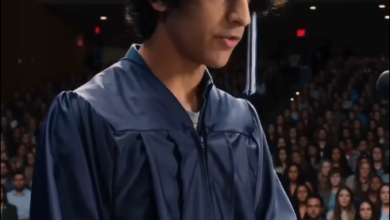
Part 2: A Student Suddenly Walked Onto the Stage During an Awards Ceremony — What She Said Made the Whole School Go Silent
For a moment, nobody seemed to understand what Lily had said.
The microphone carried her words to every corner of the gym, but they arrived like something out of place, too heavy for a room full of balloons and certificate folders.
Principal Warren stepped closer. “Lily, this is not appropriate.”
Lily held the hospital bracelet in one closed fist.
Her knuckles were pale.
Madison Wells stood beside the podium with the gold plaque pressed against her dress. She looked embarrassed at first, then angry, then frightened in a way she tried to hide.
Her mother, Diane Wells, pointed toward the aisle. “Someone needs to remove her.”
That sentence should have made Lily step back.
Instead, she looked smaller but stayed where she was.
Mr. Alvarez, the janitor, took one step forward from the back doors. Then he stopped, as if there was an invisible line he was not allowed to cross.
He was in his late sixties, with brown skin, silver hair under a faded cap, and a navy work shirt with his name stitched crookedly over the pocket. Most students called him Manny. Most parents did not know his name at all.
“Lily,” he said gently from across the gym.
He did not sound angry.
He sounded scared for her.
That was the first small thing that made people pause.
A student who was trying to make trouble usually looked toward the crowd for victory. Lily looked only at the janitor, as if asking permission from the one person with the least power in the room.
Principal Warren reached for the microphone.
Lily pulled it closer.
“This says Noah Dawson,” she said.
Her voice cracked around the name.
A few teachers recognized it.
Noah was Lily’s younger brother, a seven-year-old first grader with asthma so severe he kept an inhaler clipped to his backpack. He had missed weeks of school that winter. People had sent cards for a while, then slowly returned to normal.
Lily opened her fist and held up the bracelet.
The white plastic band caught the gym lights.
“It was from the day he almost died,” she said.
Madison’s mother shook her head. “This has nothing to do with Madison.”
Lily looked at Madison.
“It does.”
The room shifted.
Madison lowered her eyes.
That was the second small thing.
If Lily were lying, Madison could have laughed. She could have denied it. Instead, she stared at the polished gym floor like it had suddenly become safer than every face watching her.
Principal Warren lowered his voice. “Lily, whatever this is, we can discuss it after the ceremony.”
“No,” Lily said.
The word came out barely above a whisper, but the speakers made it clear.
“You discussed it after. You discussed it for three months.”
Several teachers looked toward the principal.
Mrs. Harlan, the school nurse, sat near the first row. Her hand moved to the lanyard around her neck. The ID badge trembled against her blouse.
Mr. Alvarez shook his head slightly, almost pleading.
Lily saw him.
“I’m sorry,” she said to him.
Then she looked back at the room.
“Madison didn’t call 911.”
A collective sound moved through the gym, half gasp and half denial.
Madison’s mother snapped, “That is a terrible accusation.”
Lily’s face flushed.
“She didn’t find Noah in the hallway. She didn’t keep him breathing. She didn’t run for help.”
Madison began to cry quietly, but not like someone falsely accused. She cried like someone whose secret had finally found daylight.
The principal’s face hardened. “Lily, enough.”
Then a voice rose from the teachers’ row.
“Let her finish.”
It was Mrs. Harlan.
Everyone turned.
The nurse stood slowly, her eyes wet, her mouth tight with a decision that had waited too long.
Principal Warren stared at her. “Mary.”
Mrs. Harlan did not sit down.
Lily looked at the nurse, stunned.
That was the third small thing.
She had not expected anyone to stand with her.
Mrs. Harlan took a breath. “There is a report.”
Diane Wells went still.
“What report?” a father in the bleachers asked.
Principal Warren said nothing.
Mr. Alvarez lowered his eyes.
The gym, only minutes earlier filled with awards and applause, began to feel like a courtroom.
Lily held the bracelet against her chest.
“My brother was on the floor outside the art room,” she said. “He couldn’t breathe. People walked around him because they thought he was having a tantrum.”
Her voice shook harder.
“One person stopped.”
She turned again to the back doors.
Mr. Alvarez stood there with both hands folded over the mop handle, looking as if every eye in the gym hurt.
“He dropped everything,” Lily said. “He carried Noah to the nurse. He knew where the spare inhaler was because he fixed the cabinet lock the week before.”
Mrs. Harlan wiped her cheek.
Lily looked at Madison’s plaque.
“And when the newspaper asked who saved him, the school said Madison did.”
The silence that followed was different.
Not confusion now.
Recognition.
Something had been polished for public view, and Lily had just scratched the surface.
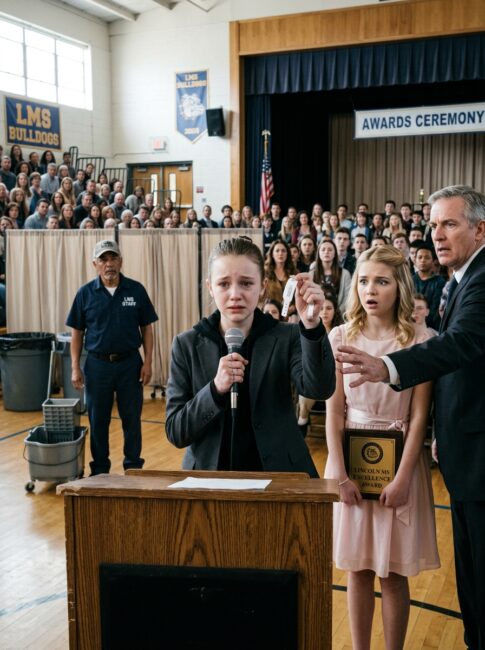
Madison Wells was crying openly now.
Her mother put an arm around her, but Madison stepped away from it.
That was the fourth small thing.
The girl who had smiled for cameras all morning no longer wanted to be held up.
Principal Warren moved to speak, but Madison reached for the microphone before he could.
“I didn’t ask for the award,” she said.
Her voice was thin, frightened, and very young.
Diane Wells whispered, “Madison, don’t.”
But Madison had already looked at Lily.
“I was there,” she said. “I saw Noah on the floor. I froze.”
Lily stared at her.
“I thought he was pretending at first,” Madison continued. “Then I saw his lips. I didn’t know what to do.”
A low murmur spread through the parents.
Madison wiped her face. “Mr. Alvarez came running. He told me to get Nurse Harlan, and I ran. That is all I did.”
She looked at the plaque in her hands as if it had become something dirty.
“When the principal said I showed leadership, I didn’t correct him.”
Diane Wells closed her eyes.
Madison held the award out toward Lily. “I should have.”
No one clapped.
This was not the kind of confession people applauded.
It was too painful and too late.
Principal Warren cleared his throat. “The school recognized Madison because she alerted staff quickly. That action mattered.”
Mrs. Harlan’s voice was calm but sharp. “The report named Mr. Alvarez as the first responder.”
All eyes returned to the janitor.
Manny Alvarez did not lift his head.
He looked ashamed, though he had done nothing wrong. That was the part that began to break people.
Lily stepped away from the podium.
“Why didn’t anyone say his name?” she asked.
The question hung there.
Principal Warren adjusted his tie.
“Manny requested not to be included,” he said.
Mr. Alvarez finally looked up.
“No,” he said softly.
The gym heard him because the silence was complete.
Principal Warren turned. “Manny—”
“No,” Mr. Alvarez repeated. “I said I did not need a ceremony. I did not say to give the story to someone else.”
A few teachers looked down.
The fifth small twist arrived not as a shout, but as a quiet correction from a man who had spent years cleaning up rooms after everyone left them.
Lily walked down the stage steps with the microphone still in her hand.
No one stopped her now.
She crossed the gym floor slowly, past rows of students who had once laughed when Mr. Alvarez mopped around their sneakers, past parents who had never noticed him holding doors open during rainy mornings.
When she reached him, she held out the hospital bracelet.
He looked at it and shook his head.
“I just did what anyone should do,” he said.
“But everyone didn’t,” Lily answered.
The words were not cruel.
They were simply true.
Mr. Alvarez looked toward Noah, who sat beside Aunt Rebecca in the third row. He was small, pale, and wearing a clip-on tie with one crooked corner. He lifted his hand in a shy wave.
Manny’s face softened.
That was when Lily’s anger finally cracked.
She was not trying to ruin a ceremony. She was a thirteen-year-old girl who had spent three months watching the wrong person praised for the day her brother almost never came home.
“I waited,” she said, still facing Mr. Alvarez. “Mom said the school would fix it. Then they said it was complicated. Then they said it would embarrass Madison. Then today, they put her onstage.”
Diane Wells covered her mouth.
Madison began crying harder, but she did not look away this time.
Lily turned toward the crowd.
“Mr. Alvarez came to the hospital that night,” she said. “He brought Noah’s backpack because nobody remembered it.”
Noah nodded from the bleachers.
“He also brought my math folder,” Lily added, and a small, broken laugh escaped her. “He said I might still need it.”
A few people smiled through tears.
“He sat in the waiting room until midnight,” Lily said. “When my mom didn’t have cash for the vending machine, he gave her quarters from a little envelope.”
Mr. Alvarez lowered his head again.
Lily continued, each detail uncovering the life hidden beneath his uniform.
“When Noah came back to school, Mr. Alvarez walked the halls before first bell to make sure the air freshener sprays were gone because they triggered his asthma. He fixed the loose tile outside the art room because Noah had fallen there. He cleaned our classroom last so Noah would not breathe bleach smell.”
Mrs. Harlan began crying again.
A teacher whispered, “I didn’t know.”
Most people didn’t.
They had seen a mop bucket.
They had missed the man.
Lily turned back to Manny.
“You told me not to be mad,” she said.
He smiled sadly. “Being mad is heavy for a child.”
“I know,” she said. “But being quiet was heavier.”
That was the twist that changed the room entirely.
Lily had not stepped onstage because she wanted attention. She had stepped there because the adults had asked her to carry a silence they should never have placed in her hands.
Madison slowly walked down from the stage, holding the plaque.
Her mother reached for her, but Madison shook her head.
She crossed the gym and stopped beside Lily.
Then she turned to Mr. Alvarez.
“I am sorry,” Madison said.
Her voice broke.
“I liked how people looked at me. I knew it wasn’t the whole truth, and I still let them.”
Mr. Alvarez’s eyes filled, but he did not reach for the plaque.
Madison looked at Lily. “I’m sorry to Noah too.”
Lily did not answer right away.
Forgiveness was not a school assembly requirement.
Finally, she nodded once.
Not to erase it.
Only to acknowledge that the truth had arrived.
Madison faced the room, then placed the plaque on the floor in front of Mr. Alvarez’s mop bucket.
“It belongs to him,” she said.
The gym stayed quiet for one more breath.
Then Noah stood.
Small, shaky, and still not fully strong, he walked down the bleacher steps with Aunt Rebecca’s hand hovering behind him.
He crossed the gym while every student watched.
When he reached Mr. Alvarez, he pulled something from his jacket pocket.
It was a drawing.
A child’s drawing in crayon, folded twice.
In it, a man in a blue shirt carried a boy under a yellow sun. Above them, Noah had written five careful words.
Mr. Manny helped me breathe.
Mr. Alvarez read it and finally broke.
He pressed one hand over his eyes, the mop handle falling softly against the wall behind him.
And for the first time that morning, the entire school understood why Lily had refused to sit down.
Principal Warren did not try to finish the program right away.
He stood beside the stage with the award list in his hand, looking at the gold letters on the banners as if they had started asking him questions.
Excellence.
Leadership.
Character.
The words had been hanging there all morning, bright and clean.
Now they felt heavier.
Mrs. Harlan walked to the back of the gym and stood beside Mr. Alvarez. She did not speak into the microphone. She simply placed a hand on his shoulder.
That small gesture did what the plaque had failed to do.
It named him without decoration.
Madison picked up the plaque from the floor. She wiped it with the sleeve of her dress, then held it out again.
Mr. Alvarez shook his head.
“No, mija,” he said softly. “I don’t need that.”
Lily looked at him. “Maybe Noah does.”
Manny looked toward the little boy.
Noah nodded.
So Mr. Alvarez accepted the plaque with both hands, not like a trophy, but like something fragile that belonged to more people than himself.
The applause began slowly.
One teacher.
Then a parent.
Then the eighth-grade row.
Soon the whole gym stood, but it was not the loud, polished applause planned for the ceremony. It was uneven and emotional, filled with shame, relief, and the quiet ache of people realizing what they had nearly missed.
Lily did not smile.
She looked exhausted.
Mrs. Harlan gently took the microphone from her hand and passed it to the principal.
Dr. Warren stepped forward.
He looked at Madison first.
Then at Lily.
Then at Mr. Alvarez.
“I owe this school an apology,” he said.
No one moved.
“We will correct the record today.”
He paused.
“And I owe Mr. Alvarez more than a sentence in a program.”
Manny looked uncomfortable with every word, but he stayed.
Madison returned to her seat beside her mother. Diane reached for her hand. This time Madison let her hold it, but she kept her eyes on Lily.
After a few minutes, the ceremony resumed.
Awards were still given.
Names were still called.
Parents still took pictures.
But something had changed in the room. People looked toward the back doors differently now. They noticed the mop bucket. They noticed the man standing beside it. They noticed Lily sitting with both hands folded over her knees, as if she had used every bit of courage she had.
When the ceremony ended, Noah walked to Mr. Alvarez again.
He did not say much.
He only leaned against him for a moment, small forehead pressed to the navy work shirt.
Manny rested one hand gently on the boy’s back.
Lily watched from a few feet away.
Her mother arrived then, breathless from a late shift at the hospital cafeteria, still wearing her work shoes. She had missed the speech, but not the aftermath.
When she saw Lily’s face, she opened her arms.
Lily stepped into them and finally cried.
Not loudly.
Not for attention.
Just enough for the silence to leave her body.
Across the gym, Madison stood near the stage with her mother, holding the empty award folder. She looked younger than she had that morning. Less perfect. More real.
Before leaving, she walked over to Lily.
“I should have said something sooner,” Madison whispered.
Lily wiped her face with her sleeve.
“Yeah,” she said.
Madison nodded, accepting that.
Then Lily added, “But you said it today.”
It was not forgiveness wrapped in a bow.
It was a door left slightly open.
Outside, the afternoon sun covered the parking lot in gold. Families crossed toward their cars, speaking more softly than when they had arrived.
Mr. Alvarez stayed behind to stack chairs.
This time, three fathers helped him.
Noah’s drawing remained propped against the golden plaque on the janitor’s cart, the crayon sun shining above a man in a blue shirt.
Before Lily left, she looked back once.
Mr. Alvarez raised two fingers in a small wave.
She lifted the hospital bracelet from her pocket and held it up, just for him to see.
Then she followed her mother and brother into the sunlight.
Follow the page for more emotional stories that stay with you long after the last line.