A VETERANS POST VOLUNTEER CALLED THE BIKER A SCAMMER—THEN HE OPENED A LUNCH BAG AND THE OLD MAN STOPPED HIS WHEELCHAIR
THE VOLUNTEER CALLED THE BIKER A SCAMMER. THEN THE MAN HELD OUT HALF A SANDWICH, AND THE VETERAN STOPPED HIS WHEELCHAIR.
On the second Saturday in October, Walter Hayes was showing his granddaughter how to clean a bird feeder without getting seed in the front casters of his wheelchair. They were on the porch of his little house in Millfield, Ohio. Sadie had found a blue chalk stub in a flowerpot and drawn a line where he told her to keep the seed tray. She’d gone outside that line twice and blamed the wind both times.
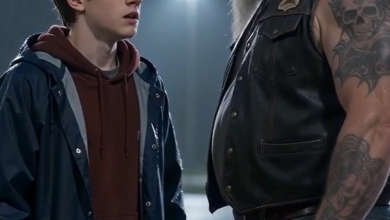
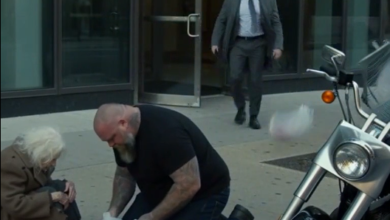
A silver van with a red bow rolled into the driveway. Two motorcycles pulled to the curb behind it. The man who climbed out of the van was nearly as broad as its door, with tattoos down to his knuckles and a black leather vest. Dean Pritchard, who coordinated rides for the local veterans post, left the porch before Walter could ask who the man was.
“Take your van and go,” Dean said. “I know a scam when I see one.”
The woman across the street stopped winding up her garden hose. One of the riders took his helmet off. The man by the van looked up at Walter, then set a brown lunch bag on the passenger seat. He stayed beside the van with his boots planted on the gravel. The nearest cruiser’s engine clicked as it cooled. Walter could smell the gas somebody had spilled while filling up.
“I keep people from taking advantage of you,” Dean told Walter. “Last month somebody on this street signed for a roof they didn’t need. You want me to wait until he puts a pen in your hand?”
Walter had heard about the roof. For a second, that was enough to make him wonder if Dean had a point. Then he realized he’d never been asked whether he wanted the man to leave.
The biker turned so Walter could see what he was doing. He opened the van’s side door and pressed a button. A gray ramp unfolded and settled against the driveway under the red bow.
“Grandpa, look,” Sadie said.
Walter looked. The ramp landed exactly where the concrete widened. He could have turned his chair there without dropping a caster into the gravel. One of the riders stood back from the landing, holding his helmet at his waist. The woman across the street let the hose sag across her shoes.
“I came to see Mr. Hayes,” the biker said. “I can wait right here.”
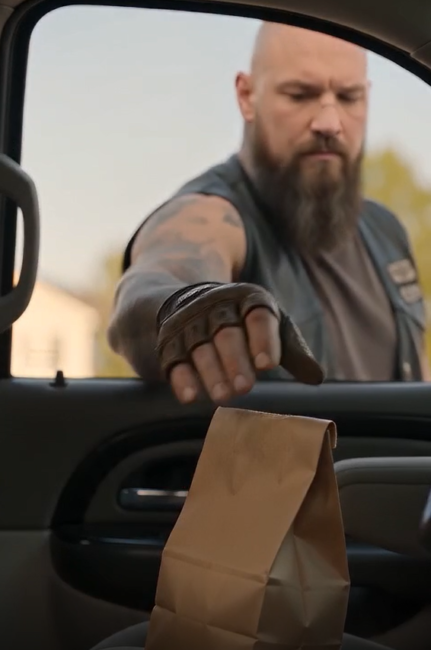
There was a grease-dark line across the heel of one glove. He took that glove off slowly, finger by finger, then picked up the brown bag. Walter had expected a clipboard or an envelope with a return address. The man opened the bag with his bare hand and left it on the seat.
What he brought out was half a sandwich in white deli paper. He folded the paper back just far enough to show the bread. It had been torn across the middle, and a corner of cheddar stuck out past the crust. Walter put a hand on his wheel to move closer. Then he stopped.
Part 2
“You still tear it,” Walter said.
The man looked down at the bread. “Couldn’t find a knife that day.”
“You didn’t have a knife. I was the one with the sandwich.”
“That’s right.”
Walter looked up at him. The boy at the bus stop had been thin enough that his sweatshirt hung straight from his shoulders. This man’s leather vest looked as though somebody had made it from the widest piece of hide they could find. But he still tipped his head a little when he was waiting for an answer. Walter remembered that.
“Ethan?”
“Yes, sir.”
“You can quit with the sir.”
“I remember you saying that, too.”
Sadie came down the porch ramp to stand beside Walter. She’d put the chalk in her pocket, but a blue line still crossed the side of her little finger. Walter was conscious of her looking between him and Ethan, waiting for one of them to say something she could follow.
“Where do you know him from?” she asked.
“County bus stop,” Walter said. “Back when there was a bench.”
“There’s a bench now.”
“Back when there was a wooden one. You could get a splinter just looking at it.”
Ten years earlier, he’d gone into town to get his glasses fixed. The optician had put in a new screw, and Walter had spent half an hour in the drugstore afterward because he could read the labels again. He bought sandwich bread and a packet of ham. His wife, June, had already given him a sandwich for the ride home, wrapped in the white deli paper she bought by the box.
The young man at the bus stop kept looking at the schedule without moving his eyes far enough to be reading it. Walter knew the trick. There were days after he came home from the Army when he’d pretended to study a menu just to have somewhere to sit.
“You waiting on the county bus?” he’d asked.
“Maybe.”
“Which way?”
“Where does it go?”
Walter had told him. The boy said he might go the other way. Then he asked if there was a water fountain near the drugstore.
Walter opened the sandwich and tore it down the middle. The cheddar came away unevenly, so he tucked the bigger piece back into the half he passed over.
“Ham okay?”
The boy nodded. He waited until Walter took a bite before he took one himself. After a few minutes he asked whether Walter thought the county bus would take him even if he only had enough money for one direction.
“Where you headed once you get there?”
“I haven’t got that far.”
They’d talked for forty minutes. Walter knew because he kept checking his watch and putting it down against his leg so Ethan wouldn’t think he was trying to leave. In the driveway now, he watched the man fold the deli paper into a little tray the way June used to. It was the first time in years he’d had a chance to ask whether the boy ever got wherever he was going.
“Did you make it home?” Walter asked.
Ethan looked at him. “That’s the part I didn’t tell you. There wasn’t a home to go back to.”
Part 3
“I’d aged out of foster care at eighteen,” Ethan said. “I’d been crashing wherever I could for almost a year. The last guy said I could stay until his brother got back, and his brother got back.”
Walter remembered asking the boy about his family. Ethan had said everybody was busy. Walter had taken it to mean there was an aunt or a cousin he could call if things got bad enough. Now he wondered how many times Ethan had given that answer because people expected one.
“Why didn’t you tell me?”
“I thought you might give me the other half.”
Walter waited.
“I wanted to eat with somebody,” Ethan said. “I didn’t want you to stop eating and start trying to fix me.”
Walter looked down at the sandwich. After the Army, he’d spent a stretch telling June he’d had supper at work when all he’d had was coffee. Work had been a loading dock then, two nights a week if they needed him. He told Ethan a little about those years at the bus stop. The part about June he’d kept to himself.
“I told you about the foreman?” he asked.
“The one who said he could get another man to do your job before lunch.”
“He could, too. I was pretty bad at it.”
“You said that didn’t give him the right to tell you what you were worth.”
Walter remembered saying something close to that. He remembered the boy finishing the last bite and folding the empty paper into a square. By then the bus had turned the corner. Walter had looked at him once more, because the kid’s hands had started shaking as soon as there was nothing left to hold.
“Don’t let anybody tell you you’re throwaway.”
He’d used the word his own father used for bent nails and old screws. It sounded clumsy in his head now. Ethan said he’d gone to the county vocational center the next morning because Walter had mentioned the evening welding classes. He walked in while the janitor was shaking out a rug. The receptionist found him a counselor and showed him where he could get a meal before the first appointment.
“I had to take a basic math class twice,” Ethan said. “Then a place hired me to sweep floors.”
“What kind of place?”
“Mobility shop. We fit vehicles for people who need different ways to get in or drive. I started getting the seats ready for the techs. I do conversions now.”
Walter looked at the split gear on the back of Ethan’s vest. One tooth was missing. The patch caught a little sun as he turned.
“Gauge,” one of the riders said. “Want me to get the folder?”
“In a minute,” Ethan said.
“Gauge?” Sadie asked.
“I measure stuff until it fits.”
“Even after it fits,” the rider said.
Walter smiled, then saw that Dean still stood between the porch and the front of the van. Dean’s phone was in his hand. He’d brought Walter groceries during June’s last winter and had once stayed long enough to fix the screen door. Walter wanted that man back. He didn’t know what to do with the one who was recording the driveway.
“I’ve asked the post commander to come over,” Dean said. “He needs to see how you people got this address.”
Ethan finally looked straight at him.
“Your post asked Mr. Hayes if I could come,” he said. “I was there when you told them he’d said no.”
Part 4
“I never said no,” Walter said.
Dean put his phone down at his side. “You told me you didn’t want anybody making a fuss.”
“I told you I didn’t want a picture for the newsletter.”
Sadie looked up. “You said that about the turkey.”
She was right. The post had delivered Thanksgiving meals, and Dean had wanted Walter to hold the foil pan while somebody took a picture. Walter had given him a hard time about it. That had been almost a year earlier.
“You said it then, too,” Dean told him. “You hate being put on display.”
Ethan reached for the folder the other rider had offered. He took out one sheet and gave it to Walter. It was a printout from Marlene, the post secretary. Walter recognized the block of type at the bottom because Marlene always listed two phone numbers, one of which went to an empty office on Tuesdays.
The message confirmed a Saturday visit and gave the driveway measurements Walter had dictated to her by phone. He’d thought somebody from the post was checking whether a van could fit for a future ride. Marlene had asked him if she could share the address and chair measurements with the person bringing the vehicle. He’d said yes.
The porch screen door opened. Sadie’s mother, Beth, had been in the kitchen. She came out drying her hands on a dish towel.
“Dad,” she said, “you want everybody here?”
Walter took a moment to look around. The neighbor across the street had gone back to the hose. The two riders were waiting where he could see them. One was a woman with gray hair tucked into the collar of her vest. Neither had tried to come up the porch ramp.
“Ethan can stay,” he said. “The people he brought can stay.”
Dean looked toward the curb. “Marlene told me it was a trial ride.”
“That’s what I asked her to tell you,” Ethan said. “I wanted him to try it before anybody talked about taking it home.”
Walter felt the cold edge of the wheelchair rim where his hand rested. “Taking it home?”
Ethan set the folder across his forearm. “The club put money in. We found a used van with good service records. I spent four months fitting it out at the shop. Another tech checked my work.”
“Who’s it for?”
Ethan waited until Walter looked at him. “You.”
Nobody moved for a while. Somewhere behind him, Walter heard the porch screen hit its latch. Beth had let go of the handle.
“Why didn’t you ask me?” Walter said.
“We should’ve been clearer about why we needed the measurements. If the van doesn’t suit you, it goes back to the shop. I wanted you to get a look at it first.”
Walter could see the red bow from where he sat. It was held down with a strap through the roof rails. Ethan had done up the strap the way Walter used to secure a tarp, with the loose end folded back so it wouldn’t flap.
“You paid for that van because I fed you lunch?”
Ethan rubbed the back of his bare thumb. The two marks there looked more like lines on a ruler up close.
“I started thinking about the van when I watched you get on the bus,” he said. “Do you remember how long that lift took?”
Walter looked at the ramp lying flat on the concrete. He remembered every minute.
Part 5
“Ten,” Walter said.
The bus driver had tried the controls twice before stepping outside. A pin had jammed. He called dispatch, opened a panel, and worked through the manual procedure with a tool from the compartment under his seat. Walter had sat on the sidewalk with his lap full of groceries, watching people turn their faces to the windows.
One man checked his watch where Walter could see it. A woman with a grocery cart got off and said she’d walk. Somebody called, “Can’t he just take the next one?” The next bus was more than an hour away. Walter remembered the driver saying so without turning around.
Ethan had stood by the shelter. He’d asked whether Walter wanted him to hold the groceries while the driver worked. Walter said yes. The boy held them against his chest the whole time. When Walter finally got on the lift, Ethan handed up the bag and said his glasses were slipping. Walter put a finger on the bridge of his nose. It was easier to think about that than to look down the aisle.
“I thought you’d be glad to be going home,” Ethan said now.
“I was.”
“Did you take that bus again?”
Walter looked at Beth. He’d told her and June that the route had gotten inconvenient. Over the years it had become easy to say he’d rather have things delivered. He’d kept the house and front porch as his world, apart from necessary medical trips. Ten years had passed without him going anywhere he’d chosen just because he wanted to be there.
“No,” he said. “I came home that day and stayed.”
“Dad,” Beth said softly. “You could’ve told me.”
“I kept meaning to tell you why. By then it sounded like a long time to stay mad about ten minutes.”
Sadie took the chalk out of her pocket and rubbed the side of it against her jeans. “Was that why we had your birthday here even when I was little?”
Walter nodded. “I liked having you here. I also knew I wouldn’t have to ask how I was getting home.”
He looked past Ethan’s shoulder toward Dean. Walter had trusted Dean to handle the ride requests because Dean knew which vans could carry a chair and which drivers worked Saturdays. When June died four years earlier, Walter called about a ride to the cemetery. Dean told him it was outside the bus route. Walter had asked whether there was anything the post could arrange.
“You said you’d look,” Walter told him.
“I did. We had a driver and no vehicle that weekend.”
“What about the next one?”
Dean ran a thumb along the edge of his phone. “I put down that you declined to reschedule. Beth was going over to put flowers out. I figured you’d worked something out with her.”
Beth stopped twisting the dish towel. “I went because Dad asked me to. I thought you were still looking.”
“You could’ve called me,” Dean said.
“I’m asking you now,” Walter said. “Did you call me and offer another date?”
Dean’s face had gone red above the collar of his jacket. “I should have.”
Walter had watched June’s burial on Beth’s phone. He knew the picture froze when her cousin turned the camera toward the road. He couldn’t have said what the ground looked like around her marker. Beth had told him there was a maple. Sometimes when she talked about taking flowers there, he asked her to tell him what color its leaves were.
A car pulled to the curb. Marlene got out with the post commander, who was carrying a binder against his chest.
Marlene looked at Walter. “Would you like to see what happened to the other requests?”
Part 6
Walter hadn’t known there were other requests. Marlene pulled a chair down off the porch so she could sit at his height, then asked whether he wanted to look at the binder himself. He said yes. The commander, a retired school custodian named Tom Riley, asked the others to give them room. Ethan took two steps back. Dean stayed close enough to hear.
The binder contained copies of Walter’s own ride records. Each entry had a date, a destination, and a short note. Walter recognized the hardware store. He’d asked about a ride there because he wanted to choose the boards for Sadie’s bird feeder himself. The other was a Thursday evening meeting at the post. He remembered putting on a clean shirt and deciding against calling again when the clock got past six.
The line beside both said rider declined.
“You told me the Thursday van was full,” Walter said.
“It was,” Dean answered. “We had six people trying to get to appointments. I was doing the schedule on my lunch breaks. I had to close things out somehow.”
Marlene turned the binder so he could see the notes. “There’s a box for ‘no accessible vehicle available.’”
“That went on the monthly sheet,” Dean said.
Tom waited. “Yes.”
“If it went on every month, we’d have to explain why we kept saying we offered rides when the one van was always booked. I thought if people wanted it badly enough they’d call back.”
Walter took his hands off the binder. It was hard to admit how close he’d come to calling, how often he’d gotten as far as picking up the phone. It was worse to think Dean had been counting on him to do it.
“I called once because I wanted to go,” he said. “It took a lot to call once.”
Dean looked up. For the first time that afternoon he seemed to see Walter’s face before looking for somebody else to answer to.
“I used to carry groceries in for you,” he said.
“You did. I remember.”
Walter let the silence sit between them. He was grateful for every bag Dean had carried up the porch ramp. He’d wanted the rides, too.
Tom asked Dean to hand Marlene the post phone and the scheduling binder he kept at home. Marlene would call the people whose requests had been marked declined and see what they’d actually asked for. Tom said he’d take over the schedule until the post could hold a meeting. Dean opened his mouth once, then took the phone from his jacket pocket and passed it over.
Sadie had gone to look at the ramp. She stood to one side with her hands behind her back, the way Walter had taught her to wait when he was about to maneuver somewhere tight.
“Did you put the van there on purpose?” she asked Ethan.
“Yes. Your grandpa needs room to turn.”
“How did you know?”
“He told Marlene how wide his chair was. I asked how much room he likes around it.”
Walter saw Beth glance at him. He remembered having that conversation. Marlene had let him decide how much space he needed, right down to the inch. He’d enjoyed being asked.
Ethan picked up his glove and tucked it into his back pocket. “Want to see how it feels before you decide anything?”
Walter could see the interior of the van from where he sat. There was a clear place for his chair and a window he could see out of without leaning. He’d had a dozen things ready to say about insurance and keys. All he could think about now was the maple.
“If it fits,” Walter asked, “can we go see June?”
Part 7
Ethan put the sandwich on the porch rail so Walter could have both hands free. Then he told him where the ramp began and asked whether he wanted a hand.
“Stay near me,” Walter said. “I’ll tell you if I need it.”
He turned the chair where the concrete widened. There was room, just as he’d thought there would be. Going up the ramp took more effort than rolling across the kitchen, and for a second he thought about how many people were watching. Ethan kept his hands by his sides. Sadie looked down at her sneakers. Walter understood what she was doing and was grateful for it.
Inside the van, he stopped beside the window. He could see the maple across the street from his house, its top leaves already red. The window was at the right height. That was a small thing, and it was the first thing he wanted to tell June.
Ethan showed him how the chair would be secured for the ride and where the passenger belt sat. He explained that the club still owned and insured the van, so he could drive it that afternoon. There was time to deal with the ownership papers later, if Walter wanted it. Walter asked about a rattle he’d heard when the ramp came down. Ethan showed him the clasp for the ribbon, which was tapping the bodywork.
“We’d better take the bow off before we go,” Ethan said.
“Sadie ought to do it.”
Sadie stood on the porch step while Beth freed the strap. They carried the bow inside between them. When Sadie came back, she had the sandwich and a second half from the bag.
“You left yours,” she said to Ethan.
“I did.”
She handed him the bigger half. Walter saw him notice which piece she’d chosen. He took a bite before he put it on the dashboard for later.
The cemetery was twenty minutes away by the county road. Beth and Sadie followed in Beth’s car. Walter watched a feed store pass that had been painted green since he last saw it. A corner where June used to buy tomatoes was empty now. He’d known things would be different. He hadn’t expected so many things to be in exactly the same place.
At the cemetery, Beth pointed out a paved lane past the office. Ethan pulled into the turnout at the far end and put the ramp down. He waited while Walter checked the slope between the turnout and June’s row. The grass was dry. Beth walked beside him until he saw the marker.
The maple was smaller than he’d pictured.
He had prepared things to say to June in his kitchen over the past four years. In front of her name, all he could think of was a question about a pan he’d found at the back of a cupboard. He didn’t know what she’d bought it for. He wished he’d asked when he’d had the chance.
Sadie straightened the little flag at the next marker while Beth set flowers in June’s vase. Ethan stayed at the edge of the pavement. Walter ate the last bite of his sandwich. He could smell damp leaves in the ditch and gasoline on the cuff of Ethan’s vest when the younger man came over to gather the paper.
“Would you bring me back next month?” Walter asked.
Ethan folded the wrapper into a square. “Same Saturday?”
Walter nodded. Then he looked back toward the silver van and thought of the binder in Marlene’s hands.
“How many people called that post once,” he asked, “and never called again?”
Part 8
Marlene found six people on the schedule who’d been listed as declining a ride they were still waiting for. One had moved away. Two already had another way to get around. Three asked whether the post still had their phone numbers. Walter heard the last detail from Marlene himself on the first Thursday he went back to a veterans meeting.
She had saved him an aisle seat. He asked her to give it to someone who needed a chair and parked in the open space at the end of the table. The man beside him handed over the coffee pot without asking whether he needed help pouring. Walter spilled a little anyway.
Dean was at the other end of the room. The post had removed him from the transportation role after reviewing the logs. He’d called the people whose records he’d changed, and he wrote Ethan and the riders an apology that named what he’d accused them of in the driveway. That Thursday he asked Walter if he could sit beside him.
“Sure,” Walter said. “Get a napkin while you’re up.”
Dean brought two. Walter put one under his coffee cup and handed the other to the man beside him, who had spilled some, too.
Once the van’s paperwork was settled, Beth took her father for groceries on Mondays. Ethan kept the second Saturday for the cemetery. If the ground was wet, they stayed on the pavement and Beth put the flowers out another day. Some months Walter talked to June. Some months he and Ethan ate lunch in the turnout and looked at the trees.
The club kept a list of veterans who had vehicles that could be adapted. Their first project after Walter’s van was for a woman who needed a different transfer seat so she could use the car she already owned. Ethan’s shop did the work. The riders covered parts and labor with donations and their own money, and other shops took on jobs as the list grew. By the time they finished the fourteenth free conversion, the club had learned to ask each owner where they most wanted to go. Walter liked hearing the answers. One man wanted to buy his own tomatoes.
Sadie made the club a card for number fourteen. On the front she drew a silver van with a roof bow big enough to shade the windshield. Inside she drew her grandfather measuring a driveway. She included his chair and one of his good shirts. She drew Ethan’s tattooed hands holding the other end of the tape.
“Make his boots bigger,” Walter told her.
“They already take up the whole driveway.”
“About right, then.”
On the next cemetery Saturday, Ethan arrived in his leather vest with his gloves pushed into one pocket. Walter had two sandwiches on the kitchen counter. He asked Ethan to wrap one whole and leave the other out. Then he took it in both hands and tore it down the middle. The bread gave unevenly. Ethan saw the corner of cheddar sticking out and put his hand out for the smaller piece.
Walter gave him the bigger one.
Follow the page for more stories about the people worth taking a second look at.