Part 2: A Woman Snatched the Microphone From the Bride’s Hand — The Story That Followed Made Both Families Cry
For the first few seconds, nobody moved.
The music had stopped. The servers stood near the kitchen doors holding silver trays. The wedding photographer lowered his camera as if even taking a picture would make the moment worse.
Emily Harper stood on the stage without the microphone, her fingers still curled around air.
Her new husband, Daniel, looked from his bride to Ruth Bennett with the stunned expression of a man watching a beautiful day tilt sideways.
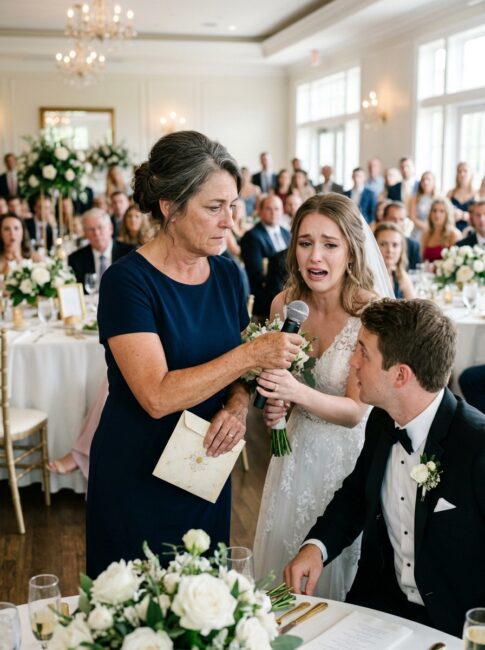
Ruth held the microphone too tightly.
She did not look triumphant.
That was the first strange thing.
People expected anger from someone who interrupted a wedding. They expected bitterness, drunkenness, jealousy, or a desire to embarrass somebody.
Ruth looked terrified.
Her left thumb rubbed the edge of a small envelope tucked beneath the microphone cord. The envelope was old, cream-colored, and softened at the corners from being opened too many times.
Emily noticed it.
So did Ms. Marjorie Whitmore, Daniel’s mother, though her face remained hard.
“This is my son’s wedding,” Marjorie said, rising from the front table. “Give the microphone back.”
Ruth turned toward her.
“It is also her wedding,” she said quietly.
The sentence was simple, but it landed in the room with a strange weight.
Emily’s father, Robert Harper, stood then. He was a broad-shouldered man in his late fifties, wearing a gray suit and a face full of restrained anger.
“Ruth,” he said, and the way he said her name made several heads turn.
They knew each other.
That was the second strange thing.
Emily looked at her father.
“Dad?”
Robert did not answer her.
He walked slowly toward the stage, his eyes fixed on the envelope in Ruth’s hand.
“Not tonight,” he said.
Ruth’s mouth trembled.
“You promised there would be a place for her.”
The hall grew quieter.
“For who?” Emily asked.
Ruth turned toward the bride. For the first time, her eyes softened.
“For the woman whose hands made sure you could stand here.”
Emily blinked.
“My mother is right there.”
At the front table, Linda Harper pressed a napkin to her lips. She had raised Emily from the age of three, after Emily’s birth mother died of complications following a late winter illness. That was the story everyone knew.
Linda was kind. Devoted. Gentle. Nobody in the room doubted she was Emily’s mother in every way that mattered.
Ruth nodded toward Linda with respect.
“Yes,” she said. “And she deserves every flower in this room.”
Then she looked back at Robert.
“But she was not alone.”
Robert’s face seemed to age in front of everyone.
Daniel came to Emily’s side and touched her elbow.
“Do you want me to stop this?”
Emily shook her head, though she looked frightened.
“No. I want to know why she knows my father.”
Ruth closed her eyes.
That was when Emily noticed the small pin on Ruth’s navy dress. It was shaped like a white daisy, old and slightly chipped.
Emily had seen that pin before.
Not on Ruth.
In a wooden memory box her father kept in the attic.
The box held baby photos, hospital bracelets, an old knitted cap, and one blurry picture of a young woman holding newborn Emily beside a window. The woman in the picture had worn the same white daisy pin.
Emily turned pale.
“Where did you get that?”
Ruth touched the pin as if she had forgotten it was there.
“Your mother gave it to me.”
Linda made a soft sound from the front table.
Robert lowered his head.
Marjorie looked suddenly less angry and more uncertain.
Emily’s voice became small.
“My mother died when I was little.”
Ruth nodded.
“Yes.”
“Then why are you here?”
Ruth looked at the envelope in her hand.
“Because she asked me to be.”
The words opened something in the room.
Not enough to explain everything.
Just enough to make every person stop judging so quickly.
Ruth took a careful breath.
“I did not come here to ruin your wedding, Emily. I came because your speech had a blank space in it, and I heard the name that was missing.”
Emily looked at her notes on the sweetheart table.
Her thank-you speech thanked Daniel, both families, her father, Linda, her bridesmaids, the nurses who had cared for her as a baby, and the guests who had traveled far.
There was no missing name she could see.
Then Ruth unfolded the envelope.
A faded photograph slipped partly into view.
Three women stood outside a hospital entrance in the snow. One was Linda, younger and exhausted. One was Ruth, thinner, wearing a coat too large for her shoulders. Between them stood a woman with the daisy pin, holding a wrapped baby close to her chest.
Emily stepped toward it.
“Who is she?”
Ruth’s voice cracked.
“Her name was Sarah.”
Robert covered his face.
“And before she died,” Ruth said, “she made me promise I would speak if everyone forgot what she gave up.”
Sarah Harper had not died the way Emily had been told.
Not exactly.
She had been twenty-nine, bright-eyed, stubborn, and known in their small Michigan town for planting daisies in places they did not belong. Cracks in sidewalks. Empty coffee cans. The strip of dirt behind the laundromat where Ruth worked nights.
Ruth had met her there.
Back then, Ruth was twenty-four and living in a rented room above a closed barber shop. She cleaned hotel rooms by day and washed linens at the laundromat after midnight. She had no family nearby, no savings, and no reason to believe anyone would notice her if she disappeared.
Sarah noticed.
She brought Ruth coffee. Then soup. Then a winter coat she claimed “didn’t fit right,” though it fit Ruth perfectly.
When Sarah became pregnant with Emily, she was already ill more often than she admitted. The doctors used careful language. High risk. Complications. Bed rest. Monitoring.
Robert worked construction then, taking any job that paid. Linda was Sarah’s older sister, a quiet nurse who came over after shifts to help with groceries and laundry.
Ruth came too.
Not because anyone paid her.
Because Sarah asked if she could sit awhile, and Ruth did not know how to say no to someone who had once made loneliness feel less permanent.
By the time Emily was born, Sarah’s condition had worsened.
The night of the emergency, a snowstorm closed half the roads into town. Robert was stuck on a job site an hour away. Linda was already at the hospital on shift but could not leave her floor.
Ruth was the one at the house.
She was the one who called 911.
She was the one who wrapped Sarah in blankets, held her upright on the bathroom floor, and listened as Sarah whispered instructions between breaths.
“My baby box is under the bed.”
“Tell Robert I tried.”
“Tell Linda not to blame herself.”
“And if my girl ever gets married,” Sarah said, gripping Ruth’s wrist, “make sure she knows love started before she remembers it.”
Ruth had cried and told her not to talk that way.
Sarah had smiled anyway.
At the hospital, Emily was delivered safely, small but fierce. Sarah held her once, with Linda and Ruth beside the bed, while the snow tapped the window like soft fingers.
The photograph in Ruth’s envelope was taken by a nurse just before Sarah was taken back for another procedure.
Sarah gave Ruth the white daisy pin.
“Keep it,” she said. “You’re family too.”
She died before morning.
For years after that, Ruth remained close.
She brought casseroles she could barely afford. She watched Emily when Linda was working and Robert was too broken to stand in the nursery. She sang the same off-key lullaby Sarah had sung. She mended tiny dresses. She wrote down the first words Emily said because Robert cried too hard to hold a pen.
Then life changed.
Robert married Linda when Emily was three, not because anyone was replacing Sarah, but because grief and love had made a family where one already existed. Ruth was happy for them.
At first.
Then whispers started.
Some relatives thought it was strange that a laundromat worker was always around. Marjorie Whitmore, who knew the Harpers through church circles long before Daniel and Emily ever met, once asked Linda if Ruth was “appropriate company” for a child.
Linda defended her.
Robert did too, until custody paperwork, insurance forms, and school registrations began needing clean stories.
Mother. Father. Stepmother. Aunt.
There was no box for the woman who had held the door open during the worst night of their lives.
Ruth slowly became “Mom’s old friend.”
Then “someone who used to help.”
Then nothing at all.
She did not fight it.
That was the part that made Emily’s hands cover her mouth.
Ruth had not stayed away because she stopped caring. She had stayed away because every time she appeared, somebody looked at Linda as if her motherhood was less complete.
Ruth loved Linda too much to do that.
So she became a quiet guest at the edges of family history.
She sent birthday cards without a return address. She left Christmas books on the porch and let Robert pretend he did not know who brought them. She stood in the back at Emily’s high school graduation and left before the family photos.
And when Emily got engaged to Daniel, Ruth received no invitation.
Linda had wanted to send one.
Robert had hesitated.
Not out of cruelty.
Out of fear that one old name would open pain on a day meant for joy.
But Sarah had left a letter.
Ruth had kept it for twenty-four years.
Inside the cream-colored envelope was not a speech for Ruth to give. It was a note written in Sarah’s thin hospital handwriting, addressed to “My girl, when she wears white.”
Emily unfolded it with trembling hands as the reception hall remained completely silent.
My sweet Emily,
If this letter reaches you on your wedding day, it means someone loved me enough to remember my promise.
I hope your father laughs again. I hope Linda lets herself be your mother without guilt. I hope Ruth is somewhere nearby, pretending she does not matter, which means she matters more than she knows.
On the night you were born, three people held the world together for you.
Your father loved you before he saw you.
Linda saved every breath she could.
Ruth held my hand when I was afraid.
If your wedding has room for flowers, music, and cake, I hope it has room for all the women who carried you.
Not because blood is everything.
Because love is never only one person.
Emily could not finish reading aloud.
Daniel took the letter gently and continued, his own voice breaking before the final line.
Dance once for me, if you can. And if Ruth is there, make sure she does not stand in the back.
The room fell apart quietly.
Linda wept into both hands. Robert sat down as if his legs had forgotten him. Marjorie Whitmore, who had looked at Ruth with contempt minutes earlier, lowered her head until her pearls touched her chest.
Emily stepped off the stage.
Ruth immediately tried to give back the microphone.
“I’m sorry,” she said. “I should have found another way.”
Emily looked at the woman’s rough hands, the daisy pin, the envelope, and the face she should have known.
Then she wrapped her arms around Ruth.
Ruth stood stiff for one second, as if she had trained herself not to accept things not meant for her.
Then she broke.
Not loudly.
Not for attention.
She folded around Emily like a person finally allowed to grieve in the room where the grief belonged.
Across the hall, both families watched the bride hold a woman most of them had mistaken for kitchen staff.
And one by one, they understood that the interruption had not stolen the wedding.
It had returned a missing piece of it.
The reception did not continue in the same way after that.
It became quieter first.
Then softer.
The DJ did not know whether to restart the music, so he waited. The servers moved carefully around tables where guests sat wiping their eyes with linen napkins. Children asked questions their parents could not answer without pausing.
Emily kept the letter in her hand.
Daniel stood beside her, not trying to guide the moment away from its pain. That was one reason she had married him.
Linda was the first to approach Ruth.
For years, guilt had sat between them like an extra chair at every family table. Linda had gained a daughter and lost a sister in the same breath. Ruth had lost a friend and then slowly lost her place in the story.
Neither woman had known how to ask for what had been missing.
Linda took Ruth’s hands.
“I should have kept calling,” she whispered.
Ruth shook her head.
“I should have answered anyway.”
Robert came next.
He stood in front of Ruth with his gray suit wrinkled and his eyes red.
“I erased you because I thought it would make the story easier for Emily,” he said.
Ruth looked past him toward the bride.
“She deserved the whole story.”
“I know.”
Then Robert did something nobody expected.
He turned to the room and took the microphone himself.
His voice was unsteady.
“I asked Emily’s mother, Sarah, for one dance at our wedding twenty-eight years ago,” he said. “Tonight, she asked for one back.”
He looked at Ruth.
“Would you dance with my daughter for her?”
Ruth’s face emptied of all defense.
Emily reached for her hand.
The DJ chose no dramatic song. Just an old, slow melody that Sarah used to hum in the kitchen, one Robert had mentioned once and Daniel had quietly found for the reception playlist.
Emily and Ruth stepped onto the dance floor.
The bride’s white gown brushed against Ruth’s simple navy dress. Ruth held one of Emily’s hands carefully, as if afraid the right to touch her might disappear.
Halfway through the song, Linda joined them.
Then Robert.
Then Daniel.
Nobody clapped until the music ended.
When they did, it was not loud at first. It rose slowly, like something being forgiven across the room.
Later that night, after the cake had been cut and the guests had begun to leave, Emily found Ruth near the service hallway, helping a young waitress gather empty glasses.
“You don’t have to do that,” Emily said.
Ruth looked embarrassed.
“Old habit.”
Emily held out the bouquet.
It was made of white roses and small daisies tucked between them.
Ruth stared at it.
“I can’t take your bouquet.”
“You are not taking it,” Emily said. “You are carrying it.”
Ruth touched one daisy with her thumb.
Then Emily leaned close and whispered, “She said not to stand in the back.”
Ruth looked toward the empty dance floor.
For the first time that evening, she smiled without apologizing for it.
Weeks later, Emily framed Sarah’s letter and placed it beside her wedding photo. Not in a hallway where guests would admire it casually, but in the small dining room where family dinners happened.
In the photo she chose, Ruth stood beside Linda, Robert, Daniel, and Emily. Her navy dress was plain. Her hands were rough. The daisy pin rested over her heart.
No one stood behind anyone.
On quiet mornings, Emily sometimes read the final line again.
If Ruth is there, make sure she does not stand in the back.
And every time, she understood her wedding had not been interrupted.
It had been completed.
Follow this page for more emotional stories about the hidden moments that change how we see the people around us.