Part 2: A Woman Was Looked Down On for Living in a Mobile Home — What She Did During the Storm Changed the Entire Neighborhood
For nearly six years, Leah Morgan had lived in the oldest home on Willow Bend Road.
Technically, her property sat just outside the Maple Ridge homeowners association boundary. The distinction mattered to Leah more than it mattered to anyone else.
Her mobile home had pale aluminum siding, a narrow wooden porch, and flower boxes she repainted every spring. A small wind chime hung beside the front door.
Nothing about the place looked impressive.
Across the street, newer brick homes curved around wide lawns and decorative mailboxes. Families installed outdoor kitchens, replaced patio furniture each season, and hired landscapers before neighborhood events.
Leah trimmed her own grass with an old push mower.
She worked weekday mornings in the billing office of a physical therapy clinic. On weekends, she repaired loose porch boards, collected canned food for the local pantry, and checked weather alerts on a battery-powered radio.
Most neighbors knew little else about her.
They noticed the mobile home.
They noticed her secondhand pickup truck.
They noticed the rusted shed behind the trailer and assumed it was filled with junk.
At the previous homeowners association meeting, Denise had suggested installing a privacy fence along the edge of Leah’s property.
“It would improve the view from the entrance,” she had said carefully.
Leah sat in the back row holding a paper cup of coffee.
“Whose view?” she asked.
The room became quiet.
Denise offered the polished smile she used whenever she wanted a sentence to sound kinder than it was.
“We are only discussing curb appeal.”
Leah nodded once.
Then she went home.
The fence was installed two weeks later.
That Thursday evening, the tornado watch began as a line of storms crossed central Oklahoma.
Leah had already moved three plastic bins into the shed before the first warning appeared on local television.
One bin held flashlights and spare batteries. Another held bottled water, blankets, and first-aid supplies. The third contained children’s masks, granola bars, and several small stuffed animals sealed inside plastic bags.
At 8:17 p.m., her weather radio sounded.
At 8:19, lightning struck somewhere near the elementary school.
The neighborhood lost power.
Leah stepped onto her porch and looked toward the clouds.
Then she walked across the street and knocked on the Whitakers’ front door.
Denise opened it holding her phone.
“We are going to the clubhouse,” she said. “The basement is reinforced.”
“The clubhouse key box is electronic,” Leah replied. “The power is out.”
“We have a backup generator.”
“It did not start during the last outage.”
Denise frowned.
“How would you know?”
Leah glanced toward the sky.
“Because I checked it.”
Denise stared at her.
Leah turned away before the question could continue.
She went from house to house, knocking harder each time.
At the Alvarez home, she helped seventy-eight-year-old Mr. Alvarez into a rain jacket and placed his oxygen tank inside the red wagon.
At the corner house, she told a young father not to waste time moving his truck beneath the carport.
At the Peterson home, she crouched beside six-year-old Owen Peterson and handed him a small blue flashlight.
“Keep this pointed toward your shoes,” she said. “That way, you can see every step.”
The boy gripped it tightly.
His mother looked toward Leah’s trailer.
“Where are we going?”
“To the shelter.”
“What shelter?”
Leah did not answer.
Wind bent the trees until their branches touched the pavement.
Families rushed toward the clubhouse anyway.
The generator would not start.
Someone tried the basement door.
Locked.
A man pulled on the handle until his shoulders shook.
Denise called the property manager, but the call dropped before anyone answered.
Then Leah arrived with the wagon.
“Follow me,” she said.
Several neighbors hesitated.
They looked past her toward the faded mobile home and the narrow shed behind it.
Denise shook her head.
“You expect us to hide under your trailer?”
“No,” Leah said. “I expect you to trust me for three minutes.”
A loud crack split the street.
Part of a maple tree collapsed across a parked SUV.
Nobody argued after that.
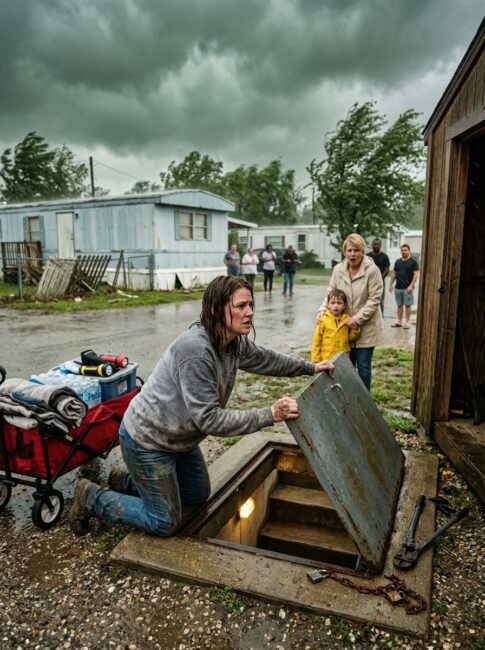
Leah cut the chain on the service gate, opened the shed, and removed the plywood panel from the floor.
The steel hatch waited beneath it.
Inside, concrete steps led underground.
Small emergency lights glowed along the walls.
Denise stared at the opening.
“You built this?”
Leah looked toward the remaining houses.
“Count the children,” she said. “I am going back for the Harris family.”
Before anyone could stop her, she ran into the wind.
The shelter smelled faintly of concrete, cedar boards, and fresh batteries.
It was larger than anyone expected.
Benches lined both walls. Shelves held water, blankets, a first-aid kit, and plastic containers labeled by category.
One label read:
CHILDREN — HEADPHONES, MASKS, SMALL TOYS
Another read:
MEDICAL — INHALER SPACERS, BANDAGES, EMERGENCY CONTACTS
Denise stood beneath the dim lights, holding the railing with one hand.
Her grandson Owen sat beside his mother, clutching the blue flashlight Leah had given him.
Mr. Alvarez settled onto a bench while a neighbor adjusted his oxygen tank.
Above them, the wind grew louder.
It did not sound like thunder.
It sounded like a train crossing a bridge directly overhead.
“Where is Leah?” someone asked.
Nobody answered.
Denise climbed two steps toward the hatch.
A man named Carl Peterson stopped her gently.
“You cannot go outside.”
“She went to the Harris house alone.”
“She told us to stay down here.”
Denise looked toward the shelves.
Every item had been arranged carefully.
The supplies were not random.
They had been chosen by someone who had thought about children afraid of noise, elderly neighbors who needed medication, and parents arriving with nothing in their hands.
A framed photograph rested on the highest shelf.
Denise lifted it.
The picture showed Leah many years earlier, kneeling beside a little girl with red hair and a yellow raincoat. The child appeared to be seven or eight.
Both were smiling.
Taped beneath the frame was a handwritten note.
For Emma. Keep the door open.
Denise stared at the words.
The hatch opened suddenly.
Rainwater poured down the first step.
Leah appeared, breathing hard, with one arm around nine-year-old Sophie Harris. Behind her came Sophie’s father, carrying a sleeping toddler against his chest.
“They were in the laundry room,” Leah said. “Their hallway window broke.”
Carl pulled the hatch closed.
The shelter darkened again.
Leah crouched beside Sophie.
“Are you hurt?”
The girl shook her head.
Leah noticed a cut on the child’s forearm and reached for the first-aid kit.
Her hands were steady until Sophie spoke.
“Was that your little girl in the picture?”
Leah froze briefly.
Denise lowered the photograph.
“I am sorry,” she whispered. “I should not have touched it.”
Leah cleaned the cut and applied a bandage.
“It is all right.”
The wind pressed against the shelter door.
Dust fell from the ceiling in thin lines.
Several children began crying.
Leah sat on the floor between them and opened the container of stuffed animals.
She handed Sophie a small bear.
Owen received a gray rabbit.
A toddler reached for a soft green dinosaur.
Leah spoke quietly.
“Everybody keep one hand on the bench. We are going to count backward from twenty.”
The children followed her voice.
By the time they reached twelve, the lights flickered.
By eight, the sound above them became heavier.
At four, something struck the shed with enough force to shake the concrete walls.
Leah continued counting.
“Three.”
Her voice remained calm.
“Two.”
Denise watched her closely.
“One.”
Then the worst of the sound moved away.
Nobody spoke for several seconds.
Only the children’s breathing filled the shelter.
Mr. Alvarez looked toward Leah.
“You have done this before.”
Leah sat beside the first-aid kit.
“Yes.”
Denise still held the photograph.
“Who was Emma?”
Leah looked at the hatch.
For years, she had avoided answering that question whenever someone noticed the name written inside the shelter door.
That night, there was nowhere else to look.
“My daughter,” she said.
Her voice remained level, but her hands tightened around a roll of medical tape.
“She was eight.”
Silence settled across the room.
Leah took a slow breath.
“Twelve years ago, we lived in an apartment across town. The warning came late. There was no shelter in the building.”
She looked toward the photograph.
“The church basement two blocks away was the nearest safe place. By the time we reached it, the side entrance was locked.”
Denise covered her mouth.
Leah continued without raising her voice.
“We tried another door. Then the storm arrived.”
Nobody asked what happened next.
Leah’s face answered enough.
She had survived beneath the concrete steps behind the church.
Emma had not.
Afterward, Leah received a small insurance payment and sold everything she could live without.
She bought the narrow property outside Maple Ridge because it was cheaper than rebuilding a conventional house.
Then she moved into the used mobile home.
People assumed she could not afford anything better.
That was partly true.
What they did not know was that Leah spent nearly every remaining dollar on the reinforced shelter beneath the shed.
She added shelves when she could afford them.
She purchased supplies slowly.
She replaced batteries every spring.
She never locked the hatch.
“Why did you never tell anyone?” Sophie’s father asked.
Leah looked toward the children.
“I mentioned it at two neighborhood meetings.”
Denise lowered her eyes.
She remembered one of them.
Leah had stood near the back row and suggested adding the shelter location to the emergency plan.
The discussion had moved immediately to parking permits and landscaping costs.
Denise had written a reminder to revisit the subject.
She never did.
Leah had not argued.
She had simply gone home and checked the batteries again.
“I stopped bringing it up,” Leah said. “But I kept room for twenty-four.”
Denise counted the people around her.
Twenty-three neighbors sat inside the shelter.
Leah had planned for one more.
The emergency radio crackled on the shelf.
A local dispatcher warned residents to remain sheltered. Power lines were down across several roads. Emergency crews were responding to multiple calls.
Leah reached for the radio.
Before she could speak, Denise touched her arm.
“I am sorry about the fence.”
Leah glanced upward toward the shed.
The fence had likely been damaged already.
“That can wait.”
“No,” Denise said softly. “I mean before tonight.”
Leah studied her for a moment.
Then she handed Denise the radio.
“Tell them we have twenty-three people safe at Willow Bend.”
Denise accepted it with both hands.
Her voice broke slightly as she gave the address.
The storm damaged fifteen homes in Maple Ridge.
Two roofs were partially torn away. Several windows shattered. The clubhouse lost part of its rear wall.
The decorative fence beside Leah’s property collapsed completely.
Her mobile home suffered the worst damage.
A tree had fallen across the narrow porch. One side of the roof peeled upward like an opened envelope. Rainwater soaked the living room and ruined most of the furniture.
The small wind chime disappeared.
By sunrise, emergency crews had cleared the street.
Neighbors gathered near Leah’s property wearing borrowed jackets and muddy shoes.
For the first time, nobody stood across the road and stared at her trailer as though it were something they wished could be hidden.
They stood beside it.
Carl Peterson brought a chainsaw.
Mr. Harris carried plywood from his garage.
Denise arrived with coffee, work gloves, and a legal pad filled with names.
“What is that?” Leah asked.
“A repair schedule,” Denise replied. “People volunteered.”
Leah looked toward the damaged trailer.
“You all have your own homes to fix.”
Denise nodded.
“We know.”
The neighborhood worked for most of the day.
Nobody made speeches.
They removed branches, covered Leah’s roof with tarps, and carried wet furniture onto the lawn.
Owen Peterson found the missing wind chime beneath a pile of leaves near the shed.
One metal tube had bent slightly.
He carried it to Leah.
“I think it still works,” he said.
Leah held it gently.
“We can test it after the rain stops.”
The following month, Maple Ridge held another association meeting.
The clubhouse repairs were still underway, so folding chairs were arranged in Leah’s yard.
For once, nobody complained about the view.
The first item on the agenda was an emergency plan.
The shelter beneath Leah’s shed became an official gathering point. Several neighbors paid for additional supplies and brighter path lights.
A small sign was installed near the service gate.
STORM SHELTER — THIS DOOR REMAINS OPEN
Denise asked whether Leah wanted a larger plaque recognizing her contribution.
Leah declined.
“The sign is enough,” she said.
By early autumn, her mobile home had a repaired roof, new porch boards, and fresh pale-blue paint.
The trailer was still modest.
It still sat outside the association boundary.
It still looked smaller than every house across the street.
But the new fence was never rebuilt.
On warm evenings, neighbors walked along the edge of Leah’s yard and stopped to talk instead of hurrying past.
Children left painted rocks near the shelter sign.
One rock carried a small yellow raincoat.
Another showed a blue sky above a square door.
Leah kept both beside the shed.
One afternoon, Denise brought a potted plant for the porch and noticed the old photograph resting on Leah’s windowsill.
Emma stood in her yellow raincoat, smiling beneath a cloudy sky.
Denise looked toward the shelter.
“You left room for twenty-four people,” she said. “There were only twenty-three of us that night.”
Leah adjusted the bent wind chime beside the porch.
“I know.”
“Who was the last space for?”
Leah looked at the photograph.
Then she turned toward the open shelter gate.
“Anyone who still needed a door.”
A breeze moved across the yard.
The repaired wind chime made an uneven sound, softer than before but clear enough to hear.
Leah sat on the porch steps as children rode bicycles along the street and neighbors waved from their driveways.
Behind her, the mobile home remained small.
Beside it, the shelter door remained unlocked.
Follow our page for more heartfelt stories about the quiet people we sometimes overlook until the moment we need them most.