Part 2: A Woman Was Sued for “Stealing Bread” at a Grocery Store — Then Her Words in Court Made the Plaintiff Drop the Case
Margaret did not begin with an apology.
That unsettled people.
The courtroom had been waiting for tears, excuses, or the trembling performance of a poor woman begging not to be punished. Instead, she looked at the judge with tired gray eyes and said, “Your Honor, I did not come here to say I am innocent.”
Victor Hale gave a short nod, as if that settled everything.
But Judge Raymond Carter did not move. He had presided over enough small-town cases to know that the first sentence was rarely the whole truth.
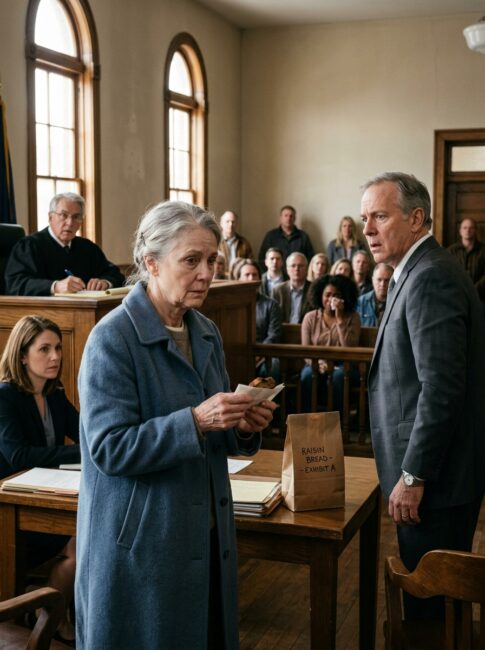
Margaret turned the napkin over in her palm. Something inside it made a soft crackling sound.
“I took two loaves of bread from Hale’s Market,” she said. “I walked past the register without paying. The camera saw me, and the clerk saw me.”
A woman in the back row whispered, “At least she admits it.”
Margaret heard her.
She did not look back.
“I also came back the next morning and paid five dollars,” she continued. “It was not enough. I know that.”
Victor’s attorney leaned back, satisfied. He had a thin face and a pen he kept clicking whenever Margaret spoke, as if her voice irritated him.
Judge Carter glanced at the security still in the file. Then he looked at Margaret’s hands.
They were not the hands of a shoplifter trying to perform innocence. They were red, swollen at the knuckles, with a small burn mark near the wrist. Her nails were cut short and uneven. One thumbnail had a crescent of dried flour beneath it.
“Mrs. Ellis,” the judge said gently, “what is in your hand?”
Margaret looked down, as if she had forgotten she was holding it.
“A piece of the bread,” she said.
A ripple moved through the courtroom.
Victor frowned.
“You brought evidence of the theft?” his attorney asked.
Margaret opened the napkin.
Inside was not a slice from Hale’s Market.
It was a hard, dry corner of homemade bread, darker than store-bought, with raisins baked into one side. It looked old enough to have lost all softness.
“My husband used to make this every Sunday,” she said. “Before the accident took his hands, and before the stroke took his voice.”
The room quieted, but not with sympathy yet.
People listen differently when grief enters a courtroom. Some soften. Others brace themselves, afraid they are being led somewhere uncomfortable.
Margaret continued slowly.
“His name was Thomas Ellis. He worked twenty-nine years at the paper mill. After it closed, he fixed lawn mowers, patched porches, and shoveled snow for people who forgot to pay him.”
Victor’s face changed at the name.
It was small, almost nothing.
But the judge saw it.
So did the bailiff.
Margaret looked at Victor for the first time.
“I knew your store policy, Mr. Hale,” she said. “I knew what cameras saw. I knew what people would think.”
Victor’s jaw tightened.
“Then you should have paid,” he said.
“I tried.”
The words were quiet enough that the court reporter leaned forward.
Margaret reached into the pocket of her blue coat and pulled out a receipt. It was folded many times, softened at the edges like something carried too long.
The judge took it from the bailiff and examined it.
It was not for bread.
It was for a prescription from Miller Pharmacy, dated the same morning as the theft.
The total was $47.82.
Margaret’s payment had been $48.00 in cash.
The judge looked up.
“Is this relevant, Mrs. Ellis?”
Margaret nodded.
“That was every dollar I had until the first of the month.”
Victor’s attorney stood.
“Your Honor, financial difficulty does not justify theft.”
“I understand that,” Margaret said before the judge could answer.
Her voice did not rise. That made it worse.
She was not arguing.
She was placing pieces on a table.
The clerk from Hale’s Market, a young Black woman named Tasha Reed, shifted in her seat. She had testified earlier, but now her eyes had dropped to her lap.
Judge Carter noticed.
“Ms. Reed,” he said, “you seem to have something to add.”
Tasha looked startled.
Victor turned toward her sharply.
She swallowed.
“I just remember Mrs. Ellis asking if the day-old bread was still donated after closing,” Tasha said.
Victor’s attorney stood again. “That was not in her statement.”
“No,” Tasha said, her voice smaller. “Mr. Hale told me to keep it simple.”
The room changed.
Not dramatically. Not yet.
But something had cracked.
Margaret closed her napkin around the stale bread and whispered, almost to herself, “I did ask first.”
Judge Carter leaned back in his chair.
“Mrs. Ellis,” he said, “tell the court why you took the bread.”
Margaret looked at the witness stand, then at Victor, then toward the small gallery where three strangers had come to watch a poor woman be punished for two loaves.
“My husband had not eaten in two days,” she said.
Nobody moved.
“He could swallow soft bread if I soaked it in milk. Not soup. Not rice. Not the food boxes from the church, because most of it was too hard for him. Bread was the last thing he still accepted without turning his face away.”
Victor looked down.
Margaret went on.
“I had spent the money on his blood thinner. The doctor said missing even one dose could be dangerous. I thought there might be day-old bread, the kind Hale’s Market used to leave in boxes for the shelter.”
Judge Carter glanced at Victor.
“Used to?” he asked.
Tasha answered before Victor could.
“They stopped donating after the new insurance policy,” she said. “Mr. Hale said it was safer to throw it away.”
Victor snapped, “That is standard practice.”
Margaret did not challenge him.
She only said, “There were six loaves in the disposal bin that morning. Still wrapped. Still clean. I saw them through the employee door when Ms. Reed took out cardboard.”
Tasha lowered her head.
“I told her I could get fired,” she whispered.
“And she was right,” Margaret said quickly.
That was the first moment the courtroom saw something unexpected.
Margaret was protecting the clerk who had helped build the case against her.
“She did not give me anything,” Margaret said. “She only looked away for a second because she was kind enough not to watch me be ashamed.”
Tasha began to cry.
Victor’s attorney stopped clicking his pen.
Margaret turned back to the judge.
“I took two loaves from the shelf instead of the trash because the trash bin was locked by then. I was wrong. I knew it when I did it. But my husband was sitting at our kitchen table with a blanket on his shoulders, pretending not to be hungry so I would not feel worse.”
Her voice trembled for the first time.
“He used to bring me bread with raisins when we were young. He said raisins made poor bread feel like a holiday.”
No one laughed.
Not even politely.
Margaret opened the napkin again and looked at the hard corner in her palm.
“This is the last piece he ever made before his hands stopped working. I kept it in the freezer for four years. When I had nothing else to give him, I took it out and held it under warm milk. He smiled, but he could not swallow it.”
Judge Carter removed his glasses.
Margaret continued because stopping would have been harder.
“So I went to Hale’s Market. I asked about day-old bread. I asked whether I could sweep the sidewalk, clean the storeroom, anything. I was told no. I had ten minutes before my husband’s next dose. I took two loaves.”
Victor suddenly stood.
“Your Honor, this is emotional manipulation.”
Margaret turned toward him with no anger in her face.
“Mr. Hale, I came back the next morning to pay you because Thomas died that night.”
The courtroom became completely still.
Even Victor’s attorney froze.
Margaret’s fingers tightened around the napkin.
“He ate three bites,” she said. “Three good bites. Then he fell asleep in his chair with his hand on mine. By morning, he was gone.”
A woman in the gallery covered her mouth.
Tasha wiped her face with both hands.
Margaret looked at Victor, and now the story turned again.
“I came back to pay because twenty-three years ago, your wife came to our door at midnight.”
Victor’s face drained.
“Margaret,” he said, almost warning her.
But she did not stop.
“She was pregnant with your second child. Your old truck had slid into the ditch on Route 11. My husband pulled you out with his tow chain. He drove your wife to the hospital because the ambulance was twenty minutes away.”
Victor lowered himself slowly into his chair.
Margaret looked at the judge.
“The baby was born before sunrise. A girl. Red hair. Loud cry.”
Victor whispered, “Emily.”
“Yes,” Margaret said. “Emily.”
The fifth twist settled over the courtroom like snow.
Everyone in town knew Emily Hale. She had died at nineteen in a winter car accident, years before. Her framed photo still hung near the registers at Hale’s Market beside a small brass plaque.
Margaret’s voice softened.
“Thomas never accepted money for that night. Mr. Hale tried to pay him, but Thomas said a child born safely was payment enough.”
Victor’s eyes glistened, but he stared hard at the table.
Margaret folded the napkin again.
“I did not take the bread because I thought I deserved it. I took it because I thought Thomas deserved not to leave this world hungry.”
Nobody spoke.
Then Judge Carter asked a question in a voice lower than before.
“Why did you not tell Mr. Hale who you were?”
Margaret glanced at Victor’s silver watch, then at her own worn shoes.
“Because people change when they no longer need you,” she said.
It was not cruel.
That made it unbearable.
Victor closed his eyes.
The store owner who had come to court to make an example of a thief now sat like a man being shown an old debt he had forgotten to carry.
But Margaret was not finished.
“I also did not want pity,” she said. “And I did not want Ms. Reed blamed. She has two children. She needs her job. So when they said I stole, I said yes. Because that part was true.”
Judge Carter looked at the plaintiff’s table.
“Mr. Hale,” he said, “do you wish to proceed?”
Victor did not answer.
His attorney leaned toward him, whispering quickly, but Victor raised one hand.
For the first time all morning, the man in the expensive suit looked older than sixty-two.
He stood.
His chair scraped the floor.
“I want to withdraw the complaint,” he said.
The attorney blinked. “Mr. Hale—”
“I said I want to withdraw it.”
Judge Carter studied him.
“On what grounds?”
Victor’s mouth opened, but no words came. He looked at Margaret, and the anger he had carried into court seemed to loosen from his shoulders, piece by piece.
“On the grounds,” he said quietly, “that I forgot who helped me when I had nothing.”
The judge dismissed the case.
He did not make a speech. He did not turn the courtroom into a lesson. He simply signed the order, set down his pen, and looked at Margaret with the kind of tired mercy that sometimes comes too late but still matters.
“You are free to go, Mrs. Ellis,” he said.
Margaret nodded once.
She gathered her purse, the receipt, and the napkin with the last piece of Thomas’s raisin bread. Her movements were careful, almost formal, as if dignity had become something she had to fold and carry by hand.
Tasha met her near the aisle.
“I’m sorry,” the young clerk whispered.
Margaret touched her arm.
“You told the truth when it cost you something,” she said. “That is not small.”
Tasha cried harder then.
Victor remained by the plaintiff’s table until everyone else began to leave. Then he walked toward Margaret, stopping a few feet away as though he no longer trusted himself to come closer.
“I knew your husband’s face,” he said. “But I didn’t remember his name.”
Margaret looked at him.
“That happens,” she said.
He flinched slightly, because forgiveness would have been easier to receive than that plain sentence.
Victor reached into his coat and pulled out his wallet. Margaret shook her head before he could open it.
“No,” she said.
“It is not charity.”
“It would feel like it today.”
He closed the wallet.
For a moment, they stood in the aisle between the benches, two people connected by bread, grief, hunger, and an old midnight rescue neither had spoken of in years.
Then Victor said, “The market throws away food every night.”
Margaret did not answer.
“I will change that,” he said.
She looked at him for a long moment.
“I hope you do.”
Outside the courthouse, the November air was cold and sharp. Margaret stepped down the stone stairs slowly, one hand on the railing. Victor followed, carrying nothing now but the weight of what he had almost done.
At the bottom, he asked if she needed a ride.
She said no.
“My husband and I walked home from this courthouse once,” she said. “We got our marriage license here.”
Victor nodded.
Margaret began down the sidewalk.
She was halfway to the corner when he called after her.
“Mrs. Ellis.”
She turned.
Victor’s voice broke on the simple words.
“What was his favorite bread?”
Margaret held the napkin against her chest.
“Raisin,” she said. “But only if it had too many raisins.”
The next morning, before Hale’s Market opened, a small wooden shelf appeared near the front doors. There was no big announcement, no ribbon, no newspaper photographer.
A handwritten sign sat above it.
Take what you need. Leave what you can.
The first loaf placed there was raisin bread.
It had too many raisins.
Margaret did not come that day. She came three days later, just before closing, wearing the same blue coat. She did not take a loaf. She only stood before the shelf and touched the sign with two fingers.
Then she placed something beside it.
A folded napkin.
Inside was the last hard corner of Thomas’s bread, the piece she had carried through court.
Victor watched from behind the register but did not speak.
Margaret looked once toward the empty bakery aisle, then walked out into the evening light with her purse tucked under her arm.
Behind her, the bell over the door gave one soft ring.
And if this story stayed with you, follow this page for more heartfelt stories about the quiet choices that reveal who people really are.