An Eleven-Year-Old Led Her Confused Grandfather Into a Biker Bar—Then He Named Every Man Inside, and Her Father Ordered Her to Bring Him Home
I looked at Grandpa.
He was rubbing the little triangular notch in the coaster with his thumbnail. His mouth had softened into a smile I usually saw only when someone brought strawberry jam.
“Did you hear me?” Dad asked.
“Yes.”
“Good. Stay outside. I’m coming.”
He hung up before I could tell him Grandpa had already forgotten why the bartender was crying.
That was the part that frightened me.
A minute earlier, Grandpa had named every old man along the counter. Now he looked at Eddie and whispered, “Am I in trouble?”
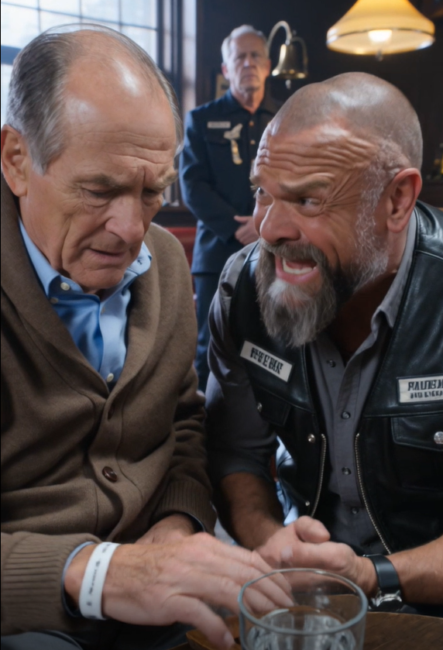
Maybe Dad was right.
Maybe remembering names didn’t mean remembering anything else.
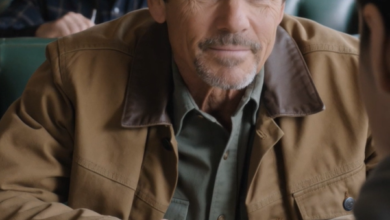
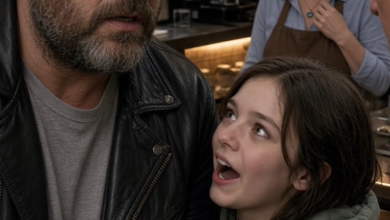
Eddie crouched beside the stool. He was broad enough to block the refrigerator behind him, with a gray beard, scarred knuckles, and a leather vest that creaked when he moved.
“You’re having some trouble with your memory, Art,” he said. “We can take our time.”
Grandpa flinched.
“Henry.”
Eddie nodded immediately.
“All right. Henry.”
He didn’t argue. He put a glass of water where the beer would have gone and asked me whether a nurse knew we were out.
Mrs. Alvarez did. Our Saturday walk was supposed to follow the fenced garden and the sidewalk beside the care home. Grandpa had insisted on continuing toward a bell he said he could hear.
I called her.
She sounded frightened, then relieved, then frightened again when I gave her the address.
“Keep him seated. I’ll bring his medication list. Is there a responsible adult with you?”
I looked at Eddie.
He was carefully folding a paper towel beneath Grandpa’s glass so the water wouldn’t drip onto his trousers.
“Yes.”
While we waited, Eddie asked whether he could look at the bracelet. Grandpa offered the wrong wrist first, then laughed at himself.
That laugh changed Eddie’s face.
He turned toward the kitchen and called for Leon.
Nobody asked Grandpa to prove anything after that.
They brought a cushion. Somebody lowered the television. A man with a cane moved his chair so Grandpa could see the door.
I had never heard a bar become quiet so carefully.
Then Dad arrived in the wool coat he wore to school meetings.
He smiled at me first.
“There’s my girl.”
I nearly ran to him.
Then Grandpa pulled the coaster against his chest.
Dad noticed.
His smile stayed where it was, but his hand stopped reaching for me.
“Dad,” I said, “they know him.”
“Of course they think they do.”
Eddie stood.
Dad looked smaller beside him, although Eddie hadn’t moved closer.
“We’ve called his nurse,” Eddie said. “She’s on her way.”
“You’ve upset a sick man.”
“He walked in remembering us.”
Dad lowered his voice.
“He does that. He makes people into other people.”
Grandpa looked up.
“Daniel?”
Dad’s jaw tightened.
For the first time that afternoon, Grandpa sounded completely certain.
“You moved the bell.”
Dad glanced at the wall beside the kitchen before looking back at him.
The brass bell was hanging above the front door.
Why had Dad looked somewhere else?
Mrs. Alvarez arrived carrying Grandpa’s coat, a medication sheet, and the expression adults get when they are trying very hard not to frighten a child.
She checked him before asking anybody questions.
He knew his first name was Henry. He thought it was Tuesday. He recognized me as “Daniel’s little girl,” which was better than some Saturdays.
“He needs a quieter room,” she said.
Dad reached for his elbow.
Grandpa recoiled.
It was small. Just his shoulders drawing inward.
But Mrs. Alvarez saw it.
“Let him choose who helps.”
He chose Eddie.
Later, Eddie told me about the last summer before Grandpa disappeared. We were sitting in the kitchen, waiting for the nurse to finish her calls.
There had been Sunday breakfasts before the bar opened. Grandma June worked the griddle while Grandpa sat meandering club members down with plates they hadn’t ordered.
My father, then twenty-eight, handled the books.
“He used to get aggravated with that drawer,” Eddie said.
The drawer beneath the back counter stuck unless you lifted its left corner before pushing the little brass catch. Grandpa called it the handshake.
Dad could open it one-handed.
Inside was a tobacco tin holding repair receipts, property papers, and wooden coasters Grandma cut from thin scraps of walnut.
One coaster had a triangular bite missing.
Her scissors had snapped.
Grandpa refused to throw it out.
He used to place it beneath Grandma’s coffee and tell anybody who complained, “Things can be damaged and still have a place here.”
That was the whole happy story Eddie gave me.
Then he stood up because his eyes were bothering him.
I kept looking at the coaster in Grandpa’s lap.
It wasn’t a key. It didn’t contain a secret compartment.
It was something my grandmother had made badly and somebody had kept.
Mrs. Alvarez asked Dad about Grandpa’s name.
“Henry Bell is the name on our residence file,” she said. “These gentlemen have photographs identifying him as Arthur Mercer.”
“Bell was his mother’s name. He changed it.”
“Do you have the documentation?”
“At home.”
Dad said it quickly.
So quickly I recognized it.
That was how he answered when school asked for a form he had forgotten.
Except Dad never forgot forms.
He kept insurance papers in labeled sleeves. He photographed parking meters before walking away. He made me put permission slips in a blue folder before dinner.
Mrs. Alvarez didn’t accuse him of anything.
She asked whether he would bring the documents to the care home.
Eddie asked about twenty years.
Dad stared at him.
“You told Leon you found my father’s coat beside the river.”
“I found his coat.”
“You said nobody could have survived.”
“I was grieving.”
Grandpa had begun picking at his sleeve.
“June’s waiting,” he said.
Nobody answered immediately.
My grandmother had died before I was born.
Dad’s face changed then. The hard part went away, and he looked so tired I almost hated Eddie for asking.
He knelt beside Grandpa.
“I’ve been doing this a long time,” he said quietly.
Grandpa let him straighten his collar.
For a moment they looked like any father and son.
Then Mrs. Alvarez’s phone rang.
She listened, stepped away, and came back with the medication sheet pressed flat between both hands.
“The original admission wasn’t arranged by Daniel,” she said.
“It was arranged by Miriam Cole.”
Eddie stopped breathing through his nose.
Who was Miriam, and why did hearing her name make him step away from Grandpa?
Miriam had been the club’s secretary.
She had also been the woman who told everyone Grandpa had borrowed money, quarreled with Dad, and ridden away before dawn.
Eddie remembered her standing in this kitchen with an envelope.
Inside was a note in Grandpa’s handwriting.
Need some distance. Don’t come looking.
For twenty years, that note had done the work a locked door couldn’t.
Men who would have searched every ditch in southern Ohio believed their friend had chosen to leave them.
Dad took his phone out.
“Finally,” he said. “Someone is checking facts.”
He showed Mrs. Alvarez photographs of care payments.
There were years of them.
Larger amounts than I understood. Specialist appointments. Dental bills. Shoes.
He had bought Grandpa the coat Mrs. Alvarez was holding.
I felt sick with relief.
Then sick with shame.
I had imagined my father doing something terrible because a stranger had looked sad.
“He’s my dad,” I told Eddie.
“I know.”
“You’re making him sound—”
“I know.”
He didn’t finish the sentence for me.
Mrs. Alvarez arranged for Grandpa to return with her in the care-home van. Dad was allowed to accompany him. I went too.
Nobody staged a rescue.
Nobody blocked the driveway.
Eddie gave the nurse his number and asked whether she could pass a message to whoever reviewed the old records.
“Tell them Arthur Mercer has people who knew him before.”
That night, Dad made grilled cheese.
He cut mine diagonally.
He asked whether I had been frightened.
I said yes.
“So was I.”
He put his hand over mine.
“You can’t understand what those years were like.”
I believed him.
I still believe that part.
Three days later, Miriam came to the bar at Eddie’s invitation. My mother brought me because I had been the one walking with Grandpa, and the adults wanted my account without Dad answering for me.
My parents had been divorced for four years. Mom knew Grandpa as Henry too.
Miriam was seventy-four, with swollen fingers and a supermarket bag containing an old appointment calendar.
She looked at the photograph Eddie had taken.
“That’s Arthur.”
“You admitted him,” Eddie said.
“I arranged a rehabilitation bed after his accident. Daniel brought the paperwork.”
“Under Henry Bell.”
Miriam swallowed.
“He said Arthur had asked for privacy.”
She had believed the arrangement would last six weeks.
Her calendar contained a follow-up appointment, then another. Beside the second, in cramped handwriting:
D says father refuses visitors.
She had stopped calling after Dad sent a letter asking her to respect his father’s wishes.
Miriam kept the letter.
She had kept it because it hurt.
Mom read it twice.
The signature at the bottom was Arthur Mercer.
The date was eighteen months after the accident.
Grandpa’s rehabilitation assessment, obtained later through his appointed advocate, recorded that he still couldn’t reliably write his full name then.
Miriam sat down without removing her coat.
“I thought he hated us.”
Nobody comforted her quickly enough.
Then she unfolded another paper from the bag.
It was a recent notice Dad had sent her about selling the bar property.
Why was he selling land everyone had always understood belonged to Grandpa?
The papers did not come out of a mysterious safe.
Most came from ordinary places adults forget children notice.
A county records website.
A bank envelope.
A filing cabinet beside a printer that kept jamming.
Mom found a lawyer named Ruth Halpern, who agreed to help establish who Grandpa was and who could speak for him. Ruth made no promises about getting him home.
“He may still need residential care,” she said. “Finding family doesn’t make his medical needs disappear.”
I liked her less for saying it.
Later, I understood why she had.
Mrs. Alvarez reported the conflicting identity information through the care home’s safeguarding process. Grandpa received an independent assessment. His records stayed private; Eddie couldn’t simply demand a folder because he had recognized an old friend.
What we eventually learned arrived through people authorized to obtain it.
The first surprise was that Dad had genuinely paid for care.
The second was where much of the money came from.
Rent.
For years, the club had paid monthly rent to a property company Dad controlled. He told the members a private investor had bought the parcel after Grandpa disappeared.
The payments funded care.
They also funded other things.
Ruth laid two pages beside each other.
One showed the company collecting rent.
The other showed a deed, recorded less than two years earlier, transferring Grandpa’s remaining ownership interest to that company.
The signature looked confident.
Grandpa’s hand no longer did.
“That alone doesn’t prove forgery,” Ruth said.
She kept saying things like that.
Then she turned over the sale notice.
Dad had agreed to sell the property to a developer. The closing depended on clearing questions about title and possession.
The bar would be demolished.
The club had received a deadline to leave.
Eddie stood by Ruth’s office window, holding his reading glasses like he’d forgotten what they were for.
“We paid him to keep our own friend hidden.”
Nobody corrected him.
There were complications. Dad claimed broad authority under an old document. Some signatures needed examination. Some records had been moved between facilities.
The care-home name wasn’t a complete second legal identity. It was an alias that had been carried forward in resident-facing files, supported by Dad’s repeated claim that his father had changed his name.
Billing records still led back to the family.
So did the money.
That was how Ruth began joining the pieces.
Then Leon remembered the tobacco tin.
Dad had visited the bar the previous spring, saying he needed old maintenance receipts for the proposed sale.
Eddie had let him behind the counter.
Afterward, the tin was gone.
“Did you see him take it?” Ruth asked.
“No.”
“Then say exactly that.”
A week later, Dad sent a letter through his lawyer demanding that Eddie stop contacting Grandpa.
Attached was a statement about threatening bikers exploiting a vulnerable adult.
There was also a photograph of me standing beside Eddie outside the bar.
The picture had been cropped.
Mom was standing just beyond its edge.
Dad wasn’t only trying to make Grandpa’s memories unreliable anymore.
What would happen if he made the people listening to those memories look dangerous?
Dad collected me from school on Thursday.
It was his afternoon. His name was on the list.
There was nothing unusual about his car waiting beneath the bare maple trees.
Until he took my phone.
“You’re eleven,” he said. “You don’t need adults putting this on you.”
He put it in the center console.
I watched the lid close.
At home, he asked me to sit at the kitchen table.
He had printed a statement.
It said Grandpa had wandered into the bar after I suggested going inside. It said Eddie asked leading questions. It said I had mistaken ordinary confusion for recognition.
Some of it sounded almost true.
That was worse.
I had helped Grandpa through the door.
Eddie had asked questions.
I had wanted the photograph to mean something.
“Just tell them you were upset,” Dad said.
“Why does it need my name?”
“Because people are twisting what happened.”
He slid a pen toward me.
I looked at the blue folder where he kept my school forms.
For the first time, it looked like something I should have read more carefully.
“I want Mom.”
“She knows where you are.”
“Can I call her?”
“When we’re finished.”
Dad didn’t shout.
He didn’t have to.
I sat there listening to the refrigerator click on and off while he told me how much care cost, how little the club had helped, how easy it was for people with motorcycles to criticize someone doing the actual work.
Some of it was true too.
Then he said something he couldn’t take back.
“If they hadn’t filled his head with that building, we could have settled this.”
Not Grandpa’s head.
His claim.
I began crying, which annoyed him more than arguing had.
He got a tissue and put it beside the pen.
Across the room, my backpack lay open. My school planner was sticking out.
I asked to finish homework first.
He said we could do that after.
There wasn’t a clever escape.
Mom came because Dad hadn’t answered two scheduled calls and had ignored her message asking to speak to me.
He told her I was upset.
She saw the statement.
“Ellie,” she said, very evenly, “get your shoes.”
The adults argued in the doorway.
I remember Dad saying he had a right to speak to his own daughter.
Mom said, “You had that conversation. She’s leaving with me.”
She didn’t make me explain everything in the car.
She stopped at a grocery store, bought crackers, and let me hold my phone without answering anyone.
Ruth documented what had happened. After that, arrangements for my visits changed while the family court reviewed the concerns.
I didn’t see every paper.
I didn’t need to.
Meanwhile, Grandpa’s advocate asked that disputed financial decisions be paused. An emergency court order temporarily stopped the sale while the documents were examined.
Dad could no longer complete the deal that week.
But the next afternoon, Grandpa told his advocate something that made Eddie leave the room.
“I asked Daniel to hide me.”
If that was true, what exactly had we been trying to save him from?
They did not gather everyone around Grandpa and demand the rest.
His advocate spoke with him over several visits, during the hours when he was usually most alert. Some answers changed. Some didn’t come.
The older records mattered more than any one conversation.
Together, they showed something messier than the story I wanted.
Before the accident, Grandpa had borrowed against his share of the property to help Dad’s failing auto-parts business.
He hadn’t told the club.
He had also signed a private agreement that could have put the building at risk if the debt wasn’t paid.
Eddie had spent twenty years defending a friend who had kept that from him.
For several days, he didn’t visit.
I was angry.
Mom said he was allowed to be hurt.
Miriam’s old calendar helped establish the sequence. Grandpa wrote the goodbye note before the accident, intending to leave town briefly while Dad negotiated with the lender.
He wanted distance from the men he had disappointed.
Then he crashed on a wet county road.
The head injury left lasting problems with memory and judgment. Years later, dementia added new losses.
Dad hadn’t caused the accident.
Nobody ever found evidence that he had.
At first, he arranged treatment and kept his father away from an angry creditor and people Grandpa was ashamed to face.
Henry Bell began as a private name.
A temporary hiding place.
Then weeks became months.
Dad told the club his father was probably dead. He told the care providers the old friends were estranged. When Grandpa asked questions, Dad repeated a simpler story until Grandpa could no longer separate it from anything else.
The original debt was eventually paid.
The hiding continued.
So did the rent.
Ruth obtained a copy of the paid release. The creditor had filed it years before I was born.
There had been no remaining financial reason to keep Grandpa’s existence from his friends.
There had been a personal one.
Dad controlled everything while Arthur Mercer was gone.
When Eddie finally visited, he brought no photograph.
Just the broken coaster.
Grandpa turned it in his hand.
“June’s?”
“Yeah.”
Eddie sat far enough away to leave space between their chairs.
“You should’ve told us about the loan.”
Grandpa looked at him.
For a moment I thought he understood.
Then he asked whether June was working late.
Eddie rubbed both palms over his knees.
“No, brother.”
He stayed anyway.
Afterward, in the parking lot, he told Mom he didn’t know how to forgive a man who might never understand the question.
Mom didn’t answer.
There wasn’t a useful answer.
That evening, Ruth called about the missing tin.
Dad’s lawyer had produced several old documents in response to a formal demand, including photographs taken inside the tin before its contents were separated.
One photograph showed two folded payment receipts.
One white.
One pale green.
Ruth asked Eddie whether he recognized them.
He recognized the tin.
The receipts meant nothing to him.
Then she asked him not to discuss the green one.
Why would the color of a piece of paper matter more than all the things Grandpa could no longer say?
The public confrontation happened at a township meeting.
Not a trial.
The developer’s proposed use of the property required a public hearing, and the club had already planned to attend before Grandpa walked through its door.
Ruth explained that the meeting wouldn’t decide ownership or criminal responsibility. Those questions belonged elsewhere.
But people would hear Dad’s explanation of the sale.
And they would hear it with the disputed documents preserved.
Grandpa stayed at the care home.
There was no reason to put him beneath fluorescent lights while strangers discussed what had been taken from him.
I went with Mom.
Eddie wore a clean shirt beneath his vest. Leon brought a folder. Miriam carried the same supermarket bag.
Nobody arrived revving engines.
The loudest sound before the meeting was a folding chair scraping the floor.
Dad stood beside the developer’s representative.
He looked like every father who had ever volunteered to organize a school fundraiser.
He described the property company. He described unpaid responsibilities. He said his father had wanted to leave the club behind.
Then he looked toward Eddie.
“Some people remember friendship. I remember bills.”
Eddie kept his hands flat on his knees.
When public questions began, Miriam asked about the old debt.
Dad said it was complicated.
She read the date on the release.
The developer’s representative leaned toward him.
Dad didn’t lean back.
Ruth asked permission to correct one statement concerning the ownership dispute. She identified herself as counsel involved in the pending proceedings and explained that the sale was temporarily restrained.
She did not wave private medical files.
She did not tell the room that a confused old man had solved his own case.
She referred to recorded documents and the court’s order.
Dad said the recent deed reflected his father’s longstanding wishes.
“Then why was the tin removed?” Eddie asked.
Dad looked at him.
“I was given those records years ago.”
“In the bar?”
“Yes.”
“By Arthur?”
“Yes.”
Eddie paused.
“You told us you hadn’t seen him since the accident.”
Dad’s mouth opened.
He corrected himself.
“Before. Obviously before.”
Ruth placed a photograph on the document table.
It showed the open tin and a white receipt.
She asked whether this was among the papers he relied on.
Dad glanced at it.
“That’s the wrong receipt. The green one is his authorization.”
The room became very quiet.
Ruth had never mentioned a green receipt.
Neither had Eddie.
She turned to Dad’s lawyer.
“The green document was created by a care facility in 2012.”
Dad stared at her.
“It isn’t authorization to sell land. It records instructions to maintain the resident’s alias and restrict contact.”
His lawyer stood.
Ruth stopped speaking.
She had made the point she was entitled to make, and no more.
Dad had placed himself with Grandpa’s records six years after claiming he last saw him.
The remark wasn’t the whole case.
It was one thread joining the payments, the false statements, the questionable deed, and the instructions in Dad’s own hand.
The meeting chair called a recess.
The developer walked into the hallway without Dad.
As people stood, Dad looked toward me.
He looked frightened.
I had wanted that for weeks.
Now that it was happening, why did I still want somebody to help him?
The case took months.
That part would make a terrible short video.
There were postponements. Statements corrected after records arrived. A handwriting examiner who refused to say more than the evidence supported.
There were also ordinary afternoons when Grandpa forgot the whole thing.
He complained that his toast was cold.
He asked a nurse whether she had seen his wife.
He laughed when I spilled apple juice on my own shoe.
While adults argued over twenty years, he still had to get through Tuesday.
The disputed deed was eventually set aside. An independent fiduciary took responsibility for Grandpa’s financial affairs under court supervision.
The club did not receive the property as a reward for loving him.
Grandpa’s interests came first.
A new lease was negotiated, with rent paid into an account managed for his care. Eddie grumbled about the terms, then signed them.
“That’s what we should’ve been doing all along.”
The developer withdrew.
The investigation into Dad’s conduct continued separately. He later entered a plea agreement involving the forged transfer and financial exploitation. The agreement required repayment and barred him from managing Grandpa’s money.
His payments for real care counted in the accounting.
They did not erase the rest.
I learned those details from Mom when she thought I could understand them, and from records I read when I was older.
At eleven, what I understood was smaller.
Dad no longer came to school assemblies without arrangements being made first.
He sent birthday presents through Mom.
One had a card saying he hoped someday I would understand.
I put it in a drawer.
I didn’t throw it away.
I didn’t answer it either.
Miriam began visiting Grandpa on Wednesday mornings. Sometimes he recognized her. Sometimes he told her she looked like a woman who used to make excellent potato salad.
She brought potato salad anyway, after checking with the kitchen.
Eddie came on Saturdays.
At first, he tried old stories.
When they tired Grandpa, he stopped.
He learned to sit through ten minutes of silence without filling it with another test.
The care home corrected Grandpa’s displayed name.
Arthur Mercer.
Staff still answered gently when he called himself Henry.
There was no celebration for the new bracelet. Mrs. Alvarez checked that it wasn’t too tight and asked him whether he wanted his cardigan.
He did.
The brass bell stayed at the bar.
We learned it had once hung beside the kitchen before renovations moved it to the front door. Dad had remembered the old position when Grandpa mentioned it.
That glance had meant something.
It just hadn’t meant everything.
I keep thinking about that.
How easy it would have been to build the wrong story from one frightened face.
On Grandpa’s first supported visit back, Eddie had lowered the bell so he could reach it without stretching.
Grandpa touched the brass.
He didn’t ring it.
Instead, he looked across the tables and asked, “Do I work here?”
“Sometimes,” Eddie said.
“What do I do?”
“Mostly complain about the coffee.”
Grandpa smiled.
Then his eyes moved toward the empty stool beside him.
Was he waiting for June, or remembering the son who used to sit there?
We never found out.
There were things Grandpa could explain and things the rest of us had to stop asking him to.
His doctors did not promise that familiar places would restore him.
The bar didn’t cure anything.
Some visits lasted twenty minutes. One lasted four because the refrigerator motor upset him and he wanted to leave.
Eddie paid the check for the sandwiches we hadn’t eaten and helped Mrs. Alvarez carry the bags outside.
Nobody called it a setback in front of him.
That winter, the club started opening early one Saturday a month.
No loud music. No crowded tables.
A few relatives came with people who needed quieter rooms and somebody willing to repeat an answer.
Eddie objected to calling it a program.
“It’s breakfast.”
So that was what everybody called it.
Miriam handled the coffee. Leon put soft covers over the chair legs because the scraping sound bothered one woman.
The men who once argued about whose turn it was to sweep learned where the spare napkins were.
Not all of them stayed.
One said seeing Arthur like that was too hard.
Eddie told him he understood, then asked him to wash the outside windows.
He did.
Dad wrote Grandpa a letter.
Ruth and his advocate discussed it before it was read aloud during a visit.
I wasn’t there.
Mrs. Alvarez told Mom only that Grandpa listened for a while, then asked whether Daniel needed money for school shoes.
He remembered a younger son.
Maybe that was mercy.
Maybe it was another loss.
I stopped trying to choose.
In the spring, Dad and I had a supervised visit in a room with a puzzle nobody had finished.
He asked about school.
I told him about a science project.
He said he was proud of me.
For a while, we talked like we used to.
Then he started to explain Grandpa.
I put down my juice.
“Not today.”
He looked at the woman sitting near the door.
Then back at me.
“All right.”
It was the first time I remember him letting that answer stand.
I still loved him.
That was something I wished adults had explained earlier: knowing what someone did doesn’t make every good memory disappear on command.
The next Saturday, I brought Grandpa a small container of strawberry jam.
He was sitting at the bar with Eddie, both hands around a mug of decaf.
Grandpa didn’t know my name.
He knew I was someone he wanted beside him.
He patted the stool.
I climbed up.
Eddie placed the damaged wooden coaster beneath my glass, turning the triangular notch away from the edge so it wouldn’t catch my sleeve.
For years, I had thought that coaster was proof.
Proof Grandpa belonged there.
Proof Dad had lied.
By then, it had become something easier to live with.
A thing Grandma made.
A thing Grandpa saved.
A thing people kept putting back on the table.
I told him I had to leave early for a school concert.
He nodded as though he understood, though a moment later he asked whether June would be singing.
I said I didn’t think so.
He touched the empty stool beside mine.
The bell moved slightly in the draft from the door.
“Will you save my seat?”
PHẦN 4 — HAI PROMPT VIDEO