Part 2: An Old Woman Locked Her Granddaughter Out in the Rain — What Happened Next Left the Neighbors Silent
By morning, the whole block had already decided what kind of woman Eleanor Whitaker was.
They said she had grown hard after her husband died. They said she never forgave Olivia for leaving town three years earlier. They said some old people became bitter when the world stopped needing them.
Nobody said it to her face.
They said it over fences, beside mailboxes, and in the slow aisles of Miller’s Grocery.
Eleanor heard enough.
She had lived on Hawthorne Lane for forty-seven years, long enough to know that curtains could gossip better than mouths. By ten o’clock, she could feel the neighborhood staring at her house.
Olivia’s car was gone.
That made the story worse.
Mrs. Harlan told two women that Eleanor had left the girl outside until she finally drove away. Mr. Pierce said he almost called the police. Someone else said Olivia had once been “troubled,” though nobody could explain what that meant.
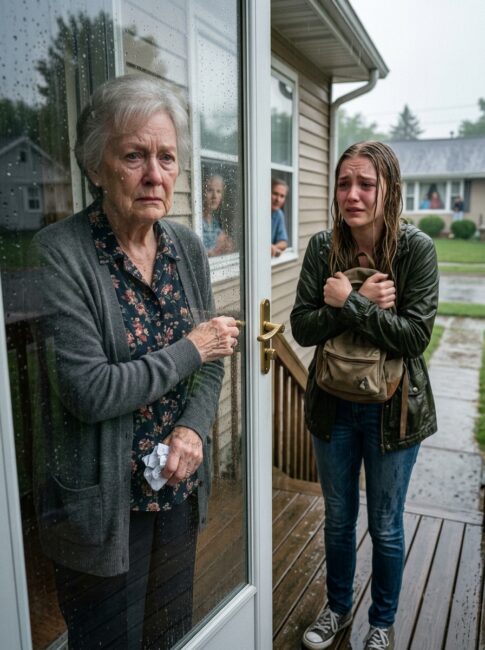
At noon, Eleanor stepped onto her porch with a broom.
The rain had stopped, but the air still smelled of wet maple leaves and cold pavement. She swept slowly, her gray cardigan buttoned wrong, her thin white hair pinned in a loose knot.
On the welcome mat, there was a half-moon stain where Olivia’s sneakers had stood.
Eleanor paused over it.
Her hand tightened around the broom handle.
Across the street, Mrs. Harlan watched through her blinds and saw the old woman bend down, touch the damp mat, and whisper something no one could hear.
That should have been the first sign.
Cruel people do not usually apologize to doormats.
Later that afternoon, a delivery truck stopped in front of Eleanor’s house. The driver carried a small brown paper pharmacy bag to the porch. Eleanor opened the door only a few inches, took it quickly, and looked up and down the street before closing herself inside again.
Mrs. Harlan noticed that too.
So did Mr. Pierce.
At 4:30, Eleanor called the county shelter.
Her voice was steady until the young woman on the phone asked for a name.
“Olivia Whitaker,” Eleanor said.
There was a pause.
Then the shelter worker said, “Are you family?”
Eleanor looked at a framed photo on the mantel. Olivia at seven years old, missing both front teeth, sitting on Eleanor’s lap with the same red scarf wrapped around both their shoulders.
“Yes,” Eleanor said. “I am her grandmother.”
Another pause.
“We cannot confirm whether someone is here,” the worker replied carefully.
“I understand,” Eleanor said. “Please just tell her the blue folder is still under the sewing machine.”
The young woman on the phone went quiet in a different way.
“What blue folder?”
Eleanor closed her eyes.
“If she hears it, she will know.”
That evening, Olivia returned.
Not to knock.
Not to beg.
She came back just before dusk, walking from the bus stop at the end of Hawthorne Lane, her hair tied back, her face pale. She did not approach the front door. Instead, she stood near Eleanor’s mailbox and stared at the house like it had become a place she loved and feared at the same time.
Eleanor saw her from the kitchen window.
For one second, her hand lifted toward the glass.
Then she forced it down.
Olivia turned to leave.
That was when Mr. Pierce stepped out of his garage.
“Olivia,” he called gently. “Are you all right?”
The girl looked at him, and her face did something strange. It almost smiled, then broke.
“I’m fine,” she said.
“No, you’re not.”
She looked toward Eleanor’s window. The curtains moved slightly.
Olivia swallowed.
“She did the right thing,” she whispered.
Mr. Pierce frowned.
“Your grandmother?”
Olivia nodded once, but she did not explain.
She only reached into her jacket and pulled out something small wrapped in plastic.
It was the old red scarf.
The same one Eleanor had kept by the door.
Only this one was torn at one end.
Olivia held it like proof of something.
Then a dark sedan turned onto Hawthorne Lane.
The color left Olivia’s face so quickly that Mr. Pierce stepped forward without thinking.
She backed away.
The sedan slowed near Eleanor’s house, then continued down the street.
Olivia’s eyes followed it until it disappeared.
Mr. Pierce finally understood one small piece of the night before.
Olivia had not been locked out because Eleanor did not love her.
She had been kept outside because someone else might have been watching.
And Eleanor, alone inside that little white house, had known it before anyone else did.
The truth came out because of a cracked kitchen window and an old woman who had learned to notice silence.
Three weeks before the storm, Olivia had come back to Cedar Rapids after disappearing from family life for nearly a year. She had not called ahead. She arrived at Eleanor’s back door just after sunrise, thinner than before, with a bruise fading beneath one sleeve and a smile that looked borrowed.
Eleanor had not asked questions right away.
She made oatmeal. She found dry socks. She put the red scarf around Olivia’s shoulders and sat beside her until the girl stopped shaking.
Only then did Olivia tell her pieces.
Not the whole story.
Just enough.
There had been a man. Not a husband, not anymore, but someone who had learned how to sound sorry just long enough to be dangerous again. He had kept Olivia’s phone, watched her accounts, followed her when she tried to leave.
Eleanor listened without interrupting.
She did not say, “Why didn’t you come sooner?”
She did not say, “I told you so.”
She only reached for an old blue folder under her sewing machine, the one where she kept insurance papers, warranty receipts, and her late husband’s army discharge form.
By the next morning, that folder held copies of Olivia’s documents, a shelter number written in large black ink, a bus schedule, and sixty dollars folded inside an envelope.
“You may not need it,” Eleanor said.
Olivia cried when she heard that.
Not because of the money.
Because Eleanor had said “may,” not “will never.”
For three weeks, they planned quietly.
Olivia would stay at Eleanor’s only until the shelter had a safe bed open outside town. Eleanor would not tell neighbors. She would not call relatives. She would not post concern online. She would give Olivia something rare and almost invisible.
A head start.
The plan almost worked.
Then, on Friday afternoon, Olivia saw the dark sedan outside the grocery store.
She called Eleanor from a stranger’s phone.
“He found me,” Olivia whispered.
Eleanor was in the produce aisle, holding a bag of lemons.
She did not panic.
She asked only one question.
“Is he close enough to hear you?”
“No.”
“Then listen carefully.”
Eleanor told Olivia to come to the house at 9:15, not the back door, not the side gate, but the front porch where every neighbor could see. She told her to knock loudly, to cry if she had to, and to leave when Eleanor refused her.
Olivia did not understand.
Neither did anyone else.
That was the point.
The man who had followed Olivia believed family would hide her. He believed she would run toward warmth, guilt, and open doors. Eleanor wanted him to see the opposite.
She wanted him to believe Olivia had nowhere to go.
She wanted him to stop watching the house.
It was a cruel performance, and Eleanor gave the ugliest role to herself.
At 9:17, while rain hammered the roof, Eleanor locked the door in her granddaughter’s face.
Inside her left hand was the note Olivia had slipped through the mail slot before knocking.
Dark sedan by corner. He is watching. I love you.
Eleanor read it once.
Then she did the hardest thing she had ever done.
She let the neighborhood hate her.
After Olivia walked off the porch, she did not go to her car. She crossed behind the Harlan house, cut through two yards, and reached the old church parking lot where a volunteer from the shelter waited with headlights off.
Eleanor watched none of it.
She kept her eyes forward, because if she looked, she might run after the girl and ruin everything.
The next morning, the shelter confirmed nothing, but the message about the blue folder reached Olivia. Inside it, under Eleanor’s sewing machine, was the last piece Olivia needed: a copy of her grandmother’s house key taped to a card.
Not for that night.
For someday.
When the sedan returned on Saturday evening, Eleanor opened her door before the man reached the porch.
Neighbors heard only part of it.
A male voice asked if Olivia was inside.
Eleanor said, “No.”
He asked when she would be back.
Eleanor said, “She is not welcome here.”
Mrs. Harlan, listening from across the street, felt her stomach twist. She thought Eleanor was being monstrous again.
Then Eleanor added something so quiet only the porch microphone on Mr. Pierce’s security camera caught it.
“And if you believe that, you are exactly as foolish as I hoped.”
The man stepped closer.
Eleanor did not move.
She was five feet tall, in house slippers, with one hand gripping a cane she barely used.
But behind her, on the little table by the door, her phone was already connected to 911.
The police arrived four minutes later.
The man ran before they reached the porch.
He did not get far.
By Sunday afternoon, Hawthorne Lane knew enough to be ashamed.
Mr. Pierce was the first one to bring Eleanor the security footage. He stood in her kitchen, cap in both hands, while the video played on his phone.
There was Eleanor in the storm, her face white with fear.
There was Olivia at the door, crying exactly as planned.
There was the dark sedan at the corner, headlights dimmed.
And there was Eleanor, after the porch light went out, sliding down the inside of the door until she sat on the floor, both hands over her mouth, shaking so hard she could barely breathe.
Mr. Pierce looked away.
“I’m sorry,” he said.
Eleanor did not answer at first.
She was watching the paused image of Olivia on the porch.
“She used to be afraid of thunder,” Eleanor murmured. “When she was little, she would climb into my bed and count between the lightning and the sound.”
Mrs. Harlan came the next day with a casserole she had no right to bring.
Eleanor accepted it anyway.
Not warmly.
Not coldly.
Just with the tired grace of someone who knew guilt was also a kind of weather people had to stand in.
“I thought terrible things,” Mrs. Harlan said.
Eleanor looked down at the covered dish.
“So did I,” she replied. “About myself.”
That was the sentence that stayed with the neighbors.
Because Eleanor had not enjoyed being misunderstood.
She had endured it.
There was a difference, and it had taken them too long to see.
Two days later, Olivia returned with a shelter advocate and a police officer.
This time, she came in daylight.
This time, Eleanor opened the door before she knocked.
The neighbors were outside pretending not to watch, trimming hedges that did not need trimming, checking mailboxes already empty.
Olivia stepped onto the porch.
For a moment, neither woman moved.
Then Olivia lifted the torn red scarf from her bag.
“I kept it,” she said.
Eleanor touched the torn end with two fingers.
“I know.”
Olivia’s chin trembled.
“I hated you for about ten seconds.”
Eleanor nodded.
“I hated me for longer.”
Then Olivia fell into her grandmother’s arms with such force that the old woman nearly lost her balance. Mr. Pierce took one step forward, then stopped. Mrs. Harlan pressed a napkin to her mouth.
No one clapped.
No one spoke.
The street had finally learned how to be quiet.
In the weeks that followed, Hawthorne Lane changed in small ways.
Not dramatic ways.
Nobody put up banners. Nobody held a meeting. Nobody said they had all learned something, because that would have made the whole thing smaller than it was.
Instead, Mr. Pierce fixed the loose porch rail at Eleanor’s house without leaving a bill. Mrs. Harlan stopped reporting every neighborhood rumor like a weather forecast. The teenagers on the corner began carrying Eleanor’s trash cans back from the curb without being asked.
Eleanor noticed.
She never made a speech about it.
She only left lemonade on the porch table when the afternoons grew hot.
Olivia did not move back in permanently. Eleanor would not let her confuse safety with hiding. With help from the shelter, she found a small apartment near the community college and started taking evening classes again.
Every Thursday, she came to dinner.
At first, she used the back door.
Then one night in late October, when the first cold rain of the season tapped softly against the windows, Olivia came to the front porch and stood beneath the yellow light.
Eleanor saw her through the glass.
For one breath, both women remembered the storm.
The locked door.
The watching car.
The terrible sound of love pretending to be rejection.
Then Eleanor opened the door wide.
Olivia stepped inside, carrying grocery bags and a nervous smile.
“I brought lemons,” she said.
Eleanor looked at the bag, then at her granddaughter.
“For oatmeal?”
“For lemonade,” Olivia said. “Mr. Pierce says your recipe is too sour.”
Eleanor made a small offended sound, but her mouth curved.
From across the street, Mrs. Harlan saw the two of them through the window. Eleanor at the counter. Olivia taking down glasses from the cabinet like she had never left. The red scarf was folded over the back of a kitchen chair, repaired with uneven stitches in blue thread.
Mrs. Harlan turned away before she could stare too long.
The next morning, a small envelope appeared in every mailbox on Hawthorne Lane.
Inside was a copy of the neighborhood emergency numbers, the shelter hotline, and one handwritten line at the bottom.
If someone knocks in the rain, look twice before deciding what you are seeing.
No name was signed.
Everyone knew.
That evening, Eleanor sat on her porch with two glasses of lemonade, one for herself and one for Olivia, who was late because her class had run over.
The street was quiet.
The porch light glowed.
When Olivia finally came walking up the sidewalk, she was wearing the red scarf, the repaired tear resting near her heart.
Eleanor stood slowly and opened the door before her granddaughter reached the steps.
This time, nobody watched from behind curtains.
They simply let the old woman hold the door open in the rain.
Follow this page for more emotional stories about the quiet moments that change how we see people.