Part 2: An Old Woman Threw the Birthday Cake on the Floor in Front of Her Granddaughter — What She Said Next Silenced the Room
The woman who stepped out of the kitchen was not part of the family.
At least, that was what everyone assumed.
She wore black slacks, a white catering shirt, and an apron with a small bakery logo stitched near the pocket. She could not have been older than thirty-five. Her dark hair was pinned back, but a few strands clung to her cheek as if she had been standing near the oven too long.
Her name tag read Nora.
She stopped when she saw the cake on the floor.
Not with anger.
With fear.
It was so quick most people missed it. The way her hand touched the edge of her apron. The way her eyes moved from the ruined cake to Margaret, then toward the hallway where Emily had been taken.
Daniel did not miss his mother’s reaction.
Margaret, who had not apologized once, reached down with surprising effort and picked up a broken sugar rose from the floor. She held it between two fingers as if it were evidence.
“Mom,” Daniel said, lower this time, “what is going on?”
Claire came back into the room with Emily pressed against her side. The little girl’s face was red and streaked with tears.
“That lady scared me,” Emily whispered.
Margaret flinched.
For the first time, shame crossed her face.
Not because she had thrown the cake, but because she had frightened the child.
“I’m sorry, sweetheart,” she said softly. “I am more sorry than you know.”
Claire’s expression hardened.
“No. You don’t get to sound gentle now.”
The guests shifted uneasily. Nobody wanted to be the first to leave, and nobody wanted to admit they wanted to stay. It had become the kind of family disaster people watched because walking away felt impossible.
Nora bent down and began gathering the larger pieces of cake with napkins.
Margaret turned sharply.
“Don’t touch it.”
The words came out too loud.
Nora froze.
That was the first moment the room changed.
Not because Margaret sounded cruel. She had sounded cruel all afternoon. She had criticized the balloons, asked why the children were eating before the prayer, and refused to sing when everyone else sang. People had been watching her the way families watch an older relative they have learned to manage.
But this time, something in her voice was different.
It was not disgust.
It was warning.
Daniel noticed the small paper box sitting on the sideboard. It had been hidden behind a vase of sunflowers. The bakery seal matched Nora’s apron.
He picked it up.
Inside was a second cake.
Smaller. Plain. Vanilla frosting. No fondant castle. No glittering sugar crown. Just seven blue candles wrapped in tissue paper and a small envelope taped beneath the lid.
Claire stared at it.
“What is that?”
Nora stood slowly. Her lips parted, but no words came.
Margaret answered for her.
“The cake I ordered.”
Daniel looked from the ruined cake to the small box.
“You ordered a different cake?”
Margaret nodded.
“For Emily.”
Claire gave a sharp, humorless laugh.
“So you destroyed the cake we bought because you liked yours better?”
Margaret’s face tightened, but she did not defend herself.
That made Daniel uneasy.
His mother defended everything. She defended expired coupons, old recipes, the correct way to fold towels, and the reason his father’s chair had never been moved after he died. Silence was not her habit.
Emily sniffled and looked at the small cake.
“It’s not pretty,” she said.
Margaret’s eyes softened.
“No,” she said. “But it is safe.”
The word landed oddly.
Safe.
It was too serious for frosting.
Claire pulled Emily closer.
“What do you mean safe?”
Nora suddenly whispered, “Mrs. Harper, please don’t.”
Her voice cracked on the last word.
Daniel turned toward the caterer.
“You know my mother?”
Nora looked down.
Margaret’s hand closed around the broken sugar rose until frosting pressed into her palm.
“She knows me because I came to her bakery three weeks ago,” Margaret said. “And because I asked her to promise me something.”
Claire shook her head, anger returning.
“You went behind my back for a birthday cake?”
Margaret looked at her daughter-in-law then, and the room saw something it had not seen before. Not resentment. Not age. Not confusion.
Fear.
“I went behind your back,” Margaret said, “because you stopped answering when I asked about Emily’s medicine.”
The silence after that was not empty.
It had weight.
A cousin near the patio lowered his phone.
Claire’s face changed so quickly Daniel barely recognized it. Her anger did not disappear, but it bent into something guarded.
“This is not the place,” Claire said.
Margaret looked at the guests, then at her son.
“No,” she replied. “That is why I waited until the candles.”
Daniel felt heat climb his neck.
“Waited for what?”
Margaret pointed to the ruined cake.
“For the first slice.”
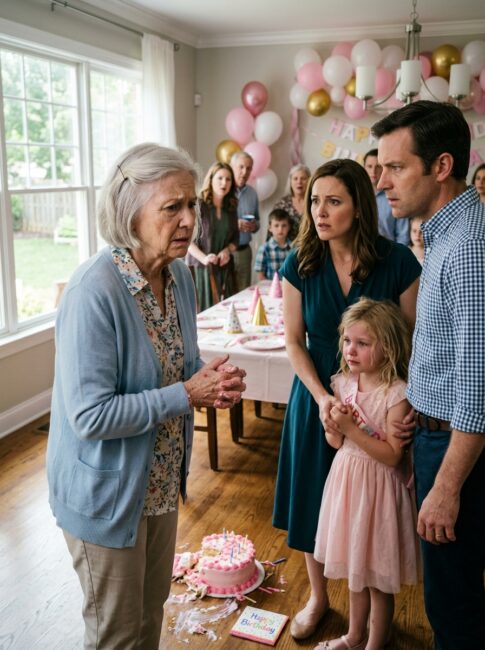
Nobody moved toward the cake after that.
Not even the children.
The sunny room, decorated with pink streamers and gold paper stars, felt suddenly too small for all the adults inside it.
Daniel looked at Claire.
“What is she talking about?”
Claire’s hand tightened on Emily’s shoulder.
“She’s making it sound worse than it is.”
Margaret closed her eyes briefly, as if the sentence hurt more than shouting would have.
Then she reached into the pocket of her cardigan and took out a folded sheet of paper.
It was soft at the edges, opened and closed many times.
Daniel recognized his mother’s careful handwriting across the top: Emily – Birthday – Ask Claire Again.
Beneath it were dates.
Three weeks of them.
Calls unanswered. Messages ignored. One pharmacy receipt. One pediatric appointment written in blue ink. One sentence underlined twice.
No red dye. No almond extract. No cherry filling.
Daniel stared at the paper.
His daughter had allergies.
Everyone in the immediate family knew that. They had known since Emily was four, when a school cupcake sent her to urgent care with swelling around her mouth and panic in her eyes.
But it was manageable. They were careful. Claire was careful.
At least, Daniel thought she was.
Margaret turned to Nora.
“Tell them what you told me.”
Nora looked miserable.
“I can’t discuss customer orders.”
“You can tell them what you saw.”
Nora pressed her lips together.
Claire said, “Nora, don’t.”
Daniel turned to his wife.
The second twist arrived quietly, not as an accusation, but as a question.
“Why does she know your name?”
Claire’s face went pale.
Nora’s eyes filled with tears.
“She came to the bakery yesterday,” Nora said. “She changed the order.”
Claire snapped, “I changed a flavor. That’s all.”
Nora shook her head.
“You changed more than that.”
The room seemed to lean inward.
Nora explained slowly, every word reluctant. The original cake Margaret ordered had been plain vanilla, no almond extract, no red dye, no fruit filling, with the bakery’s allergy protocol marked in red on the ticket. It had Emily’s name written in small blue flowers because Margaret said the child liked blue more than pink.
Then Claire came in.
She said the cake looked cheap.
She said Emily deserved a “real birthday cake,” the kind that photographed well for the family group and the neighborhood moms. She upgraded it to a pink princess cake with cherry filling and almond-flavored buttercream.
“I told her the ticket had allergy warnings,” Nora said.
Claire’s eyes flashed.
“You told me the amount was small.”
“No,” Nora said, trembling now. “I told you small amounts can still matter.”
Daniel looked as if someone had removed the floor beneath him.
Claire turned toward him, desperate.
“I thought it would be fine. She has been better for months. I wanted her to have one normal birthday, Daniel. One pretty party where your mother did not make everything about fear.”
Margaret’s face collapsed.
Not into victory.
Into grief.
“She is seven,” Margaret said. “Her life is not a photo.”
Emily looked between them, confused and frightened by words too large for her.
Daniel knelt in front of his daughter.
“Did Mommy tell you not to eat anything yet?”
Emily nodded.
“Grandma told me to wait for her.”
Daniel looked up.
Margaret’s eyes dropped.
That was another piece falling into place.
All afternoon, Margaret had followed Emily too closely. She had taken a cupcake from her hand. She had refused to let her drink the pink lemonade. She had looked rude, controlling, impossible. Several guests had laughed behind her back when she replaced Emily’s party punch with water.
Now Daniel remembered something else.
Every time Claire became irritated, Margaret said nothing.
She simply stayed near Emily.
Margaret had not been trying to ruin the party.
She had been guarding the child.
Claire’s mother, Patricia, who had spent most of the afternoon sighing about Margaret, stepped forward.
“Claire,” she said softly, “why didn’t you tell us?”
Claire’s eyes burned.
“Because I am tired,” she said. “I am tired of every birthday being about labels and warnings and what she cannot have. I am tired of being judged when I try to give my daughter something beautiful.”
Margaret looked at her for a long moment.
Then she did something nobody expected.
She nodded.
“I know.”
Claire blinked.
Margaret’s voice became low and rough.
“I know what it feels like to be tired of fear. I raised Daniel after his father’s first heart attack. I measured salt while other mothers brought casseroles. I cut birthday ham into tiny pieces and pretended it was enough. I know how ugly caution can look when everyone else is celebrating.”
Daniel’s eyes filled.
His father had died when Daniel was nineteen, but the years before that had been full of pill bottles, bland meals, and Margaret reading labels under fluorescent grocery lights.
She had never talked about it that way.
Margaret turned toward Emily, who still clung to her mother.
“But fear is not the enemy, sweetheart. Not when it is standing between you and something worse.”
Claire covered her mouth.
The grandmother’s hand began to shake harder. The frosting-covered sugar rose slipped from her fingers and landed on the floor beside the ruined cake.
“I called you six times,” Margaret said to Claire, but there was no accusation left. “I came early because I wanted to check the kitchen. Nora tried to warn me when she arrived. She said the decorator had already loaded the wrong cake because the change order replaced my ticket.”
Nora nodded, wiping her face.
“I was supposed to bring both. Mrs. Harper asked me to keep the safe one hidden until she could talk to Claire privately.”
Daniel stood.
“Then why throw it?”
Margaret looked at him, and the room went still again.
“Because Emily reached for the cherry on top.”
Nobody breathed.
Margaret’s voice thinned.
“She was smiling. Everyone was singing. Your phone was in your hand. Claire was lighting the last candle. I saw Emily touch the frosting, and for one second I was back in that urgent care room watching her lips swell while she asked why she couldn’t breathe.”
Daniel’s face broke.
“I couldn’t get across the table fast enough,” Margaret said. “So I did the only thing that would stop everyone.”
She looked down at the cake destroyed across the floor, the cake that had made her look cruel in front of a house full of people.
“I made myself the villain.”
The sentence settled over the room like dusk.
Not dramatic. Not polished.
Just true.
Claire sank into a chair as if her knees had failed. Emily climbed onto her lap, not fully understanding, but understanding enough to stop crying.
“I didn’t think,” Claire whispered.
Margaret’s mouth trembled.
“Yes, you did,” she said. “You thought about the wrong thing. We all do that sometimes.”
That mercy hurt more than blame.
Claire began to cry then, not loudly, not for attention. She cried with one hand over Emily’s hair and the other gripping the edge of the table.
“I wanted one picture where she looked like every other little girl,” she said.
Margaret stepped closer, slowly, leaving footprints of frosting behind her sensible shoes.
“She is not every other little girl,” she said. “She is Emily. That is already enough.”
Emily looked up.
“Grandma,” she whispered, “am I still having cake?”
For the first time all afternoon, Margaret laughed through tears.
It was a small sound, cracked but alive.
“Yes,” she said. “If your mother says yes.”
Everyone turned to Claire.
Claire looked at the small plain cake on the sideboard. No castle. No glitter. No dramatic sugar crown. Just safe vanilla, seven blue candles, and a grandmother’s careful fear baked into something ordinary.
She nodded.
“Yes,” Claire said. “But Grandma cuts the first piece.”
Margaret shook her head.
“No,” she said.
Daniel frowned.
“Why not?”
Margaret picked up the envelope taped beneath the cake box.
“Because that is not the first gift.”
She handed it to Emily.
The little girl opened it with sticky fingers.
Inside was a folded photograph, faded at the corners. It showed Daniel as a boy at a kitchen table, sitting before a plain white birthday cake with blue candles. Beside him stood Margaret, much younger, smiling with tired eyes.
On the back, in her late husband’s handwriting, were seven words.
Plain cake. Full heart. He was safe.
Daniel covered his face.
Claire looked at the photo, then at Margaret’s shoes, still marked with frosting from the cake she had destroyed to protect a child who might never understand the cost.
The room did not applaud.
It would have felt wrong.
Instead, one by one, people set down their plates.
Patricia walked into the kitchen and returned with a wet towel. Without a word, she knelt and began cleaning the floor beside Margaret.
Then Daniel joined her.
Then Nora.
Then Claire, still holding Emily with one arm, reached down and picked up a broken pink candle.
The party had gone silent, but somehow it no longer felt ruined.
It felt honest.
They relit the candles fifteen minutes later.
Not in the dining room.
Outside, beneath the maple tree where the afternoon light fell through the leaves in soft gold pieces, Daniel carried the small vanilla cake to a folding table. The children gathered again, quieter this time, curious in the way children become when adults stop pretending.
Emily stood on a chair with her mother behind her and her grandmother beside her.
There were no sugar towers. No pink frosting roses. No perfect photo for social media.
Only seven blue candles trembling in the breeze.
Before they sang, Claire touched Margaret’s arm.
“I should have listened,” she said.
Margaret looked at her daughter-in-law for a long moment.
Then she placed her wrinkled hand over Claire’s.
“I should have found a kinder way before it came to that.”
Claire shook her head, but Margaret did not let her.
“No,” the old woman said. “Both things can be true.”
That sentence stayed with Daniel longer than anything else.
Emily blew out her candles.
This time, no one rushed her.
Margaret cut the first slice with a plastic knife, slow and careful. She checked the plate, checked the fork, and looked at Claire. Claire nodded.
Only then did Margaret hand it to Emily.
The little girl took a bite.
Everyone watched.
Emily smiled with frosting on her upper lip.
“It tastes like Grandma’s house,” she said.
Margaret turned away quickly, pretending to look for napkins.
Daniel saw her wipe her eyes with the sleeve of her blue cardigan.
Later, after the guests left and the balloons sagged in the warm evening air, Claire found Margaret alone in the dining room. The ruined cake was gone, but faint streaks of pink frosting remained between the floorboards.
Margaret was on her knees, trying to scrub them out.
Claire knelt beside her.
“You don’t have to do that.”
Margaret kept rubbing the floor.
“I made the mess.”
Claire took the cloth gently from her hand.
“No,” she said. “You stopped one.”
For a while, neither woman spoke.
In the kitchen, Daniel was washing plates while Emily showed Nora her birthday cards. The baker had stayed even after being told she could leave. She said she wanted to make sure the little girl got her cake.
At the door, Nora handed Claire a new bakery card.
“Next year,” she said, “call me directly. We’ll make it beautiful and safe.”
Claire smiled through swollen eyes.
“I’d like that.”
When Margaret finally stood to leave, Emily ran to her with something in her hand.
It was the blue candle shaped like the number seven.
The wick was blackened now, the wax bent from heat.
“You keep it,” Emily said.
Margaret took it as if she had been handed something priceless.
“For me?”
Emily nodded.
“So you remember I still had a birthday.”
Margaret crouched slowly, her knees stiff, and touched the child’s cheek.
“I will remember,” she whispered.
Emily leaned forward and hugged her.
Not carefully.
Not politely.
She threw both arms around the old woman’s neck, the way children do when they have already forgiven what adults are still learning to carry.
Margaret closed her eyes.
Behind them, Claire reached for Daniel’s hand.
Outside, the last of the guests drove away. Inside, the house smelled faintly of vanilla, wet towels, and the sweet remains of a party that almost became a tragedy.
The next morning, Daniel found the number seven candle on his mother’s kitchen windowsill.
Beside it sat the old photograph of his own plain birthday cake.
Margaret had placed both where the morning sun could touch them.
Not as proof.
Not as a warning.
Just as two small things that had survived being misunderstood.
And if stories like this stay with you after the last line, follow this page for more heartfelt stories about the quiet ways people love each other.