They Fired a Young Mother for Staying Home With Her Sick Son—Then a Biker Walked Into the Office and Nobody Knew Why
“You should’ve called before you brought him here,” the manager snapped, just as a leather-vested biker stepped through the glass office doors and every receptionist froze.
It was 8:37 a.m. on a damp Monday in early November, inside a regional insurance processing office in Dayton, Ohio, where the carpet always smelled faintly of copier heat and burnt coffee and nobody expected real life to arrive before lunch.
The front lobby was all beige restraint. Gray-blue chairs arranged along one wall. A potted plant by the window already losing its leaves. A framed mission statement near the check-in counter using words like integrity and care in a font too clean to believe. Beyond the frosted doors stood rows of cubicles under white office lights, the low electric hum of printers and keyboards building the usual weekday illusion that every problem in the world could be organized, scanned, timestamped, and filed.
At the reception desk stood twenty-six-year-old Rachel Mendez with her four-year-old son asleep against her shoulder and a cardboard banker’s box on the floor at her feet.
That box was how everyone knew it was already over.
Not maybe over. Not almost over. Over in the humiliating, unmistakably American way companies preferred: not a conversation, not a warning, just a box with the employee’s mug, framed photo, cardigan, hand lotion, and two years of quiet usefulness reduced to something liftable.
Rachel had tried to come in looking composed.
That was the cruelest part.
She had brushed her hair back into a knot while her son was half-asleep on the couch. She had changed him into the cleanest hoodie he had left after a feverish weekend. She had put on mascara in a bathroom mirror while he coughed in the hallway because she still believed looking pulled together might help adults behave decently toward her.
It hadn’t.
Her manager, Colleen Fisk, stood behind the desk with an HR rep beside her, both of them wearing the stiff expressions people borrowed from policy when they did not want their own judgment visible. Colleen was forty-three, compact, beautifully dressed, and permanently irritated by human unpredictability. The HR rep, a pale man named Neil with a legal pad and apologetic shoulders, looked as if he already wished he were elsewhere but not enough to leave.
Rachel’s son Mateo slept hot and limp against her, one small sneaker dragging against her hip, cheeks flushed from fever, inhaler peeking out of the side pouch of her tote bag. He had been sick since Friday night. Ear infection first, then vomiting, then a cough that got tight enough by Sunday dawn to send Rachel to urgent care where she waited three hours under fluorescent lights and then six more in a pharmacy line for antibiotics they almost couldn’t afford.
She had called work twice.
Emailed once.
Left a voicemail no one returned.
By Monday morning, she had run out of options and childcare in the same breath.
“I did call,” Rachel said now, voice hoarse from too little sleep and too much explaining to too many indifferent people. “Twice Saturday, once yesterday, and again this morning before we came in.”
Colleen folded one arm over the other. “You missed your third shift in six weeks.”
“My son had a fever of one-oh-three.”
“That does not change attendance policy.”
Mateo stirred against Rachel’s shoulder, made a weak unhappy sound, and tightened his arm around her neck without waking fully. Rachel closed one hand over the back of his hoodie automatically.
The receptionist—a woman in her fifties with lacquered nails and the watchful fatigue of someone who had seen dozens of bad office mornings and still knew how to be embarrassed by them—looked down at her keyboard as if it had suddenly required urgent attention. Two claims clerks just beyond the frosted doors had stopped pretending not to listen.
Rachel swallowed once. “I’m not asking for special treatment.”
“No,” Colleen said. “You’re asking us to ignore a pattern.”
That word hit harder than it should have.
Pattern.
As if a mother with no backup, no paid leave, and a sick child was not living through separate crises but performing a recognizable flaw in character.
The banker’s box sat by Rachel’s shoe like a public verdict.
Neil from HR shifted his grip on the legal pad. “Rachel, we understand this is difficult.”
That was the exact tone people used when they understood nothing and needed to say something that sounded morally padded.
Rachel looked at him for a second too long. “Do you?”
Mateo coughed in his sleep.
The sound was wet and child-small and impossible to hear without feeling the whole scene become meaner. One of the claims clerks behind the glass turned away. The receptionist kept typing with fingers that weren’t actually hitting anything.
Colleen’s jaw tightened. “This is not a daycare.”
Rachel stared at her.
There it was. The sentence underneath all the others. Not policy. Not attendance. Not productivity. Just the old American hostility toward women who brought visible caregiving into places built to pretend workers came from nowhere and returned to nobody.
“I know what this is,” Rachel said quietly.
Colleen opened her mouth to answer.
The front door opened first.
Cold air slipped into the lobby. Then the deep, unmistakable sound of a motorcycle engine dying outside filtered through the glass.
No one looked immediately.
Then a man stepped inside.
He was large enough to change the room just by occupying it. White, maybe fifty, broad through the shoulders, dark beard gone gray at the chin, sleeveless black leather vest over a worn charcoal thermal, tattooed forearms, boots carrying road grit and November rain. He held a helmet in one hand, gloves in the other, and had the flat, unreadable face of a man who had long ago stopped apologizing for how he looked in professional spaces.
He did not belong there.
Which meant, to everyone present, that he was probably trouble.
He took one look at Rachel.
One look at the sleeping boy.
Then at the banker’s box by her feet.
And he said, in a voice low enough to force the room to quiet down around it, “You firing her over that kid?”
No one in the lobby thought that question was going to help.
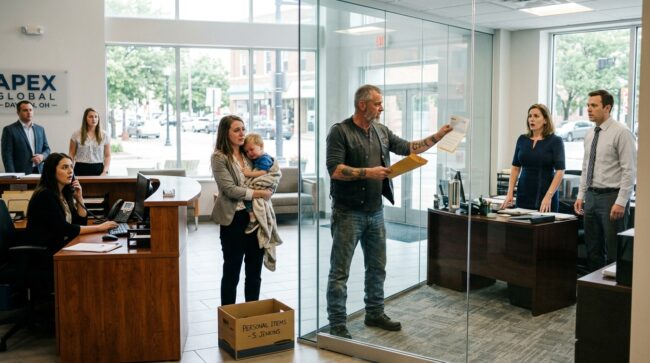
The entire office reacted to the biker before anyone answered him.
Fear moved fastest through formal spaces because formal spaces were built on the assumption that all disruption would arrive dressed wrong. And this man, standing in the doorway with a leather vest over tattooed arms and rain on his boots, looked like disruption in a form people already knew how to distrust.
The receptionist stood up too quickly and knocked her knee on the underside of the desk.
One of the claims clerks behind the glass whispered, “Oh my God,” before catching herself.
Neil from HR straightened instinctively, not because he was brave but because panic made administrative men stand taller for two seconds before they started searching for security.
Colleen Fisk did what managers often did when they were frightened in public: she became sharper.
“Sir,” she said, “this is a private workplace.”
The biker shut the door behind him.
That small act made the room feel smaller.
He did not step closer yet. He simply stood there near the entrance, helmet down by one thigh, and looked at Rachel as if the only true thing in the lobby was the sick child on her shoulder.
Rachel stared back, bewildered and defensive in the same breath. She didn’t know him. That much she was sure of. But there was something unnerving in the way he had taken the scene in so quickly, not like a stranger asking what happened, but like a man arriving late to something he had already suspected.
Colleen tried again. “You need to leave.”
He looked at her then. His face did not change.
“Answer the question.”
That made everything worse.
Not because he raised his voice. He didn’t. But men who stayed calm while crossing boundaries unnerved people more than loud ones. Loud was familiar. Loud could be framed. A silent biker in a corporate lobby asking direct questions in a voice too steady to dismiss—that was harder to manage.
Neil took a step sideways toward the internal phone. “I’m calling building security.”
The biker ignored him.
Mateo coughed again. Rachel shifted him higher with one arm, exhaustion written all through the movement. She could feel the room turning, not toward compassion but toward spectacle. A mother getting fired was uncomfortable. A biker entering mid-firing gave everyone something cleaner to judge.
Colleen folded her arms. “This does not concern you.”
The biker’s eyes moved to the banker’s box. Then to Mateo’s flushed face. Then back to Rachel.
“She miss work because of him?”
Rachel answered before anyone else could stop her.
“Yes.”
The room turned toward her sharply, as if she had just validated the wrong witness.
Colleen snapped, “Rachel, do not engage—”
“She asked me a question,” the biker said.
“I asked her not you,” Colleen fired back.
He gave one slight nod, like acknowledging weather again. “Same answer.”
One of the claims clerks behind the door actually stepped into the lobby now, drawn by the heat of the moment and the seductive terror of being near something other than spreadsheets at 8:40 on a Monday.
The receptionist found her voice. “Sir, you need to go before we call the police.”
He finally moved then.
Only three steps.
That was enough.
The receptionist backed into her chair. Neil stopped reaching for the phone and grabbed it instead. Colleen’s face went carefully blank, which meant she was more unsettled than ever. Rachel stiffened, because no matter how cruel the office had just been, the appearance of a biker advancing toward a woman holding a child in a corporate lobby was not a development any sane person should have welcomed.
But he did not go to Rachel.
He stopped beside the banker’s box.
Looked down into it.
There was a ceramic mug with WORLD’S OKAYEST MOM chipped at the rim. A framed photo of Mateo at a pumpkin patch. A tiny plastic dinosaur. A cardigan folded too neatly because she had packed it herself, not someone else.
He looked up at Colleen.
“You packed her out in front of the kid.”
That was the first moment anyone in the office looked ashamed instead of defensive.
Only for a second.
Then Colleen answered like shame was just another problem to file.
“She was informed this morning that her position had been terminated.”
“With him there.”
Rachel’s throat tightened. Not because of the words. Because he had somehow identified the exact point of humiliation no one else in the lobby had bothered to name.
Neil, flustered now, said, “Sir, we are not discussing personnel matters with unauthorized individuals.”
The biker’s eyes moved to him. “Then stop doing them in the lobby.”
That hit. Hard.
The claims clerk by the door looked down. The receptionist pretended to rearrange papers that did not need rearranging. Even Rachel, sick with anger and embarrassment and sleeplessness, felt the air shift slightly around the sentence.
Colleen recovered first. “This is over. Rachel, collect your things and leave.”
Mateo woke fully then.
Not crying at first. Worse. Quietly confused. Fever-hot face lifting from Rachel’s shoulder, one hand clutching her shirt. He blinked at the office lights, the strange adults, the biker, the box, and asked the one question that made the entire lobby feel less professional than it ever had in its life.
“Mommy, are we in trouble?”
Rachel closed her eyes.
That should have been the end of any decent conversation. The point where someone with authority said enough, we’ll do this later, this child needs to go home.
Instead Colleen exhaled sharply through her nose and said, “No one is in trouble. Your mother simply has to leave now.”
Mateo looked at the banker’s box.
Then at the biker.
Children always read rooms faster than adults realized. Not correctly, maybe. But sharply.
He pressed his face back into Rachel’s shoulder and started crying.
That was when the biker did the thing that made the office certain he was about to turn a bad morning into a disaster.
He bent, picked up Rachel’s banker’s box, and started walking toward Colleen’s office door.
“Put that down!”
The command cracked through the lobby so hard even the copier hum seemed to pause under it.
Neil moved first, alarm finally outrunning policy. He came around the desk too quickly, suit jacket flaring, one hand lifted as if he actually intended to physically stop a broad-shouldered biker carrying a cardboard box full of a fired employee’s things. The receptionist gasped. One of the claims clerks said, “Call 911,” in the trembling voice of someone already composing the incident report in her head.
And Rachel—humiliated, exhausted Rachel, who had spent the last two days praying nobody would make her child’s illness into a public morality play—heard herself say, “Don’t.”
It came out soft.
Not enough to stop anyone.
The biker kept walking.
Not fast. Not rushing. Just moving with blunt purpose toward the frosted office door with COLLEEN FISK, OPERATIONS MANAGER stamped on it in black vinyl lettering.
That was what made it look so wrong.
A man like him, too calm, too certain, carrying a woman’s desk things deeper into her manager’s office while the entire reception area came apart around him. It looked like intimidation. Like escalation. Like the beginning of one of those public office meltdowns people later retold in cleaned-up versions that made them sound braver than they had been.
Neil grabbed for the side of the box.
Bad choice.
The biker shifted one shoulder and Neil lost his grip instantly, stumbling into the edge of a chair. No violence. No shove. Just a man much larger than him refusing to let a clumsy hand dictate the moment.
That was enough to make everyone else’s fear spike.
The receptionist finally dialed. One claims clerk pulled another backward toward the cubicles. Colleen stepped out from behind the desk with a flush climbing her neck, her voice now stripped of HR polish and sharpened into pure managerial panic.
“Sir, if you take one more step, I will have you arrested.”
The biker stopped.
The whole office inhaled.
He turned halfway toward her, banker’s box still in both hands, and for the first time Rachel saw something dangerous in him that had nothing to do with leather or tattoos. Not violence. Certainty. The kind earned by men who no longer needed rooms like this to agree with them before acting.
“She shouldn’t have to carry this with him on her shoulder,” he said, nodding once toward Mateo.
Every eye turned to the child.
He was still crying against Rachel’s neck, small fingers twisted in the collar of her sweater, skin hot enough to flush bright beneath the office lights. Rachel had been shifting his weight from one arm to the other for nearly fifteen minutes while Colleen recited policy and Neil made notes and no one once thought to offer a chair.
The receptionist lowered the phone a fraction.
Not enough.
But some.
Colleen said, “That is not your concern.”
The biker’s expression didn’t change. “Seems to be.”
That infuriated her more than shouting would have.
Because a shout she could call security on. This she had to answer in front of witnesses.
Neil steadied himself and tried to reassert order. “You can put the box down and leave now or this becomes trespassing.”
The biker looked at him as though trespassing was the least morally interesting thing happening in the room.
Then he did something even worse for optics.
He opened Colleen’s office door with the back of his boot and stepped inside carrying Rachel’s things.
Rachel’s stomach dropped.
The claims clerks both cried out at once. The receptionist said, “Oh my God,” in the exact tone of a woman who had wanted drama but not this much. Neil lunged toward the office. Colleen went after him too, heels clicking hard across the tile. Even Mateo lifted his head from Rachel’s shoulder just enough to stare through wet lashes at the open door.
From the lobby, all anyone could see at first was the biker setting the banker’s box down on the floor just inside the office.
Then he turned and looked at the wall behind Colleen’s desk.
That was where the framed employee recognition certificates hung.
Quarterly excellence awards. Productivity benchmarks. Team leadership plaque. All the polished little affirmations companies gave people who confused endurance with ethics.
The biker stared at them for one long second.
Then at the framed family photo on Colleen’s credenza—husband, two children, summer lake, perfect light.
The room tensed all over again.
Because from the doorway, under fluorescent office light, it looked exactly like the moment before a man decided to smash something.
Neil said, voice breaking now, “Don’t touch anything.”
The biker reached inside the inner pocket of his leather vest.
Everyone froze.
Rachel felt her whole body go cold.
Not because she thought weapon first. Because by then anything—paper, phone, tool, accusation—felt capable of detonating the morning beyond repair.
Colleen stopped in the doorway.
Neil stopped beside her.
The receptionist had the police dispatcher in one ear and a hand over her mouth.
And Rachel, holding her feverish son in the lobby with her life reduced to a cardboard box and a stranger in leather standing inside her manager’s office, watched the biker pull something folded and official-looking from inside his vest just as Mateo whispered through tears:
“Mommy… he knows her?”