They Fired a Young Mother for Staying Home With Her Sick Son—Then a Biker Walked Into the Office and Nobody Knew Why

“You should’ve called before you brought him here,” the manager snapped, just as a leather-vested biker stepped through the glass office doors and every receptionist froze.

It was 8:37 a.m. on a damp Monday in early November, inside a regional insurance processing office in Dayton, Ohio, where the carpet always smelled faintly of copier heat and burnt coffee and nobody expected real life to arrive before lunch.

The front lobby was all beige restraint. Gray-blue chairs arranged along one wall. A potted plant by the window already losing its leaves. A framed mission statement near the check-in counter using words like integrity and care in a font too clean to believe. Beyond the frosted doors stood rows of cubicles under white office lights, the low electric hum of printers and keyboards building the usual weekday illusion that every problem in the world could be organized, scanned, timestamped, and filed.

At the reception desk stood twenty-six-year-old Rachel Mendez with her four-year-old son asleep against her shoulder and a cardboard banker’s box on the floor at her feet.

That box was how everyone knew it was already over.

Not maybe over. Not almost over. Over in the humiliating, unmistakably American way companies preferred: not a conversation, not a warning, just a box with the employee’s mug, framed photo, cardigan, hand lotion, and two years of quiet usefulness reduced to something liftable.

Rachel had tried to come in looking composed.

That was the cruelest part.

She had brushed her hair back into a knot while her son was half-asleep on the couch. She had changed him into the cleanest hoodie he had left after a feverish weekend. She had put on mascara in a bathroom mirror while he coughed in the hallway because she still believed looking pulled together might help adults behave decently toward her.

It hadn’t.

Her manager, Colleen Fisk, stood behind the desk with an HR rep beside her, both of them wearing the stiff expressions people borrowed from policy when they did not want their own judgment visible. Colleen was forty-three, compact, beautifully dressed, and permanently irritated by human unpredictability. The HR rep, a pale man named Neil with a legal pad and apologetic shoulders, looked as if he already wished he were elsewhere but not enough to leave.

Rachel’s son Mateo slept hot and limp against her, one small sneaker dragging against her hip, cheeks flushed from fever, inhaler peeking out of the side pouch of her tote bag. He had been sick since Friday night. Ear infection first, then vomiting, then a cough that got tight enough by Sunday dawn to send Rachel to urgent care where she waited three hours under fluorescent lights and then six more in a pharmacy line for antibiotics they almost couldn’t afford.

She had called work twice.

Emailed once.

Left a voicemail no one returned.

By Monday morning, she had run out of options and childcare in the same breath.

“I did call,” Rachel said now, voice hoarse from too little sleep and too much explaining to too many indifferent people. “Twice Saturday, once yesterday, and again this morning before we came in.”

Colleen folded one arm over the other. “You missed your third shift in six weeks.”

“My son had a fever of one-oh-three.”

“That does not change attendance policy.”

Mateo stirred against Rachel’s shoulder, made a weak unhappy sound, and tightened his arm around her neck without waking fully. Rachel closed one hand over the back of his hoodie automatically.

The receptionist—a woman in her fifties with lacquered nails and the watchful fatigue of someone who had seen dozens of bad office mornings and still knew how to be embarrassed by them—looked down at her keyboard as if it had suddenly required urgent attention. Two claims clerks just beyond the frosted doors had stopped pretending not to listen.

Rachel swallowed once. “I’m not asking for special treatment.”

“No,” Colleen said. “You’re asking us to ignore a pattern.”

That word hit harder than it should have.

Pattern.

As if a mother with no backup, no paid leave, and a sick child was not living through separate crises but performing a recognizable flaw in character.

The banker’s box sat by Rachel’s shoe like a public verdict.

Neil from HR shifted his grip on the legal pad. “Rachel, we understand this is difficult.”

That was the exact tone people used when they understood nothing and needed to say something that sounded morally padded.

Rachel looked at him for a second too long. “Do you?”

Mateo coughed in his sleep.

The sound was wet and child-small and impossible to hear without feeling the whole scene become meaner. One of the claims clerks behind the glass turned away. The receptionist kept typing with fingers that weren’t actually hitting anything.

Colleen’s jaw tightened. “This is not a daycare.”

Rachel stared at her.

There it was. The sentence underneath all the others. Not policy. Not attendance. Not productivity. Just the old American hostility toward women who brought visible caregiving into places built to pretend workers came from nowhere and returned to nobody.

“I know what this is,” Rachel said quietly.

Colleen opened her mouth to answer.

The front door opened first.

Cold air slipped into the lobby. Then the deep, unmistakable sound of a motorcycle engine dying outside filtered through the glass.

No one looked immediately.

Then a man stepped inside.

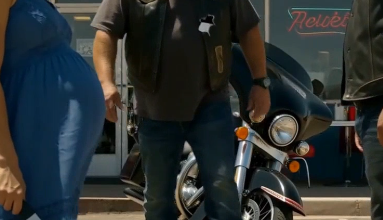
He was large enough to change the room just by occupying it. White, maybe fifty, broad through the shoulders, dark beard gone gray at the chin, sleeveless black leather vest over a worn charcoal thermal, tattooed forearms, boots carrying road grit and November rain. He held a helmet in one hand, gloves in the other, and had the flat, unreadable face of a man who had long ago stopped apologizing for how he looked in professional spaces.

He did not belong there.

Which meant, to everyone present, that he was probably trouble.

He took one look at Rachel.

One look at the sleeping boy.

Then at the banker’s box by her feet.

And he said, in a voice low enough to force the room to quiet down around it, “You firing her over that kid?”

No one in the lobby thought that question was going to help.
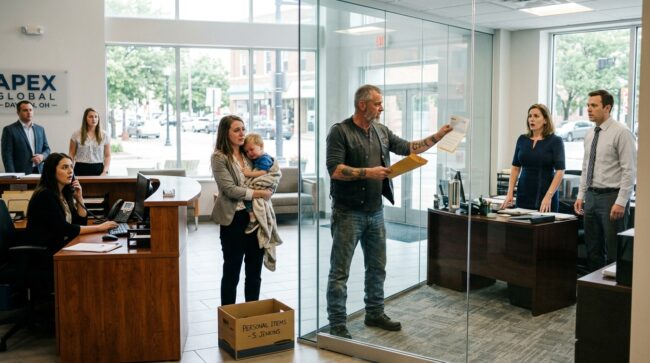
The entire office reacted to the biker before anyone answered him.

Fear moved fastest through formal spaces because formal spaces were built on the assumption that all disruption would arrive dressed wrong. And this man, standing in the doorway with a leather vest over tattooed arms and rain on his boots, looked like disruption in a form people already knew how to distrust.

The receptionist stood up too quickly and knocked her knee on the underside of the desk.

One of the claims clerks behind the glass whispered, “Oh my God,” before catching herself.

Neil from HR straightened instinctively, not because he was brave but because panic made administrative men stand taller for two seconds before they started searching for security.

Colleen Fisk did what managers often did when they were frightened in public: she became sharper.

“Sir,” she said, “this is a private workplace.”

The biker shut the door behind him.

That small act made the room feel smaller.

He did not step closer yet. He simply stood there near the entrance, helmet down by one thigh, and looked at Rachel as if the only true thing in the lobby was the sick child on her shoulder.

Rachel stared back, bewildered and defensive in the same breath. She didn’t know him. That much she was sure of. But there was something unnerving in the way he had taken the scene in so quickly, not like a stranger asking what happened, but like a man arriving late to something he had already suspected.

Colleen tried again. “You need to leave.”

He looked at her then. His face did not change.

“Answer the question.”

That made everything worse.

Not because he raised his voice. He didn’t. But men who stayed calm while crossing boundaries unnerved people more than loud ones. Loud was familiar. Loud could be framed. A silent biker in a corporate lobby asking direct questions in a voice too steady to dismiss—that was harder to manage.

Neil took a step sideways toward the internal phone. “I’m calling building security.”

The biker ignored him.

Mateo coughed again. Rachel shifted him higher with one arm, exhaustion written all through the movement. She could feel the room turning, not toward compassion but toward spectacle. A mother getting fired was uncomfortable. A biker entering mid-firing gave everyone something cleaner to judge.

Colleen folded her arms. “This does not concern you.”

The biker’s eyes moved to the banker’s box. Then to Mateo’s flushed face. Then back to Rachel.

“She miss work because of him?”

Rachel answered before anyone else could stop her.

“Yes.”

The room turned toward her sharply, as if she had just validated the wrong witness.

Colleen snapped, “Rachel, do not engage—”

“She asked me a question,” the biker said.

“I asked her not you,” Colleen fired back.

He gave one slight nod, like acknowledging weather again. “Same answer.”

One of the claims clerks behind the door actually stepped into the lobby now, drawn by the heat of the moment and the seductive terror of being near something other than spreadsheets at 8:40 on a Monday.

The receptionist found her voice. “Sir, you need to go before we call the police.”

He finally moved then.

Only three steps.

That was enough.

The receptionist backed into her chair. Neil stopped reaching for the phone and grabbed it instead. Colleen’s face went carefully blank, which meant she was more unsettled than ever. Rachel stiffened, because no matter how cruel the office had just been, the appearance of a biker advancing toward a woman holding a child in a corporate lobby was not a development any sane person should have welcomed.

But he did not go to Rachel.

He stopped beside the banker’s box.

Looked down into it.

There was a ceramic mug with WORLD’S OKAYEST MOM chipped at the rim. A framed photo of Mateo at a pumpkin patch. A tiny plastic dinosaur. A cardigan folded too neatly because she had packed it herself, not someone else.

He looked up at Colleen.

“You packed her out in front of the kid.”

That was the first moment anyone in the office looked ashamed instead of defensive.

Only for a second.

Then Colleen answered like shame was just another problem to file.

“She was informed this morning that her position had been terminated.”

“With him there.”

Rachel’s throat tightened. Not because of the words. Because he had somehow identified the exact point of humiliation no one else in the lobby had bothered to name.

Neil, flustered now, said, “Sir, we are not discussing personnel matters with unauthorized individuals.”

The biker’s eyes moved to him. “Then stop doing them in the lobby.”

That hit. Hard.

The claims clerk by the door looked down. The receptionist pretended to rearrange papers that did not need rearranging. Even Rachel, sick with anger and embarrassment and sleeplessness, felt the air shift slightly around the sentence.

Colleen recovered first. “This is over. Rachel, collect your things and leave.”

Mateo woke fully then.

Not crying at first. Worse. Quietly confused. Fever-hot face lifting from Rachel’s shoulder, one hand clutching her shirt. He blinked at the office lights, the strange adults, the biker, the box, and asked the one question that made the entire lobby feel less professional than it ever had in its life.

“Mommy, are we in trouble?”

Rachel closed her eyes.

That should have been the end of any decent conversation. The point where someone with authority said enough, we’ll do this later, this child needs to go home.

Instead Colleen exhaled sharply through her nose and said, “No one is in trouble. Your mother simply has to leave now.”

Mateo looked at the banker’s box.

Then at the biker.

Children always read rooms faster than adults realized. Not correctly, maybe. But sharply.

He pressed his face back into Rachel’s shoulder and started crying.

That was when the biker did the thing that made the office certain he was about to turn a bad morning into a disaster.

He bent, picked up Rachel’s banker’s box, and started walking toward Colleen’s office door.

“Put that down!”

The command cracked through the lobby so hard even the copier hum seemed to pause under it.

Neil moved first, alarm finally outrunning policy. He came around the desk too quickly, suit jacket flaring, one hand lifted as if he actually intended to physically stop a broad-shouldered biker carrying a cardboard box full of a fired employee’s things. The receptionist gasped. One of the claims clerks said, “Call 911,” in the trembling voice of someone already composing the incident report in her head.

And Rachel—humiliated, exhausted Rachel, who had spent the last two days praying nobody would make her child’s illness into a public morality play—heard herself say, “Don’t.”

It came out soft.

Not enough to stop anyone.

The biker kept walking.

Not fast. Not rushing. Just moving with blunt purpose toward the frosted office door with COLLEEN FISK, OPERATIONS MANAGER stamped on it in black vinyl lettering.

That was what made it look so wrong.

A man like him, too calm, too certain, carrying a woman’s desk things deeper into her manager’s office while the entire reception area came apart around him. It looked like intimidation. Like escalation. Like the beginning of one of those public office meltdowns people later retold in cleaned-up versions that made them sound braver than they had been.

Neil grabbed for the side of the box.

Bad choice.

The biker shifted one shoulder and Neil lost his grip instantly, stumbling into the edge of a chair. No violence. No shove. Just a man much larger than him refusing to let a clumsy hand dictate the moment.

That was enough to make everyone else’s fear spike.

The receptionist finally dialed. One claims clerk pulled another backward toward the cubicles. Colleen stepped out from behind the desk with a flush climbing her neck, her voice now stripped of HR polish and sharpened into pure managerial panic.

“Sir, if you take one more step, I will have you arrested.”

The biker stopped.

The whole office inhaled.

He turned halfway toward her, banker’s box still in both hands, and for the first time Rachel saw something dangerous in him that had nothing to do with leather or tattoos. Not violence. Certainty. The kind earned by men who no longer needed rooms like this to agree with them before acting.

“She shouldn’t have to carry this with him on her shoulder,” he said, nodding once toward Mateo.

Every eye turned to the child.

He was still crying against Rachel’s neck, small fingers twisted in the collar of her sweater, skin hot enough to flush bright beneath the office lights. Rachel had been shifting his weight from one arm to the other for nearly fifteen minutes while Colleen recited policy and Neil made notes and no one once thought to offer a chair.

The receptionist lowered the phone a fraction.

Not enough.

But some.

Colleen said, “That is not your concern.”

The biker’s expression didn’t change. “Seems to be.”

That infuriated her more than shouting would have.

Because a shout she could call security on. This she had to answer in front of witnesses.

Neil steadied himself and tried to reassert order. “You can put the box down and leave now or this becomes trespassing.”

The biker looked at him as though trespassing was the least morally interesting thing happening in the room.

Then he did something even worse for optics.

He opened Colleen’s office door with the back of his boot and stepped inside carrying Rachel’s things.

Rachel’s stomach dropped.

The claims clerks both cried out at once. The receptionist said, “Oh my God,” in the exact tone of a woman who had wanted drama but not this much. Neil lunged toward the office. Colleen went after him too, heels clicking hard across the tile. Even Mateo lifted his head from Rachel’s shoulder just enough to stare through wet lashes at the open door.

From the lobby, all anyone could see at first was the biker setting the banker’s box down on the floor just inside the office.

Then he turned and looked at the wall behind Colleen’s desk.

That was where the framed employee recognition certificates hung.

Quarterly excellence awards. Productivity benchmarks. Team leadership plaque. All the polished little affirmations companies gave people who confused endurance with ethics.

The biker stared at them for one long second.

Then at the framed family photo on Colleen’s credenza—husband, two children, summer lake, perfect light.

The room tensed all over again.

Because from the doorway, under fluorescent office light, it looked exactly like the moment before a man decided to smash something.

Neil said, voice breaking now, “Don’t touch anything.”

The biker reached inside the inner pocket of his leather vest.

Everyone froze.

Rachel felt her whole body go cold.

Not because she thought weapon first. Because by then anything—paper, phone, tool, accusation—felt capable of detonating the morning beyond repair.

Colleen stopped in the doorway.

Neil stopped beside her.

The receptionist had the police dispatcher in one ear and a hand over her mouth.

And Rachel, holding her feverish son in the lobby with her life reduced to a cardboard box and a stranger in leather standing inside her manager’s office, watched the biker pull something folded and official-looking from inside his vest just as Mateo whispered through tears:

“Mommy… he knows her?”
For one suspended second, nobody in Colleen Fisk’s office moved.

The folded paper in the biker’s hand seemed to pull all the oxygen toward it. Neil from HR stood in the doorway with one palm lifted uselessly, as if procedure might physically shield him from whatever this rough-looking stranger had just taken from inside his vest. Colleen’s face had gone still in the dangerous way controlled people’s faces did when they realized control might no longer belong to them. Rachel remained in the lobby, Mateo burning hot against her shoulder, banker’s box on the office floor, cardboard edges already bending under the weight of a life she hadn’t expected to carry out before noon.

The biker unfolded the document with slow, precise fingers.

No flourish. No threat.

Just paper.

He set it on Colleen’s desk beside the framed family photo she had almost certainly assumed would soften how the room judged her.

Neil leaned first, because fear and curiosity often wore the same shoes. His eyes ran over the heading, then widened before he could stop them.

Colleen snatched the page up.

The letterhead sat in clean black print across the top:

MONTGOMERY COUNTY COMMON PLEAS COURT
PETITION FOR GUARDIANSHIP — EMERGENCY SUPPORTING AFFIDAVIT

Rachel did not understand the words at first. They were too legal, too far from the practical panic occupying her mind. Job gone. Rent due Friday. Antibiotics on the debit card. Mateo’s fever still climbing. But Colleen understood enough, and what the document did to her face told the room more quickly than reading would have.

Neil’s voice came out thinner than before. “What is this?”

The biker kept his eyes on Colleen. “Page three.”

That was the second time that morning he had said those kinds of words in that kind of tone—calm, direct, impossible to dismiss without first obeying. It should have sounded arrogant. Instead it sounded like somebody who had already watched this woman dodge plain truth before and had no interest in wasting anyone’s time now.

Colleen flipped pages too quickly, then slowed when she reached the tabbed section. Her expression changed in stages. First irritation. Then confusion. Then something sharper and much less flattering.

Recognition.

Rachel saw it before she understood it.

Mateo lifted his head enough to look from the paper to the biker to Colleen’s face. “Mommy?” he whispered.

Rachel tightened her hold on him. “It’s okay.”

But it wasn’t. Not in any simple way. The room had changed shape. The biker was no longer just an intruder in a corporate lobby. He was a man holding a document with Colleen’s name somewhere in it, and everybody present could feel that the story they had been telling themselves about him had started to crack down the middle.

Neil stepped closer. “Ms. Fisk?”

Colleen’s eyes didn’t leave the page. “This is a sealed support filing.”

The biker nodded once.

“You have no legal right to possess this.”

“Never said I did.”

That made Neil bristle. “Then how did you get it?”

The biker didn’t answer that. He was still watching Colleen in a way that made Rachel strangely certain that whatever mattered most here was not the paper itself, but the fact that Colleen knew exactly what it meant.

Rachel shifted Mateo higher on her shoulder and finally asked the only question that felt remotely grounded enough to speak aloud.

“What is it?”

Colleen still didn’t answer.

Neil did, because sometimes the weakest people in a room told the truth first simply because they had no experience carrying it well.

“It’s a guardianship filing,” he said. “Emergency support for a dependent child.”

Rachel blinked. “Whose child?”

Silence.

Then the biker answered.

“Her granddaughter.”

Nobody breathed quite right after that.

Not the receptionist just beyond the open office door. Not the claims clerks pretending to stay in their cubicles while listening with their whole bodies. Not Neil. Not Rachel. Certainly not Colleen, whose hand now gripped the page hard enough to crease it.

Mateo, confused but alert again, pressed his flushed cheek against Rachel’s collarbone and looked toward the manager’s office with the solemn suspicion children reserved for adults who had made the room feel bad.

The biker’s voice remained low. “You left county probate twenty-two minutes ago.”

Rachel stared at him.

Then at Colleen.

Then back again.

The story still made no sense, but it had suddenly become clear that the biker was not here by accident. He had followed a line of truth into this office the way men like him followed roads—directly, without asking whether the people waiting at the end liked the sound of his engine.

Neil looked as if he wanted to sit down and couldn’t.

“Colleen,” he said, too softly, “is this true?”

Colleen lifted her head at last.

For the first time since Rachel had entered the lobby that morning, the manager no longer looked irritated or professionally composed. She looked exposed. Not guilty yet, not fully. Just dragged into a kind of public contradiction polished people feared more than scandal: visible hypocrisy.

Rachel’s throat tightened. “You fired me for staying home with my sick child…”

The sentence died there because she still could not fit the rest of it into human shape.

The biker did not help her. He simply said to Colleen, “You asked a judge for emergency leave to care for family.”

The fluorescent office felt suddenly vicious. Too bright for the truth now crawling across it.

Neil’s face was red. The receptionist in the lobby had gone completely still. Even the copier had stopped, which Rachel knew rationally was coincidence but emotionally felt like the building itself waiting to hear what came next.

Colleen set the filing down carefully, like something unstable.

And outside, faint at first but coming closer, the sound of security boots crossed the lobby tile.

Building security arrived with all the confidence of men who assumed the visual story would do most of their work for them.

Two guards in navy uniforms came through the glass doors with radios clipped high and that clipped-body stride low-level authority used when it expected to restore order by identifying the largest person in the room and treating him like the problem. They saw the biker first, of course. Big frame. Leather vest. Tattoos. Standing inside a manager’s office with an official-looking document in play and half the staff visibly rattled.

Easy.

Until it wasn’t.

“Sir,” the taller one said, “step away from the desk.”

The biker didn’t move immediately.

Not defiant. Not compliant.

He glanced once at Rachel.

Then at Mateo.

Then back to Colleen, as if the only people whose next minute actually mattered were the mother clutching a feverish child and the woman who had almost successfully punished her for doing the exact same thing she had just claimed in court for herself.

Rachel felt something hot and humiliating rise behind her eyes. Anger. Exhaustion. Recognition of a cruelty so cleanly structured it would have made her laugh if she had not been carrying a sick child and a cardboard box of her own employment.

“Is he telling the truth?” she asked Colleen.

The question landed harder than security’s commands.

Because now the office could no longer pretend this was about trespassing alone. Now it was about whether the manager who had called Rachel unreliable for caring for Mateo had, within the same hour, petitioned a judge for emergency support to care for her own granddaughter.

Colleen looked at Rachel and, for one terrible beat, seemed to consider denying it.

Then her shoulders dropped just enough to betray her.

“My daughter is in rehab,” she said.

It did not answer the question.

Rachel’s voice sharpened. “That’s not what I asked.”

One of the claims clerks in the lobby gasped under her breath. Not because rehab was shocking. Because the moral terrain of the morning had just collapsed under everyone’s feet.

Neil tried again to regain procedure. “This is not appropriate—”

“No,” Rachel said, turning on him at last. “It isn’t.”

Security hesitated, which was the first useful thing they had done.

Because even they could now feel that dragging the biker out physically while the fired mother stood there with a sick child and a manager holding a guardianship filing would make the office look worse, not safer.

Mateo coughed wetly against Rachel’s shoulder.

That small sound cut through everything.

The biker shifted his gaze to the inhaler sticking out of Rachel’s tote. “He need urgent care again?”

Rachel blinked at the question. “What?”

“He breathing worse?”

She stared at him.

Not because the question was invasive. Because it was the first practically useful question anyone in the office had asked since she walked in with a feverish child and a banker’s box at her feet.

“He’s been tight since four,” she said before she could stop herself. “I gave him one treatment in the car.”

The taller security guard looked irritated now, not at her, but at the fact that the biker had somehow become the calmest adult in the room.

Neil said weakly, “Rachel, maybe you should take him home.”

She almost laughed.

Home. To what? To the apartment where rent was already late. To the nebulizer she had to stretch because the refill wasn’t due until Thursday. To no paycheck. No guarantee. No childcare. No idea whether she’d even still have health coverage by Friday.

The biker turned back to Colleen.

“Did you sign off on her attendance write-up Friday?”

Colleen went pale.

That told Rachel more than an answer would have.

Neil looked between them. “You reviewed that file?”

The biker’s jaw shifted. “No.”

A beat.

“Her husband did.”

There it was.

The room took it like a blow.

Rachel felt all the air leave her lungs at once.

Her husband.

Not current husband. Former. Dead for eighteen months, in the ugly practical sense that mattered most to widows with children and paperwork. Luis Mendez had spent twelve years running medical transport before the crash on I-75 put his ambulance into a barrier and left Rachel with a funeral account, an insurance payout too small to matter, and a son who still woke up asking whether sirens hurt heaven.

Colleen’s lips parted. Neil actually said, “What?”

The biker answered without heat.

“Her husband trained your husband.”

Nobody in the room moved.

Because the sentence made no obvious sense until it made too much.

Rachel stared at Colleen so hard her vision blurred.

Colleen looked back with the haunted, cornered face of a woman whose private life had just stepped barefoot into the fluorescent office where she kept her cruelty neatly shelved under policy. “My husband works county EMS,” she said quietly.

The biker nodded once.

Rachel’s heart slammed.

Luis had trained medics. Not all of them, obviously. But enough young county hires had come through his shadow in Dayton that his old coworkers still sent Christmas cards the first year after he died, until life did what life did and moved them along.

The biker spoke again.

“He rode with Luis three months before the crash.”

Rachel’s mouth went dry.

Not to Colleen.

To her husband.

The manager looked as though someone had opened a locked drawer inside her with a crowbar.

Neil said, almost childishly, “How would you even know that?”

The biker’s face hardened by only a fraction. “Because I was there too.”

The office had gone past shock now into something quieter and more devastating. Not because the pieces were fully in place, but because everyone could sense the outline of a connection no one had asked for and no one could now ignore: a widow fired for tending her sick child. A manager claiming family emergency protections for her own grandchild. A biker who knew both histories not from gossip, but from the long, ugly roads of emergency work and aftermath.

Security stepped back half a pace.

The receptionist sat down because her knees apparently had opinions of their own.

And Mateo, burning with fever and unaware of the ethical collapse surrounding him, whispered against Rachel’s shoulder, “Mommy, can we go now?”

That was the most devastating question in the room.

Because yes. Of course they could go.

But now nobody in the building believed she should have to go the way they had planned.

Rachel would later remember the next few minutes not as a sequence of sounds or sentences, but as the precise moment the office stopped belonging to Colleen Fisk.

Not because Colleen shouted or broke or confessed theatrically. She didn’t. She stayed standing behind her desk in her fitted navy sheath dress, one manicured hand on the court filing, the other flat against the polished wood as if that surface alone still recognized her authority. But authority in offices like that was a fragile thing. It depended less on truth than on people’s willingness to continue acting as if truth did not inconvenience hierarchy.

That willingness was gone now.

Neil from HR looked at Rachel, then at Mateo, then at the banker’s box on the floor, and for the first time all morning seemed to understand what the scene actually looked like from outside his role in it. A young mother with a sick child, publicly packed out in a lobby. A manager defending attendance policy while privately claiming emergency family need. And a biker—God help them all, a biker—being the only person in the building cruel enough to tell the truth plainly.

The taller security guard cleared his throat. “Ma’am, do you want us to remove him or not?”

Colleen didn’t answer.

That was answer enough.

The biker finally stepped back from the desk on his own.

Again, that should have made him easier to like.

It didn’t.

Not exactly.

He still looked like trouble. Still wore the road on his body. Still carried himself like a man too used to carrying bad news to care whether soft people found him approachable. But now the office’s fear of him had been contaminated by something worse: shame.

Rachel shifted Mateo, who had gone heavy with fatigue again.

Her arms ached.

Her head ached worse.

She looked at Colleen. “You knew Luis?”

The question cracked something in the room that even the court filing had not.

Because now the hypocrisy was not abstract. It had a human bridge. One dead paramedic. One widow. One manager married to a man who had once trained under the man whose family she was now dismissing as attendance noncompliance.

Colleen’s answer came out smaller than Rachel had ever heard her voice.

“My husband knew him.”

“Did he know I’m his wife?”

Silence.

Rachel understood before Colleen spoke.

That was the worst part.

Because there it was: not just policy. Not just institutional cruelty. Personal knowledge. A conscious decision to allow this particular woman—this widow, with this sick little boy—to be handled like a replaceable staffing inconvenience.

Neil looked physically ill now.

The biker reached into his vest again.

Security stiffened reflexively, then stopped themselves halfway through the movement, annoyed by their own reflex and by him for exposing it. He pulled out something much smaller this time. A faded laminated badge on a cracked retractable clip. Old county EMS ride-along access, edges worn white, photo nearly gone with age.

He set it on Colleen’s desk beside the court filing.

“My brother was on that truck too,” he said.

That changed the story again.

Rachel stared at him.

The room did too.

Not her husband’s brother. Colleen’s husband’s brother. One of the young medics Luis had trained. One of the men who had worked those cramped overnight shifts with him long before Rachel ever knew the exact smell of the station laundry or the rattle Luis’s keys made when he came home after midnight.

Colleen’s face finally broke.

Not into tears. Into memory.

“My husband said there was a biker who used to wait outside after shift change,” she said softly, like the sentence had escaped her rather than being chosen. “To ride out with his brother.”

The biker nodded once.

That was all the confirmation anyone needed.

Rachel felt something twist painfully inside her—not gratitude yet, not forgiveness, certainly not peace. Just the sick recognition that her husband’s life was still sending consequences into rooms he would never stand in again.

The biker’s voice stayed level.

“Luis covered your husband on his second week when he puked behind the rig after a pediatric call.”

Neil blinked at the specificity.

Security looked lost now, trapped between their role and a story they had not trained for.

Colleen sank slowly into her chair. The court filing trembled once between her fingers and stilled. Her private emergency, the granddaughter in rehab-related guardianship limbo, had not made her gentler. It had made her more ruthless. Rachel could see that now with painful clarity. Some people, when frightened, recognized themselves in others. Others protected their own fragility by punishing anybody who made it visible.

The biker said, “Your husband still says Luis was the only one on that crew who noticed when somebody couldn’t carry another shift.”

Rachel closed her eyes.

She could hear Luis saying that. Not in those exact words maybe, but in his way. Quiet. Direct. Bring coffee. Ask once. Don’t make a speech out of concern. Just notice.

Mateo’s forehead burned through her sweater.

She whispered, “I need to take him in.”

And that, somehow, was what ended the whole office theater.

Not the court filing. Not the exposed hypocrisy. Not the EMS badge. Just a mother saying the practical next thing while adults around her were still stuck in their own moral wreckage.

The biker turned to her immediately. “Children’s urgent care on Wyoming’s open. I called on the ride over.”

Every head in the office jerked toward him.

Rachel stared. “You what?”

He seemed almost irritated that this required explanation. “He looked bad in the parking lot.”

Parking lot.

So he had seen her before entering. Seen her carrying Mateo, the banker’s box, the panic. Called ahead anyway, as if there had never been any possibility that this morning would stay administrative.

Rachel’s throat tightened hard.

No one else in the office knew what to do with that level of practical preparation. It made their concern look decorative.

Neil cleared his throat, then found whatever remained of his conscience. “Rachel, your termination is… suspended pending review.”

Colleen looked up sharply, but he was already going.

“I’m authorizing paid emergency leave for today,” Neil said, and when Colleen opened her mouth, he added, “And I’m copying regional on all of this.”

That was the final shift.

Not moral. Bureaucratic.

Which, in places like that, was often the only kind that stuck.

Rachel looked at the banker’s box on the floor. At the chipped mug. The pumpkin patch photo. Her cardigan. Her son’s flushed face. The biker standing in the manager’s office like the least corporate form of witness imaginable.

Then Mateo coughed again, and everything simplified.

They left the office twelve minutes later.

Not triumphantly.

That would have been false to the morning.

Rachel carried Mateo out with her tote and the inhaler and the coat she had nearly forgotten in the chair by reception. Neil carried the banker’s box to the elevator because at some point his guilt had finally become useful. No one stopped them. The claims clerks looked down when she passed. The receptionist murmured something like “hope he feels better” that might have been sincere if it had arrived an hour earlier. Security held the outer door without meeting her eyes.

Colleen never came out of her office again.

Rachel did not look back for her.

The air outside was cold enough to hurt. A fine November drizzle had started, silvering the parking lot and beading on windshields. Across two spaces under a bare maple tree stood the black motorcycle, still ticking softly from the ride over. It looked exactly like what it was: a machine built for distance and weather and men who didn’t expect the road to be kind.

The biker—Cal, though she hadn’t yet heard him say it to her directly—took the banker’s box from Neil without comment and set it in the back seat of Rachel’s ten-year-old Corolla as if this were the most ordinary part of his morning.

Neil hovered awkwardly on the curb. “Rachel, I’ll call you by noon.”

She almost said don’t bother.

But Mateo had tightened against her shoulder again, and practicality beat dignity on days like that.

“Okay,” she said.

Neil nodded, grateful for mercy he had not earned, and retreated toward the building.

Rachel stood there in the drizzle, one hand on Mateo’s back, and looked at the biker properly for the first time outside fluorescent office light. He was older than she had thought at first. Lines at the eyes. Gray through the beard. The kind of weathered stillness men got when life had handed them a lot of sharp things and they had learned to carry them without waving them around.

“You knew Luis,” she said.

He gave one short nod. “Cal Voss.”

The name meant nothing for half a second.

Then something from years ago surfaced. Luis mentioning a Voss boy who waited outside the station on certain nights with a bike too loud for the neighborhood and a brother still green on trauma calls. Rachel had not remembered the name because back then, before the accident, before widowhood, before absences became structural, she had still believed there would be time to remember every person in Luis’s orbit later.

“I remember your brother,” she said. “Ben.”

Cal’s face changed by almost nothing. Enough.

“Yeah.”

Rachel looked at Mateo, then back at him. “You didn’t have to come inside.”

The rain ticked softly on the Corolla roof.

Cal adjusted his gloves in one hand. “Yes, I did.”

There was no drama in the answer. Just truth stated by somebody too old to decorate it.

Rachel swallowed once. “Why?”

He glanced toward the office windows where no one now stood watching. Then at Mateo’s flushed face.

“Because Luis once covered a double for Ben so he could get to my niece in the ER,” he said. “He told me after that, ‘If you ever see my family stuck, don’t stand around admiring the problem.’”

Rachel made a sound that was almost a laugh and almost breaking apart.

It was such a Luis sentence. So him it hurt.

Cal continued, because maybe he understood that one clean truth was kinder than a dozen softer ones.

“He said it like a joke,” Cal said. “Didn’t sound like one after the crash.”

There it was.

The line beneath everything.

Not debt. Not hero worship. Not saviorism.

A promise carried forward because the man who made it had died before collecting on any part of the world he improved.

Rachel looked down so Mateo wouldn’t feel her crying under his cheek.

She hadn’t meant to cry. There had been too much public humiliation already that morning. But grief did not care what setting you preferred for it. Sometimes it arrived because a stranger with road grit on his boots said your dead husband’s name in the right tone.

“Thank you,” she managed.

Cal shook his head once. Not refusing gratitude. Refusing the shape of it.

“Take him in,” he said.

She nodded.

Then, because exhaustion stripped social caution away faster than courage did, Rachel asked, “How bad was Ben after Luis died?”

Cal looked out at the rain.

A long second. Then another.

“Bad enough,” he said. “Better now.”

That was all.

It was enough.

Rachel opened the back door and wrestled Mateo into his car seat with the weary gentleness of someone who had done everything alone too long to believe help would last the length of a buckle. Cal leaned in only once, to hold the banker’s box steady so it wouldn’t tip onto the child’s feet. When he stepped back, Mateo stirred and blinked feverishly up at him.

“You’re loud,” Mateo whispered.

Cal almost smiled.

“Bike is.”

Mateo considered that. Then, in the grave way sick children sometimes offered trust, he held out the little plastic dinosaur that had fallen from the banker’s box onto the seat.

Cal looked at it.

Then took it from Mateo’s hand with absurd care.

“For the ride?” Mateo asked.

Rachel opened her mouth to protest and stopped herself.

Cal turned the toy once between thick scarred fingers. “Just till urgent care.”

Mateo nodded and drifted back against the seat.

Rachel closed the car door and moved around to the driver’s side. Her clothes still smelled faintly of copier heat and office carpet. Her stomach hurt from too much adrenaline and too little breakfast. She had no idea what noon would bring—suspended termination, retaliatory review, one more bureaucratic performance dressed as compassion. She had an urgent care visit ahead, a pharmacy pickup, maybe another fevered night, and rent due in four days.

None of that was fixed.

Real stories rarely fixed things completely.

But some mornings changed direction.

Cal pulled on his gloves, tucked the plastic dinosaur into the inside pocket of his vest, and swung a leg over the motorcycle. The engine turned over low and steady, more felt than heard through the drizzle.

Rachel lowered her window.

“Luis was right about one thing,” she said.

Cal looked over.

“What’s that?”

“He always said bikers were either the worst men you’d ever meet,” she said, voice rough with fatigue, “or the ones who showed up when polite people were finished helping.”

Cal’s mouth shifted almost into a smile and then out of it again.

“Drive,” he said.

That was all.

Rachel did.

She pulled out first toward urgent care, windshield wipers dragging rain into gray arcs. In the rearview mirror, the motorcycle rolled in behind her, not close enough to crowd, not far enough to disappear, just there on the wet Dayton road while her son slept hot in the back seat and the banker’s box rode beside her like proof that some humiliations did not get the last word.

At the urgent care drop-off, Cal didn’t come inside.

He stopped at the curb.

Mateo, half-awake as Rachel lifted him from the seat, pressed one hand against the glass and looked through it at the bike.

Cal reached into his vest, pulled out the plastic dinosaur, and set it carefully on the hood of Rachel’s car.

Then he lifted two fingers once, barely.

No speech. No promise to call. No neat ending.

Just a biker in the rain returning a child’s toy before the next hard part began.

Rachel picked the dinosaur up on her way around the car and tucked it into Mateo’s hoodie pocket.

Later, after the nebulizer treatment and the antibiotics and the call from Neil confirming her leave had been reversed pending investigation, after Mateo finally slept properly and the day began sinking into the kind of exhaustion that arrived only after fear, Rachel would find one more thing in the banker’s box she swore had not been there that morning.

A plain white card.

No name on the front.

Just a number written on the back in blocky black ink and six words beneath it:

If daycare falls through, call Ben.

Để lại một bình luận

Email của bạn sẽ không được hiển thị công khai. Các trường bắt buộc được đánh dấu *

Back to top button