A Biker Pulled a Girl’s Portrait Off the Charity Wall, Then Her Mother Saw What Was Printed Beneath the Picture Frame
Part 2
“Why is this here?” Rachel asked.
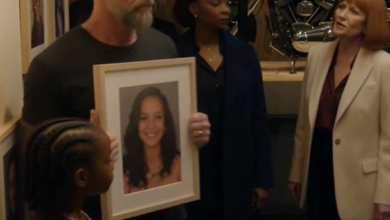
Nolan Brooks kept the front of the picture against his jacket. Rachel had turned the label toward her for less than a second before she covered it with her thumb. At first Ava could only see the last line, because her mother stood where the lamps made a shadow down the front. The number on their borrowed front door was printed just above Rachel’s hand.
“Lena,” Rachel said to the woman with the camera. “Please point that at the floor.”
The woman lowered the camera. The red indicator went dark when she put it down. Her assistant, a college student in green boots, pulled the screen closer to himself and asked whether the next segment had started sending. He brought up the line of thumbnails on the tablet. There had been people coming through the gallery and two views of empty chairs. The camera hadn’t made it to the family wall.
Joan Barlow, the event director, stood about a foot away with her glasses on a short chain. “We have a signed release,” she said.
Rachel took the label by the other corner and folded it in half. “You can bring me the one I signed.”
Nolan asked Ava if she wanted him to take the portrait to the car. She nodded, then looked back toward the other families. The photograph was a close-up, Ava in the cardigan a shelter volunteer gave her when she got too big for the sleeves of her old one. A photographer asked her to stand close to a window and look back toward a chair where her mother sat. They had carefully left the setting out of the image. It was supposed to hang with a note that said her best subject was math and she wanted a room with a big enough desk to spread out her pencils.
Ava looked at the card again. She took a tiny step out of the spotlight. One of the other children was getting ready to pose by a portrait at the end of the row. Nolan went over to tell her grandmother the camera break might take a while. Rachel had already called her advocate and asked for a private place she and Ava could go until they knew what else had been printed. Lena folded her tripod and offered the small sound room with the latch out of view behind a black curtain.
On the way there Ava touched the bare strip of wall under the nail where her picture had been. Then she held up the label so the assistant could see just the folded side.
“Could there be one under everybody’s?” she asked.
Nolan looked down the hall. Each of the other portraits had a card, flush with the lower edge. One of the cards was slightly longer than it needed to be.
Part 3
Nolan framed pictures on Webster Avenue. His shop could keep a half dozen dry cut mats flat at a time, which meant the rescue dogs that visited from the coffee shop next door were allowed to make themselves a bed only on the rug. The guys he rode with called him Frame. He’d fixed pictures from cell phones, from a single school photo or a dusty negative people found when they opened a new drawer after a death. He was good at deciding which part of the room to crop out when a customer asked whether they could just have the face.
Rachel and Ava had been in his shop because they were borrowing six frames for the event, not because they were going to buy their own. Ava studied the corners before she put names on their backings. In the dark ones she thought everybody’s chin looked different, and the light wood felt as if you could keep it near your own bed without asking if it matched anything. She handed him the one she wanted for her picture and helped cut the lettering strip down until it stopped touching the inner edge.
Rachel had asked Nolan two questions before the event. One was whether a picture could be printed a little larger from what the photographer sent. The other was whether he could cut all the labels to the same length because she didn’t want hers to look short. Joan originally told her every family would have a little description of what they’d said was all right. Rachel put down “Ava” and “math,” declined to list the new school or their address and asked to approve the photographed wall once the cards were printed. She kept a copy of the page in an envelope in her glove box.
Nolan kept another envelope in the motorcycle’s saddlebag. The address his sister Carrie left on it consisted of an otherwise readable street and a long bar of marker where she decided halfway through that he didn’t need the number. It was the last letter he got from her with her own writing on the front. He could picture the desk she must have used from a stain on the paper that matched the kind of seal on their aunt’s dining table.
Years ago, after she moved to get away from a former partner, an organizer included her location in a public announcement for a fundraiser. Carrie thought she could find the publication and ask them to take it down before more people got it. Somebody read it before she got there. She died after being found by the person she’d been trying to stay away from. Nolan kept the envelope because it was a record of what she intended to tell him. The strip of marker was even beyond the edge of the last number.
On the night of the gallery, he went in through the delivery entrance and left his black cruiser in a space across the glass. A swallow in charcoal thread spread its wings on the back of his black leather jacket. He wanted to hold still long enough that the photographer there could take a picture of him with Rachel’s family if Ava asked. From beside the portrait, he saw Joan clip a card to the frame. The first line carried Ava’s name. Two lines down, where the stamp should have stopped, the card gave a building number he remembered from a delivery.
After the livestream stopped, Rachel called the photographer from the sound room and asked whether any images of the wall had already gone up. Lena checked the actual feed archive with the assistant. They could see exactly where his wide shot ended. There was no readable family label in it. Then he saw a second channel in the production schedule he hadn’t been asked to manage.
“Which feed was going to the donors?” he asked.
Part 4
The second feed turned out to be a list of people invited to receive digital material. An email had gone to them with a link to the wall before the event. It showed photographs of the exhibition, for people in another time zone who didn’t want to watch the whole live stream. A new version of the gallery had been prepared but the assistant couldn’t see a send receipt. On a monitor, Lena could see where the camera had picked up dozens of reflections off the frames while she did her first walkthrough. She remembered covering the first half of the wall and leaving the second for later.
A staff member from the center froze distribution and went to ask the office who had signed off. Rachel told the advocate she needed to speak to the other two families if they could be reached privately. Ava sat with her legs stretched out on a chair. She offered to hold Rachel’s coat while she called, which reminded her mother she should check whether the keys to their place were inside it. Once Rachel had the keys in her hand, she asked the advocate if they could sleep somewhere else until they knew what photographs had gone out.
Joan sent a statement across a staff mailing list, where a volunteer who painted the gallery walls forwarded it to Nolan with a question mark. It described a man who removed a young person’s portrait while she was standing under it and refused to give it back. It said something about his role as a family volunteer and included a still image that started just after Ava brought her hand toward the frame. Nolan looked at the image twice. Ava had been reaching out because she wanted to see him set the picture straight. Her hand at the bottom of the frame made it look as if he had taken it directly from her.
Ava was still at the center when a girl she knew sent her the same image. Ava turned her phone over, then picked it back up to call her mother across the room before she sent anything. To get the phone off the floor, Nolan pulled a chair close enough for her to set it down. She asked quietly if Joan could make them stop helping at the center because they had made the event go wrong.
Rachel knelt and told her that she could still get the math tutoring they’d been coming for. Ava asked whether she could wear the sweater again. Rachel pulled it very slightly back up her daughter’s shoulder and said she’d worn it that morning and would wear it again whenever she wanted. Nolan busied himself with cleaning the edge of an empty frame while the advocate set out the things the family could decide immediately.
The print technician was a woman named Wynn who usually worked with the sound crew twice a year. There was no late charge on the invoice for the labels. She had told Joan they could send everything that came by Friday evening to press without a problem. On Saturday morning she got a second printing request. Somebody had moved the whole stack of labels to the printer by taking the paper tray out of one machine and putting it into the next. Wynn kept the proof she had already mailed Rachel for the earlier version.
“I printed some replacements,” she told Nolan. “I told her I’d never been given this information before.”
She brought up the email with the changed list and another email from Joan, instructing that the Saturday layout serve as the only version people could see on their monitors.
Part 5
Wynn’s regular customer account at the printer came with a way to recover the project order. The director asked for the draft proof to be thrown away after the poster run. Wynn had printed notes on the back about a short roll of tape she needed to send with a customer’s brushes. She had tucked it beneath the extra matte paper so the surface would stay flat.
The approved release had a copy at the center. A receptionist found it after Rachel showed her own. There were no marks under three boxes: family name, identifiable location and permission to use the story in targeted publicity. On the printed gallery card, those facts had come from a different document the grant writers used privately to estimate how far families had to travel for appointments. Some people filled their forms in months before there was an event on the calendar. Joan had told a staff member that nobody would donate for a series of first names.
The donor representative had come to the gallery because he used the center’s old front room to keep his son entertained after a concussion. He told the advocate his foundation preferred to show what neighborhoods benefited. His own emails requested aggregate numbers. He had written that twice when Joan told him it would be stronger to give every story a location. He’d never asked for a street address and wanted the email preserved exactly as he sent it.
The computer operator had put a camera cover in one envelope and a different kind of release form in another. He asked Nolan how he remembered which common size a mat went into after taking it out. Nolan laid a measuring tape next to the first frame and showed him where he penciled an unobtrusive number on the reverse. A photograph in the next pile had a pencil mark where a family wanted to remove the street sign that had been visible through a window. Nolan set it aside so the director could ask them whether they recognized what they’d chosen before staff sent home the photograph in a new envelope.
A boy turned up to get his brother’s portrait in the afternoon. The family had a photo of the two of them in a booth from the week before and wanted to know if they could frame the pair together. Nolan showed him a long mat board with enough room to cut new openings and offered a piece of foam the back could travel against. The boy asked whether he’d have to tell anybody the name of the person in the second picture. Nolan said he could just ask for a wider board. The boy came back twenty minutes later with his brother and still hadn’t told Nolan which face belonged to whom.
At the shop after supper, somebody slid an invoice with an old number under the door. Nolan opened the binder he kept behind the counter. A line of Carrie’s letters stayed flat under the last divider, where he’d moved them while he was looking for sleeves to take to the gallery. He went through them and noticed the one that still had a phone number had a question before it. She’d asked him to read the digits back if she phoned so she could hear the order he wrote them down. He could not remember doing it. He set the binder down and called Carrie’s son, knowing he might already be at work.
Her son stayed on the phone long enough to tell Nolan he kept a copy of the same letter in an old shoebox. He’d learned where his mother liked to draw a line across something from the time she helped him put his own name on a middle-school worksheet. He asked Nolan whether he might be able to make that line go somewhere good at the center. He said he meant a real line where a person could stop writing without feeling they had to finish the form.
Nolan found that out when he went down to the center to take apart the remaining portrait frames. He was undoing clips with both gloves off because he recognized by feel the one he’d repaired. It was on a picture of a father and a little girl holding a blue notebook like the sort that Carrie used to take to the grocery store. The father came to pick it up and asked whether the girl could have it with the card removed. Nolan showed him where the paper slid out so he could do it himself.
Rachel didn’t know at that point what she was going to do with Ava’s picture. She had promised not to get rid of it while Ava was at school. After talking to the two other families, she found them an hour in a plain meeting room where there were no event photographers. She asked if Nolan could bring a frame she could cover quickly. He gave her a black canvas bag. The portrait fit and the opening zipped across it.
Ava tagged along with permission from her mother. She brought a notebook and sat by the half wall, making little boxes on the page. When the advocates began to talk about reviewing the email list, she asked if there was a way she could hear where they needed her answer before she went back to the waiting room. She wanted time to say no to a picture while she could still stand beside it.
Later Nolan took the envelope from his saddlebag and brought it inside. He hadn’t let Carrie’s last letter out of the plastic sleeve for months. He slid it out for Rachel and kept a hand under it so she could turn it over.
Rachel looked at the crossed-out return address for half a minute. “Was this how she used to write to you?” she asked.
Nolan told her the envelope with the missing part was the one he knew she had spent the longest getting right.
Part 6
The center’s board held a closed session first to protect the families. With permission from the families it also released a plain account of what happened to everyone who had attended. The report included no addresses, photographs or details about why the families were receiving services. Wynn produced the old proof. The print operator showed when the new batch came through. The camera assistant was able to establish that the planned gallery view with the changed captions had not gone out during the live segment. The program had interrupted it before anyone could deliberately send that view to the archived list.
The board asked Joan whether she’d changed the cards. She acknowledged asking Wynn to make the new ones but said she meant for them to be visible only within the hall and believed the release allowed it. The center’s advocate pulled up Joan’s second email. It told the photographer to include each new card during the stream. Joan asked whether they could take the equipment schedule out of the report because someone else had written it. Lena said she’d written the camera order and put her own name on it. The request to show the cards was in Joan’s reply.
Nolan had the envelope zipped into his chest pocket. The chair asked whether he’d like to say what he’d seen. He said which end of the wall he’d been standing at and gave them the time on the camera clock. Then he said he didn’t know Joan’s motive by looking at her face and asked that they confirm what had been planned with the documents they had. They did.
The board removed Joan from the role and asked a privacy advocate who didn’t report to the event crew to work with the families on a review process. The announcement that they issued acknowledged that a resident address had been printed on cards without authorization. It corrected the suggestion that Nolan had taken away Ava’s photo against her wishes. The board also canceled the archive link from the invitation until it could be verified, then asked individually whether families wanted their photos included in a limited record. Rachel chose to take theirs home.
When they got ready to leave, Ava pulled her sleeve down and asked her mother if she could have another minute in the room. She went over to the board chair and showed her the left page of her notebook. She’d drawn several houses with light in the windows. There was no place in the picture to put words. Ava asked whether the board still needed to know where all the houses went.
“Which one do you want them to see?” the chair asked.
Ava went down the page and found a house she’d laid out beside a big letter A. “That one is mine to keep,” she said. “I could make you a different one.”
Part 7
The center took portraits off the main hall and put other work up where the families could swap anything they liked in and out. A girl who’d come there waiting for help with a science project kept taking home the paper she brought from school even after everybody said they liked it. She said she was planning to put it somewhere it could catch real morning light. For a while it went in and out three days in a row. The woman at the desk learned to ask if the girl wanted a paper clip to hang it before she asked if she wanted to leave it.
The new approval process was named for Carrie with permission from Nolan and his sister’s son. Her son said he’d like the description to mention that Carrie wanted to tell some of her own story. Nolan remembered the letters that started with a description of the table she sat at, how she laid a pencil under the page to keep it from rocking on a groove. She wanted him to imagine a real person in the place she had made. She had gone to considerable trouble deciding which parts were his to know.
Wynn came in to walk the advocates through a printed test where the public labels could be seen and approved independently from the files used for appointments. Ava and her mother got to try it out if they wanted. Ava wrote a false aisle number on the sample label long enough to show the adults exactly where she’d ask them to take it out. Rachel said she got her gift for trying things from a grandmother who once used a blank check to teach her where signatures belonged.
One Thursday Ava came to Nolan’s shop. She brought the portrait to have the glass replaced with something light enough that it could hang on a narrow strip of wall beside her desk. Rachel handed it to him out of the black bag. While he unhooked the parts, Ava held a second flat piece of paper to the counter with her elbow and asked what size frame would take it.
He finished taking the portrait apart before he turned it over.
Part 8
The picture Ava made for him was a dark house with big yellow windows and a porch that went halfway around the side. The closest window had a lamp. She had put a plant on a sill because she’d heard him say he didn’t know which plants grew where Carrie lived. In the doorway there was a line of trim and then room for somebody to stand without being drawn yet.
“Do you want to know where that house is?” she asked.
Nolan could see Rachel straighten a screw on the work counter with the pad of her thumb.
“Only if you want to tell me,” he said.
“It’s in the middle of the page. It’s supposed to stay there.”
Nolan set the drawing in an old frame that stood behind the counter. He brought Carrie’s envelope out of the bag and rested it under the folded cloth he used for the glass, so it could stay in the room while he worked.
“I still keep her letter,” he told Ava. “She sent me exactly the part she wanted me to have.”
Ava slid a clean piece of frame paper toward him. It was wide enough to cover the back without leaving a visible scrap. Nolan tucked the envelope behind the picture with the sample a fraction crooked where he could find it later. Then he handed Ava her own portrait with the little card cut exactly to the length she had chosen. Her mother made room beside her in the bag for both pieces to travel home together.
Follow the page for more stories about the things people trust us to hold.