A Blind Dog Led a Biker Into a Stranger’s House—Then a Little Girl Called Him by a Secret Name Her Supposedly Dead Father Had Never Forgotten
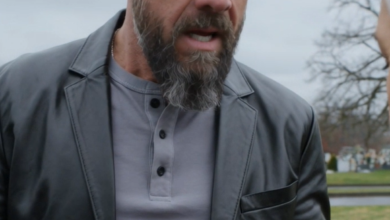
I knew Rachel before she finished saying my ex-wife’s name.
Seven years had changed her hair and the shape of her face. They hadn’t changed the way she stood with one shoulder against a doorframe, as if the house behind her belonged to somebody else.
“Put the phone down,” I said.
The girl tightened her arms around my dog.
I stopped moving.
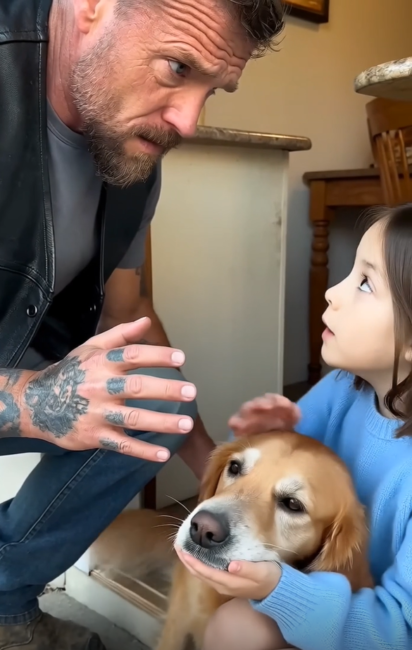
He was twelve now, nearly blind, with cloudy eyes and a stiff back leg. When he pulled toward the open gate, I had expected a discarded sandwich. Instead, he had followed a scent up a short path, through an open front door, and straight to this child.
He hadn’t run. Neither of us ran much anymore.
But he hadn’t hesitated.
Now his chin rested on her sock, and she was rubbing the soft notch in his left ear.
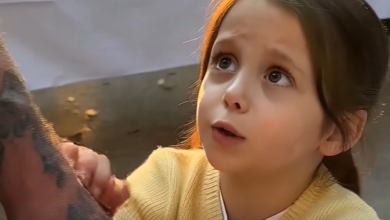
“Who are you?” she asked.
I almost said Daddy.
The word reached my teeth.
Then Rachel covered the phone and said, “Ben, don’t frighten her.”
That was my name.
The girl looked from her to me.
“You know him?”
A delivery truck rattled past on the street. Somewhere behind the house, a lawn sprinkler clicked against a fence.
My hands were shaking so badly that I sat on the bottom step.
“Call the police,” I told Rachel.
She stared.
“Please.”
I took out my own phone and called instead.
I gave the dispatcher the address, my name, and the number of the detective who had called me every year around my daughter’s birthday.
Then I said the sentence I had practiced in dreams.
“I think I’ve found my missing child.”
Rachel started crying.
The girl didn’t.
She drew her knees up, keeping my dog between us.
“My name is Sophie.”
My daughter’s name was Emma.
“And my dad died.”
I pressed my thumb against the rough seam of my jeans.
Seven years earlier, I had once followed a little girl through a grocery store because her laugh sounded right. Her frightened father had nearly called security.
I remembered that now.
Maybe grief had finally made me dangerous.
“Okay,” I said. “We don’t have to decide anything on the porch.”
The girl touched the dog’s collar.
Five crooked red stitches crossed its faded blue fabric. She put her finger on them, one at a time.
“One for everybody.”
Rachel turned toward the kitchen.
I knew those words.
But she was three when she last said them. Children remembered things from photographs and stories. A dog wasn’t a laboratory test. Neither was a father’s certainty.
I kept both hands where Sophie could see them.
Sophie said she had been outside a moment earlier, carrying a package in from the gate. Her scent would have been fresh along the path. I held on to that ordinary explanation. I needed this to be real without needing the dog to do anything impossible.
“Can he stay?” she asked Rachel.
Her voice broke on the last word.
Rachel said yes.
Not to me.
To her.
When the patrol car arrived, Rachel handed the officer a folder from a kitchen drawer before he had even asked for identification.
How long had she been keeping that folder ready?
The last good Sunday had smelled of pancake batter and wet dog.
Emma was three. Julia wore my shop sweatshirt, and Rachel sat at our kitchen table repairing the blue collar Emma insisted looked “too plain.”
Rachel threaded a needle.
Emma chose red.
“Five stitches,” she announced.
“For who?” I asked.
“Me. Mommy. Daddy. Aunt Rachel. Mister Tuesday.”
The dog had another name on his veterinary paperwork. Emma had renamed him after the day we brought him home.
Rachel made each stitch bigger than the last.
Then Emma put her stuffed rabbit on the table. It had a silver bell sewn into its stomach, and our dog followed its jingling around the kitchen.
Julia complained that the noise would drive everybody crazy.
“Then don’t hide the rabbit,” Rachel said.
Emma crawled beneath my chair and tucked it into my boot.
That afternoon, I took them to the park.
I remember Julia laughing when the dog stole a pancake from the bag.
For years, I polished that memory until nothing ugly could fit inside it.
On Rachel’s porch, the officer asked whether I was willing to wait at the sidewalk.
I agreed.
He didn’t touch my vest. He didn’t ask about the tattoos across my knuckles.
He asked whether anybody had been hurt.
“No.”
Whether I had entered the house.
“Following the dog. Two steps. Then I came back outside.”
Whether there were custody papers.
Rachel held up the folder.
The officer took it without choosing a side.
I stood beside the mailbox, listening to the old dog’s tags scrape the threshold whenever Sophie shifted her feet.
He was still on his leash.
I had loosened it enough for him to stay with her, and the extra line lay across the path between us.
My phone rang.
Detective Mara Ellis.
She had inherited Emma’s case three years earlier and had never promised she would solve it.
“Stay where you are,” she said. “I’m coming.”
I told her about the name.
The collar.
Rachel.
Then I told her the part I couldn’t make sense of.
“She called Julia.”
My ex-wife hadn’t vanished permanently. She had reported Emma missing from a rest stop outside Toledo, answered questions for months, and eventually moved away.
Her lawyer had told mine that she wanted no further contact.
I had believed she was grieving differently.
Ellis went quiet.
“Did you hear another voice?”
“No.”
“Then don’t assume who answered.”
That was why I trusted her.
She wouldn’t give me my daughter on the strength of a dog lying down.
Across the yard, Sophie looked toward me.
“Does he still hate thunder?”
I nodded.
She pressed her cheek into his gray muzzle.
Rachel closed her eyes.
The officer asked Rachel whether there was another adult who should be contacted. She gave him a number, then corrected the last two digits. That small correction stayed with me. Whatever else she was frightened of, she knew exactly how to reach Julia.
She could have learned that from anyone who knew him.
I told myself that twice.
Then Sophie asked whether he still slept in my left boot when it rained, and I couldn’t remember ever writing that anywhere.
What else had survived inside her while the rest of us were searching?
Ellis arrived without lights.
She spoke to Sophie inside with another officer nearby, then came out and asked whether I could come to the station voluntarily.
My stomach sank.
“Am I in trouble?”
“I need somewhere quieter to show you what Rachel gave us.”
The folder contained a custody order, a photocopy of a death certificate, and a letter supposedly written by Julia.
The order identified Rachel as a temporary caregiver.
The death certificate had my name.
I stared at the line where somebody had assigned me an occupation.
Construction laborer.
I repaired commercial refrigeration systems. I had been doing it since before Emma was born.
A small wrong thing.
I couldn’t stop looking at it.
“Is it real?” I asked.
“The information needs verification.”
Ellis never let my anger outrun her language.
Rachel’s version came a little at a time.
Julia had brought Emma to her shortly after the reported disappearance. She said she was escaping a violent marriage and that publicity around the missing-child case was part of my effort to track them.
Rachel had been living in western Pennsylvania.
She said she believed her.
Later, Julia supplied the documents.
Rachel moved again, eventually returning to Ohio for a hospital billing job. The little rental house near my new apartment had been available at the right price.
That was why we had crossed paths.
A lease and an afternoon walk.
Not fate arranging every street.
“She says she thought you were dead,” Ellis told me.
I looked at the photocopy.
Somebody had given my daughter a date to grieve.
“When?”
“Four years ago.”
Four years.
I had still been mailing birthday cards through Julia’s attorney then. I kept copies because somebody once told me a future judge might want to see that I hadn’t given up.
“What about her name?”
“Rachel says Julia told her to use Sophie.”
“Without asking why?”
“She says she was afraid.”
I laughed once.
It came out mean.
Ellis let it sit.
Then she turned over the last page.
There was an email address at the bottom of the letter. A contact number. Instructions about school enrollment.
Rachel had turned those over herself.
That counted for something.
Maybe she had been tricked.
Maybe the woman on the porch had been trying to protect a child with the wrong facts.
The thought relieved me, which made me ashamed.
I wanted one of the adults who had raised Emma to have loved her without calculating anything.
Ellis asked whether I would provide a DNA sample.
“Yes.”
Then she asked about the dog.
I explained that I had moved after selling the house, that I walked him before my evening shift, that this was our third time taking the quieter street.
She wrote it down.
Nothing about miracles.
Just the route.
Before I left, she told me they had reached Julia at the number Rachel supplied.
“She’s alive. She’s agreed to speak with investigators.”
“Did she ask about Emma?”
Ellis looked down at her notes.
“Her first question was whether Rachel had given us the bank statements.”
Why would a frightened mother ask about money before asking whether her missing daughter was safe?
Rachel’s statements didn’t arrive in a dramatic envelope.
They came as a PDF her bank helped her download.
I saw copies later through my attorney, after investigators had done their work. At the time, I knew only that Ellis had stopped describing the matter as a possible identification.
Rachel had been paying Julia every month.
Sometimes seven hundred dollars.
Sometimes nine.
The descriptions changed: school costs, legal fees, support.
None of it came to me.
None of it paid for the search.
Rachel had covered Sophie’s ordinary expenses herself, working extra shifts and putting dental work on a credit card.
I could almost feel sorry for her.
Her own application described Sophie as her daughter, although Julia’s private messages called her an aunt. On one page, Rachel asked for permission to make medical decisions. On another, Julia demanded cash. The same child occupied two different stories, depending on who needed something.
Then my attorney turned to the messages.
Julia had written that if Rachel stopped paying, she would collect the girl and disappear again.
One message mentioned a summer trip.
Another mentioned a new car.
“I thought she needed money to stay stable,” Rachel had told Ellis.
For a while, maybe she had.
Then the payments became a price.
Rachel paid to keep the child.
Julia collected because she could.
My attorney, Denise Warren, asked me to put the papers down.
I hadn’t realized I was gripping them.
“There’s another document,” she said.
A proposed guardianship filing.
Sophie was approaching an age when school trips, identification, and ordinary paperwork were making the borrowed story harder to maintain. Rachel wanted authority that would survive questions.
Julia had offered to help.
For twenty-five thousand dollars.
Rachel had borrowed against a retirement account.
That transaction had happened the previous month.
While I was replacing a compressor in a restaurant basement, somebody had been putting a final price on my daughter’s name.
I went outside.
Denise let me.
My motorcycle was parked beside her office. I rested both hands on the seat until the urge to do something stupid passed.
Then I called my sponsor.
I had been sober for seven years.
He answered before the second ring.
“Where are your feet?”
“Parking lot.”
“Good. Keep them there.”
That evening, I was allowed a short supervised visit at a neutral office while the adults sorted out immediate arrangements.
The girl asked for the dog.
Nobody had to persuade me.
He rested on a towel beneath the table while she offered her hand for him to smell.
“Do I have to call you something?” she asked me.
“Ben is fine.”
“Rachel says you used to be angry.”
My mouth went dry.
“I was.”
“At me?”
“No.”
She rubbed the collar.
“People say that.”
I looked at the social worker, then back at her.
“You don’t have to believe me today.”
She seemed to like that better than anything else I’d said.
Before the visit ended, she asked whether Mister Tuesday could come again.
I said yes.
Outside, my phone filled with notifications.
A neighborhood post showed a photograph of me kneeling on Rachel’s porch.
The caption called me an unstable biker using a child’s attachment to a dog to force contact.
The account that posted it belonged to Julia.
She knew exactly what people would see first.
But how had she obtained a photograph taken after the police arrived?
By morning, the photograph had reached customers at my shop.
One called to ask whether the police were looking for me.
Another quietly canceled a service visit.
I shut off the comments on our business page and sent the post to Denise.
My riding friends offered to stand outside Rachel’s house.
I told them no.
One friend, Luis, argued.
“If they move her—”
“Then we call Ellis.”
“You already waited seven years.”
I put the phone down before I said something that would make him stay away when I needed him.
An hour later, he arrived with coffee.
He didn’t mention the house.
Neither did I.
The pressure came through official channels, too.
Julia alleged that I had threatened Rachel and ignored a warning to stay away. Rachel confirmed she had asked me to leave, which was true in the narrowest possible way.
The requested emergency restriction didn’t decide who Sophie was.
It did mean Denise told me to avoid direct contact while the court considered the allegations.
No porch.
No messages.
No approaching Rachel.
I could follow rules.
I had spent seven years following rules that never seemed to lead anywhere.
What frightened me was how easily another week could disappear.
The next supervised visit was postponed.
The dog waited beside the door at the usual time.
I sat on the floor with him.
At four fifteen, my phone rang.
Not Ellis.
Sophie.
“I’m not supposed to have this.”
Her voice was so low I could hear her breath brushing the microphone.
I stood up, then forced myself to sit again.
“Where are you?”
“At home.”
“Is somebody hurting you?”
“No. We’re packing.”
I looked at the clock.
“Who’s there?”
“Rachel. She says we’re visiting somebody until things settle.”
I didn’t ask for an address she couldn’t know.
I asked whether she could safely stay where she was, then called Ellis from Luis’s phone while Sophie remained on mine.
The detective told me to keep my voice ordinary.
So I asked about school.
Sophie told me her class was reading a book she hated because the dog died.
Then she started crying.
Not loudly.
“I don’t want him to forget me again.”
I closed my eyes.
“He hasn’t forgotten you.”
“You don’t know.”
She was right.
I didn’t know what the old dog remembered or how.
I knew where he had chosen to lie down.
I knew he had pressed his nose beneath her hand.
“That’s true,” I said. “But I’ll bring him whenever they let me.”
Ellis called back after officers reached the house.
Rachel had packed two suitcases. Julia had arranged an out-of-state rental.
They hadn’t left.
The immediate plan changed under supervision, with Sophie’s safety and identification questions handled through the proper people.
By that evening, an emergency arrangement placed her with an approved caregiver while the court reviewed the conflicting papers. Denise explained it to me twice. Being her father would matter enormously. It did not let me skip the work of making her feel safe.
I never went near the street.
That mattered later.
But before she ended our call, Sophie asked something that left me staring at the kitchen wall.
“Did you really break the door when Mommy was holding me?”
“Yes,” I said.
The word stayed between us.
I heard a suitcase wheel scrape on her end of the call.
“Were you trying to get us?”
“No. I was drunk. I was angry. I punched the bedroom door.”
Silence.
“Was I there?”
“Yes.”
I had never been convicted of hurting Julia or Emma.
For years, I had used that sentence like a clean shirt.
It didn’t erase the door.
It didn’t erase the sound.
“I’m sorry,” I said. “You shouldn’t have had to hear it.”
Sophie didn’t tell me it was okay.
I was glad.
I had lied to myself about that last good Sunday, too. The pancakes were real. So was the laughter.
The night before hadn’t been good.
A broken door was waiting upstairs while we smiled over breakfast.
Julia had reasons to leave me.
She had the right to seek safety.
She didn’t have the right to invent a rest-stop disappearance, keep our daughter out of a search, and sell access to her sister.
Both things fit in the same room.
I had spent years trying to make only one fit.
After the call ended, I told Denise everything.
She already had the old incident report. She wanted to know whether I would try to explain it away.
“I want her to know I’m different.”
“Then let her notice,” she said.
That meant records.
Treatment.
People who had watched me keep appointments when there was no child to impress.
It also meant accepting a slower reunion than I had imagined.
I had dreamed of a girl running toward me.
Instead, she asked careful questions across a table.
I answered.
Sometimes badly.
Once she asked whether I had stopped looking when I sold the house.
I brought a photograph of the tiny apartment I moved into and the boxes of search flyers under its bed.
I also brought the red lunchbox I had kept. She didn’t remember it. I put it away without telling her she should. Every forgotten object felt like another loss to me. That didn’t make remembering it her job.
She studied it.
“Where did you keep my stuff?”
“Storage unit.”
“All of it?”
“Some. Not all.”
She looked up.
I told her about the clothes I couldn’t afford to keep paying to store. The toys that went to a church drive. The rabbit I never found.
Her fingers stopped moving on the dog’s collar.
“The one with the bell?”
“Yes.”
She looked toward Rachel, who was waiting beyond the office window.
“I had a rabbit.”
Denise passed that information to Ellis.
I didn’t ask Sophie to search her memories for evidence.
She was a child, not a witness I owned.
But Rachel requested another interview two days later.
Her attorney came with her.
I learned afterward that she admitted knowing I was alive long before the porch.
She had found a search interview online.
She recognized my voice.
Then she closed the page.
That had been four years earlier.
“I thought taking her away from me would hurt her again,” she said.
My daughter had been loved.
She had also been kept.
The DNA result arrived that afternoon.
Emma Mercer.
My child.
Now that nobody could dispute who she was, what would the adults do when they had to explain why they kept her?
The hearing took place in a county courtroom with a broken wall clock and a water fountain that clicked between cases.
There was no crowd of motorcycles outside.
Luis drove me.
Two other friends waited with him because sitting alone in a hallway can become its own kind of danger.
Emma wasn’t there for the testimony.
Her attorney had arranged for her to wait elsewhere with a support person. Her memories weren’t going to become a performance for the adults.
Denise had warned me that one hearing would not settle every criminal allegation or rebuild a family.
It could establish what happened next.
That was enough to get me through the door.
Julia wore a gray jacket I didn’t recognize.
She looked at my hands first.
I folded them in my lap.
Rachel sat several feet away from her.
The judge heard about the identification, the old missing-child report, the documents, and the disputed claims about my conduct on the porch.
The officer described where I had waited.
The recording from his body camera mattered more than Julia’s post.
So did the call I had made myself.
Then came the financial records.
Julia said Rachel had volunteered to support her while she rebuilt her life.
Rachel said she had been frightened that Julia would take Emma away.
Both statements contained something true.
Neither contained enough.
Ellis testified about messages Rachel preserved and the copies Julia had supplied when investigators questioned the payments.
Among them was a photograph of a stuffed rabbit.
Its stomach seam had been opened and sewn shut again.
I looked at Denise.
She touched my sleeve once.
Wait.
Julia’s attorney tried to keep the discussion on my old behavior.
Denise didn’t pretend it hadn’t happened.
She put my treatment records beside the incident report.
Then she returned to the seven missing years.
Rachel described receiving Emma after Julia claimed they were escaping.
She said she hadn’t known about the false disappearance until later.
Julia turned toward her.
“You knew before I made that call.”
Her attorney spoke quietly.
Julia kept going.
“You were the one who took the bell out.”
The room became very still.
I could hear the fountain outside.
Rachel stared at the rabbit photograph.
Then she said, “It would have woken everybody at the motel.”
Nobody had mentioned a motel in that answer.
The judge stopped them from talking over each other.
Ellis identified an earlier message Julia had retained.
A photograph attachment.
A motel receipt.
Instructions to keep the child quiet until the report was made.
The rabbit’s missing bell wasn’t proof by itself.
It was the small thing that made their prepared stories fall apart in front of the records.
Rachel lowered her head.
Julia began crying.
I didn’t feel better.
One of the court staff put a box of tissues beside Rachel. I watched her take one and remembered all the nights I had pictured Emma alone somewhere. She hadn’t been alone. That answer was a relief, and it brought a different hurt with it.
I thought about a three-year-old reaching for a toy that no longer made its familiar sound.
I thought about the collar Rachel had stitched while my daughter counted all five of us.
Afterward, Denise guided me into the hallway before I could look at either woman again.
There were orders to follow, interviews still pending, and a separate investigation moving forward.
Then Emma’s attorney approached.
“She’d like to see you.”
I stood so quickly that my chair struck the wall.
“Does she want the dog?”
The attorney smiled a little.
“She asked for both of you.”
What do you say to your daughter when the truth finally gives you a room together, but cannot give either of you back the years?
I said, “He stole my toast this morning.”
Emma looked down at the dog.
He was resting on a towel, unaware that several adults had reorganized their lives around his afternoon walk.
“He used to steal pancakes.”
“Yes.”
She sat beside him.
I sat in a chair.
For a while, that was enough.
The missing-child case changed into something with answers. The criminal proceedings took months. Julia eventually admitted her part in the disappearance and false reports.
Rachel answered for helping conceal Emma and for documents she had knowingly continued to use.
I didn’t attend every hearing.
Sometimes Emma had an appointment at the same time.
I chose the appointment.
The custody work moved in smaller steps than people online wanted.
Visits.
Longer visits.
Dinner at my apartment.
An afternoon when she asked where the bathroom towels were without asking permission to get one.
Rachel had been the person who knew her lunch order and the teacher she disliked. Emma missed her.
I hated hearing that.
Then I learned to keep my face still.
The counselor helped us make room for grief that didn’t match neatly.
When contact was permitted under the arrangements made for her, Emma could care about Rachel without proving anything about me.
She could be angry with Julia and still ask whether her mother was eating.
Those were her feelings.
I had already lost seven years trying to reach her. I wasn’t going to spend the next seven demanding she arrive empty-handed.
She moved into my home the following spring.
We chose a place with a ground-floor entrance because the dog’s back leg was getting worse.
The veterinarian knew about his cloudy eyes and adjusted his care as he aged. We kept the furniture in the same places and stopped leaving shoes in his path.
Emma learned to speak before touching him when he slept.
He learned where she dropped her backpack.
He slept there first.
My motorcycle stayed in the garage most school mornings. Breakfast took longer than I expected. So did finding a missing worksheet while somebody shouted that the bus was coming.
One Friday, Emma asked whether she could keep using Sophie at school until she decided.
I gripped the sink.
Then I said yes.
The first name she trusted after everything happened was allowed to be her own choice.
She used Emma at home that summer.
Sometimes Sophie.
I answered to Dad only after she offered it.
There was no announcement.
I was carrying groceries.
She needed me to hold the door.
I stood there so long that she asked whether I was going to let the ice cream melt.
That night, she brought me the blue collar.
Its five red stitches were coming loose.
“Can we fix it?”
I got a needle.
She chose the thread.
We kept the old stitches instead of pulling them out.
Emma asked whether five still meant everybody. I told her she could decide what the number meant now. She studied the collar a long time, then pressed her thumb over the new thread. Neither of us tried to make the answer tidier.
The new ones sat beside them, uneven and bright.
At four, we took our walk.
The dog moved slowly between us, his nose working at the cool air. Emma held the leash. I carried the folded towel for the bench.
At the corner, she stopped.
“Same way home, Dad?”