Part 2: Eight Bikers Entered the Courthouse for Sophie — Bear’s Silent Nod Revealed Why He Came
Eight Engines on a County Road
My name is Claire Monroe.
I work as a victim advocate in McCracken County. My job is not to promise families that court will feel easy. It rarely does.
My job is to explain the hallways.
The waiting rooms.
The places where a child can sit.
The people who will ask questions.
The choices a child still controls.
When Sophie’s mother, Allison, called me, she sounded like somebody trying to hold a cracked glass together with both hands.
Sophie had stopped sleeping through the night.
She jumped when doors closed.
She hid when unfamiliar men entered a room.
She could not say the courthouse address without becoming silent.
Her stepfather had been charged after Sophie disclosed that he had violated her trust and harmed her. I will not describe more than that.
A child’s pain is not a spectacle.
The case required Sophie’s testimony.
That was why Allison asked whether there was anyone who could help her daughter feel less alone.
A counselor suggested contacting a local BACA support chapter.
The group’s purpose was simple in Sophie’s case: show up, respect boundaries and remain a visible source of support while trained professionals did their jobs.
Bear called me first.
His legal name was Daniel Holt.
Fifty-one years old.
Former Marine.
Three deployments in Iraq.
Retired diesel mechanic.
Road captain for a local support chapter.
He spoke in short sentences.
“What does the kid need?”
“Predictability,” I said.
“Good.”
“No surprises.”
“Better.”
“She decides whether anyone comes near her.”
“Always.”
When the bikers arrived at Sophie’s house, they followed that rule without discussion.
Bear stayed near the porch steps.
Tess, a forty-four-year-old white woman with auburn hair and tattooed hands, placed a box of sidewalk chalk on the walkway but did not ask Sophie to use it.
Mack, a broad-shouldered Black man in his late forties with a gray goatee, stood near the gate where Sophie could see the exit remained open.
Road Dog removed his sunglasses.
Preacher held a paper bag of peppermints.
Doc carried a folded diagram of the courthouse.
Diesel kept his helmet beneath one arm.
Red stood farthest back because he understood that eight leather vests already made the yard feel crowded.
They introduced themselves one at a time.
No one demanded an answer.
Bear did not ask Sophie to be brave.
I noticed that immediately.
Adults tell frightened children to be brave because adults need to believe bravery is simple.
Bear said something else.
“You set the pace, kid.”
The first afternoon, Sophie did not step onto the porch.
The second time the bikers visited, she opened the screen door halfway.
Tess sat on the walkway drawing a purple cat with sidewalk chalk.
Diesel studied it.
“That thing got four ears?”
Tess looked at him.
“Art is personal.”
Sophie smiled behind the door.
It lasted less than a second.
Bear saw it.
He did not react.
He knew better than to turn a small moment into a performance.
On their third visit, Sophie sat on the porch beside her mother.
Bear remained near the flower bed.
His vest opened slightly when he shifted his weight.
Inside the left seam was a small patch shaped like a crooked yellow star.
The stitches were uneven.
The fabric looked old.
It did not match the hard leather or the weathered patches on the outside.
Sophie pointed.
“What is that?”
Bear looked down.
For a second, his rough face changed.
“Something I carry,” he said.
“Why?”
Bear rubbed one thumb across his beard.
“For dark days.”
Sophie considered the answer.
Then she nodded.
Bear closed the vest carefully.
Nobody asked another question.
The First Row
The courthouse morning arrived beneath a low gray sky.
Rain had darkened the sidewalks in downtown Paducah. Trucks moved along the nearby roads with the wet hiss of tires against pavement. The Ohio River air settled cold against the building.
Sophie wore a navy dress with tiny white flowers.
Her pink shoelaces came undone before we reached security.
Allison knelt to tie them.
Her hands shook.
Outside the courthouse, eight motorcycles were parked in a straight line along the curb.
The bikers stood beside them.
No roaring engines.
No theatrical entrance.
No confrontation.
Bear held his helmet against one hip. His beard moved slightly in the wind. He wore the same leather cut and the same scuffed boots Sophie had seen in her driveway.
When Sophie stepped out of the car, he did not walk toward her.
He waited.
She looked across the sidewalk.
Bear placed two fingers against his chest.
I am here.
Sophie stared at him.
Then she raised two fingers toward her own sweater.
Bear nodded once.
Inside, the courtroom smelled like old wood, paper and damp coats.
The judge entered.
People stood.
Chairs scraped against the floor.
Sophie flinched at the sound.
Allison reached for her hand.
The victim advocate assigned to remain near Sophie guided her carefully toward the witness stand.
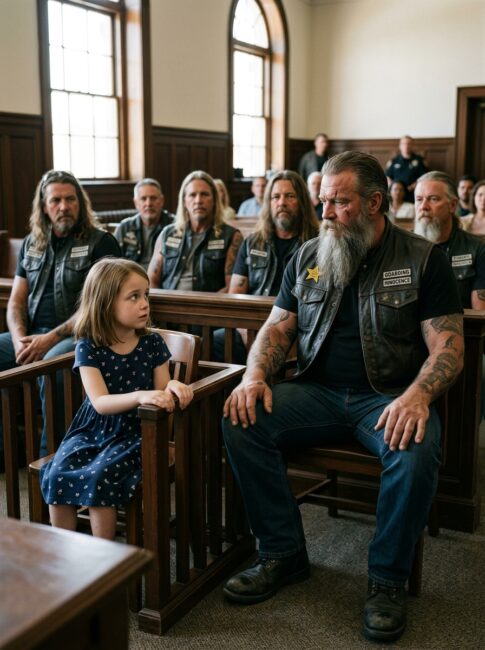
The bikers sat in the first row of the gallery.
Bear took the seat directly within Sophie’s line of sight.
Tess sat beside him.
Mack folded his hands loosely.
Road Dog removed his glasses and cleaned them twice despite the fact that they were already clean.
The man Sophie feared sat at a separate table with his attorney.
The court handled the case with the safeguards required for a child witness.
Nobody raised a voice.
Nobody moved toward Sophie.
Still, fear does not need movement.
Sometimes presence is enough.
The prosecutor started with questions Sophie knew.
“What is your name?”
“Sophie.”
“How old are you?”
“Six.”
“What color is your bedroom?”
“Yellow.”
“What is your dog’s name?”
“Biscuit.”
Her voice was small.
But it was there.
Then the questions changed.
The prosecutor remained careful.
The judge watched closely.
Sophie understood that she could pause.
She understood that she could say she did not know.
But when she looked toward the other table, her shoulders tightened.
Her fingers curled around the wooden edge of the witness stand.
Her mouth opened.
Nothing came out.
The court reporter stopped typing.
Rain tapped against one tall window.
Somebody shifted in a chair.
I sat behind Allison and watched her lean forward as if every part of her body wanted to cross the room.
Sophie looked toward her mother.
Then the door.
Then the judge.
Then the first row.
Bear had not moved.
He sat with his boots planted firmly against the floor.
His vest open slightly at the chest.
His tattooed forearms resting near his thighs.
He placed both hands flat on his knees.
Palms down.
Still.
Visible.
The same way he had on Sophie’s driveway.
Bear lifted his chin.
Then he nodded.
One time.
Slowly.
Sophie stared at him.
Bear did not smile.
He did not mouth words.
He did not ask her to become fearless.
He simply stayed.
Sophie breathed in.
Then out.
Her first answer cracked in the middle.
The prosecutor waited.
Sophie tried again.
One sentence.
Then another.
She paused.
Looked toward Bear.
Bear remained still.
Sophie spoke again.
She told the truth in the plain language of a six-year-old child.
No graphic details belong here.
What mattered was that she answered.
Her voice shook.
She cried once.
She wiped her cheek with the sleeve of her dress.
But she kept going.
The adults in the room listened.
When Sophie finished, the judge thanked her.
She stepped down carefully.
Allison moved toward her.
Sophie ran in the other direction.
Straight toward the first row.
She stopped in front of Bear and lifted both arms.
Bear froze.
Even then, he looked toward Allison before touching her child.
Allison nodded.
Bear bent slowly.
Lifted Sophie against his chest.
Forty pounds held by a man built like a wall.
Sophie wrapped both arms around his neck.
Her cheek disappeared into his beard.
Then she whispered something.
Bear closed his eyes.
His jaw tightened.
His shoulders shook once.
Then the Marine with scarred hands and three deployments behind him began to cry.
The Star Beneath the Leather
The court proceedings continued after Sophie testified.
There were motions.
Schedules.
Legal steps I will not compress into a dramatic montage.
Justice moves through paperwork as often as it moves through courtroom speeches.
Outside the courthouse, reporters waited near the lower steps. Sophie’s privacy was protected. Allison kept her close.
The eight bikers remained near the motorcycles.
Quiet.
Tess held Sophie’s small backpack.
Mack stood between the family and the wider sidewalk without creating a scene.
Bear wiped one cheek with the back of his wrist.
He looked embarrassed by the tears.
Sophie stood beside him, holding two of his fingers.
“What did she say?” I asked quietly when the child had moved closer to her mother.
Bear looked toward the row of Harleys.
“She said she was not scared anymore.”
His voice came out rough.
I thought that explained everything.
It did not.
Bear opened the left side of his vest.
He removed the crooked yellow-star patch Sophie had noticed weeks earlier.
The fabric was thin with age.
The stitches were uneven.
It looked as though a child had made it.
Bear held the patch between his thumb and forefinger.
“I was six,” he said.
The sidewalk noise seemed to pull away.
Bear did not give us every detail.
He did not need to.
Forty-five years earlier, Daniel Holt had sat in a courtroom in another Kentucky county.
Different building.
Different case.
Same age.
He had been asked to speak about harm inside a home where adults should have protected him.
His mother had brought him to court.
A lawyer had asked questions.
The room had smelled like paper and furniture polish.
Daniel had stared at the microphone.
Then toward the gallery.
Nobody familiar sat where he could see them.
No steady face.
No signal.
No person whose only job was to remain.
His body locked up.
His words disappeared.
Adults eventually moved on.
The truth came out later through other evidence and other testimony, but Daniel remembered the silence as if it had happened the day before.
After his final military deployment, a counselor asked him to draw something the frightened child inside him might have needed.
Bear drew a star.
“Why a star?” I asked.
He looked toward the courthouse doors.
“Something small you can find in the dark.”
He had stitched the patch himself during therapy.
Badly.
He hid it inside his vest near his heart.
Not for strangers.
Not for the club.
For himself.
Sophie had noticed the edge of the yellow fabric because children often see what adults overlook.
Bear knelt in front of her again.
His knee cracked.
He held out the patch.
“This helped me remember I got through,” he said. “Maybe you hold it awhile.”
Sophie took the star.
She turned it over in her small fingers.
“Do you still need it?”
Bear looked at her.
Then toward his brothers waiting near the motorcycles.
“Some days.”
Sophie considered that.
Then she pressed the patch back into his palm.
“You keep it,” she said. “I saw you.”
Bear’s face tightened.
Sophie touched two fingers against her own chest.
“You were there.”
Bear closed his hand around the star.
The tears returned.
Quietly.
The nod inside the courtroom had helped Sophie speak.
But Sophie had done something for Bear too.
She had allowed the six-year-old boy inside a scarred Marine to witness a different ending.
A child looked toward the gallery.
Somebody stayed.
The Rules That Looked Like Kindness
The case ended months later.
The man who harmed Sophie was convicted and received a long prison sentence.
The sentence mattered.
Accountability mattered.
Safety mattered.
But healing did not arrive neatly on the same day.
Sophie still woke from nightmares.
She still avoided certain rooms.
She still froze when unfamiliar men spoke too loudly nearby.
She continued therapy.
Allison kept routines predictable.
The bikers did not pretend their presence could replace professional care.
They simply continued showing up when invited.
One Saturday morning, the sound of Harley engines rolled down Allison’s county road.
Not loud for the sake of being loud.
Steady.
Controlled.
Eight bikes entered the gravel driveway and shut off one by one.
Ticking metal replaced the engines.
Bear stopped at the gate.
“Permission?” he called.
Sophie looked at her mother.
Allison nodded.
Sophie opened the gate herself.
That small action mattered more than any dramatic speech.
Tess brought sidewalk chalk.
Mack noticed a loose board on the porch and asked before retrieving his toolbox.
Preacher brought peppermints.
Road Dog carried two coloring books.
Doc brought nothing except time.
Diesel placed a container of nuts, bolts and washers on the porch because Sophie liked sorting small objects by size when she felt anxious.
Bear sat near the flower bed with coffee in one hand.
He did not crowd Sophie.
He never did.
After a while, Sophie disappeared inside the house.
She returned carrying a folded sheet of yellow construction paper.
She handed it to Bear.
Inside was a star.
Five uneven points.
Tape across the back.
A line of purple crayon near one edge.
Bear stared at it.
“This one is for you,” Sophie said.
Bear touched the paper carefully.
“I have one.”
“That one is old.”
Bear looked offended.
“I am old.”
Sophie smiled.
“Now you have two.”
Bear slid the paper star into his vest beside the faded fabric patch.
The following month, Tess helped Sophie cut seven more stars.
One for every biker who had sat in the first row.
Each volunteer stitched the star inside their leather cut.
Hidden near the inner seam.
Not displayed on the outside.
Mack explained it to me while tightening the loose porch board.
“Outside patches tell people who you ride with,” he said.
He pressed one hand briefly against his chest.
“Inside ones tell you why.”
That was when I understood how carefully the bikers had built every interaction with Sophie.
Bear placing his hands on his knees.
Mack standing near the open gate.
Tess sitting lower than Sophie on the porch step.
No sudden touch.
No unnecessary questions.
No promises larger than they could keep.
They did not tell Sophie the world could never hurt her again.
They told her the truth.
“You control the gate.”
“You decide the distance.”
“You look for us if you need us.”
“We stay where you can see us.”
Some of those rules came from training.
Some came from listening to advocates.
Some came from pain the bikers carried quietly beneath leather.
Bear never told Sophie his full story.
A child should not carry an adult’s history.
He told her only this:
“When I was little, I needed somebody to stay.”
Sophie looked at him.
“Did they?”
Bear paused.
“Not that day.”
Sophie thought for a moment.
Then she pointed toward the star hidden inside his vest.
“But you stayed for me.”
Bear nodded.
“Yes.”
She touched two fingers against her own chest.
“I stayed for you too.”
Bear looked away toward the road.
His hand rose briefly to his beard.
The other bikers pretended to be interested in Mack’s porch repair.
Nobody embarrassed him by naming the emotion.
That was brotherhood too.
Knowing when to look away.
One Nod
The visits became less frequent over time.
That was the goal.
Sophie did not need eight motorcycles outside her house forever.
She needed to discover that safety could exist inside her own body again.
Still, certain rituals remained.
On the first Saturday of each month, one or two bikes rolled along the county road toward Allison’s house.
Sometimes Bear came alone.
Sometimes Tess rode with him.
Sometimes Mack arrived carrying tools and discovered something minor to repair.
They stopped at the gate.
Always.
They waited.
Always.
Sophie decided whether it opened.
By the time she turned seven, she could sit on the porch while Bear drank coffee from a travel mug.
She asked about his beard.
“How long does it take to grow?”
“Longer than patience.”
“Does food get stuck in it?”
Bear glanced toward Preacher.
“Ask him.”
Preacher frowned.
“Traitor.”
Sophie laughed.
The sound surprised everyone the first time.
Nobody made a big deal of it.
Bear learned that Sophie liked bugs, except spiders.
Sophie learned that Bear disliked hospitals, cheap coffee and people who touched his tools without asking.
Boundaries moved in both directions.
That mattered.
One afternoon, Sophie asked whether Marines cried.
Bear looked toward the road.
“Smart ones do.”
“Did you cry in court?”
“Yes.”
“Were you embarrassed?”
Bear rubbed his beard.
“Little bit.”
“Why?”
“Still learning.”
Sophie nodded as if that was a complete answer.
Before Bear left, he placed his helmet on his head and started the Harley.
The V-twin rolled across the gravel driveway.
Sophie stood near the porch rail.
Bear looked toward her.
Then he nodded once.
Slowly.
Sophie nodded back.
That became their signal.
No speeches.
No dramatic promises.
Just one nod.
Before therapy appointments.
Before the first day of school.
Before Sophie entered a crowded room.
Sometimes Bear was there.
Sometimes he was not.
When he was absent, Sophie stood in front of the hallway mirror and gave herself the same nod.
Slowly.
Once.
Then she took the next step.
Where the Star Stayed
Sophie is nine now.
The faded yellow-star patch still belongs to Bear.
He keeps it stitched inside his leather vest beside the paper star Sophie gave him.
The paper has softened around the folds.
One point has torn slightly.
Bear refuses to replace it.
The other seven bikers still carry matching stars inside their cuts.
Strangers never see them.
At diners, people notice the boots.
The beards.
The tattooed hands wrapped around coffee mugs.
The motorcycles cooling beneath the parking-lot lights.
They do not see the yellow fabric hidden near each biker’s chest.
Last spring, Sophie had to speak at a school assembly.
Nothing heavy.
Nothing connected to court.
She had written three paragraphs about a book she loved and volunteered to read them aloud.
Allison sat near the back of the cafeteria.
I sat two rows behind her.
Bear did not attend.
He had asked Sophie whether she wanted him there.
Sophie considered it.
Then shook her head.
“I think I can do this one.”
Bear nodded.
“Good.”
On the afternoon of the assembly, Sophie stepped toward the microphone.
The room contained parents, teachers and children shifting in folding chairs.
A custodian rolled a cart through the hallway.
Somebody dropped a water bottle.
Sophie looked down at the paper in her hands.
For one second, she became still.
Then she touched two fingers against her sweater.
The place where a hidden star might rest.
She lifted her chin.
Nodded once.
Slowly.
And started reading.
Outside, beyond the school parking lot, traffic moved toward U.S. Route 60.
A motorcycle passed somewhere in the distance.
The engine note traveled across the building and faded toward the river.
Sophie did not look toward the window.
She kept reading.
Follow the page for more stories about the people behind the leather cuts.