Everyone Saw a Tattooed Biker Shove a Homeless Man onto the Pavement—Then an Empty Bench Disappeared Beneath a Runaway SUV
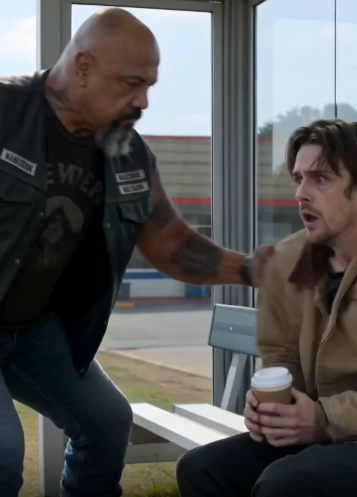
The tattooed biker crossed the sidewalk, planted both hands against a homeless man’s chest, and sent him crashing beside the curb while strangers shouted, raised phones, and prepared to stop what looked like a vicious attack.
I know exactly how violent it appeared because I was the biker who pushed him.
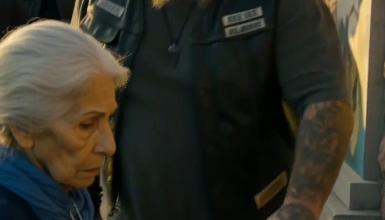
My name is Gabriel Torres, though the Iron Lanterns have called me Brick since I was twenty-six. At fifty-two, I stood six-foot-four and weighed nearly 280 pounds, with a shaved head, a gray-streaked beard, scarred knuckles, and black ink covering both arms and climbing the left side of my neck.
People rarely waited to learn whether I was angry.
They usually decided from the leather vest.
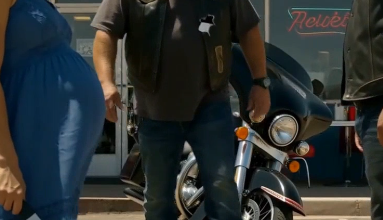
That October morning, my Harley was parked outside Miller’s Diner beside U.S. Route 40 in Richmond, Indiana. The engine had gone quiet, but heat still rose from the pipes while I waited for three club brothers to finish breakfast.
A man sat near the bus shelter with a bedroll beneath one arm and a paper cup between his boots. His brown coat was too thin for the weather. A cardboard sign rested against the bench, but he never lifted it when people passed.
His name was Nathan Cole.
I did not know that yet.
I only noticed that he watched every pair of shoes moving past him while carefully avoiding the faces above them. Someone had spent years teaching that man how quickly eye contact could become an invitation to judgment.
I carried him a coffee.
He thanked me without looking up.
Then I heard an engine roar where no engine should have been accelerating.
Across the street, an SUV lurched through an intersection. Its horn blared continuously. One front wheel jumped the curb, dropped back, then turned sharply toward the diner.
People saw it.
They froze.
Nathan did not. A departing bus blocked his view, and the noise of its diesel engine swallowed the screaming from across the street.
I had no time to explain.
No time to ask permission.
I ran.
Nathan looked up just as my boots struck the sidewalk. Fear crossed his face when he saw a giant tattooed stranger charging directly at him.
I hit him with both hands.
He fell hard beside the shelter, his coffee flying across the pavement. My knee struck the ground as I went down with him.
A woman screamed.
Someone shouted, “Get away from him!”
Another person raised a phone. From their angle, all they saw was a biker towering over a homeless man whose belongings had spilled across the concrete.
Nathan stared at me with shock and fury.
“What is wrong with you?”
Then something enormous rushed behind my back.
The sound was not a crash at first. It was metal scraping concrete, glass trembling inside the diner, and a wooden bench breaking into pieces where Nathan had been sitting less than two seconds earlier.
The crowd went silent.
I kept one hand against Nathan’s shoulder and spoke the only sentence my lungs could manage.
“I pushed him down. That vehicle nearly ran over him.”
But when Nathan looked past me, he did not stare at the destroyed bench.
He stared at my Harley.
And the warning he gave me next turned the rescue in a direction none of us expected.
Want to know what Nathan noticed on my motorcycle and why he refused the money offered afterward? Drop CURB in the comments — I’ll share more soon.
Before that morning, I believed speed had taught me everything it could.
I had driven fire engines through intersections where every civilian seemed determined to occupy the same twelve feet of pavement. I had ridden Harleys through hail, desert heat, and Indiana rain that found every opening in a jacket.
Still, I was not prepared for Nathan.
My years with the Richmond Fire Department ended after a warehouse roof came down on my right shoulder. The surgeons rebuilt what they could. The department called it a medical retirement.
I called it being asked to leave the only work I understood.
The Iron Lanterns kept me from disappearing inside my garage. We were not saints, and we never pretended to be. Some brothers had criminal records. Others were veterans, mechanics, roofers, welders, fathers, and men who had learned late how expensive anger could become.
I had my own history.
At twenty-two, I spent eleven months in county jail after breaking a man’s jaw outside a tavern. He insulted my younger brother Rafael, and I answered with both fists because fists were the only language I trusted.
Rafael visited every Sunday.
He never lectured me. He just sat across the scratched metal table, talked about engines, and waited for me to realize that loyalty without restraint could become another form of selfishness.
Six years later, a distracted driver struck Rafael while he changed a tire beside Interstate 70.
I arrived after the ambulance.
That loss sent me into fire service. I could not return for my brother, so I spent twenty-one years arriving for strangers.
The old habits never vanished. I simply gave them different work.
That morning at Miller’s Diner, our club was supposed to ride east to Columbus for a fundraiser benefiting two families displaced by an apartment fire. Bear Donnelly, Amos Green, and our youngest patched member, Eli Mercer, were finishing eggs when I stepped outside.
Nathan was already beside the shelter.
Most people noticed the cardboard sign first.
I noticed his hands.
They were not soft. The fingertips were dark with old grease, and the nails had the black half-moons mechanics carry even after scrubbing. A narrow scar crossed his left thumb, the kind produced by sheet metal or a slipped utility knife.
I asked whether he wanted coffee.
“Black,” he said. “No charity speech.”
“Good. I don’t have one.”
I brought him the cup and a breakfast sandwich. He accepted the coffee but pushed the food back toward me.
“I can pay for food.”
He opened his palm. Three quarters and four dimes rested there.
“That won’t cover it.”
“Then I can’t pay.”
“Check the receipt.”
The diner ran a breakfast promotion that morning. Buy one sandwich, receive a second for a dollar. I told him mine had cost me more if I ate both and placed the wrapped sandwich beside his cup.
That was not true.
Nathan knew it.
He took the sandwich anyway, which was his way of allowing both of us to keep our pride.
While we spoke, I heard a rough ticking near the back of my Harley. I crouched beside the bike and ran my fingers near the lower frame, but Bear called from the doorway that our food was getting cold.
Nathan watched me stand.
“Check that before you ride,” he said.
“You hear something?”
“I hear plenty.”
He did not elaborate.
Inside, Eli joked that I had found another stray. I told him Nathan was a man, not a dog, and Eli immediately looked ashamed.
The correction mattered.
I knew how easily help could become ownership. Give somebody breakfast, and a certain kind of person begins believing he has purchased the right to define him.
Nathan owed me nothing.
Eight minutes later, I was pushing him into the pavement.
The SUV entered my vision as a reflection.
Miller’s front window showed the intersection behind me, including a beige vehicle rolling too fast through the turn. At first, I assumed the driver was trying to beat the light.
Then the horn began.
One long note.
No pause.
The SUV clipped a plastic road marker and crossed the center line. Its driver appeared folded over the steering wheel. The front tires jumped when they reached the curb, and the vehicle turned toward the shelter.
Nathan could not see it.
A city bus was pulling away between him and the intersection. Its diesel engine shook the glass and buried every warning beneath a wall of noise.
I shouted.
Nathan looked toward the diner, not the road.
The SUV was perhaps forty feet away.
I ran.
Thirty feet.
A woman near the newspaper box saw me coming and backed away. Nathan’s eyes widened when he realized I was not stopping.
Twenty feet.
He started to rise, but his duffel strap had looped around one ankle.
Ten.
There was no gentle option left.
I struck him with the flats of both hands and drove through his chest. He went backward. I twisted as we fell so my shoulder, not his skull, took most of the pavement.
The impact emptied my lungs.
The SUV crossed the spot behind us.
Its passenger mirror hit the shelter. Tempered glass burst across the sidewalk. The wooden bench cracked beneath the front bumper, and one steel support tore free of the concrete.
Then the SUV stopped against a planter.
Silence came late.
First there was the horn, the hiss of a damaged radiator, and the metallic rattle of a street sign spinning on one bolt. Then came the voices.
“Call 911.”
“Don’t move him.”
“That biker attacked him.”
The last sentence came from the college student holding the phone.
He had begun recording after seeing me run. His video captured the shove but not the SUV approaching behind the bus.
Nathan rolled onto his side and swung one arm toward me. The punch missed my jaw and landed against my vest.
I did not blame him.
“Easy,” I said.
“You jumped me.”
“I moved you.”
“You broke my arm.”
He had not, but pain does not wait for a diagnosis.
I checked his wrist, elbow, and shoulder. He pulled away twice before recognizing the old fire department commands in my voice.
“Move your fingers.”
He did.
“Now your wrist.”
He cursed but moved it.
The waitress from Miller’s knelt beside us. Her name was Jo Alvarez, and she knew I had been a first responder. That detail changed the crowd less than I expected.
People had already selected their version.
The driver remained slumped inside the SUV. Bear and Amos reached the door before I could stand. Bear switched off the ignition while Amos checked the driver’s breathing.
She was alive.
Later, we learned that seventy-one-year-old Margaret Ellis had suffered a sudden medical episode. Her foot pressed the accelerator while her upper body trapped the horn.
She had not chosen the path toward Nathan.
Neither had the SUV.
That distinction did not matter in those first seconds.
Police arrived with paramedics. Officer Claire Bennett ordered everyone back while another officer reviewed the damaged shelter and the scattered belongings.
Nathan’s duffel had split open.
Two shirts, a shaving kit, a small socket set, and a framed photograph lay near the curb. I reached for the photograph, but Nathan caught my wrist.
“Leave it.”
I released it immediately.
The image showed Nathan beside a smiling woman and a teenage boy in front of a garage named COLE & SON AUTOMOTIVE.
I did not ask.
The paramedics examined him. He had bruising on one elbow and a shallow scrape across his palm. My rebuilt shoulder burned, but I told them it was old damage.
Officer Bennett separated us.
The student with the phone insisted he had witnessed an assault. A second customer agreed. Neither had seen the SUV until after Nathan hit the ground.
Jo pointed toward the broken bench.
“If Brick hadn’t moved him, we’d be covering a body.”
Nathan sat on the ambulance step with a cold pack against his elbow. He looked at the wreckage for a long time.
Then he looked at me.
“You could have shouted.”
“I did.”
“I didn’t hear you.”
“I know.”
“You could have pulled me.”
“There wasn’t time.”
His jaw tightened.
I expected gratitude because ego is sneaky that way. Even when we tell ourselves we acted without wanting praise, some small part still waits to be declared good.
Nathan gave me no such comfort.
“You scared the hell out of me.”
“Yes.”
“You hurt my arm.”
“Yes.”
“You spilled my coffee.”
“I’ll replace that.”
He stared at me, then released one short laugh.
It was not forgiveness.
But it was a door.
The video reached social media before the tow truck reached the SUV.
Thirteen seconds.
That was all the student posted.
The clip showed me running toward Nathan, striking him with both hands, and driving him out of frame. It ended before the runaway vehicle entered view.
The caption described a biker attacking a homeless man outside a diner.
By noon, strangers had identified the Iron Lanterns. By two o’clock, they had found my garage. Messages arrived calling me a coward, a predator, and proof that motorcycle clubs hated people living on the street.
The full security footage would have ended the argument.
Miller’s exterior camera captured the SUV, the bus, Nathan, and me in one wide frame. Officer Bennett had already reviewed it. No charges were filed.
Jo offered to publish the recording immediately.
Nathan said no.
His answer tested the club.
Eli wanted the complete footage online before the false clip spread farther. Bear agreed. Amos wanted our attorney to demand that every account carrying the partial video remove it.
I wanted my name cleared.
Nathan wanted his face left alone.
“They already made me the homeless victim,” he said. “You post that other angle, and I stay the homeless victim forever.”
Nobody answered.
He was right.
People discussing the clip rarely used his name. They called him “the homeless man,” as if the absence of an address had erased everything else he had ever been.
Publishing the full footage would vindicate me, but it would also replay the worst seconds of Nathan’s life for people who treated suffering as entertainment.
Our club president, Jonah Reed, made the decision.
“Brick’s reputation can wait,” he said. “Nathan owns Nathan.”
Bear protested. Eli cursed and walked outside. I stayed quiet because the vote had exposed something I did not enjoy seeing in myself.
I wanted proof more than I wanted Nathan’s consent.
That evening, I found him behind a Methodist outreach center three blocks from the diner. He was sitting on an overturned bucket, repairing the zipper on his duffel with a pair of pliers.
I brought coffee.
He glanced at the cup.
“You keep spilling those.”
“You keep sitting near traffic.”
This time he smiled.
I asked about the photograph. He could have told me to leave. Instead, he wiped his thumb across the crease in the damaged frame.
The woman was his wife, Megan. The boy was their son, Tyler.
Nathan had owned Cole & Son Automotive in New Castle for eleven years. He specialized in steering, suspension, and driveline problems—failures that made vehicles move in directions drivers had not chosen.
Megan developed ovarian cancer.
Insurance covered enough to keep hope alive and left enough unpaid to destroy everything else. Nathan mortgaged the garage, sold his tow truck, and missed work to drive her to treatment.
She died after nineteen months.
The garage followed six months later.
Tyler moved to Kentucky with Megan’s sister while Nathan searched for work. Grief became whiskey. Whiskey became missed shifts, then arguments, then a night in jail after Nathan punched a motel door until his hands bled.
By the time he stopped drinking, he had no job and no room.
He had been sober for fourteen months when I met him.
“I’m not living out here because I love cardboard,” he said. “But I’m not drunk.”
The distinction mattered to him.
It should have mattered to everyone.
I asked what he had noticed on my Harley before the crash.
Nathan stood and walked with me to the outreach center’s parking lot. My bike was where I had left it, its chrome catching the yellow light from a utility pole.
He crouched near the rear wheel.
“Start it.”
I did.
The V-twin settled into its uneven idle. Nathan placed two fingers against the lower frame, then pointed toward the rear engine mount.
The rubber isolator had split. A metal bracket beside it showed a thin, bright fracture.
“You felt vibration in the pegs?” he asked.
“For a week.”
“Movement when you roll on the throttle?”
“A little.”
“Then you knew something was wrong.”
“I knew something felt different.”
He stood.
“You were going to Columbus on this?”
“Yes.”
“Not anymore.”
I almost dismissed him. The crack looked narrow, and I had ridden machines with worse problems.
Nathan studied my face.
“You saw a vehicle moving wrong and trusted yourself fast enough to throw me down. I’m telling you this motorcycle is moving wrong.”
That ended the argument.
We trailered the Harley to my garage.
When I removed the bracket beneath proper light, the fracture extended almost completely through the metal. Another hard acceleration could have finished it, allowing the engine to shift and destabilize the bike.
Nathan had seen the irregular movement from a bus shelter.
The man I pushed away from one vehicle may have kept me from going down beneath another.
Nathan refused cash.
Bear offered him five hundred dollars from the club’s emergency fund. Nathan pushed the envelope back without opening it.
“I didn’t warn Brick for money.”
Bear disliked refusal because he heard it as judgment. His face hardened, and the leather of his vest creaked when he folded his arms.
Nathan remained still.
I stepped between two proud men who were technically trying to thank each other.
“He needs work,” I said.
Nathan looked at me. “I didn’t say that.”
“You need work?”
“Yes.”
“Then say it.”
His eyes lowered for half a second.
“I need work.”
My garage did motorcycle electrical repair, but we also handled tires, brakes, bearings, and basic fabrication. I had more bookings than hands and no patience for paperwork.
Nathan started Monday.
Not as a charity case.
As a mechanic.
The first week was rough. He had no permanent address for payroll documents, no reliable phone, and only two sets of work clothes. The outreach center allowed him to receive mail, while Jo collected enough diner uniforms and mechanic shirts to give him options without making a ceremony of it.
He arrived forty minutes early every day.
He swept without being asked, reorganized my sockets in a system I pretended to dislike, and diagnosed a front-end wobble on Eli’s Road King that three other shops had blamed on tire balance.
The real problem was a worn steering-head bearing.
Eli stopped complaining about the withheld security footage after that.
Brotherhood rarely changes through speeches. Usually, somebody fixes a machine, covers a shift, brings coffee, or stands beside you when silence costs something.
Nathan still slept at the outreach center.
I asked Jonah whether the club could pay for a motel. He shook his head.
“You heard the man. He wants wages.”
So we gave him hours.
Bear brought in a backlog of fleet repairs from his roofing company. Amos referred three customers. Eli began handling pickup and delivery so Nathan could remain on the clock.
By the end of the month, Nathan had enough for a rented room above a hardware store.
The room was small. One window faced an alley. The radiator knocked through the night.
He carried his duffel upstairs as if entering a mansion.
I offered to help.
He said, “Bring the coffee. I’ve got the bag.”
That became our arrangement.
The partial assault video continued circulating. Some viewers eventually found news reports describing the SUV and rescue, but the correction never traveled as quickly as the accusation.
Nathan noticed me reading comments one evening.
“Why do you care?”
“Because they’re lying.”
“They were wrong for thirteen seconds. I’ve been wrong about myself for three years.”
He tightened a bolt and wiped his hands.
“Don’t let strangers rent space that expensive.”
It sounded like wisdom. It was actually something Megan used to tell him.
Nathan spoke about her more after moving into the room. Not dramatically. He mentioned how she hated wind chimes, loved burnt toast, and could identify a bad wheel bearing before most customers entered the garage.
Tyler remained more difficult.
His son was nineteen now and training as an electrician near Louisville. They exchanged brief messages on birthdays but had not seen each other since Nathan entered treatment.
Nathan believed Tyler was ashamed of him.
I believed Nathan was afraid to discover whether that was true.
Neither of us said it aloud.
Then Officer Bennett called.
The driver of the SUV had recovered. Margaret Ellis wanted to meet the two men who prevented the accident from becoming fatal.
Nathan refused at first.
“She didn’t do it on purpose,” I said.
“I know.”
“Then why not meet her?”
“Because people will bring cameras.”
He had learned what cameras cost.
Officer Bennett arranged a private meeting at Miller’s before opening time. No reporters. No public statement. Only Margaret, her daughter, Nathan, Jo, and me.
Margaret walked with a cane. Her voice shook when she saw the broken shelter through the window.
She apologized to Nathan.
He stopped her.
“You got sick. You didn’t aim at me.”
Then she turned to me and thanked me for acting.
I pointed toward Nathan.
“He saved me afterward.”
Margaret looked confused.
Nathan explained the cracked engine mount.
For the first time since the incident, the whole story occupied one room: the woman who lost control, the man without a home, and the biker everyone thought had attacked him.
Nobody was a villain.
That made the truth less marketable and more human.
Three months after the crash, Miller’s replaced the shelter.
The city installed a stronger steel bench and protective concrete planters between the road and sidewalk. A small brass plaque was proposed, naming me as the man who saved Nathan Cole.
I declined.
Nathan’s name did not need to appear beneath mine as evidence of my virtue.
Instead, we asked the city to engrave four words on the back of the bench:
LOOK TWICE. MOVE QUICKLY.
No names.
Nathan approved.
The student who recorded the partial video eventually came to my garage. His name was Caleb Ross, and he looked younger without the phone between us.
He apologized.
I told him he owed Nathan first.
Caleb found him beneath a lifted Electra Glide, replacing a worn bushing. He waited until Nathan rolled out.
“I should’ve kept recording,” Caleb said.
Nathan wiped grease from his hands. “You should’ve helped before recording.”
Caleb accepted that.
Then Nathan surprised both of us.
He agreed to make one video.
It would not show the shove. It would not replay his belongings spilling across the pavement or label him by his housing status.
He sat on a stool inside the garage and introduced himself.
“My name is Nathan Cole. I’m a mechanic. Last October, a biker pushed me down outside Miller’s Diner. People thought he attacked me.”
He paused.
“I thought so too.”
Then he delivered the sentence that strangers had been asking me to repeat.
“He pushed me down because a vehicle was coming. That SUV nearly ran over me.”
Nathan pointed toward my Harley on the lift.
“Later, I found a cracked engine bracket on his bike. He listened when I warned him. That’s the whole story. Two men saw danger at different times.”
The video ended there.
No dramatic music.
No request for praise.
Caleb posted it beside an apology and removed the original clip. Within a week, Nathan’s statement had been shared more widely than the accusation.
Reporters contacted him. He declined every interview.
He was not trying to become famous for almost dying.
He was trying to become a father again.
With his permission, I called Tyler. The conversation lasted less than three minutes. I explained who I was, where Nathan worked, and how long he had been sober.
Tyler did not ask about the rescue.
He asked whether his father still carried the photograph.
“Yes.”
“Is the frame broken?”
“Yes.”
“I gave him that frame.”
A week later, a young man entered the garage carrying a new wooden frame beneath one arm.
Nathan was balancing a rear wheel when he saw him.
Neither moved.
The compressor cycled off. A ratchet rolled across the workbench and stopped against a wrench.
Tyler placed the frame on the counter.
“You still owe me four birthdays,” he said.
Nathan’s hands began to shake.
He did not cry easily. Men like us often confuse control with strength until grief finds a narrow opening.
Nathan took one step forward.
“I owe you more than that.”
“Start with four.”
They embraced beside my tool chest.
The Iron Lanterns suddenly found urgent work in the back room. Bear inspected an empty shelf. Eli carried the same box outside twice.
I turned away too.
Some reunions deserve walls.
A year after the SUV destroyed the shelter, Nathan had his own apartment and a set of keys to my garage.
He did not call the place home.
Not yet.
But he kept coffee in the cabinet, spare boots beneath his workbench, and Tyler’s electrical-school schedule pinned near the office calendar.
That was close.
Margaret Ellis visited once a month. She brought pie from a bakery across town and complained whenever Nathan tried to inspect her SUV without charging labor.
He charged her anyway.
She paid in exact change.
The Iron Lanterns gave Nathan a leather work vest on his first anniversary at the garage. It carried no club colors because he had not asked to join, and nobody pressured him.
Inside the vest, Bear stitched a small patch shaped like a coffee cup.
Nathan pretended to hate it.
He wore it every day.
My Harley returned to the road after Nathan fabricated a reinforced bracket and replaced every worn isolator. On the first ride, I felt the machine settle cleanly beneath me.
No stray vibration.
No warning hidden inside the familiar rhythm.
Nathan stood outside the garage listening as I rolled back to the curb.
“Better?” he asked.
“Quiet.”
“It’s a Harley.”
“You know what I mean.”
He did.
On cold mornings, I still stopped at Miller’s before opening the shop. Sometimes Nathan rode with Tyler from Louisville and met me there. Sometimes he arrived alone in a battered pickup he had purchased with his own wages.
We carried two coffees to the steel bench.
People passing on Route 40 rarely recognized us. The video had moved on, replaced by other fragments, other judgments, and other stories cut short before the truth entered the frame.
That suited Nathan.
One October morning, a man with a backpack sat at the far end of the bench. His coat was thin. His eyes stayed on the pavement.
Nathan entered Miller’s and returned with coffee and a breakfast sandwich.
The man reached for his pocket.
Nathan shook his head.
“Promotion,” he said. “Second sandwich costs a dollar.”
It was still not true.
Across the lot, I started the Harley. The V-twin rolled through the cold air and settled into its rough idle.
Nathan listened.
Then he glanced at the rear wheel.
“Sounds right,” he said.
I pulled on my gloves.
Behind him, four words caught the morning light on the back of the bench.
LOOK TWICE. MOVE QUICKLY.
Nathan lifted his coffee as I rode away.
This time, nobody misunderstood.
Follow our page for more unforgettable biker stories about frightening first impressions, unexpected protectors, tested brotherhood, and the quiet humanity hidden beneath leather and roaring engines.