Part 2: Everyone Thought the Biker Was Stealing Her Child — Then the Little Girl Fell Asleep on Him
My name is Daniel Price, and I’m not a biker.
I’m a middle school history teacher from Sapulpa, Oklahoma, the kind of guy who buys allergy medicine, dog food, and printer paper at Walmart on a Thursday evening because payday is Friday and the house is already out of everything.
I had seen the biker before.
Everybody around Sapulpa had.
His name was Wade “Tank” Mercer, president of a small club called the Iron Mercy MC. They weren’t angels. Nobody pretended they were. Some had prison years. Some had court papers. Some had old habits they fought every day and new habits they weren’t proud of.
But they also did things nobody posted about.
They fixed the ramp at the VFW after a storm ripped half of it loose. They rode escort for a fallen Marine from Broken Arrow to Fort Gibson National Cemetery. They paid for a waitress’s transmission at Route 66 Diner after she served them coffee for twelve years and never once acted scared.
Wade was the biggest of them.
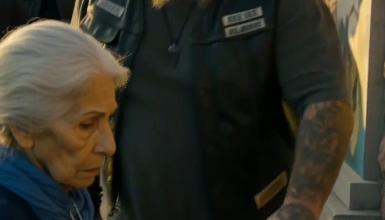
His beard was iron gray. His left eyebrow had a scar through it. His arms were inked from wrist to shoulder: skulls, names, dates, a folded flag, a little girl’s handprint near his right elbow. His hands looked like they could bend a wrench.
But there was one thing that never matched.
A small purple bead bracelet around his wrist.
It looked handmade. Child-sized. Cheap plastic letters spelled L-I-L-Y.
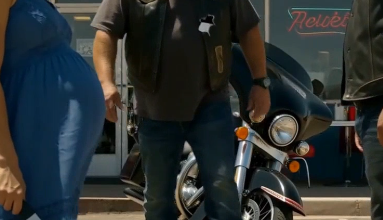
I noticed it the first time he came into the diner where my sister waited tables. He sat in the corner with three other bikers, leather creaking, boots heavy under the table, their Harleys cooling outside with those soft metallic ticks that sound like rain on a tin roof.
A little boy in the next booth dropped his crayons.
Wade reached down, picked them up, and slid them back without saying a word.
The boy stared at his tattoos.
Wade stared back.
Then he picked up the purple crayon and said, “Best color.”
The boy smiled.
That was Wade. Scary until you looked twice.
I learned later that Lily was his brother’s daughter. Six years old. Autistic. Nonverbal most days. She loved purple beads, truck stop pancakes, and sitting on Wade’s Harley when it was turned off because she liked the warm seat but hated the engine.
Wade never said much about her.
But every Saturday morning, he rode twenty-three miles down Route 66 to his sister-in-law’s apartment and watched Lily for four hours so her mother could sleep, clean, cry, or sit in silence without anyone needing her.
He learned her rhythms.
He learned that fluorescent lights could hurt.
He learned that loud music in stores could turn the world into knives.
He learned that some cries weren’t tantrums.
Some were alarms.
And that Thursday at Walmart, Wade heard one.
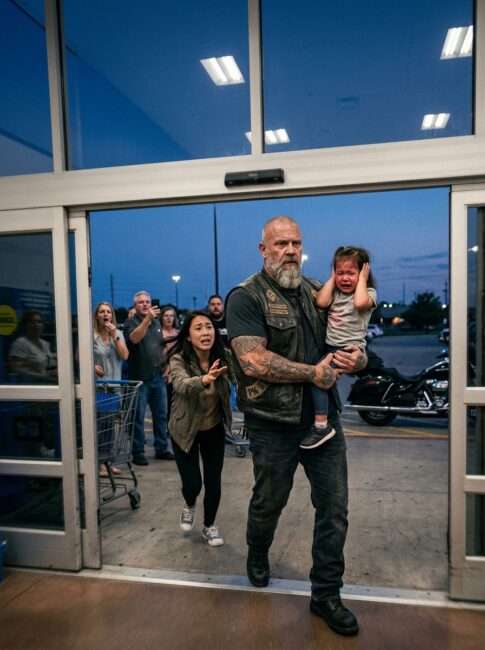
The Walmart on South Memorial Drive was loud that night.
Not normal loud.
Mean loud.
A speaker above seasonal was blasting some pop song with too much bass. Checkout machines beeped. Cart wheels rattled. A baby screamed near groceries. Someone dropped a jar of salsa in aisle seven. The whole building had that hard electric Walmart hum, like the lights themselves were angry.
The little girl was in a shopping cart near self-checkout when it started.
She was tiny. White sneakers. Pink shirt. Dark hair stuck to her wet cheeks. Her hands were clamped over her ears, fingers digging in. Her body stiffened so hard it looked painful.
Her mother, a young Asian American woman in her late 20s, tried everything.
She bent down. Spoke softly. Rocked the cart. Tried to lift her out, then stopped when the girl arched backward and screamed harder. People stared. Some with pity. Some with annoyance. Some with that ugly look people get when they think another person’s emergency is poor parenting.
The mother’s English was broken, and fear made it worse.
“Please, baby. Please. We go. We go,” she kept saying.
But she was trapped between a cart full of groceries, a line of impatient customers, and a child who couldn’t hear comfort through pain.
That was when Wade stepped out of the pharmacy aisle.
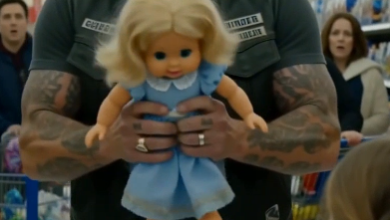
I saw people move away from him without knowing they were moving. His boots hit the tile slow and heavy. His black vest had road dust on the shoulders. The 1%er patch stood out like a warning label. His tattooed hand held a bottle of children’s melatonin and a pack of gum.
He didn’t touch the child.
He didn’t touch the cart.
He crouched beside the mother, making himself smaller, which was almost impossible.
His voice was low.
“Ma’am,” he said, “I know that cry.”
The mother looked at him like she didn’t understand.
He pointed toward the doors.
“Too loud. Too bright. I can take her outside five minutes. Bench right there. You can see us.”
The girl screamed again, sharp and broken.
Wade flinched.
Not from irritation.
From recognition.
He tapped his own ears, then pointed outside.
“Quiet,” he said. “Five minutes.”
The mother’s face was gray with exhaustion. She looked at her daughter. Looked at the doors. Looked at the huge biker crouched in front of her.
She nodded.
Maybe she understood.
Maybe she only understood the word quiet.
Maybe she was so tired that help, even from a frightening stranger, looked like air.
Wade moved carefully. Slow hands. Open palms. No sudden reach. He waited until the little girl leaned forward between screams, then lifted her with the practiced awkwardness of a man who has held a child in meltdown before.
She hit his chest with both fists.
He took it.
She kicked once.
He shifted her legs safely against his hip.
Then he walked.
Fast, but not running.
That was when the mother’s face changed.
She realized what it looked like.
She realized what she had allowed.
And the whole front of Walmart exploded.
“Stop him!”
“Call the police!”
“Sir, put the child down!”
Wade heard all of it.
His jaw tightened.
His eyes went wet, but no tears fell.
He kept walking.
Not away from the store.
Toward the bench.
The deputy who arrived first was a white American woman in her 30s named Harris. Sharp eyes. Brown hair pulled tight. Hand near her radio, not her gun. Smart.
She saw the mother crying.
Saw the crowd pointing.
Saw Wade Mercer holding a sleeping child.
“Sir,” Deputy Harris said, “I need you to stay exactly where you are.”
Wade nodded once.
“Already was.”
His voice was gravel and smoke.
The little girl was asleep against him, one cheek flattened against his dirty leather vest, her small hand tangled in the purple bead bracelet on his wrist.
The mother was sobbing now, trying to explain and apologize at the same time.
“My baby. I say yes. I no understand. I scared. I thought— I thought—”
Wade looked at her.
No anger.
No insult.
Just tired.
“You did right,” he said. “You came after her.”
That shut down half the crowd.
Deputy Harris asked him why he took the child outside.
Wade gave the same answer.
“I know that cry.”
The deputy asked how.
Wade didn’t explain with a speech. Bikers don’t do courtroom speeches in parking lots.
He pulled his phone from his vest pocket.
The leather creaked. The purple bracelet slid against his tattooed wrist.
He opened a photo.
Held it out.
There was a little white American girl in purple headphones sitting on the seat of a parked Harley, smiling at a paper plate full of pancakes. She had the same kind of faraway eyes as the child asleep on Wade’s shoulder. Next to her was Wade, looking twice as big and half as dangerous because the girl had covered his beard in syrup with one small hand.
“My niece,” he said. “Lily. Six. Autistic.”
He looked down at the sleeping girl.
“Same cry.”
Nobody spoke.
Even the people who had been filming lowered their phones a little.
Deputy Harris looked from the photo to the child to the mother.
Then the second twist came.
Mr. Ellis, the Walmart greeter, stepped forward with his hands raised.
“I saw him ask,” he said. “He didn’t snatch that baby. He asked the mama. I saw her nod.”
A cashier joined him.
“I heard him say five minutes,” she said. “He said the bench. He said outside.”
Then a manager came out, pale and sweating, holding a tablet.
“Security footage confirms he spoke to the mother first,” the manager said. “He never ran.”
Wade said nothing.
He just kept tapping the child’s back.
One.
Two.
Three.
Like a metronome against panic.
The mother’s name was Mei Lin Tran.
She had moved to Tulsa from Houston six months earlier after her husband left. Her daughter’s name was Ava. Three years old. Recently diagnosed autistic. Mei worked nights packing medical supplies and spent days trying to learn a system that handed her forms, appointments, acronyms, and judgment.
That night, she had gone to Walmart because Ava needed pull-ups and rice and apple juice, and Mei had only one evening before her shift.
She didn’t know the store had turned the music up for a promotion.
She didn’t know one speaker was broken and buzzing sharp near self-checkout.
She didn’t know Ava had been holding it together for twenty minutes until her body couldn’t hold anymore.
What Wade knew in three seconds, the rest of us misread in one.
That was the ugly part.
We saw a huge biker with a crying child and filled in the blanks with fear.
Mei saw her daughter asleep on his shoulder and filled in the blanks with shame.
She stepped closer to Wade, hands shaking.
“I’m sorry,” she whispered. “I’m so sorry.”
Wade shook his head.
“No.”
Just that.
No.
Then he shifted Ava carefully, supporting her head with a hand that had skulls tattooed across the knuckles. The same hands people feared were the hands keeping that child asleep.
He handed Ava back to Mei like she was made of warm glass.
The girl stirred, whimpered once, then tucked her face into her mother’s neck.
Mei broke.
Not loud. Not dramatic. She folded over her daughter and cried the way exhausted parents cry when somebody finally understands the thing they’ve been trying to explain.
Wade looked away to give her privacy.
That was when Deputy Harris noticed the purple bracelet.
“Lily make that?” she asked.
Wade looked at his wrist.
“Yeah.”
“Your niece?”
He nodded.
“My brother couldn’t handle it,” he said.
That was the third twist. Quiet. Brutal.
Wade’s younger brother had left when Lily was two. Said he wasn’t built for doctors, therapy, screaming, no sleep, no normal. He took off west on I-40 and sent money twice before disappearing completely.
Wade was the one who stayed.
Not because he was gentle by nature.
Because someone had to be.
His club brothers learned, too.
Crow, a Black American biker in his 50s with a white beard and hands like shovel blades, built Lily a wooden rocking chair because motion helped her calm down. Preacher, a Hispanic American biker with neck tattoos and a soft voice, changed the pipes on his bike before visiting because Lily hated the sharp crack of loud exhaust. Dutch, an older white American biker with prison-blue eyes, carried purple ear defenders in his saddlebag.
People called them dangerous.
Maybe they had been.
Maybe some still were.
But they had learned to go quiet for one little girl.
Wade looked toward the Walmart doors, where the broken speaker was still thumping.
“Turn that damn thing down,” he said.
The manager nodded fast.
And for the first time all night, everybody listened to the biker.
The story should have ended in that parking lot.
Police report closed. No charges. Security footage reviewed. Mother and child safe. Biker free to leave.
But some stories don’t end where the panic stops.
They echo.
The next Saturday, Wade rode back to that same Walmart. Not with the whole club. Just him and Crow. Two Harleys rolling in low, engines cut before they reached the entrance so the sound wouldn’t hit the doors too hard.
Wade walked inside carrying a small purple backpack.
People stared again.
Different this time.
Mei was near customer service with Ava in a stroller, waiting to return the groceries she had abandoned that night. Ava wore soft blue headphones and held a stuffed rabbit by one ear.
When she saw Wade, she didn’t smile.
She didn’t speak.
She reached one hand toward the purple bracelet.
Wade crouched.
Slow.
Same way he had in self-checkout.
“Brought you something,” he said.
Inside the backpack were noise-canceling headphones, a laminated card that said “I am autistic and overwhelmed,” a small weighted blanket, and three packs of the apple juice Mei had dropped during the panic.
Mei covered her mouth.
“I cannot pay—”
Wade stood.
“Wasn’t a sale.”
Then he nodded toward Crow.
“Club handled it.”
Crow looked uncomfortable, like kindness was a jacket that didn’t fit right.
“Lily picked the color,” he muttered.
After that, Wade stopped by once a month.
Not to be a hero.
Just to check the speaker volume.
He’d walk in, boots heavy on tile, leather vest creaking, purple bracelet on his wrist, and Mr. Ellis would nod from the door.
“Evening, Tank.”
“Ellis.”
That was the whole conversation.
But the music stayed lower near the front lanes.
Cashiers learned to kill the beeps on one checkout when Ava came in. The manager put a bench outside in the shade. Mei started carrying the purple backpack everywhere.
And every time Wade left, he would sit on his Harley for a second before starting it, like he was listening for something the rest of us missed.
Maybe he was.
Maybe some men spend their whole lives trying not to hear pain.
And some learn the exact sound of it.
Three months later, I saw Wade again at Route 66 Diner.
He was in the corner booth with Lily on one side and Ava on the other. Mei sat across from him, drinking coffee with both hands wrapped around the mug. Crow was at the counter pretending not to watch them.
Lily wore purple headphones.
Ava wore blue ones.
Both girls were dipping fries into ketchup and ignoring everyone.
Wade had syrup in his beard again.
He didn’t know it.
Or he did and didn’t care.
A man walked in, saw the leather vests, saw the tattoos, saw the 1%er patch, and pulled his little boy closer.
I saw Wade notice.
He didn’t react.
He just tore a pancake into small pieces and placed them on Lily’s plate, one by one, patient as a clock.
Outside, the Harleys sat in the morning sun, chrome warm, engines quiet, road dust on the tires.
No thunder.
No show.
Just machines waiting while complicated men did gentle work.
When Wade finally stood to leave, Ava reached for his bracelet.
He let her touch it.
Then he tapped his chest twice, nodded to Mei, and walked out.
His boots hit the diner floor.
The leather creaked.
The bell over the door rang once.
Then the Harley started low.
Not loud.
Just enough.
Follow the page for more biker stories about rough-looking people, hidden kindness, and the moments nobody sees coming.