Everyone Thought the Biker Was Waiting for Trouble—Until the Forgotten Girl on the School Steps Looked Up
“Don’t make her walk home alone,” the biker said, dropping onto the school steps beside a crying child, “because if no one comes, I’m staying.”
The first scream came from a parent across the pickup lane.
By 3:27 p.m. on a windy Thursday in late October, the front entrance of Maple Ridge Elementary in Cedar Grove, Ohio, should have been emptying into routine. Minivans idled in a crooked line beneath yellow maples. Teachers were corralling the last second-graders toward car doors. A crossing guard in a neon vest blew one final whistle at a father rolling through too fast. The air smelled like wet leaves, cold asphalt, and the burnt sweetness of someone’s coffee forgotten in a cupholder.
Then people noticed the motorcycle.
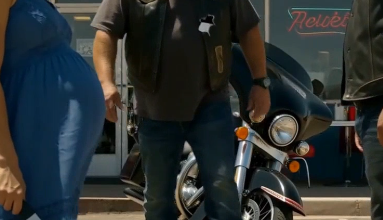
A black Harley had come in low and loud, then cut silent beside the curb just after the late bell. The man riding it was too big for the bright little school entrance, broad in the shoulders, gray threading his beard, tattooed forearms bare beneath a sleeveless leather cut despite the cold. He looked like the kind of trouble schools taught children not to approach. He parked near the handicapped ramp, killed the engine, and kept watching the front steps while every other adult was busy getting somewhere.
At first, nobody paid him much attention.
Then the doors opened again.
A little girl stepped out carrying a glittery purple backpack almost as wide as her back. White cardigan. Pink sneakers. Hair half fallen from two braids. She stood just outside the doors and scanned the pickup lane with that brave, rigid little stillness children use when they’re already scared and trying not to show it.
No one waved.
No one called her name.
The traffic thinned. Minivans pulled away. Teachers disappeared back inside. The girl kept standing there.
And then, before any of the mothers with SUVs or the fathers checking their phones or the office aide locking the side entrance had fully registered what they were seeing, the biker walked straight toward her.
That was when people started moving.
A woman near the curb shouted, “Hey!”
Another parent grabbed her son’s shoulder and pulled him closer. Someone fumbled for a phone. The crossing guard blew her whistle again, this time not for traffic. The biker, without hurrying and without looking at anyone else, climbed the front steps and sat down two feet from the girl like he had every right in the world to be there.
She flinched.
So did half the parents still watching.
He said something to her then—too low for the crowd to catch—and instead of standing up and leaving the way a decent stranger should have, he leaned his elbows on his knees and stayed.
That was how it looked.
A rough-looking biker sitting beside a stranded second-grader on elementary school steps while the adults around them were still figuring out whether they were watching concern or the beginning of a nightmare.
And because fear always writes its own version first, nobody yet asked the question that mattered most.
Why had he been watching that doorway before anyone else noticed she’d been left behind?
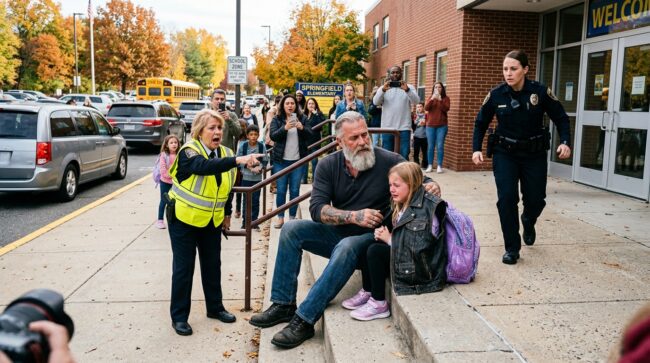
Within two minutes, the scene had turned from uneasy to ugly.
No one at Maple Ridge Elementary needed facts anymore. The image was enough. A little girl alone after school. A biker beside her. No visible parent. No explanation. That was all it took for the crowd to start building a story around him faster than the truth could ever catch up.
“Call the office.”
“I already am.”
“Don’t let him take her anywhere.”
A mother in a tan coat had her phone halfway raised, recording from behind a row of trimmed hedges as if documentation itself could protect the child. A man in scrubs, maybe coming off shift at the county hospital, muttered that security should have been outside already. Two fourth-graders waiting near the bike rack were dragged farther back by an older sister who kept glancing over her shoulder. Every face in the pickup lane wore the same strained uncertainty: if this man meant well, why did he look so wrong for the moment?
The little girl made it worse without meaning to.
She had gone from rigid to quietly crying, the kind of crying children do when they’re trying not to lose control in public. Her small hands were tucked into the straps of her backpack. Her lunchbox sat beside one pink sneaker. She kept looking toward the road and then down at the concrete as if maybe, if she stared long enough, the right car would appear.
The biker didn’t touch her.
He didn’t crowd her.
But he didn’t leave, either.
That unsettled everyone.
He stayed seated beside her, not too close, not far enough away to make people comfortable. His expression was hard to read under the beard and the weathered lines of his face. Late fifties, maybe. White. Scar near one eyebrow. Heavy boots planted square on the step below. The leather cut across his shoulders was sun-faded and worn at the seams, with a small American flag patch on one side and no loud club name visible from where anyone stood. He seemed disciplined in the way some men were—still, economical, difficult to rattle. In that moment, it only made him look more dangerous.
The crossing guard marched toward the steps with the rigid courage of someone who knew she was frightened and resented it.
“Sir,” she called out. “You need to move away from that child.”
The biker looked up at her once.
The look wasn’t aggressive. That was almost worse. It was too calm.
“She’s waiting,” he said.
The girl wiped her face with the sleeve of her cardigan.
The crossing guard took another step. “And you need to wait somewhere else.”
He glanced toward the pickup lane, where only three cars remained. “No.”
The word landed hard.
A collective ripple passed through the parents. Someone actually gasped. The mother recording zoomed in. A teacher’s aide appeared in the doorway, spotted the scene, and disappeared back inside so quickly it was obvious she was calling for someone higher up.
Then the little girl spoke in a voice so small the nearest adults had to strain to hear it.
“My grandma was supposed to come.”
That changed the air.
Not enough to help him. Just enough to deepen the tension.
A forgotten child was one thing. A forgotten child saying it out loud while a stranger sat beside her was something worse. A few parents turned their anger toward the school now. Others doubled down on the biker.
“How long has he been there?”
“Did he follow her?”
“Why is he talking to her?”
The biker answered none of it.
Instead, he did something that made the whole pickup lane jolt.
He took off his leather cut and draped it over the little girl’s shoulders.
Several people shouted at once.
The crossing guard backed up half a step, then got angry at herself for it and blew her whistle directly toward the office doors. The little girl looked swallowed by the oversized vest, blinking in surprise as it slid down nearly to her knees. The biker adjusted it once, carefully, with two fingers to the collar only, then sat back down.
The action was gentle.
It looked terrible.
Because now, to a crowd already primed for the worst, he was not just sitting beside her—he had wrapped her in his clothing. The mother with the phone said, “Oh my God,” like she had just captured proof of something. The man in scrubs started toward the steps. Somewhere behind him, a child began crying because adults always passed fear downhill.
Then the assistant principal hurried out through the front doors.
Mrs. Bell was in her sixties, sharp-faced, efficient, one of those women who kept a school stitched together with posture alone. She took in the biker, the child, the crowd, the recording phones, and the whistle-blowing crossing guard in one sweep. Then she locked onto the little girl.
“Maddie?”
The child looked up.
So now the crowd had her name.
Mrs. Bell started down the steps and stopped when the biker rose too.
It wasn’t a violent movement. It was simply sudden, large, and enough to trigger the exact reaction everyone had been bracing for. The man in scrubs lunged forward. A father near the minivans shouted, “Back off!” The crossing guard yelled for someone to call the police if they hadn’t already. For one hot, stupid second, the whole school entrance felt one wrong gesture away from disaster.
The biker stood between the child and the adults.
Not close. Not threatening. Just there.
And with the wind lifting dead leaves around the steps and the school office lights coming on behind the glass doors, he reached into the inside pocket of his cut.
That was the moment the shouting really began.
By the time the patrol car pulled into the pickup lane, the story had already turned against him.
Parents had decided he was unstable or suspicious or one of those men who enjoyed forcing other people to react. The crossing guard was near tears from the strain of holding her ground. Mrs. Bell had Maddie half behind her now, though the oversized leather cut still hung around the little girl’s shoulders like evidence no one knew how to interpret. The man in scrubs stood at the bottom of the stairs with his jaw clenched and fists opening and closing, ready to do something noble and stupid.
And the biker still hadn’t explained a thing.
Officer Jen Morales arrived first, door barely shut before she was moving. Mid-thirties. Hispanic. Winter uniform jacket zipped high. Hair pulled back so tight it made her expression look sharper than it probably was. She came up fast with one hand lifted and the other near her radio, reading the scene the way cops do when all the witnesses are loud and none of them are useful.
“What do we have?”
Too many people answered at once.
“He approached her.”
“He won’t leave.”
“He put his jacket on the girl.”
“No one knows who he is.”
Officer Morales raised her voice just enough. “Everyone quiet.”
The biker complied before anyone else did.
That did not help him.
He stood on the second step, big and silent, his leather cut now off his body and around the child’s shoulders, making his thermal shirt and tattooed arms even more visible. Without the vest, he looked rougher somehow, as though stripping off one layer had made him more immediate. A faded scar crossed one forearm. Another disappeared beneath his sleeve. His face was unreadable, but not blank. Controlled. The kind of control frightened people when they’d already decided to distrust the man holding it.
Officer Morales turned to Mrs. Bell. “Child’s name?”
“Maddie Pierce. Second grade. Pick-up error, apparently.”
“Apparently?” Morales repeated.
Mrs. Bell straightened. “Her grandmother hasn’t arrived. We were just handling it.”
The biker gave the smallest shift of his jaw, nothing more.
Officer Morales noticed. “Sir, you want to tell me why you’re involved?”
He looked at Maddie, then back at the officer.
“She was alone.”
It was such a simple answer that it made everyone angrier.
A father by the curb snapped, “That doesn’t give you the right to sit next to her.”
The biker ignored him.
Morales tried again. “Name?”
He hesitated just long enough for the crowd to feel vindicated.
Then: “Wes.”
“Last name.”
A pause. “Halpern.”
“Relationship to the child?”
“None.”
That landed exactly as badly as it should have.
The murmuring surged again. No connection. No reason to be there. No explanation that sounded normal enough to calm anyone down. Maddie, still inside the biker’s oversized cut, stared up at him and then at the officer as if she sensed the adults were missing something but didn’t know what.
Morales gestured with two fingers. “Step away from the stairs.”
Wes didn’t move.
The officer’s voice flattened. “Now.”
He did something then that sent the whole pickup lane back into panic.
Instead of stepping away, he turned, stooped, and picked up Maddie’s glittery purple lunchbox from beside her sneaker.
Several parents shouted at once.
“Don’t touch her stuff!”
“Oh, come on!”
The man in scrubs started up the first step, and Morales threw an arm out to stop him without taking her eyes off Wes. Mrs. Bell pulled Maddie closer. The child’s lip trembled again, but she wasn’t looking frightened now. She was looking confused, which in some ways was worse.
Wes held the lunchbox in one hand and opened the inside pocket of his cut with the other. The motion made the air itself feel thinner. Phones rose higher. Somebody near the street said, “This is insane.” The second patrol car arrived at the curb but no one noticed; all attention had narrowed to the man on the steps and the child’s bright little lunchbox in his hand.
Officer Morales’ tone changed. “Sir, stop reaching.”
He stopped.
Then, very carefully, he pulled a folded slip of paper from the cut’s inner pocket and slid it out two fingers at a time.
No one breathed.
He unfolded it once and looked at Maddie.
The girl went very still.
Whatever he was holding was not random. That much became obvious in the way her face changed. Not recognition exactly. More like the sudden stillness of a child who has just seen something adults were not supposed to know about.
Mrs. Bell noticed it too. “Maddie?”
The girl’s eyes filled again.
Wes crouched—not touching her, not even close—and held the paper low enough that only she could clearly see it.
“Is this yours?” he asked.
The whole front of Maple Ridge Elementary seemed to freeze on the question.
Because for the first time since he’d appeared, the biker’s voice held something the crowd had not expected: not menace, not defiance, but a rough, careful patience, as if he had been holding that tone back all along.
Maddie looked at the paper. Then at him.
And whispered, “Where did you get that?”
The officer heard it.
So did Mrs. Bell.
So did the nearest parents, who now found themselves leaning in not with outrage but with a more dangerous feeling—doubt.
Wes didn’t answer the girl.
Instead he looked up at Officer Morales and said, in that same level voice, “Before anybody takes that coat off her, maybe someone should call the number written on the back.”
The silence that followed felt bigger than the whole pickup lane.
Because whatever was on that paper—
whatever name or number or secret it carried—
had already changed Maddie’s face.
And in the sharp autumn wind, with two patrol cars at the curb, phones recording from every angle, and half the school still certain they were one second away from seeing this biker dragged off those steps, Officer Morales reached for the paper at the exact same moment Maddie blurted one trembling word.
“Wait.”
Everything stopped on that one word.
Not the wind. Not the phones still recording. Not the second patrol car idling near the curb with its headlights washing over the pickup lane. But the human noise stopped. The judgments, the shouting, the eager certainty that had been bouncing from parent to parent since 3:27 p.m. all snapped off at once.
Maddie’s voice had done that.
She stood on the top step of Maple Ridge Elementary with the biker’s cut hanging around her tiny shoulders and tears drying unevenly on her cheeks, staring at the folded slip of paper in Wes Halpern’s hand as if it had no right to exist in public.
Officer Morales lowered her hand only slightly. “Maddie,” she said, gentler now, “do you know what that is?”
The girl nodded before seeming to realize she had. Then she pressed her lips together, frightened not of Wes anymore, but of the adults who had suddenly turned toward her with all their questions.
Mrs. Bell crouched beside her. “Sweetheart?”
Maddie looked down. “It was in my lunchbox.”
The crowd shifted.
A strange, uncertain ripple moved through the parents on the curb. The mother who had been recording let her phone dip an inch. The man in scrubs stepped back without admitting he was doing it. Even the crossing guard, whistle still looped around one wrist like a badge of alarm, looked less ready to charge and more ready to understand.
Officer Morales extended her hand to Wes. “Let me see it.”
He gave it to her without argument.
That, more than anything so far, changed the atmosphere. A man truly looking for a scene would have hesitated. He didn’t. He handed the paper over as if it had never belonged to him in the first place.
Morales unfolded it once, then turned it over.
Her expression altered so subtly only a few people caught it. Not fear. Recognition of weight. On the front was a child’s drawing in purple crayon: a lopsided house, a stick-figure girl in a pink dress, a taller figure with yellow hair, and a dark motorcycle off to one side under a sky full of badly drawn stars. On the back, written in blue pen in an adult’s careful hand, was a phone number and one line:
If Maddie is still waiting after 3:15, please don’t let her walk. She won’t tell you she’s scared.
Morales read it twice.
Then she looked at Maddie. “Who wrote this?”
Maddie swallowed. The answer seemed too private for the crowd now listening to every syllable. “My mom.”
The silence deepened.
Mrs. Bell looked stricken. “Why was that in your lunchbox?”
Maddie kept her eyes on the concrete. “Because Grandma forgets things now.”
It came out quietly. Matter-of-factly. The kind of sentence a seven-year-old only speaks that way when she has had to say it in her own head too many times.
The man in scrubs lowered his arms. The crossing guard stopped gripping the whistle. A woman near the bike rack actually whispered, “Oh no.”
Maddie went on in the same small voice. “Mom says if Grandma’s late, I should wait by the doors and not go with anybody.” She glanced up once, straight at Morales. “But nobody came.”
Mrs. Bell’s face tightened with the kind of guilt administrators carried differently than parents. “Why didn’t you say something to the office?”
“I did,” Maddie said.
That sentence landed harder than it should have.
Mrs. Bell blinked. “You what?”
“I told the lady at the front window Grandma wasn’t here yet. She said to wait on the steps because pickup was busy.”
The office doors behind them felt suddenly too bright.
Morales stood very still for a moment, then looked at Mrs. Bell, whose composed school-day face had cracked in one place only: around the eyes. Somewhere in the crowd, a parent muttered something sharp about negligence. The crowd, always hungry for a villain, began turning toward the school with uncomfortable speed.
Wes did not help them.
He said nothing.
He stood a few feet away, bare-armed in the October cold, broad and still and road-worn, looking no more interested in the shifting blame than he had been in defending himself. Yet the entire pickup lane now seemed arranged around him differently. The threatening shape remained. Big man. Scar. Tattoos. Heavy boots. But the meaning was slipping.
Morales turned back to him. “Where did you find the note?”
He nodded toward the lunchbox. “It fell out when she dropped it.”
Maddie looked at the lunchbox in his hand and gave the tiniest nod. Confirmation. Quiet, but enough.
“And you read it?”
“I read the number.”
“Why?”
A beat. Then: “Because she was still alone.”
No speech. No self-justification. Just the same answer again, somehow heavier now that people finally had context.
Mrs. Bell rose too quickly and pressed a hand to her chest. “I need to call her mother.”
Morales already had her phone out. “I’ll do it.”
She dialed the number on the note and turned slightly away. Everyone watched her face instead of the phone, because faces told the truth faster. It rang once. Twice. Three times.
Then someone answered.
Morales listened.
The expression that crossed her features was not simple concern. It was the specific look of a person stepping into a crisis that had already been in motion before she arrived.
“Yes, ma’am,” she said. “This is Officer Jen Morales with Cedar Grove Police. Your daughter is safe.”
Maddie closed her eyes.
For one suspended second, the little girl looked not relieved but exhausted.
Morales listened again, then glanced at Maddie, then farther past her—to Wes.
“What hospital?” she asked.
That question went through the crowd like current.
Maddie’s head lifted.
Morales listened another few seconds, then said, “Stay where you are. We’ll figure the rest out.”
She hung up.
No one asked immediately. Even the parents had enough decency left to feel that the answer might hurt.
Morales crouched in front of Maddie. “Your mom’s at St. Anne’s with your grandma.”
The child didn’t cry. That was the worst part. She just nodded like she had expected complications all along.
“They had an episode in the parking lot,” Morales continued carefully. “She tried calling the school twice.”
Mrs. Bell went pale.
“And no one picked up,” Morales finished.
The wind lifted a scatter of leaves against the bottom step.
Wes looked at the school doors, then away.
No accusation. No triumph.
Just that.
By 3:46 p.m., the story had begun to reverse, but not cleanly.
Crowds never liked admitting they had been wrong, especially not in public. So people did what people always did—they turned their energy sideways. A few became suddenly concerned about school procedures. Others blamed understaffing, front-office confusion, elder care, the whole collapsing machinery of ordinary life. Some quietly put their phones away. Some didn’t. The mother who had been recording the longest kept glancing at Wes as if trying to decide whether deleting the video would feel like honesty or defeat.
Maddie was still wearing his cut.
Morales asked if she wanted to keep it on until her mother arrived. Maddie nodded once and pulled the collar tighter around her neck. It swallowed her almost completely. The black leather had likely frightened half the pickup lane twenty minutes earlier. Now it looked less like menace than shelter.
Mrs. Bell had retreated into apology. She kept saying things in fragments—“We thought—” and “The office was short today—” and “I didn’t realize—” but none of it settled anywhere. Maddie wasn’t listening to her. Maddie was looking at Wes with the wary concentration children used when they sensed adults had misnamed someone in front of them.
Officer Morales noticed too.
She came over to Wes while the second officer, a broad-shouldered man named Decker, took a few statements from the crossing guard and the parents who had called 911. “You could’ve walked into the office,” she said.
Wes’s eyes stayed on the steps. “I know.”
“Instead you sat outside with a child while half a school thought you were a threat.”
He gave the smallest shrug. “Office already missed her.”
Morales let that sit.
It was hard to argue with, and harder still because he hadn’t said it to embarrass anybody. Just as fact. Just as the reason he had chosen visibility over paperwork, proximity over protocol. A forgotten child on public steps might be judged. A forgotten child inside a busy office could disappear in a cleaner way.
“Why were you here at all?” Morales asked after a moment.
He looked toward the far side of the lot where the last of the buses had gone. “Waiting on someone.”
“For pickup?”
“No.”
That was all he offered. Same discipline. Same refusal to decorate his own motives.
Morales sighed lightly. “You always this conversational?”
A faint movement touched the corner of his mouth. Not quite a smile. “Mostly.”
It was the first hint of humor anyone had seen from him, and it startled her enough that she almost missed Maddie speaking.
“You knew my mom’s handwriting.”
Both adults turned.
Maddie had stepped down one stair, still wrapped in the oversized cut, her glittery lunchbox hanging from two fingers now. The question hung there with odd force. Children often heard the right detail before adults did.
Wes looked at her for a long second.
Then he said, “I knew the way she writes capital M’s.”
Morales went still.
Mrs. Bell, overhearing from three feet away, stopped apologizing mid-sentence.
Maddie frowned the way children did when they were assembling a shape from pieces no adult had intended to lay out in front of them. “You know my mom?”
Wes’s jaw shifted once.
“Used to.”
That was not enough for anybody, least of all Maddie. But it was enough to tilt the whole scene again. A parent relationship? An old connection? Something from before? The crowd, though thinner now, felt it. The curiosity came back, only sharper because it had been embarrassed once already.
Morales stepped in. “How used to?”
Wes didn’t answer immediately. His eyes moved to the edge of the school building, to the patch of brick near the side entrance where the afternoon sun was catching faded paint. When he finally spoke, the words sounded like they had come through several locked doors.
“She used to wait on these same steps.”
Maddie blinked.
“What?”
“Not after school,” he said. “Before. Sixth grade. Winter mornings. She’d get dropped off forty minutes early because your grandpa worked county road crew and your grandma was already forgetting then.”
Morales watched him carefully now. Not suspicious anymore. Something else. She was hearing an old local map unfold in front of her.
“You grew up here?” she asked.
He nodded once.
Mrs. Bell, who had worked at Maple Ridge for nearly thirty years, stared at him with a dawning, unsettled concentration. “What did you say your last name was?”
“Halpern.”
Her breath caught—not dramatically, not enough for the crowd, just enough for people standing close to hear it.
“Oh,” she said.
Maddie looked from one adult to the other. “What?”
Mrs. Bell hesitated. That hesitation was answer enough: she knew something.
Wes looked like he wished she didn’t.
The second officer came over then, saving no one and delaying nothing. “Dispatch got the mother’s ETA,” Decker said. “Fifteen minutes from St. Anne’s if traffic stays clear.”
Maddie held her lunchbox tighter. “Is Grandma okay?”
Morales crouched again. “Your mom says she’s stable.”
The child nodded. One small nod. Brave because there was nothing else to be.
Wes said nothing.
But he sat back down on the steps.
That simple act re-centered the scene. Not to provoke. Not to guard. Just to wait. The way he had waited before anybody noticed the child alone. The way he intended to wait until someone truly responsible reached her.
Maddie, after a pause that every adult on those steps felt, sat down two feet away again.
No one objected this time.
A gust of wind came through the pickup lane, cold enough to sting. Maddie tucked her hands deeper into the cut. The crowd had thinned to a few parents, the crossing guard, the two officers, and Mrs. Bell with her unresolved expression. The school doors reflected the entire scene back in faint ghosted shapes.
Then Maddie asked the question no adult there could stop.
“Did you know my dad too?”
The stillness that followed was total.
Wes kept his eyes on the parking lot.
And said, very quietly, “Yeah.”
Maddie’s father had been dead for three years.
Officer Morales didn’t know that from personal memory, but Mrs. Bell did, and the look that crossed the older woman’s face confirmed it before anyone spoke. Cedar Grove was small enough that tragedies lingered in people who handled rosters and lunch accounts and release forms. A widow. A little girl. Grandmother in decline. They became part of institutional memory even when the town pretended otherwise.
Maddie, too young to recognize how loaded her own question was, pressed on.
“My mom doesn’t talk about him much.”
Wes nodded once.
“That sounds right.”
Morales folded her arms. “Mr. Halpern, I think you need to tell us how you know this family.”
He stared across the pickup lane a moment longer, as if measuring whether the story still belonged to him. Then he leaned forward, elbows on knees, hands clasped lightly between them. The posture made him look less like a threat and more like a man returning to a place he had once avoided for years.
“Your dad was named Ryan Pierce,” he said to Maddie. “He was sixteen when I met him.”
The girl’s face changed at the sound of her father’s full name. Children always noticed when adults used the dead in complete sentences.
Wes continued in the same low, even tone. “He got jumped outside a gas station on Warren Road one winter. Wrong crowd, wrong hour, too much pride. Broke two fingers trying not to fall right. I was coming off shift. Saw it happen.”
Mrs. Bell closed her eyes briefly, as if something old had just slotted into place.
“I drove him to urgent care,” Wes said. “He lied about being fine the whole way.”
Maddie listened without blinking.
“After that,” Wes said, “he kept showing up where I worked. Shop on Mercer Street. Asked dumb questions about carburetors because he didn’t know how to ask the real ones.”
A tiny sound escaped Mrs. Bell. Recognition, now complete.
“You were Wesley Halpern,” she said. “Nina’s brother.”
Wes looked at her. “Yeah.”
The name meant nothing to Maddie, but it changed everything for the adults.
Because Nina Halpern had not been a random local detail. Twenty-two years earlier, she had been the high school senior who died on an icy road five days before Christmas when a drunk driver crossed the center line on County 14. Half of Cedar Grove had gone to the funeral. The rest had talked about it for a decade. Her younger brother—quiet, hard-faced Wesley—had left town not long after. People said he got rough. That he rode with clubs. That he never really came back.
Mrs. Bell had been a teacher then.
Officer Morales, younger and not from Cedar Grove originally, looked between them. “What does that have to do with Ryan Pierce?”
Wes’s answer came without flourish.
“Ryan was driving.”
The pickup lane seemed to hollow out around the words.
Maddie stared.
Mrs. Bell put a hand to her throat.
“He was seventeen,” Wes said. “Had a permit. Nina offered to let him practice on the back roads because he was scared of traffic. Ice hit before either of them saw it. She died before the ambulance got there.” He paused. “He lived.”
Nobody moved. Even Decker, who had been half-turned toward his radio, looked fully back now.
Maddie whispered, “My dad…?”
Wes nodded once.
Morales exhaled slowly. The situation had just widened beyond school neglect, beyond a forgotten pickup, into the kind of buried town history that sat under families for years like a sinkhole.
“He blamed himself,” Wes said. “Everybody said it wasn’t his fault. That’s what you say when a kid survives something and you don’t know what else to hand him.” His gaze stayed on the school lot. “Didn’t matter. He blamed himself anyway.”
Maddie’s grip on the lunchbox tightened.
“Why did you help him?” she asked.
That question struck deeper than the others.
Wes took longer answering it. “Because hating him was easy. For a while, that’s all I did.” The wind pushed a strand of Maddie’s braid loose across her cheek; he didn’t reach for it, didn’t move. “Then one day he showed up at my shop with a box.”
He looked down at his hands now.
“Inside was Nina’s cassette player. He’d kept it clean for years. Said he couldn’t keep carrying something that belonged to a dead girl and still believe he was allowed to live.” Wes’s jaw hardened once. “He was shaking so bad he dropped it on my floor.”
Mrs. Bell was openly crying now, quietly and with obvious embarrassment about it.
“I should’ve thrown him out,” Wes said. “Instead I made coffee.”
There it was: the reveal, simple and devastating in its ordinariness. No speech. No cinematic forgiveness. Coffee in a repair shop. A boy who had carried guilt until it bent him. A brother who had every right to despise him and had chosen, for reasons even he may not have fully understood at the time, not to.
Maddie’s eyes filled again.
“So you were friends?”
Wes gave the faintest shake of his head. “Not at first.”
The almost-smile touched his face and disappeared. “Then yeah.”
Officer Morales looked at the little girl in the leather cut, at Wes on the steps, at the school building behind them that had nearly let this child slip quietly into harm while everyone watched the wrong threat.
“And your mom?” she asked.
Wes answered without looking up. “Met her because Ryan wouldn’t stop dragging me into church basements and community dinners after he got his life straight.” He paused. “She married him anyway.”
The words should have been lighter than they were. Instead they carried all the years between a crash, a friendship, a marriage, and a death.
Maddie’s face had gone very still now in that older-than-her-age way children’s faces sometimes did when they realized their parents had entire histories before them, unfinished and aching.
Then she asked the question nobody was ready for.
“If you knew my dad… why didn’t you come before?”
Wes looked at her.
And for the first time since anyone had seen him, his control seemed to cost him something visible.
“Because your dad asked me not to,” he said.
Her mother arrived at 4:03 p.m.
By then the pickup lane was nearly empty. The buses were long gone. The crossing guard had stopped pretending to direct traffic and was now standing off to one side with the humbled look of someone replaying every assumption in order. Mrs. Bell had made three calls from inside the office and come back out looking ten years older. Officer Decker was finishing paperwork against the hood of his cruiser. The mother with the phone had finally slipped it into her bag.
A silver Honda turned into the lane too fast, braked hard by the curb, and Maddie was already on her feet before the engine stopped.
Her mother—Claire Pierce, thirty-four, pale with hospital fluorescent light still on her face, hair half-fallen from a hurried clip—ran from the car without even closing the door. Maddie hit her like a released breath. For a second the woman nearly lost balance on the curb, then held on with both arms and all the force left in her.
“I’m sorry,” she kept saying into the child’s hair. “I’m so sorry.”
Maddie cried then. Not the careful crying from before. The real kind. Safe crying. Shoulder-shaking, relieved, furious, exhausted. Claire held her and looked over the top of her daughter’s head toward the steps.
Toward Wes.
The look that passed between them carried too much history to be mistaken for surprise alone.
“You stayed,” she said.
Wes rose, slower than before, as if standing in front of her required a different kind of effort than facing a crowd or two patrol cars. “Yeah.”
Claire saw the cut still around Maddie’s shoulders. Saw the officers. Mrs. Bell. The shrinking crowd. The afterimage of panic all over the place. Then she looked back at Wes with eyes gone bright from too much strain in too few hours.
“I told Ryan not to write that note,” she said softly.
Morales, hearing that, turned slightly but said nothing.
Wes glanced at Maddie. “She kept it.”
Claire gave one tired, broken laugh. “She keeps everything.”
There was no dramatic reveal left now, only the final twist settling where it hurt most.
Ryan Pierce had died three years earlier not in some grand sacrifice, not in a melodramatic accident, but in the blunt unfairness of an interstate wreck on black ice outside Columbus, driving home from a warehouse shift two days before Christmas. Before he died, he had written one instruction and made Claire promise, if things ever became unsteady with her mother’s memory, to tuck his old emergency note into Maddie’s lunchbox. He had added one more line beneath the phone number, Claire admitted later, then crossed it out because it sounded foolish.
If Wes ever sees her alone, he’ll know what to do.
He had known that because once, years ago, after Nina died and before the town forgave him and long before he forgave himself, Ryan Pierce had been a forgotten boy too—sitting outside a locked auto shop after dark in freezing weather because he was too ashamed to go home. Wesley Halpern had found him there and sat beside him on the step until morning without saying much at all.
The same step. The same waiting. The same kind of silence.
Ryan had never told Maddie that whole story. Maybe he planned to when she was older. Maybe he assumed there would be time.
There wasn’t.
Claire looked from her daughter to Wes and seemed to understand that the town, the school, the police, and half the pickup lane had all just watched an old promise reach across years and land exactly where it was needed.
Mrs. Bell started apologizing again, properly this time. Not for appearances. For failing the child. Claire listened just long enough to nod once and say, “Tomorrow. Not in front of her.”
That ended that.
Officer Morales stepped back. Decker closed his notebook. The second patrol car pulled away first, then the first. The remaining parents drifted off in embarrassed pairs, suddenly aware of grocery lists and younger children and the hour. The crossing guard crossed herself once when she thought nobody saw.
Maddie, still hugging her mother with one arm, turned to Wes. “Are you taking your coat back?”
The question was so childlike it almost broke the whole scene open again.
Wes shook his head. “You can bring it back when your mom says.”
Claire looked at him then, properly. At the graying beard, the scar, the tattooed arms gone red from cold, the same hard outline the town had mistrusted on sight. Her eyes filled, but she didn’t cry. Not here.
“Come by Sunday,” she said. “If you want.”
He considered that as if it were a mechanical part he wasn’t sure he remembered how to fit.
Then he nodded once.
No promises bigger than that.
Maddie stepped toward him, lunchbox bumping against her knee. Every adult on the curb held still. The child who had spent twenty minutes on school steps watched by suspicion and panic lifted one small hand and offered him the folded drawing.
He didn’t take it right away.
“You keep it,” he said.
“It’s for the motorcycle,” she replied, as though this were obvious.
Something changed in his face then. Not enough for anyone who didn’t know to name it. Enough.
He took the paper carefully, folding it once along a crease it already knew.
Then, with the last wind of October moving leaves along the curb and the school windows reflecting the thinning gold of late afternoon, Wes Halpern bent, picked up Maddie’s glittery lunchbox, and handed it back to her like it weighed something far more serious than plastic and an apple core.
No speech followed. No lesson. No applause from the town that had nearly made him the villain because it was easier than facing its own failures.
He just walked down the steps, put his cut back on, and headed toward the black Harley waiting by the curb.
At the bike, he stopped once and looked back.
Maddie stood between her mother and the school doors, one hand holding the lunchbox, the other clutching the front edges of the oversized leather cut around herself like armor she hadn’t asked for but somehow understood.
Wes gave the smallest nod.
Then he started the engine.
And as the motorcycle rolled away through the cold Ohio light, Claire rested her hand on her daughter’s head, Maddie looked down at the note tucked safely back inside the lunchbox, and the front steps of Maple Ridge Elementary—ordinary, concrete, forgettable—held the quiet weight of two children, years apart, who had once been left waiting there longer than they should have been.
Some promises, it turned out, did not get louder with time.
They only got older.
And kept showing up anyway.