Part 2: Four Bikers Stood at My Door — Then My Son Asked Why Nobody Threw a Punch
My name is Rachel Mercer.
For most of the four years I was married to Travis, I became very good at making ordinary things look ordinary.
A cracked cabinet door became a hinge problem.
A bruise near my wrist became a clumsy moment with a laundry basket.
Noah’s sudden silence at school became a difficult adjustment after moving to a new town.
We lived in a tired white rental house near Route 66, not far from a gas station with buzzing fluorescent lights and a diner that closed at ten. Trucks rolled past at all hours. The windows trembled slightly when the larger ones hit the uneven stretch of road near the intersection.
That sound helped me lie to myself.
Whenever something rattled in the house, I could pretend it came from outside.
Travis did not begin as a monster. That would have been easier to understand. He began as a man who apologized. Then he became a man who apologized less often. Then he became a man who explained why every bad thing was somebody else’s fault.
I learned to measure the evenings by sounds.
The scrape of his key against the lock.
The heavy drop of his boots beside the couch.
The refrigerator door opening.
The first cabinet closing too hard.
Noah learned the sounds before I admitted that he had.
The knife changed everything.
It was not a large knife. It was an old folding pocketknife Travis kept in the inner pocket of his work jacket. The handle was dark wood, worn smooth at the corners. Noah found it while looking for a charger.
He hid it beneath the loose floorboard inside his closet.
I did not know until Travis came home asking where it was.
Noah lied.
Badly.
Travis saw through him.
What happened next lasted less than a minute. That is the strange thing about moments that split your life in two. They do not always announce themselves with a long buildup.
I heard Noah cry out.
I stepped between them.
I saw my son’s face.
And something in me stopped negotiating.
I took Noah into the bathroom and locked the door. My hands shook so badly that I dropped my phone twice. I called the domestic violence hotline number I had saved six months earlier under the name “Dental Office.”
The advocate kept her voice calm.
She asked whether we were safe behind the door.
She asked whether there were weapons in the house.
She asked whether I wanted law enforcement.
Then she asked whether Noah had ever spoken to anyone from the local child-advocacy biker chapter.
I had seen their motorcycles once outside the courthouse in Laclede County. Black touring Harleys. Leather cuts. Thick boots on concrete. Men and women who looked like they belonged at the edge of a road nobody stopped on after dark.
I almost said no.
Then Noah pressed both palms over his ears when Travis started yelling outside the bathroom.
I said yes.
The advocate told me deputies were on their way. She helped me request an emergency protective order. She stayed on the line while I packed Noah’s inhaler, his school folder, two shirts, and the stuffed dog he still pretended not to need.
The bikers were not there to make arrests.
They were not there to punish anybody.
They came because Noah was afraid to walk out of the bathroom.
Their engines reached us before the knock did.
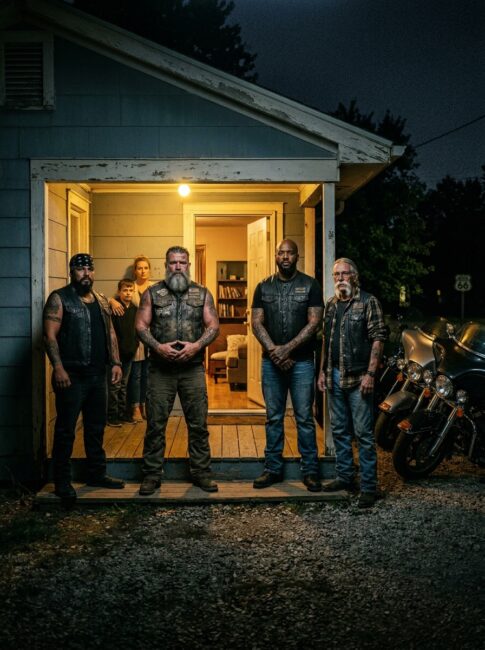
Four V-twins turned onto our street one after another, deep and uneven, then dropped into silence in the driveway. A few seconds later, heavy boots crossed the porch.
Travis stopped yelling.
For the first time that night, the house became quiet.
The knock was not loud.
Three firm taps.
That was all.
Travis stood in the hallway outside the bathroom with his shoulders raised and both fists tight. I watched his boots through the narrow gap beneath the door.
“Who is it?” he shouted.
A voice answered from the porch.
“Bear.”
Nothing else.
Travis walked away from the bathroom. I heard the deadbolt turn.
Through the small bathroom window, I could see part of the driveway. Four motorcycles stood beneath the yellow porch light. Their chrome caught thin pieces of reflection. Heat shimmered above the pipes.
The men remained on the porch.
Bear stood in front.
Behind him was Deacon, a lean white man in his sixties with a white mustache and a knee brace visible beneath worn denim. To his left stood Rome, a broad Black man around forty with a shaved head, a gray goatee, and tattooed hands folded loosely in front of him. The fourth was Luis, a stocky Latino man in his late thirties with a black bandanna, heavy boots, and the tired eyes of somebody who had driven all night.
They were frightening to look at.
That was true.
But they were also strangely still.
Nobody paced.
Nobody swore.
Nobody made a fist.
Travis opened the door halfway.
“What do you want?”
Bear looked past him, not into the house exactly, but toward the hallway.
“We are here for Rachel and the boy.”
“This is my house.”
Bear’s expression did not change.
“Deputies are on the way.”
Travis turned his head slightly.
Maybe he heard something in Bear’s voice. Maybe he saw the truth in the way the other three men stood behind him: no excitement, no hunger for a fight, no need to prove anything.
Just a wall.
Travis pushed the door wider.
“You think you scare me?”
Bear did not answer immediately.
Leather shifted across his shoulders when he took one slow breath.
Then he said it.
“You have two choices. You leave, or you leave.”
For one terrible second, I thought Travis would swing.
I knew the shape of his anger. I knew the twitch at the side of his jaw. I knew the small rocking movement in his shoulders when he was deciding whether humiliation hurt more than consequences frightened him.
Bear knew it too.
He did not step forward.
He did not smile.
He did not lift his hands.
The other bikers stayed exactly where they were.
Travis looked at them one by one.
Deacon with his tired knee.
Rome with his folded hands.
Luis with rain spots drying across the shoulders of his cut.
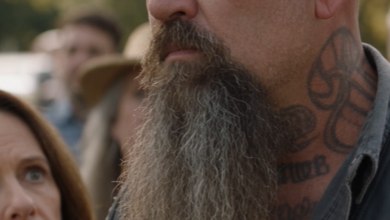
Bear with that thick gray beard and those scarred knuckles resting open at his sides.
Then Travis looked into the living room.
Noah and I had opened the bathroom door.
My son stood behind me, but not hidden.
That mattered.
Travis looked at him.
Noah did not lower his eyes.
The sound that followed was small.
A jacket zipper.
Travis grabbed his coat from the chair. His keys jingled in his hand. He stepped outside, and the four bikers separated just enough to let him through.
Nobody touched him.
Nobody spoke.
The car started.
The tires rolled over loose gravel at the edge of the driveway.
Then he was gone.
A deputy’s cruiser arrived less than two minutes later.
By then, my son was already on the porch asking Bear why he had not thrown a punch.
I thought that was the ending.
It was not even close.
The deputies took statements.
The advocate helped Noah and me leave the house safely that night. We stayed with my sister in Springfield while the court handled the next steps.
Travis was served with the protective order.
The knife stayed beneath the closet floorboard until a deputy collected it.
For the first week, Noah asked the same question in different ways.
“Did the motorcycle guys know he would leave?”
“Were they scared?”
“What if he came back?”
“What if Bear had hit him just once?”
I answered as carefully as I could.
But the answer Noah needed did not come from me.
It came eight days later, in the parking lot of a small Route 66 diner where Bear asked to meet us in daylight.
He arrived alone on a dark Harley touring bike.
The engine rolled into the lot with that familiar uneven pulse, then stopped beside our car. Metal ticked as it cooled. Bear removed his gloves slowly, one finger at a time.
Noah stayed close to me.
Bear did not approach until Noah nodded.
In daylight, the biker looked less like a wall and more like a man who had carried one for too long. His beard was still thick. The tattoos were still there. So were the scars across his knuckles.
But his eyes were tired.
Very tired.
He sat on the curb instead of standing over Noah.
Then he opened the front of his vest and showed us the small blue patch stitched into the lining.
STAND.
The embroidery was crooked. One corner had frayed.
“My sister made this,” Bear said.
Noah touched the edge of his own sleeve but said nothing.
Bear looked toward the highway.
“I was about your age when she gave it to me.”
His father had been a violent man.
Bear did not describe the worst nights. He did not need to.
He told Noah only what mattered.
When Bear was twelve, he believed strength meant becoming the biggest person in the room before somebody else did. He fought in school. Then outside school. Then in bars. He spent years confusing fear with respect.
His little sister, Emily, was nine when she cut a square from an old denim shirt and stitched one word into it with white thread.
STAND.
“She told me I kept trying to win every room,” Bear said. “She said sometimes you just stand where you are supposed to stand.”
Noah looked at the patch.
“Did you listen?”
Bear rubbed one thumb against his palm.
“Not soon enough.”
That was why his hands shook on our porch.
Not because he was afraid of Travis.
Because he remembered the boy he had been.
And because for the first time in thirty-one years, he had finally stood in the right place.
There was more.
Bear had not chosen the other three bikers because they were the largest men in the chapter.
That was what I assumed.
I was wrong.
He chose them because each one understood the difference between intimidation and protection.
Deacon had been sober for twenty-two years. Before that, he had lost a marriage and nearly lost contact with his daughter. He did not tell Noah the details. He just said that a man can spend a long time rebuilding a door after he has slammed it too many times.
Rome worked nights as an emergency room nurse in Springfield. Under his leather cut, he wore blue scrubs on the evening he came to our house. He had ended a twelve-hour shift, ridden forty miles to Lebanon, and stood on our porch without asking for coffee.
Luis coached middle-school wrestling and had two daughters. One was Noah’s age. He was the quietest of the four. When Noah asked why, Luis shrugged.
“Talking is not always the job.”
The promise they made before riding to our street was simple.
Nobody would touch Travis.
Nobody would threaten him.
Nobody would give Noah another memory of a grown man solving a problem with his hands.
They would stand between the danger and the child until deputies arrived.
Nothing more.
Nothing less.
That was the part that changed Noah.
He had spent years watching adults become loud when they felt small. He had watched Travis use size, volume, slammed doors, and sudden movements as tools.
The bikers gave him another picture.
Four men who could have filled the porch with noise chose silence.
Four sets of tattooed hands stayed open.
Four bodies held their ground without moving forward.
Bear did not need to explain that lesson again. Noah kept asking to see him anyway.
Not every day.
Not constantly.
Just sometimes.
The meetings happened at the diner near Route 66. Bear always took the same booth near the window. Noah ordered pancakes even when it was afternoon. Bear drank coffee black and turned the chipped mug slowly between his hands.
They did not talk much.
Sometimes Noah brought homework.
Sometimes Bear brought a deck of cards.
Sometimes they watched trucks pass outside and listened to the low hum of tires on pavement.
One afternoon, Noah asked about the scars on Bear’s knuckles.
Bear studied his hands for a moment.
“Bad answers,” he said.
Noah waited.
Bear tapped the blue patch inside his vest.
“This is the better one.”
Later, when Bear walked outside to take a phone call, Deacon told me something Bear had never mentioned.
Emily did not live nearby.
She had died years earlier after a long illness.
During her final week, Bear sat beside her hospital bed wearing the same leather cut he wore on rides. Emily asked whether he still carried the patch.
He opened the vest and showed her.
“She told him the word was not for fighting,” Deacon said. “It was for staying.”
That was the second meaning.
Maybe the deeper one.
Stand when a child needs a doorway protected.
Stand when a sister needs someone beside a hospital bed.
Stand when your own history tries to drag you backward.
Stand without becoming the thing you hate.
A month after we left Travis, Noah asked Bear whether he could have a patch too.
Bear did not give him a motorcycle patch. He said club patches were earned and carried meaning.
Instead, he brought a small piece of blue denim to the diner, along with white thread and a blunt plastic needle.
Bear’s tattooed fingers looked absurdly large beside the sewing kit.
He did not sew the word for Noah.
He showed Noah how to do it himself.
The letters came out crooked.
That was the point.
Noah kept his patch in the pocket of his backpack.
Not on display.
Not where anybody at school could ask questions.
Just inside the small front compartment beside two pencils, a packet of tissues, and the plastic dinosaur keychain he had carried since third grade.
The first time he used it was not dramatic.
A boy in gym class shoved him during a basketball game.
Noah came home quiet. I saw the familiar tension in his shoulders and asked what happened.
He told me.
Then he said, “I wanted to hit him.”
“What did you do?”
“I stood there.”
He opened his backpack and showed me the denim square.
STAND.
The thread was uneven. The T leaned slightly to the left.
“What happened next?” I asked.
“I told Coach.”
That was all.
A small choice.
The kind nobody writes a news story about.
Bear still rode past our old street sometimes.
He never stopped in front of the house.
Travis no longer lived there. Neither did we.
But when Bear came through Lebanon on Route 66, he turned down the block once, slow and quiet, then returned to the highway.
I asked him why.
He shrugged.
“Check the door.”
The chapter stayed in contact with Noah during the court process. They came to his school concert and stood awkwardly in the back row of the auditorium, four leather cuts among winter coats and folding chairs.
Deacon clapped too early after the first song.
Rome laughed.
Luis brought flowers for the music teacher because his mother had raised him better than the rest of them.
Bear did not say much.
After the concert, Noah ran toward him holding his clarinet case.
Bear opened both arms, then stopped before touching him.
He waited.
Noah stepped forward first.
The hug lasted two seconds.
Maybe three.
Bear looked away when it ended.
His eyes were wet, but he did not wipe them until he turned toward the exit.
Outside, the engines started one after another.
The sound rolled across the school parking lot, deep and steady, then moved toward the highway.
Noah stood beside me and listened until it faded.
Almost a year after the night on the porch, Noah and I stopped at the Route 66 diner for pancakes.
Bear was already there.
He sat in the booth near the window with his coffee and his old leather cut hanging across the seat beside him. Sunlight caught the frayed edge of the blue patch inside the lining.
Noah slid into the booth.
He was taller than he had been the year before. Not much. Enough for me to notice.
Bear noticed too.
“You growing?” he asked.
Noah shrugged.
“Maybe.”
The waitress brought pancakes and coffee. Trucks passed beyond the glass. Tires hummed against the pavement. Somewhere outside, a motorcycle engine cooled with that small ticking sound metal makes after a long ride.
Noah reached into his backpack.
He placed his own denim square on the table.
The letters were crooked. The fabric had softened from being handled too often.
STAND.
Bear looked at it.
Then at Noah.
“Still carrying it?”
Noah nodded.
“Still need it?”
Noah thought about the question for a moment.
“Sometimes.”
Bear took a drink of coffee.
“Good.”
I almost laughed.
“What is good about needing it?” I asked.
Bear set the mug down.
“Means he knows where to look.”
Noah folded the patch and returned it to his backpack.
Outside, a group of riders passed the diner heading west. Their engines filled the window for a few seconds, then thinned into the distance.
Noah watched them go.
He did not ask whether Bear could beat up the biggest man in the room anymore.
He asked a different question.
“Can you teach me how to sew another patch?”
Bear looked at him.
“For what word?”
Noah stared through the glass at the empty stretch of Route 66.
Then he answered.
“Stay.”
Bear nodded once.
The engines faded.
The two of them remained at the table.
Steady men stay.
Follow the page for more stories about the people behind the leather.