THE VETERAN’S SON YANKED A CHAIR AWAY FROM THE BIKER AT HIS FATHER’S FUNERAL, THEN THE BIKER PULLED AN ENVELOPE FROM HIS JACKET
THE MAN IN THE SUIT YANKED A CHAIR AWAY FROM THE ONLY BIKER STANDING BESIDE THE VETERAN’S COFFIN.
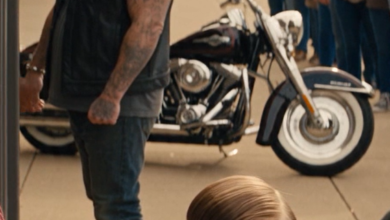
Just before eleven on a Friday in November, Ruth Bell stepped onto the wet grass at a cemetery outside Chillicothe, Ohio. Her ten-year-old daughter, Ava, carried a red paper poppy she’d made at the kitchen table. Wade “Anchor” Hayes stood beside Earl Mercer’s flag-draped coffin. His old cruiser was parked at the curb.
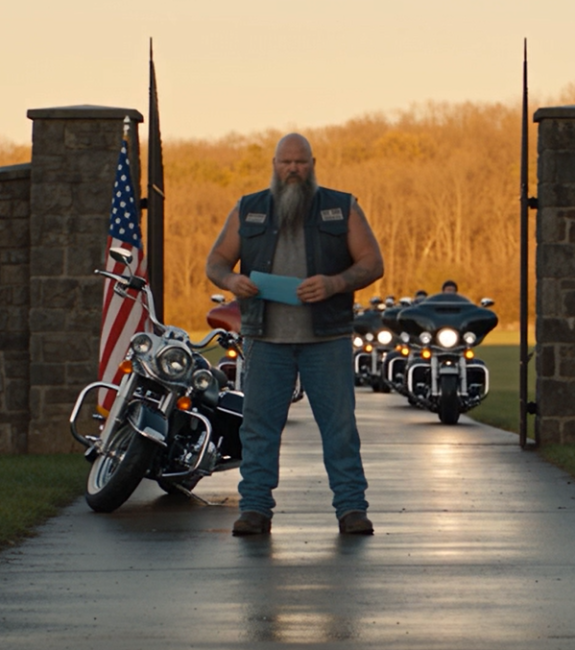
“Find another funeral.” Greg Mercer hooked his fingers under the back of the folding chair beside Wade and dragged it out of the row. One metal leg caught in the turf and tore up a wet ribbon of grass. A woman at the other end of the row turned so sharply her purse slipped off her knee. Ruth recognized Greg a beat after she recognized his father’s voice in his.
Wade stayed where he was. The leather on his short-sleeved jacket pulled tight across his shoulders, and one thumb rested against the worn seam of his riding glove. That close to the curb, Ruth could smell a trace of gasoline from the cruiser.
Greg kept one hand on the chair and looked down the row as though he’d been made to explain something painful in front of strangers. A man in a brown coat lowered his eyes. Ruth had spent the week expecting Earl’s son to call. With Greg finally standing there, she wondered whether she ought to give him the spot.
“He was here.” Ava’s voice carried. The red poppy bent between her fingers when the first V-twin sounded beyond the cemetery gate. Wade tugged one glove free, finger by finger. Chrome flashed between the stone posts, then another headlight followed the first down the lane. In the space that opened between the chair and the coffin, Ruth saw Wade reach inside his jacket. The blue envelope came out in his bare hand, the upper corner slightly bent. Greg’s grip tightened on the chair. The woman with the purse leaned forward.
Earl had trusted Wade to turn up early on mornings when he hated to ask anybody for help. Ruth knew that from watching the cruiser pull in next door when her coffee was still brewing. The envelope was something she’d never seen Wade bring.
Wade held it out to her. Ruth’s hand was halfway up when she caught sight of Greg over the envelope’s bent corner. He went so still that for a second the empty chair seemed to be holding him up.
Part 2
Ruth closed her fingers around the envelope and felt Wade let go.
Greg looked at the flap. “You opened it?”
“It was sealed when Earl gave it to me,” Wade said.
The old man’s handwriting slanted across the front. Ruth recognized the long tail of the R from three years of Christmas cards and a note Earl had taped to her trash can once, an apology for bringing it up the wrong driveway. She put a finger under the flap.
“Ruth,” Greg said quietly. “We can do this later.”
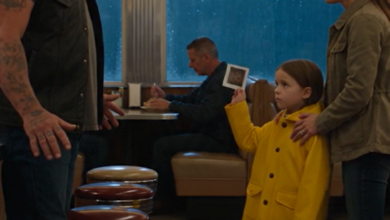
Ava looked up at her. “Is there an Earl thing inside?”
That was what they called the things he gave away and then asked to borrow back. A tape measure. A pie plate. A pair of binoculars he insisted were too heavy until the cardinals came.
Ruth opened the envelope. There was one sheet, folded around a photograph. She read the first line and folded it up again.
Ruth, ask Greg what he brought me to sign.
At the curb, the funeral director lifted one palm to guide the first riders past Wade’s cruiser. They turned in at walking speed, two abreast where the lane widened, one at a time where the road narrowed by the graves. Ruth watched them kill their engines as they parked. The whole row of folding chairs had buzzed against the metal stakes holding down the canopy. Then she could hear a man’s boot squeak when he climbed off his bike.
“How many?” she asked Wade.
“Three hundred checked in at the fairgrounds,” he said. “The last group’s still coming through.”
Ruth thought about the phone call she’d made Monday. She’d asked Wade to come because the funeral director had wanted to know how many seats to put out. Earl’s sister was gone. His friends at the breakfast counter had either moved away or stopped driving. Greg hadn’t answered two messages. “Will you stand with him if nobody comes?” she’d asked.
“Of course,” Wade had said.
She held the photograph close. Two young men sat on the edge of an Army truck, their boots hanging down. One had Earl’s ears. The other had the sitting posture Ruth recognized from every time Wade waited for Earl to finish buying groceries, one forearm braced across a knee.
“That you?”
Wade nodded.
“How long have you known him?”
“Since Vietnam.”
Something in her face must have invited a longer answer. Wade looked at the coffin. “I got hurt crossing water. He came back for me. I was twenty.”
Ruth had lived beside Earl for twelve years. In all that time he’d told her exactly one story about Vietnam, about a man who could make coffee in a dented tin and somehow keep the grounds out of it. He’d left the man’s name out.
“Is that why you all came?” Ava asked.
Wade looked down the lane. Men and women were setting their helmets on their seats and straightening their jackets. “They came because I asked.”
Greg put the chair back in the row. It sat at an angle, one leg in the groove he’d made. Ruth expected him to ask what his father had written. Instead, he pulled his phone from his coat and turned the screen toward her.
“You can read that letter twice if you want,” he said. “Then look at the date on this.”
Part 3
It was a scan of a deed. Ruth could make out Earl’s name, Greg’s name, and the address she’d written on birthday cards for twelve years.
“October tenth,” Greg said. “He gave me the house while he was alive. We can talk about his stuff after the funeral, but I need the spare key by Monday.”
The October date seemed familiar in a way Ruth couldn’t place. She looked past the screen. More riders were coming through. The woman who’d dropped her purse had picked it up and was standing beside her seat with the strap looped around her wrist.
“Who said I had a key?”
“Dad did. You watered the plants when he went in for his knee.”
“I still water them.”
Greg shut off his screen. “Then you understand why I’d like to know who’s going in.”
Ruth looked at Wade. He had put the glove he’d taken off inside the other one. He had both of them tucked under his arm now, out of the way.
“Can we give him the next fifteen minutes?” he asked.
Greg opened his mouth. Behind him, the funeral director pulled the chair all the way level and gestured toward it. Greg sat down. Ruth saw his thumb work at his wedding ring, the same way Earl’s had worked at a ring he’d worn for six years after becoming a widower.
During the service, Ruth kept finding little things Earl would have complained about. The canopy was crooked. Someone had left a plastic clip on a spray of grocery-store carnations. The man who read the prayer said Edgar once and caught himself. Earl would have looked right at Ruth and made her face the other way so they could both get through it.
Near the end, Ava whispered, “Can I give him the flower now?”
Ruth took her to the side of the coffin. Ava laid the poppy down where its stem could rest against the spray. One petal wouldn’t lie flat after she’d squeezed it.
“Leave it like that,” Wade told her. “He’ll know it’s yours.”
After the service, the riders waited for the burial crew to clear the lane. Several took the time to introduce themselves to Ruth. One woman had opened her bakery two hours early that morning so she could make the ride. A man with double hearing aids asked Ruth twice whether there was anyone who needed a lift home. They seemed to have come prepared to be useful in the small ways people could manage among strangers.
Greg was waiting by Ruth’s car.
“I know what that looked like back there,” he said. “I drove four hours. First thing I see is a man in club colors next to my father, with nobody from my family there.”
“He’d have saved you a seat.”
“You know that for sure?”
Ruth thought of the empty place at Earl’s kitchen table and all the Saturday mornings she’d sat across from it. She should have asked Earl that question while he could answer it.
Greg put his hands in his pockets. “Dad had a will. He told me after Mom died. Wade acting like he’s in charge doesn’t change what’s in it.”
Ruth unfolded the paper once Greg had gone to his car. Beneath the first line, Earl had written the name of his lawyer, Nora Ellis. Then he’d added a sentence that Ruth had to read twice.
She has the will I signed in June. Greg still thinks it says what it said fifteen years ago.
Part 4
Nora Ellis met Ruth in a narrow office above a dentist on Monday. Ruth arrived wearing her work shoes because she had a shift at noon. Wade came up the stairs slowly, his boots landing flat on every tread. Greg had driven back from Indiana and was already in a chair by the window.
The blue envelope lay on Nora’s desk between four coasters that looked as though they had come free with a bank account.
“Earl nominated me to handle his estate,” Nora said. “The June will leaves everything that passes through the estate to Wade.”
Greg put his paper coffee cup down. “Everything?”
“Yes.”
“Did you ask him what we used to do in that house on Christmas Eve?”
Nora waited.
“Mom put a mattress in front of the tree. Me and Dad slept out there. I was eleven, probably old enough to know better. Ask him if he knew why she did that.”
Ruth looked at Wade. He lowered his chin.
“She wanted us in the same room,” Greg said.
Nobody moved to pick up the coffee cup when its lid slowly flexed back into place. Then Greg pointed at the envelope. “He gave me the house in October. That’s the part that matters.”
“Tell me how he decided,” Nora said.
“He offered. He said it belonged with family.”
“Was anyone else there when he said it?”
“You’d have to ask him, wouldn’t you?”
Ruth had come expecting to tell Nora how Earl behaved around Wade. She had her own examples. The two of them arguing over which way storm windows should face. Wade listening while Earl told a fifteen-minute story about a neighbor’s new gutter. The day Earl forgot his own lunch was in the oven because he was packing food for Wade to take home. She had thought those examples would clarify something. In the office, they sounded like things she’d say at a service.
Greg opened a manila folder and set a photocopied check on the desk.
“Six thousand two hundred,” he said. “Dad paid him in September. I went through the statements after he stopped answering his phone.”
“Roof,” Wade said.
“Your roof?”
“His.”
Greg leaned back. “How’s anybody supposed to know what else he paid you for?”
Wade reached into the same jacket pocket that had held the blue envelope. He set a small packet of receipts on the desk. The lumberyard and roofing supplier receipts added up to the amount on the check, down to a credit for two unopened boxes. Earl had rounded the reimbursement up by eight dollars and change. In his handwriting, on a copy Wade had saved, was a short note about the difference. Get breakfast.
Ruth looked at the dates. A repatched patch of roof, the one over Earl’s kitchen, had caught her eye all summer. She’d washed the bucket he sat under it when it rained.
“Did you charge for the work?” she asked Wade.
He shook his head.
Greg retrieved the photocopy, sliding it against the desk so his fingernails wouldn’t buckle the corner. Ruth thought he might go. He stayed seated.
“You were at Dad’s on October tenth,” he said to her. “Your car was there. We signed at his kitchen table. Tell her how normal he was.”
October tenth. A wet Friday. Ava had brought Earl a school assignment so she could record him explaining the porch he’d built with his wife.
“I was there,” Ruth said. “So was Ava.”
Under Greg’s fingers, the piece of paper bent.
Part 5
On the kitchen calendar at home, October tenth had a crooked star Ava had drawn with a green marker. Under it she’d written RECORD EARL. On their family laptop, the finished assignment was a ninety-second video about how her neighbor had built the porch wide enough for his wife to sit outside with her bad knee.
Ava got through two sentences about it before she asked, “Is this why Mr. Mercer was mad?”
Ruth pulled out the chair beside her. “I’m trying to remember what everybody was doing while you made it.”
“You went out to our car. The window was open and it started raining.”
“Did you keep filming?”
“I was waiting for him to finish.”
Ruth remembered, then, how her phone kept sliding down the sugar tin when Ava tried to stand it upright. Ava had tucked a folded dish towel under it and pointed the camera at Earl’s hands. After Ruth had gone out, Greg and a woman with a zippered document case had come in through the side door. Ruth had seen the woman leave while she was scraping wet leaves off the car floor mat. By the time she went back inside, Ava was asking Earl if she could do the last part over.
“You sent me just the piece we used at school,” Ruth said. “Do you know if I still have the rest?”
Ava reached for the phone, then withdrew her hand. “Are you gonna put it on the internet? That man at the funeral had his phone out.”
“No. This is for Nora to look at privately, if there’s anything that might help her.”
“Can I keep the part about his wife?”
“Of course.”
Ruth found the original in her camera roll. A thumb covered one side of the picture for the first few seconds. Earl cleared his throat and told Ava the hardest part had been getting his wife to agree that the porch ought to have a roof.
“Then she’d sit out while it rained,” he said. “I’d call her in and she’d say it was her roof now.”
The next thing Ruth heard was the side door shut. Ava must have shifted the phone so it wouldn’t be in anybody’s way. All the camera showed was a sugar tin and a strip of yellow wall.
Then came Greg’s voice.
“Dad, she needs you to do the porch paperwork while she’s here.”
Earl asked whether it was for the estimate he’d gotten two weeks earlier.
“Same job,” Greg said. “You’re just giving me permission to handle it.”
A woman introduced herself. Paper slipped over paper. Ruth heard the small squeak the kitchen chair had always made when Earl leaned forward.
“Which line?” he asked.
Ava put a hand flat on her own kitchen table. “I thought that lady was from the porch place.”
Ruth did, too. The recording ended with Earl asking Ava to wait so he could find a better picture of his wife. Ruth saved a copy and called Nora before she could talk herself into playing it a third time.
Nora listened all the way through. “It matters what Greg told him. I still need to tie that recording to the deed he gave me.”
“Find the woman who was there,” Ruth said.
“I did, this afternoon.” Nora paused. “She said Greg told her there would be someone in the house who could vouch for him. He gave her your name.”
Part 6
The woman with the zippered case was Denise Parker. She’d graduated with Greg and taken his call when he said he needed a mobile notary outside her usual service area. She brought her appointment book to Nora’s office and turned to the Friday herself. Ruth could see two appointments before Earl’s and a line through the one after it.
“He said you’d already talked everything through with Earl,” Denise told her. “He said you were an old neighbor.”
“That part’s true.”
“When I got there, I asked where you were. He said we’d been over it and you didn’t need to sit through it twice.”
Ruth remembered Denise crossing the driveway with her case tucked against her side. She’d waved, the absent little wave you gave anybody coming out of Earl’s house. Denise had waved back. For weeks afterward both women had been walking around with a memory in which the other had understood what was happening.
“Do you remember which document you notarized?” Nora asked.
“The deed. Just the deed.”
“Did you hear him say why Earl was signing?”
“I was getting my case open.” Denise held her palms down on the appointment book. “Mr. Mercer said something about a porch. I could have asked him what he meant. I wish I had.”
Denise slid over a copy of the confirmation message she had sent after leaving. The timestamp fell one minute after Ava stopped recording. Ruth could finally put the scraps of the afternoon in order.
By then the paperwork nominating Nora to act for the estate had gone through, and she took Ruth over to the house that afternoon. Earl had kept the spare house key Ruth carried in a blue envelope before he’d handed it to her three winters ago. The paper was from a discount box his wife had bought. Greg had seen those envelopes his whole life.
In the sideboard drawer, tucked into a black spiral notebook, was another one, empty except for a torn grocery list. On the page under it Earl had copied the date Greg brought Denise and written three short lines.
Greg says porch only. Called contractor. Contractor knows nothing about Greg. Get Nora to ask what I signed.
The entry was dated two days before Earl died. Nora had a message from him that Monday. He’d asked for a call back while she was in a closing. She called that afternoon, and he’d gone out to pick up groceries. By the time she tried again, Ruth had already found the grocery bag on his porch, its paper soaked through from the milk inside, and called for help.
“Did he tell Wade?” Ruth asked.
“He told him where to take the envelope,” Nora said. “That was all Wade knew.”
Outside, Ruth found Wade leaning against his bike with his helmet balanced on the seat. His old engine was cooling in little metallic ticks. She told him about the notebook and about the woman who’d remembered the word porch.
“Earl must’ve felt foolish,” she said.
“Probably.”
“I wish he’d told me.”
“Probably wished that, too.”
Nora came out while Ruth was still holding her keys. She’d heard from Greg’s lawyer. He was insisting Earl had been free to give the house to his own son. He’d also filed a challenge to the June will.
“And there’s one more thing,” Nora said. She looked back toward the house. “Greg had already offered it as collateral.”
Part 7
At the settlement meeting that winter, Greg sat at the far end of a table with a box of tissues in the middle. He had thrown his coat over an empty chair. The snow under everybody’s shoes had melted into little puddles by the time Nora set down a copy of the loan application.
The application was for Greg’s business. A kitchen and bath company he’d spent eighteen years building had fallen behind on bills after two projects went unpaid. The application listed Earl’s house as a rental with no occupants.
Ruth had been inside that house the week the application went in. There had been oatmeal drying in Earl’s bowl when she stopped by, and a baseball game on the radio because he liked the announcer on a West Coast station.
“Were you waiting for him to move?” she asked.
Greg looked at his lawyer. Then he looked at the box of tissues. “I was trying to buy time.”
“For the company?”
“We had four guys with kids. Once I paid the supplier, I could finish the two jobs and get paid.”
“And where was your dad supposed to go?”
Greg rubbed a little shred of cuticle at the side of his thumb. “He could stay as long as he needed.”
Nora laid out Earl’s notebook entry and Denise’s confirmation. Then she played the full kitchen recording. Before anyone got to the chair squeak, they had to sit through Earl explaining why his wife wanted a roof on the porch. Ruth listened to Greg hear his mother talked about in his father’s voice.
When the recording ended, Greg reached for his water.
“I told him about the house earlier,” he said.
“When?” Nora asked.
“Another time.”
“You told him he was giving you the deed?”
The cup came back down.
“I told him I needed help.”
Ruth had wondered what she would feel when Greg ran out of ways to tell the story. Mostly she felt tired. He’d had a real problem and a father whose two hands were still steady enough to sign where somebody pointed. At the cemetery, he’d looked at Wade’s cut of leather and counted on everybody to make a quick decision about who belonged beside Earl. Ruth remembered how close she’d come to moving.
Greg’s lawyer asked for a break. When they came back, Greg moved his coat off the empty chair and put it on his lap.
“Did he ever talk about me?” he asked Wade.
“Sure.”
“Did he tell you I never called?”
“He told me you called from the truck on Thursdays. Said you’d give him five minutes between jobs.”
Greg stared at him.
“He liked those calls,” Wade said.
They took another break. This time Greg left his water where it was. When he returned, he agreed to undo the transfer and withdraw the will challenge. The loan had never closed. He’d pay part of what it had cost the estate to set the deed right. The signed agreement later became a court order. The house went back into Earl’s estate, and the June will stood.
Ruth was putting on her coat when Greg handed her a flattened envelope from his folder. It was white, with an old postmark and his mother’s handwriting. His fingers caught on the corner when she took it.
“Dad kept my letters too,” he said. “I found a stack of them when she died.”
“Do you want this one back?”
“Yeah. I just wanted somebody to see I used to write.”
She gave it back. Greg tucked it inside his coat, then asked Wade something Ruth hadn’t expected anyone to ask that day.
“What are you going to do with the house?”
Part 8
Wade asked Nora to draw up the papers that would let him own the house outright before he made any promises about it. By spring, the estate had settled. Everything Earl had left went to Wade, including the house and a checking account with enough in it to cover repairs for a while.
Wade used the first of that money on the porch.
Ruth came over on a Saturday and found him on the bottom step with a bag of deck screws between his boots. Ava was on her knees counting them out in groups of five. She had brought an extra pencil because Earl used to lose his in the grass just as he was about to give her something to write down.
“Are we fixing the part that made that noise?” she asked.
“You know which one?”
She put her toe on the far corner of the third board. It gave a little squeak.
“That one,” she said.
Wade lifted the board. On the underside were two initials, E and M, cut into the wood with something narrow. Ruth ran a fingertip over them. She could imagine Earl’s wife asking what he was doing down there when they had another twelve boards to go.
“Can it go back?” Ava asked.
“Turn it around and put the screw through good wood,” Wade said. “It’ll hold.”
Ruth poured coffee while he worked. On the kitchen table lay a one-page schedule for two Saturday mornings a month. A veterans’ benefits volunteer was going to take appointments at Earl’s house. Two of the riders had offered to drive anybody who couldn’t make it over on their own. Ruth remembered the man at the funeral with the double hearing aids, asking whether anybody needed a lift.
“Are you putting Earl’s name on it?” she asked.
Wade looked at the schedule. “On the coffee tin, maybe. He didn’t like people knowing his business from the street.”
Ava came in holding the picture of Earl and Wade from the blue envelope. After the settlement, Ruth had asked if Wade wanted it. He’d told her Ava could keep it as long as it didn’t get stuck to the fridge too close to the stove.
“Did he call you Anchor because of the water?” she asked.
“He called me that when I kept trying to stand up before he could get me out. Said if I wanted to sink, he’d tie a rope to me and use me for an anchor.”
“Did you think it was funny?”
“Later I did.”
Ava studied the picture. “Did he really go back by himself?”
“Yes.”
“Were you nice to him before that?”
Wade’s mouth moved slightly at one corner. “I was twenty. I thought I was nice to everybody.”
Ruth laughed. She hadn’t expected to laugh in that kitchen. From the window she could see the cruiser at the curb and Wade’s worn gloves on the seat, one inside the other. At the cemetery she’d watched a dozen people measure the man by his jacket before he’d had a chance to speak. Now Ava was asking if he could stay for lunch because he cut sandwiches the way Earl had, all the way through the crust.
Wade went out to make sure the step held. Ava followed with two cups of lemonade, taking the repaired board first. She walked over it twice to hear whether it still squeaked. Then she set one cup beside Wade and sat down next to him.
She left room for a third cup.
Follow the page for more stories about the people who show up when it counts.