Part 2: He Brought My Son His Harley for Christmas — Then My Boy Asked for Something Smaller
Before that Christmas, I knew Bear the way most people knew him: through sound.
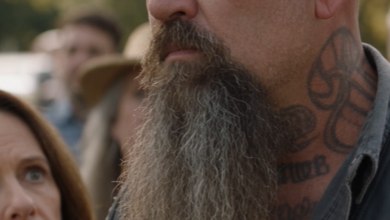
His Harley announced him before he appeared. On weekday mornings, it started at 5:40 sharp. There was the first deep cough of the engine, the second heavier rumble, then the steady pulse that made our kitchen window tremble in its frame. A few seconds later, Bear rolled past our porch with his shoulders squared beneath his leather cut, his gloved hands relaxed on the bars, his grey beard lifting slightly in the cold air.
He worked maintenance at a packaging plant outside town. Long shifts. Dirty work. He came home smelling like machine oil, gasoline, leather, and gas-station coffee. Sometimes two or three other riders followed him into the neighborhood, their exhaust notes overlapping until it sounded like a storm circling the block.
The men rarely stayed long. They would stand in Bear’s driveway with Styrofoam cups in their hands, talking quietly beneath the open garage door. Their cuts carried patches from a local riding club called the Cumberland Road Brothers. Nothing flashy. Nothing designed to scare people. Still, when a group of large tattooed men gathered around Harleys in a quiet neighborhood, curtains moved.
Bear noticed. He always noticed.
He just never reacted.
The strange part was that the little things did not match the version of him people invented from a distance.
He shoveled Mrs. Alvarez’s walkway before clearing his own whenever the temperature dropped below freezing. He repaired the chain on a teenager’s bicycle with the same careful focus he used on his Softail. Once, during a summer thunderstorm, I watched him walk into the road and carry a soaked stray dog under one arm while holding an umbrella over the animal instead of himself.
The dog bit him.
Bear only said, “Yeah, brother. I know you’re scared.”
He kept walking.
There was another detail I had noticed but never understood. On the inside edge of his leather vest, nearly hidden beneath the lining, someone had sewn a tiny blue patch by hand. The stitching was uneven. The patch was faded from years of friction against his shirt.
It said:
HOLD ON.
It looked wrong next to the skull tattoos on his knuckles and the old scars running across his hands. Too soft. Too small. Like a sentence from another life.
Eli noticed it too.
My son had always been quiet around grown men. He did not hide exactly, but his whole body became careful. If a male customer at the diner leaned too close to our booth, Eli would shift nearer to me. If another child’s father shouted across a baseball field, even happily, Eli would look down at his shoes.
But with Bear, something changed slowly.
It began with the Harley.
At first, Eli watched from our porch. Then he started waving. Bear answered with a small lift of his glove. A week later, Bear let Eli stand at the edge of the driveway while he wiped road grime from the chrome. He did not overload him with questions. He did not force conversation.
He simply handed Eli a clean rag.
“Small circles,” he said.
Eli nodded like he had been given an important job.
After that, my son found excuses to linger near the garage whenever Bear was outside. Bear taught him the names of basic tools. He showed him how to check whether a bolt was loose without tearing the threads apart. He made Eli wear safety glasses even when the engine was cold.
“Eyes don’t grow back,” Bear said.
That was Bear’s style. Six words when other people used sixty.
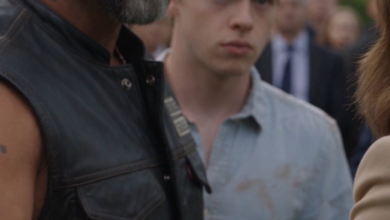
One Saturday, four riders from the club arrived while Eli was helping polish the Softail. I recognized them from the driveway gatherings: Mason, a former Army medic with a limp; Tiny, who was somehow even larger than Bear; and a younger prospect named Daniel who looked nervous every time Bear spoke.
Tiny stared at the child-sized rag in Eli’s hand and grinned.
“New mechanic?” he asked.
Bear did not look up from the saddlebag latch.
“Management,” he said.
Eli laughed so hard he snorted.
I had not heard that sound in months.
That afternoon, Bear walked Eli home and handed me an envelope. Inside was a gift card for the grocery store. No note. No explanation.
“I can’t take this,” I said.
Bear shrugged.
“Club had extra.”
It was an obvious lie. Grocery-store gift cards do not simply appear in motorcycle club garages.
I tried to return it.
Bear looked past me toward Eli, who was standing at the window pretending not to listen.
“Let the kid have cereal,” he said.
Then he walked away before I could answer.
A week before Christmas, Bear knocked on our door. He was holding Eli’s Santa letter in a clear plastic sleeve to protect it from the drizzle.
“Need to ask you something,” he said.
I braced myself for an offer I could not accept. Money. Toys. Maybe a secondhand bicycle.
Instead, Bear looked uncomfortable for the first time since I had known him.
“Would you let me take him around the block?”
I looked at the Harley in his driveway. Then at Bear. Then at the letter.
“You mean on the motorcycle?”
“Slow. Five minutes. Club will watch the intersections.”
I hesitated.
Bear nodded once, as if he understood hesitation better than most men.
Then he opened his vest slightly and tapped the faded blue patch inside.
“Holding on matters,” he said.
I still did not understand what he meant.
But I said yes.
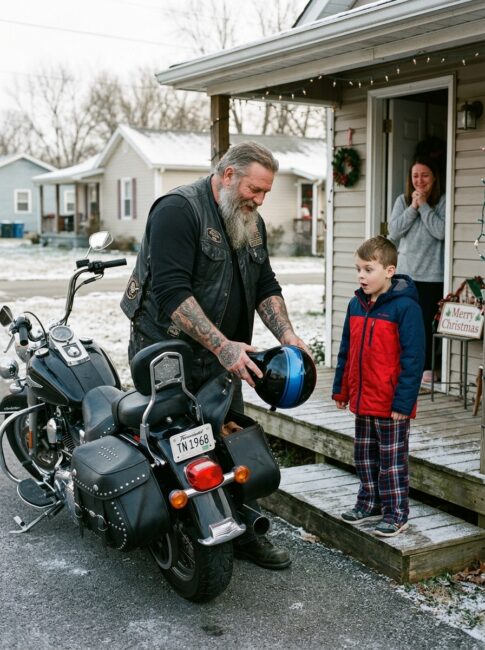
Christmas morning arrived cold and bright, the kind of Tennessee winter morning where frost stays in the grass but the roads clear quickly once the sun rises. Eli woke before six and ran into the living room wearing pajama pants with little dinosaurs printed on them.
We had done our best.
There were wrapped presents under the tree: secondhand books, a remote-control truck I found on clearance, a warm coat from my sister, and a small die-cast motorcycle I bought with cash from my tip jar. Eli opened everything carefully. He thanked me for every gift.
But every few minutes, he glanced toward the front window.
I knew what he was waiting for.
I also knew Santa had not brought a Harley-Davidson Softail to a nine-year-old boy.
At 8:12, the sound came.
Not loud at first. A low rumble somewhere beyond the bend near the end of our street. Then another engine joined it. Then another. Within seconds, the vibration moved through the windows, the floor, and the thin glass ornaments hanging from our tree.
Eli froze with the toy motorcycle still in his hand.
The Cumberland Road Brothers appeared slowly around the corner, five Harleys in a loose line, their headlights glowing in the pale morning sun. Bear rode in front. His black Softail rolled toward our house at walking speed, exhaust pulsing steadily. Mason, Tiny, Daniel, and another rider stopped at the intersections and driveways, not blocking traffic, just watching.
Neighbors stepped onto porches in robes and winter coats.
Bear parked at the curb and shut off the engine.
The sudden silence felt almost physical.
He swung one boot over the seat and stood beside the Harley. His leather cut creaked when he bent down and opened the right saddlebag. For one ridiculous second, I imagined a toy motorcycle inside.
Instead, Bear pulled out a small black helmet.
It had a clear visor, fresh padding, and a single blue stripe across the back.
Eli opened the front door but did not step outside.
Bear looked toward me first.
I nodded.
Then he crouched, bringing his huge frame down until he was nearly eye level with my son.
“Rules,” Bear said.
Eli nodded hard.
“You hold on. Both arms. No letting go.”
“Yes, sir.”
“You get scared, tap me twice.”
“Yes, sir.”
“No hero stuff.”
Eli swallowed.
“Yes, sir.”
Bear placed the helmet over Eli’s head and tightened the strap beneath his chin. His hands looked enormous against the small buckle. The tattoos across his knuckles flexed as he tested the fit twice, then a third time.
“Too tight?” Bear asked.
Eli shook his head.
“Too loose?”
Another shake.
Bear stood and climbed onto the Harley. The leather seat gave a faint squeak beneath his weight. He turned the key, and the Softail came alive with a deep mechanical heartbeat.
Eli stared at the bike.
For months, this had been the center of every Christmas wish. Now that the moment had arrived, my son could not move.
Bear looked over his shoulder.
He did not rush him. He did not reach out and pull him forward.
“Your call, brother,” he said.
Eli took one step. Then another.
Tiny held the back of the bike steady while Eli placed one sneaker on the passenger peg and climbed onto the rear seat. My son sat stiffly at first, his gloved hands hovering awkwardly in the air.
“Arms around him,” I said.
Eli wrapped both arms around Bear’s waist.
The moment his hands locked together, his shoulders dropped.
Bear noticed.
I could see it in the way his body changed. The hard set of his back softened slightly beneath the leather vest. He lowered one gloved hand from the handlebar and placed it briefly over Eli’s small fingers.
“Got me?” Bear asked.
Eli nodded against the vest.
“Use your words.”
“I got you.”
Bear started rolling.
The ride was slow. No highway. No sharp corners. No performance for the neighbors standing on their porches. Just one loop through our neighborhood, across the small road near the Baptist church, past the closed gas station, then back toward our street.
Mason and Tiny moved ahead at each intersection, signaling when the road was clear. Daniel followed at a respectful distance.
I stood in the yard with my phone in one hand, trying to record and cry at the same time.
At first, I heard only engines.
Then, as they passed the far end of our street, I heard Eli.
“WOOOOOOOO!”
His voice rose above the Harley exhaust. Pure joy. No carefulness. No hesitation. The sound bounced off the houses and carried all the way back to our porch.
Several neighbors laughed.
Mrs. Alvarez covered her mouth with one hand.
The riders disappeared briefly around the corner, then returned five minutes later exactly as promised. Bear coasted to the curb, shut off the engine, and planted both boots on the pavement.
Eli stayed seated for a second after everything went quiet.
His arms were still around Bear.
I thought that was the ending. The Christmas miracle. A lonely child wished for a motorcycle ride, and the intimidating man next door gave him one.
It would have been enough.
Then Eli climbed down.
He removed his helmet, placed it carefully on the seat, and looked up at Bear.
“Did you like it?” I asked.
Eli nodded. His cheeks were red from the cold. His hair was flattened by the helmet. His eyes were bright in a way I had not seen before.
Then he hugged Bear around the waist.
Bear went still.
Not uncomfortable. Not surprised exactly.
Still.
Eli pressed his face against the front of the leather vest and spoke so quietly that I almost missed the words.
“Uncle Bear?”
Bear looked down.
“I don’t need a motorcycle.”
Nobody moved.
Eli tightened his arms around him.
“I just wanted to sit behind somebody.”
There are sentences children say without understanding they have opened a door inside every adult listening.
Eli’s sentence did that.
I saw Bear’s jaw tighten beneath his beard. His right hand lifted halfway, as if he did not know where to place it, then settled carefully against the back of my son’s head.
Tiny looked down at the pavement.
Mason turned away and rubbed his face with his glove.
I could not speak.
Eli continued because children do not always recognize when the world has stopped.
“I liked holding on,” he said. “It felt like somebody was there.”
Bear closed his eyes.
For eight years, I had tried to give Eli enough love for two parents. I had packed lunches, attended school conferences, slept on the floor beside him when he had the flu, and stretched every diner paycheck until it nearly snapped.
But there was one thing I could not imitate.
Eli had never wrapped his arms around a father’s waist.
He had never felt the solid back of someone trustworthy in front of him. He had never experienced the quiet certainty of holding on to a grown man who was not walking away.
The motorcycle was not the wish.
The passenger seat was.
Bear understood before I did.
He lowered himself slowly to one knee on the cold pavement. His leather vest creaked. The chain on his wallet tapped against his thigh. Eli’s arms remained locked around his neck.
Bear’s voice came out rough.
“You can sit behind me anytime your mom says yes.”
Eli pulled back just enough to study his face.
“Even when it’s not Christmas?”
Bear swallowed.
“Especially then.”
That should have been the end of the twist.
It was not.
Bear looked toward me and opened the inside edge of his vest, revealing the faded blue patch I had noticed months earlier.
HOLD ON.
Up close, I saw that the letters had been sewn by a child. The thread crossed unevenly through the fabric. One side of the patch leaned downward. The final letter was smaller because whoever stitched it had run out of room.
Bear touched the patch with two fingers.
“My boy made this,” he said.
I had never heard Bear mention a son.
Not once.
“He was nine,” Bear continued. “Same age.”
His voice thinned slightly, then stopped. For a few seconds, the only sound was the ticking metal of the cooling Softail engine.
Mason stepped closer, not intruding, just present.
Bear tried again.
“My wife and I split when Tommy was little. I wasn’t around enough. Thought working and sending checks counted as showing up. By the time I figured it out, I’d missed too much.”
He looked down at Eli.
“Tommy gave me this patch after our first ride together. Told me he liked having something to hold on to.”
I felt my chest tighten.
“Where is he now?” I asked.
Bear stared toward the empty road.
“Colorado. Wife. Two girls. We talk some.”
The words were flat, but his hand stayed on the patch.
Some.
Not enough.
A grown son still at a distance. A father who had learned the cost of absence after the years were already gone.
And suddenly the child-sized helmet, the careful rules, the club riders guarding intersections, and the patch hidden inside Bear’s vest all meant something different.
Bear had not simply taken my son for a ride.
He had recognized the letter.
Later that afternoon, after the club riders had left and Eli was inside building a cardboard ramp for his new toy motorcycle, Bear stood on our porch holding two cups of coffee. One was black. The other had enough sugar to count as dessert.
He handed me the sweet one without asking which I preferred.
“How did you know?” I asked.
Bear leaned against the porch rail. The boards creaked beneath his boots.
“Know what?”
“That he did not really want a motorcycle.”
Bear took a sip and looked toward the street.
“I didn’t. Not at first.”
The Softail sat in his driveway beneath the open garage door. In the winter light, it looked less like a machine and more like a witness.
Bear nodded toward the house.
“But I know letters.”
He told me that when Tommy was nine, Bear had been living badly. Not cruelly. Not dramatically. Just badly in the slow, ordinary way a person can lose a family while convincing himself he is providing for them.
He worked nights. Rode too often. Drank more than he admitted. Came home tired and angry at the wrong things. He never hit his wife or his child. Bear made sure I understood that. But absence has more than one shape.
Sometimes it looks like an empty driveway.
Sometimes it looks like a father sitting ten feet away, staring at a television while his son stops asking questions.
After the divorce, Tommy visited every other weekend. On one of those weekends, Bear took him for a slow motorcycle ride through the back roads outside Lebanon. Tommy wore an oversized helmet borrowed from a club brother’s nephew. His arms barely reached around Bear’s waist.
When they returned, the boy refused to climb off.
“He held on after the motor stopped,” Bear said. “Five minutes. Maybe longer.”
That evening, Tommy found a scrap of blue fabric in Bear’s garage and asked for a needle and thread. Bear’s wife had taught him basic sewing for school projects. He worked quietly at the kitchen table while Bear made grilled cheese sandwiches.
Before leaving on Sunday, Tommy handed his father the patch.
HOLD ON.
“He said it was so I wouldn’t forget the rules,” Bear told me.
“What rules?”
Bear’s mouth moved slightly, almost a smile.
“Both arms. No letting go. No hero stuff.”
The same rules he had given Eli.
Bear sewed the patch inside his vest because he did not want rain or road grit wearing it away. He kept it where the fabric rubbed against his shirt each time he rode. A reminder against his ribs.
But reminders do not always fix things quickly enough.
Tommy grew older. Bear got sober. He stopped drinking, picked up steady work, and joined the Cumberland Road Brothers because the club expected more from him than showing up for weekend rides. They ran food drives. Escorted funeral processions for veterans. Repaired porches for elderly neighbors. Delivered winter coats to families who would never know where they came from.
Bear became dependable.
By then, Tommy had moved west for college and built a life of his own.
“They’re not estranged,” Mason told me later. “But Bear missed the years that make closeness easy.”
That was the first smaller twist.
Bear was not giving Eli a ride because he believed himself to be some kind of hero. He was trying to practice a lesson he had learned late: when a child asks to hold on, you show up before the asking stops.
The second smaller twist came two days after Christmas.
I found out the helmet had not been an impulse purchase.
Bear had started looking for one weeks before he read Eli’s Santa letter.
Daniel, the club prospect, told me by accident while helping Bear install new shelving in the garage.
“The old man had me calling every shop between here and Nashville,” Daniel said. “Wanted the right size. Wouldn’t settle.”
I looked toward Bear.
“You bought the helmet before you saw the letter?”
Bear kept tightening a bracket.
“Kid watched the bike every day.”
“That doesn’t explain why you bought him a helmet.”
Bear shrugged.
“Figured someday he might ask.”
Daniel laughed.
“He measured the inside of Eli’s bicycle helmet when the kid left it in the garage. Made me compare padding charts.”
Bear shot him a look.
Daniel immediately became fascinated by the shelving.
The third smaller twist came in January, when an envelope arrived at my house with a Colorado return address.
Inside was a photograph of Bear standing beside his Harley years earlier. His beard was shorter and darker. A skinny boy in a blue jacket sat behind him on the Softail, arms wrapped around his waist, smiling beneath an oversized helmet.
On the back, someone had written:
Dad said Eli needed proof that the passenger seat matters. Tell him Tommy says hello.
I walked the photograph next door.
Bear was in the garage, changing oil with a radio playing softly on a shelf. The smell of leather, metal, and coffee filled the space. When I handed him the picture, he stared at it for a long time.
“You called him,” I said.
Bear nodded.
“Christmas night.”
“How long did you talk?”
He wiped both hands on a shop rag.
“Long enough.”
That was all he offered.
But several weeks later, a pickup truck with Colorado plates pulled into Bear’s driveway. A man in his thirties stepped out with his wife and two little girls. Bear stood in the garage entrance, suddenly looking more nervous than he had looked while placing my son on the Harley.
Tommy crossed the driveway first.
The two men stopped an arm’s length apart.
For a moment, neither knew what to do.
Then Tommy leaned forward and hugged his father.
Bear’s hands remained at his sides for half a second.
Then they closed around his son’s back.
No speeches. No dramatic apology in the driveway. Just the sound of Bear’s leather vest creaking as he held on.
Eli watched from our porch.
He did not interrupt.
He understood.
The ride became a ritual.
Not every week. Not on rainy days. Not when the roads iced over or when Bear had worked a double shift at the plant. Bear was strict about that. The Harley was not a toy, and Eli never treated it like one.
But on certain Saturday mornings, usually after breakfast, Eli would walk next door carrying the small black helmet with the blue stripe.
He always knocked.
Bear always opened the garage.
The routine never changed.
Helmet strap checked twice. Shoes tied. Jacket zipped. Gloves on. One slow loop through the neighborhood, sometimes extending as far as the gas station near Highway 231, where Bear bought Eli hot chocolate and black coffee for himself.
Mason or Tiny occasionally rode behind them. Daniel, who finally earned his full patch, sometimes joined too.
Eli learned that riding clubs were not simply collections of loud motorcycles and intimidating men. He saw Mason replace the wheelchair ramp at Mrs. Alvarez’s house without accepting payment. He saw Tiny cry quietly when the club delivered groceries to the widow of a former member. He watched Bear remove his leather cut before entering our house whenever his boots were muddy, then stand awkwardly in our kitchen while Eli explained school projects in unnecessary detail.
Bear listened to every word.
He did not try to become Eli’s father.
That mattered.
He never crossed lines. Never made promises that belonged to someone else. Never positioned himself as a replacement for the man who left.
He simply became the adult who kept appearing.
When Eli had a school science fair, Bear showed up in a clean work shirt and stood in the back of the classroom with folded arms while my son demonstrated a model volcano that barely fizzed. When Eli joined a youth baseball team and struck out twice in his first game, Bear waited beside the fence afterward.
“Bad day?” he asked.
Eli nodded.
“Still came to bat.”
That was the whole speech.
It worked.
By spring, Eli was taller. Not much, but enough that his arms reached farther around Bear’s waist when they rode. The small helmet collected one scratch near the visor. Bear refused to buff it out.
“Gear gets marks,” he said. “Means you used it.”
The faded blue HOLD ON patch stayed hidden inside Bear’s vest. But he added something beside it: a narrow strip of black fabric with Eli’s initials stitched in crooked white thread.
Eli sewed it himself at our kitchen table.
The letters were uneven.
Bear did not correct them.
A year later, on Christmas morning, Eli did not ask Santa for a motorcycle.
He asked for a set of beginner tools.
Bear gave him a small toolbox with his name written on masking tape across the lid. Inside were wrenches, screwdrivers, safety glasses, and a pair of work gloves slightly too large for his hands.
At the bottom was a folded note.
Eli opened it at our kitchen table.
The message was short.
For the things worth maintaining. — Bear
That afternoon, Bear rolled the Softail out of the garage. The engine caught with the same deep rumble that once made neighbors close curtains and pull their children a little closer.
Eli stepped onto the porch wearing his helmet.
Bear looked toward me.
I nodded.
My son climbed onto the passenger seat and wrapped both arms around Bear’s waist. The blue-striped helmet rested against the back of the leather vest. Beneath that leather, hidden where only Bear knew to touch it, two hand-sewn patches pressed against his shirt.
One from the son he almost lost.
One from the boy who reminded him to call.
The Harley rolled slowly toward the end of the street. Its exhaust note softened as it turned past the church and disappeared behind the bare winter trees.
For a few seconds, I could still hear Eli laughing.
Then only the engine remained.
Steady.
Low.
Still there.
Follow the page for more stories about the people behind the leather and the engines.