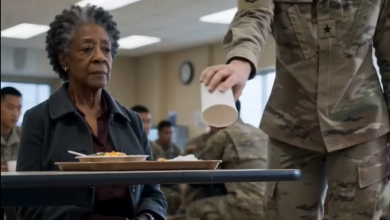
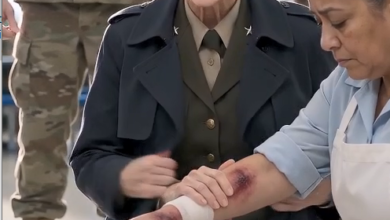
Part 2: He Left Her Because She Wasn’t “His Class” — Years Later, One Torn Check Left Him Speechless
Twelve years earlier, Ava had been twenty-six and working two jobs.
During the week, she answered phones at a dental office in downtown Columbus. On weekends, she served coffee and pie at a small diner near the interstate.
She wore sensible shoes because her feet always hurt, and she kept a notebook in her purse filled with grocery lists, overdue bills, and reminders for her mother’s medical appointments.
Grant had fallen in love with her before he understood how little money she had.
They met at the diner on a rainy Sunday morning.
He ordered black coffee and blueberry pie. Ava apologized because the last slice had just been sold.
Grant smiled and said, “Then bring me whatever you would order.”
She brought him apple pie.
He returned the following Sunday. Then the Sunday after that.
For almost two years, Ava believed the differences between them did not matter.
Grant came from a family whose name appeared on hospital wings and university buildings. His father had founded a commercial real estate company. His mother volunteered at museums and remembered every server’s name.
Ava’s mother, Rose, cleaned offices at night until chemotherapy made climbing stairs impossible.
At first, Grant seemed unbothered by any of it.
Then his father died, and Grant inherited the company.
The invitations changed. The dinners became more formal. The people around him began speaking in careful, coded sentences.
At one charity luncheon, a woman asked Ava where she had attended college.
Ava answered honestly.
She had left community college after one semester when Rose became sick.
The woman smiled politely and turned away.
A week later, Grant took Ava to a private dining room at his family’s country club.
He did not order food.
He stared at the folded napkin in front of him and said he had been thinking about their future.
“I care about you,” he began.
Ava already knew what was coming.
Grant spoke gently, which somehow made it worse.
“My life is becoming more complicated. There are expectations now. Responsibilities.”
Ava kept her hands in her lap.
Grant finally looked at her.
“You’re a good person, Ava. But we are not from the same world. We are not at the same level.”
The words sat between them.
Ava did not cry until she reached the parking lot.
She was sitting inside her old Honda, trying to start the engine with shaking hands, when someone tapped on the window.
It was Eleanor.
Grant’s mother had been leaving a luncheon in another room. She must have seen Ava walk out.
Ava lowered the window and tried to smile.
Eleanor looked at her for a long moment.
Then she said, “My son will regret confusing privilege with character.”
Ava looked away.
Eleanor reached inside her handbag and pulled out a worn index card. The edges were bent, and the handwriting had faded in several places.
“My mother’s apple pie recipe,” Eleanor said. “Grant used to ask for it every birthday.”
Ava almost refused it.
But Eleanor placed the card gently in her hand.
“Keep making something warm,” she said. “The world needs more of that.”
For years, Ava carried the recipe card in her wallet.
She did not see Grant again.
She heard small pieces of his life through mutual acquaintances. His company expanded into three states. His photograph appeared in business magazines. He became engaged, then quietly ended the engagement before the wedding.
Ava’s life changed too, although no magazine ever wrote about it.
Rose died eight months after the breakup.
She left behind a small box of photographs, a stack of medical bills, and a sentence Ava could not forget.
A week before she passed away, Rose squeezed Ava’s hand and whispered, “Do not let hard things make you hard.”
Ava returned to the diner two days after the funeral because rent was due.
One morning, the owner let her bake Eleanor’s apple pie recipe for the lunch special.
By noon, every slice had sold.
Customers began asking for whole pies. Then local offices placed holiday orders. A church asked Ava to cater a fundraiser.
She saved slowly.
Three years later, she rented a narrow storefront beside a laundromat and painted the sign herself.
She called it Rose & Honey Bakery.
The bakery grew without noise.
A second location opened. Then a third. Grocery stores began carrying Ava’s frozen pies across Ohio and neighboring states.
Still, she drove the same Honda until it could no longer pass inspection.
She did not buy designer clothes. She did not attend networking parties.
Instead, she created a private fund in her mother’s name.
The Rose Room Fund helped seniors cover the overlooked expenses that insurance often refused to pay: extended rehabilitation, transportation, memory-care support, and the quiet daily services that determined whether an elderly person felt safe or forgotten.
Ava insisted that recipients never be told who funded it.
She knew how painful it felt to need help.
She knew kindness could become humiliating when delivered like a performance.
Three years before the fundraiser, Ava received an email from the director of Willow Creek.
A resident had suffered a stroke. Her rehabilitation coverage had ended, but returning home was no longer safe.
The woman’s son had recently experienced serious financial difficulties after a failed commercial development.
Her name was Eleanor Ellison.
Ava stared at the message for several minutes.
Then she approved every expense.
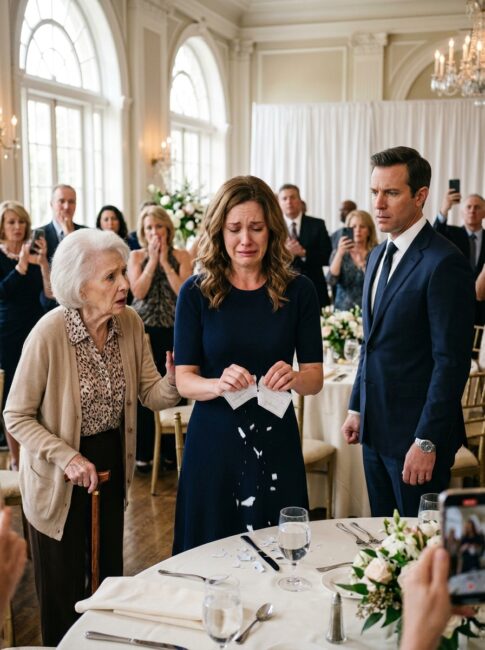
Back inside the ballroom, Grant stared at the torn pieces of his mother’s check.
Security had stopped a few feet away after Willow Creek’s director, Marianne Cole, raised her hand.
“Please,” Marianne said. “There has been a misunderstanding.”
Grant turned sharply.
“My mother just offered this woman more than eighty thousand dollars, and she destroyed the check.”
Eleanor sank slowly into a chair.
Ava moved first.
She knelt beside Eleanor, placed one hand over hers, and spoke softly.
“You do not owe me anything.”
Grant heard the sentence clearly.
His expression changed.
“Owe you for what?” he asked.
Ava looked toward Marianne.
The director hesitated.
For almost three years, Ava had required complete privacy. Her name appeared nowhere in Willow Creek’s public donor materials. Even the staff members who managed Eleanor’s account knew only that support came through the Rose Room Fund.
Eleanor had discovered the truth by accident.
The previous week, a billing clerk had placed the wrong folder in her room. Inside was a statement showing every payment the fund had covered after her stroke.
Physical therapy.
Transportation.
Additional nursing support.
A private companion on the afternoons when her memory became unreliable.
The total was $86,400.
Eleanor had asked Marianne who created the fund.
Marianne refused to answer.
Eleanor kept asking.
Finally, she recognized the bakery logo printed discreetly at the bottom of a community newsletter.
Rose & Honey Bakery had sponsored Willow Creek’s monthly family dinners for two years. Ava delivered the pies herself, usually after the dining room emptied.
That was why Eleanor had written the check.
Grant’s eyes moved from the torn pieces of paper to Ava’s face.
“You paid my mother’s bills?” he asked.
Ava stood slowly.
“The fund paid them.”
“How long?”
Ava did not answer immediately.
“Since she needed help.”
Grant looked at Marianne.
The director nodded.
“Your mother’s care plan would have changed without the assistance,” she said quietly. “The fund allowed her to remain in the same apartment with familiar staff.”
Grant’s face lost its color.
After his company’s failed development, he had spent months trying to save the business his father built. He refinanced properties, sold assets, and stopped answering calls he did not know how to return.
He told himself Eleanor was comfortable.
He told himself Willow Creek would call if there was a real emergency.
He visited when he could, although “when he could” had gradually become birthdays, holidays, and staged photographs at fundraising events.
Ava visited every Thursday.
She brought soup when Eleanor lost her appetite. She replaced the batteries in the small radio beside her bed. She sat through stories Eleanor sometimes repeated three times in a single afternoon.
She never corrected her.
She never mentioned Grant.
Eleanor reached inside her purse again.
This time, she removed a faded index card sealed inside a clear plastic sleeve.
Grant recognized the handwriting immediately.
His grandmother’s apple pie recipe.
“I gave this to Ava years ago,” Eleanor said. “The day you let her walk away.”
Grant looked at Ava.
Ava’s eyes were wet, but her voice remained calm.
“Your mother gave me something when I had almost nothing left,” she said. “She reminded me that being hurt did not mean I had to become cruel.”
Grant glanced toward the stage.
Behind him, the enormous company check remained propped beneath a banner bearing his name.
Cameras had been arranged carefully for the presentation.
For weeks, Grant’s public relations team had prepared the announcement. The donation was generous, but it also came with a request: the renovated community room would be named after the Ellison family.
Ava’s fund had paid more than that over the years across multiple facilities.
No buildings carried her name.
No banners displayed her photograph.
Grant sat down beside his mother.
The anger had disappeared from his face, replaced by something quieter and more painful.
“I didn’t know,” he said.
Eleanor studied him.
“You didn’t ask.”
The words were not loud. They did not need to be.
Grant lowered his eyes.
Several guests began looking away, embarrassed by how quickly they had judged Ava. A woman near the front quietly put her phone back inside her purse.
Ava gathered the torn pieces of the check from the table.
She placed them inside the envelope and returned it to Eleanor.
“Your money belongs to you,” Ava said. “Buy something unnecessary with it.”
Eleanor smiled faintly.
“At my age, unnecessary things are the most enjoyable.”
A small ripple of laughter softened the room.
Grant did not laugh.
He watched Ava adjust the shawl around his mother’s shoulders with the familiarity of someone who had done it many times before.
Then he asked the question that had been waiting beneath everything else.
“Why would you help her after what I said to you?”
Ava looked at Eleanor, not at him.
“Because your mother was kind to me on one of the hardest days of my life.”
Grant swallowed.
“And because she is not responsible for the man you were twelve years ago.”
The answer landed gently.
That made it harder to bear.
Grant found Ava in the hallway after the fundraiser.
She was standing beside a window overlooking Willow Creek’s garden, holding an empty pie box against her hip.
Outside, the afternoon sun rested on the wooden benches and late-summer flowers. An elderly couple walked slowly along the path, their hands linked between them.
Grant stopped a few feet away.
For the first time that day, no one was watching.
“I owe you an apology,” he said.
Ava remained quiet.
“More than one,” he added.
She turned toward him.
Grant looked older than he had onstage. Without the practiced smile and confident posture, he resembled the young man who once sat across from her at a country-club table and mistook status for certainty.
“I thought I was protecting my future,” he said. “I was protecting my pride.”
Ava did not rescue him from the silence.
“I made you feel small,” Grant continued. “You were never small.”
Her expression softened slightly, but she did not tell him everything was fine.
Some wounds could heal without disappearing.
“I spent years being angry about what you said,” Ava admitted. “Then one day, I realized I did not want to carry your words into every room I entered.”
Grant nodded slowly.
“I’m glad you built something good.”
Ava looked down at the pie box.
“I had help.”
Before she left, she returned to Eleanor’s room.
Grant followed a few minutes later.
His mother had fallen asleep in her chair beside the window. Her cane rested against the nightstand. The old radio played a soft jazz song beneath the hum of the air conditioner.
On the table sat a fresh apple pie.
Beside it was the recipe card in its plastic sleeve and a handwritten note.
For Eleanor. Still no charge.
Grant stood in the doorway for a long time.
The next Thursday, Ava arrived at Willow Creek carrying soup and a bakery box.
She paused when she saw Grant sitting beside his mother, repairing the loose hinge on an old wooden picture frame.
His suit jacket was folded over a chair.
His sleeves were rolled up.
Eleanor was telling him a story he had already heard twice that afternoon.
Grant listened as though it were the first time.
Ava placed the box quietly on the table.
Grant looked up.
Neither of them said much.
There was no dramatic reunion. No promise that the past could be rewritten. No attempt to turn regret into romance simply because two people stood in the same room again.
Ava poured soup into a bowl.
Grant cut three slices of pie.
Eleanor watched them both with a small, satisfied smile.
When Ava left, she noticed the enormous ceremonial check from the fundraiser leaning against the hallway wall, waiting to be removed after the event.
Across the bottom, someone had taped a simple handwritten sign.
Community Room Renovation — In Honor of Every Quiet Act of Kindness
No family name appeared beneath it.
Ava walked outside into the late-afternoon light.
Inside Eleanor’s room, Grant carefully folded the worn recipe card and returned it to its plastic sleeve.
Then he set it beside his mother’s pie plate, where the sunlight could reach it.
Follow our page for more heartfelt stories about the quiet moments that reveal who people truly are.