He Lost His Job Four Days Before Christmas—Then a Biker Started Pounding on His Front Door
“Open the door, Tom,” the biker said, pounding hard enough to rattle the Christmas wreath, “or I swear the whole street’s gonna hear why I came.”
By the time the third blow hit the front door, half of Willow Creek Lane had their curtains open.
The sound did not belong to a quiet suburban street in Fort Wayne, Indiana, especially not on the last Friday before Christmas, when everything outside was supposed to look warm enough to forgive whatever was falling apart inside. Snow had crusted along the curbs in gray ridges. Colored lights blinked from porches with desperate cheerfulness. Somewhere down the block, someone had a radio playing old holiday songs too loudly, the kind about home and miracles and families who somehow always found a way.
At 6:42 p.m., Thomas Grady stood frozen in his dark hallway with one hand still on the envelope that had ended his job three hours earlier.
Across the living room, his ten-year-old daughter Lily sat cross-legged on the carpet near a half-decorated tree, a strand of silver tinsel hanging from one hand. She looked up the moment the pounding started. Her face changed instantly, not into fear exactly, but into the alert silence children learn when adults around them have begun losing control.
“Dad?” she said.
Tom didn’t answer.
The pounding came again.
Not frantic. Not drunk. Not random. Precise. Heavy. Deliberate.
His wife, Marissa, stepped out from the narrow kitchen wiping her hands on a dish towel, saw his face, then heard the voice outside and stopped so sharply the towel slipped from her fingers.
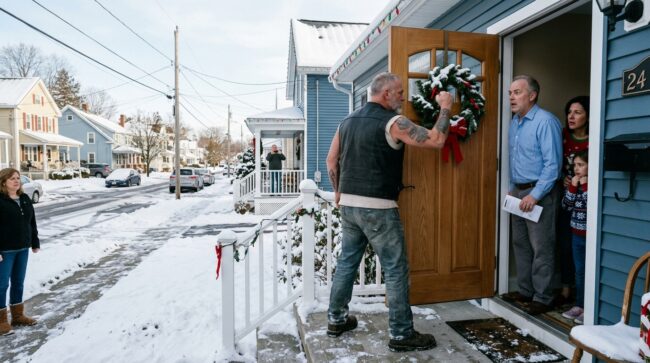
A biker stood on their porch.
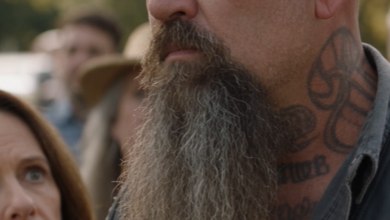
That was what the whole street would say later, because it was the first and easiest version of the truth. A large man in a sleeveless leather cut over a thermal shirt, shoulders broad under old winter muscle, gray threaded into his beard, tattooed forearms visible even in the cold, boots planted wide on a snow-dusted welcome mat that now looked absurdly small beneath him. Beside the porch steps, his black Harley was parked at an angle that made it look less like transportation and more like a warning.
From the Mullens’ front window across the street, a phone lifted behind the curtain.
On the next porch over, old Mrs. Delaney cracked open her storm door, one hand on her robe, already hungry for the shape of the trouble.
Tom knew two things at once, and neither made sense.
He had never seen that biker before.
And somehow, with a certainty so sharp it made his throat tighten, he knew the man had come for him.
“Don’t open it,” Marissa whispered.
Tom was still staring at the frosted glass panel beside the door, where the biker’s shape moved only slightly, more shadow than face. “I have to.”
“For what?”
He had no answer.
Because the question was bigger than the moment. It was the question under everything now. For what? For the mortgage two weeks late. For the heating bill folded under the toaster. For the severance packet he hadn’t shown her yet. For the shame of being fifty-three and called into a conference room at 3:10 on December 21 to be told that downsizing was unfortunate but necessary and security would walk him out like he might steal something on the way.
He opened the door anyway.
Cold air came in first. Then the biker.
Not inside. Just close enough to fill the frame.
Up close, the man looked older than Tom had guessed from the window. Late fifties, maybe sixty. White. Wind-burned skin. A deep scar along one jawline. Eyes so pale they felt almost colorless in the porch light. He smelled like snow, road leather, and something metallic, not blood, not danger exactly—just outside. He glanced once past Tom into the house.
That was all it took.
Marissa stepped forward immediately. “You need to leave.”
The biker ignored her.
“Thomas Grady?” he said.
Tom swallowed. “Yeah.”
The man reached into his vest.
Lily gasped behind them.
Mrs. Delaney let out a small cry from next door. Across the street, someone actually shouted, “Hey!”
Tom’s entire body went cold.
Because there, on a Christmas porch in a neighborhood of inflatable reindeer and white string lights, the biker had just reached inside his cut the way people reached in movies right before things shattered.
And for one suspended second, with his daughter behind him and the whole block watching, Tom truly believed that whatever had followed him home from that last terrible day at work had finally found his address.
The man did not pull out a weapon.
He pulled out a folded piece of paper.
That should have calmed things down. It didn’t.
If anything, it made the whole moment stranger.
The biker held the paper toward Tom without explaining it, without stepping back, without softening his expression the way decent men usually do when they’re standing uninvited on another man’s porch at Christmastime. Tom hesitated before taking it. His fingers were clumsy from the cold and from the humiliating pulse of adrenaline still thudding through his chest.
Behind him, Lily had left the tree completely now. She stood halfway between the living room and the front door in pink socks and a reindeer sweater, peering around her father with the cautious curiosity of a child not yet sure whether she was looking at danger or a story she’d remember forever.
Marissa moved to block her. “Lily, back up.”
But the girl didn’t.
Neither did the neighbors.
By then Willow Creek Lane had become what every American street becomes the second something unusual happens in public: a courtroom with no judge and too many witnesses. A front porch light switched on across the road. A garage door lifted halfway down the block. Someone’s teenage son came out in socks to stand on frozen concrete and record from a distance he probably thought was safe. Snow crackled under footsteps as more people edged closer without admitting that was what they were doing.
Tom unfolded the paper.
His stomach dropped.
It was a photocopy of his termination notice.
Not all of it. Just enough. The company logo at the top. His name. The date. Effective immediately.
He looked up sharply. “What is this?”
The biker’s face did not change. “You know what it is.”
That was when the fear on the street shifted.
Not vanished. Shifted.
Because now the scene was uglier in a new way. This was not some random drunk. Not a lost rider asking directions. Not a harmless misunderstanding. This was a man who somehow had a copy of private employment paperwork and had brought it, at night, to the home of a man who had just been fired.
Marissa saw the page in Tom’s hand and went white.
“Where did you get that?”
The biker kept his eyes on Tom. “That’s the question, isn’t it?”
No one on the street liked the sound of that. It was too calm. Too pointed. The wrong kind of sentence from the wrong-looking man at the wrong house.
Mrs. Delaney called out from her steps, “Tom, do you want me to call somebody?”
Marissa answered for him. “Yes.”
“It’s already being called,” someone across the street said.
The biker neither turned nor reacted.
That unsettled Tom more than if he had.
He should have been embarrassed, maybe angry, maybe scared enough to shut the door. Instead he felt something more confusing and far worse: the dawning suspicion that this moment had not begun on his porch. That it had started earlier, somewhere else, in some room or conversation he was never supposed to hear.
“What do you want?” Tom asked.
The biker finally shifted his weight. Snow clung to the edges of his boots. “To know if you signed it.”
Tom stared. “What?”
“The paper.” The biker tipped his chin toward the photocopy. “Did you sign what they put in front of you?”
The question was so specific, so bluntly practical, that Tom almost didn’t understand it at first. Marissa looked at him, then at the page, then back at the biker. Lily’s eyes moved between all three adults with growing confusion.
Tom answered slowly. “No.”
The biker gave one short nod, as if that mattered.
Across the street, a car door slammed.
The block fell quieter in that particular way people do when they sense official attention arriving. A Fort Wayne Police cruiser rolled into view through the blue dusk, headlights washing over lawns, snowbanks, mailbox posts wrapped in red ribbon. It stopped crookedly near Tom’s driveway. Officer Eric Hensley stepped out first, tall, thick around the middle, his winter jacket already half-zipped. Behind him came a younger officer, a woman with a knit cap pulled low and one hand near her radio.
For a moment, the scene looked exactly how everyone would describe it later if they wanted the easiest version: terrified family, shaken neighborhood, cops at the house, and a biker on the porch holding a fired man’s paperwork like leverage.
Officer Hensley came up the walk with his open-palmed, everybody-stay-stupid-calm posture.
“Evening,” he said. “How about we take a breath.”
No one did.
Marissa spoke first, fast and tight. “This man came to our house with private documents.”
Tom hated how exposed that sentence made him feel. His firing had barely existed for three hours. Already it was standing half-naked under porch lights for the neighborhood to inspect.
The younger officer looked at the paper. “Sir, where did you get that?”
The biker’s answer came flat. “From the place that fired him.”
That landed hard.
Officer Hensley’s expression changed almost imperceptibly, from routine caution to something more focused. “You work there?”
“No.”
“Then why were you there?”
The biker looked at Tom again, as if the man on the porch mattered more than the police officer asking the question. “That depends on what he was told.”
Marissa’s temper finally broke through her fear. “Stop talking in circles. Either say why you’re here or get off my porch.”
Lily flinched at her mother’s voice.
The biker heard that. Tom could tell because his eyes flicked once toward the girl, then away just as quickly. Not interest. Not threat. Just notice. Still, in the tension of that moment, even that looked wrong.
Officer Hensley stepped closer. “Sir, I’m asking you one more time. Purpose of contact.”
The biker reached into his vest again.
This time both officers stiffened.
Marissa pulled Lily behind her so fast the girl nearly stumbled. Tom stepped forward without thinking, protective instinct outrunning sense. Across the street, the teenager filming whispered, “Oh man,” loud enough for everyone to hear.
The biker stopped with two fingers still inside the vest.
Then, very slowly, he pulled out a small rectangular object wrapped in a clear plastic sleeve.
A badge.
Not a police badge. Old. Brass. Bent on one edge. Attached to a faded ID card beneath it.
No one on the porch could make out the details yet, but the effect was immediate and disorienting. The item did not explain him. It complicated him. A biker with a scar, a termination notice, and an old workplace badge from somewhere—none of it fit. None of it made the scene safer.
Officer Hensley frowned. “What is that?”
The biker did not hand it over.
Instead, he looked straight at Tom and asked, in the same quiet voice he had used from the beginning, “When they walked you out, did they take your keycard before or after the supervisor in the gray tie shook your hand?”
Tom felt the blood leave his face.
There had been a gray tie.
Not navy. Not black. Gray.
The room suddenly seemed to tilt, and for the first time since the pounding began, Tom was no longer sure the most dangerous thing on his porch was the man standing there.
Everything after that happened faster, though Tom would later remember it in fragments, as if the night had broken into jagged pieces the mind could only carry one at a time.
The younger officer moved first. “Sir, put the item down.”
The biker didn’t.
He did not raise it. Did not threaten anyone. He simply kept holding the plastic sleeve at chest height, his broad body still filling too much of the porch, his face unreadable under the weak yellow light.
Officer Hensley changed tone. “Now.”
Tom should have wanted the police to take control. Any normal man would have. Instead he was staring at the biker with a sick, involuntary focus, because no stranger should have known about the gray tie. No stranger should have known the exact humiliating choreography of being dismissed from a twenty-eight-year job and escorted out like dead weight before the office Christmas lunch even started.
Marissa grabbed his arm hard. “Tom.”
He barely heard her.
The biker shifted his gaze to the officers at last. “I’m not here for them.”
That was the wrong thing to say. It made everything worse.
Mrs. Delaney gasped outright. The boy with the phone on the sidewalk moved closer. Someone down the street yelled, “Then what are you here for?” as if the whole block had appointed itself to demand answers.
The biker ignored them all.
Officer Hensley stepped onto the porch. “Sir, I need you to set that down and step away from the door.”
For the first time, the biker’s jaw tightened. Not anger exactly. Frustration. As if every second spent explaining himself was stealing time from something he considered more urgent.
Then he did something that looked, to every witness on Willow Creek Lane, almost like escalation.
He took one step closer to Tom.
Marissa shouted.
The younger officer came up fast from the side. Lily cried out, and the sound tore through Tom more violently than anything else had that night. Christmas lights blinked idiotically along the porch rail as if nothing real could happen under them. The plastic sleeve in the biker’s hand caught the light. Hensley reached for his arm.
And the biker said, sharply for the first time, “Don’t.”
That single word froze the scene.
Not because it was loud. Because it carried the kind of command that made other men stop before they chose to. Discipline. Habit. Something trained long ago and not fully gone.
Tom saw it affect Officer Hensley too.
Only for a fraction of a second. But it was there.
“Sir,” Hensley said, more carefully now, “you are making this a lot worse.”
“No,” the biker said. “What made it worse happened at 3:10 this afternoon.”
Tom felt the exact time hit him like a shove.
3:10.
Conference Room B.
Human Resources on speaker because the regional director “regrettably couldn’t attend in person.”
The cardboard banker’s box they had handed him for his framed photo, his mug, and the cheap brass Christmas ornament Lily had made him at school six years ago, the one he kept on his desk all year because he had nowhere else to put the part of his life that mattered.
Marissa’s grip on his arm loosened.
Not because she trusted the biker. Because she saw Tom’s face and understood, in one terrible instant, that some of what this man was saying was true.
The street sensed it too. People didn’t know the details, but crowds always know when a story begins bending away from the version they had chosen.
“What do you mean?” Tom asked.
The biker finally lowered the plastic sleeve and held it out.
Tom took it.
Inside was an old employee badge from Grady Industrial Plastics. Not his. Not current. The photo showed a much younger version of the man on the porch—cleaner beard, darker hair, same pale eyes, same scar beginning along the jaw. The name beneath the cracked plastic read:
MICHAEL VOSS
MAINTENANCE / NIGHT SHIFT
Tom looked up slowly.
The name meant nothing.
The company did.
The biker—Michael Voss, apparently—watched him absorb that and said nothing more.
That silence became the loudest thing on the porch.
Officer Hensley eased back half a step, not satisfied, not relaxed, just recalculating. Marissa stared at the badge, then at the man, then at Tom as if waiting for some explanation he did not have. Lily pressed herself against her mother’s side, wide-eyed and silent now.
Tom shook his head. “I don’t know you.”
“I know,” Voss said.
“Then how do you know what happened today?”
A car passed at the end of the block, tires hissing over old snow. Somewhere nearby, a dog barked once and stopped. Every small sound seemed to fall away afterward, leaving the porch exposed and listening.
Voss glanced once toward the street, toward the neighbors, the phones, the police, the whole public machinery of misunderstanding now surrounding them. Then he reached into the inner pocket of his vest one last time.
Officer Hensley inhaled sharply.
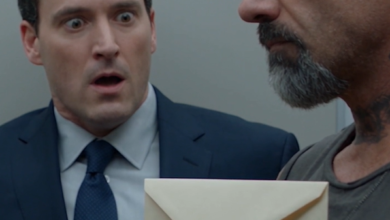
But Voss only pulled out a business envelope, creased and unsealed, with Tom’s name written across the front in black ink.
Not printed. Written.
He held it between two fingers for a moment, then offered it over.
Tom took that too.
The paper felt strangely warm despite the cold.
“What is this?” Marissa asked.
Voss answered without looking at her. “Something they didn’t want mailed.”
Tom stared at the handwriting. He didn’t recognize it. Yet the pressure in his chest changed the second he felt whatever was inside the envelope shift against his thumb. Not many pages. One, maybe two. Flat. Personal.
Officer Hensley said, “Mr. Grady, maybe don’t open anything right now.”
But Tom was already sliding a finger under the flap.
Voss stopped him with five quiet words.
“Read the signature first.”
Tom looked up.
For the first time since the pounding on the door began, something in the biker’s face had changed. Not softened. Not even close. But beneath the road-hardened stillness, beneath the suspicion he had dragged onto the porch with him, there was something else now. Something heavier than anger and older than intimidation.
Recognition, maybe.
Or grief.
Tom drew the paper halfway from the envelope. His eyes dropped to the bottom line before he read anything above it.
And the moment he saw the name there, his knees nearly gave out.
Because it was a name he had not heard spoken aloud in nineteen years.
And standing in the Christmas light with a silent biker on his porch, two police officers inches away, neighbors filming from the snow, and his wife gripping the back of his coat, Tom understood that whatever this was—
it had been coming toward him for a very long time.
Tom did not open the letter all the way.
His fingers stopped at the edge of the page, the paper trembling slightly in the porch light while the whole street seemed to lean closer without moving. The signature at the bottom had already done enough damage.
Daniel Grady.
For nineteen years, Tom had kept that name buried so deep inside himself it had stopped feeling like memory and started feeling like scar tissue. Nobody in this neighborhood knew it. Marissa knew only the outline. Lily knew nothing at all. To the people watching from behind curtains and across snow-dusted lawns, it was just ink on a page. To Tom, it was a door he had nailed shut with both hands.
Marissa saw his face and whispered, “Tom?”
He didn’t answer.
Officer Hensley, who a minute earlier had looked ready to drag the biker off the porch, lowered his voice. “Mr. Grady, do you know this person?”
Tom kept staring at the signature. “He was my brother.”
The sentence dropped into the cold and changed everything.
Not cleaned it up. Not explained it. But the fear on the block shifted into something quieter and far more dangerous: attention. People could smell a family wound even when they didn’t know the shape of it.
Lily looked up at her father, confused. “You have a brother?”
Tom closed his eyes for half a second.
Had. The word came to him first. Not have. Had. But he couldn’t say that to his daughter with the whole street standing outside like witnesses to a private collapse.
Michael Voss said nothing. He stood as still as the Harley at the curb, the snow gathering white along the seams of his boots, letting the silence do what explanation couldn’t.
Marissa stepped closer to Tom. “You told me Daniel ran off when you were young.”
Tom swallowed. “He did.”
Michael’s pale eyes shifted to her at last. “No,” he said. “He was pushed.”
That made Officer Hensley look up sharply.
Tom felt something hot and immediate rise under his shame. “You don’t get to come to my house and rewrite my family.”
Michael didn’t flinch.
“I’m not rewriting it,” he said. “I’m carrying the part you never got.”
The porch went still again.
Snow blew in a loose line across the walkway. Somewhere down the block, a plastic Santa tipped sideways in the wind and then settled back upright. The neighborhood lights kept blinking with their automatic, indecent cheer.
Tom looked down at the page and finally pulled it free.
It was written by hand. Not recent. The ink had gone a little brown with time, and there were folds pressed into it so hard they had nearly cut the paper. It wasn’t long. Daniel had always written the way some men talk—like too many words felt dangerous.
Tom read the first sentence twice before it landed.
If Mike is standing at your door, it means I waited too long again.
His throat closed.
Marissa pressed a hand against her mouth. Even she could read the age in the paper, the fact that this had not been written yesterday or at the factory or in some stunt arranged to make a fired man panic before Christmas.
Michael reached into his vest once more, and this time no one moved to stop him. He took out a small object wrapped in a red shop rag and set it carefully on the porch rail beside the little ceramic angel Marissa put out every December.
Tom knew what it was before the cloth even came off.
A cheap silver Zippo lighter, dented at one corner, with the initials D.G. scratched into the bottom by a nail years ago.
Tom had given it to Daniel on Christmas Eve 1987 behind their parents’ garage.
Lily, still hidden against her mother’s side, whispered, “Dad?”
Tom didn’t trust his voice enough to answer.
Michael unwrapped the lighter fully and said, in the same level tone he had used all night, “He kept it until the end.”
That was the quiet turn.
Not a confession. Not an explanation. Just a lighter, a letter, and a sentence that made the whole threatening shape of the biker on the porch begin to fracture into something harder to look at.
Officer Hensley stepped back off the porch.
Not retreat. Respect.
Tom looked at Michael. “Where did you know him from?”
Michael glanced once toward the street, at the neighbors still watching, the phones still out, the officers still there because none of them yet understood they were no longer dealing with a disturbance. They were standing in the middle of an old unfinished story.
“Inside,” Michael said.
Only that.
Marissa hesitated. Tom did too. Every instinct told him not to let this man farther into his house. Every other instinct—the older one, the one now awake and hurting—told him that if he let Michael walk away, he would lose Daniel a second time.
Tom stepped aside.
The crowd on Willow Creek Lane made a sound almost too soft to hear, disappointment and relief mixed together.
Michael Voss ducked under the wreath and entered the Grady home without another word, carrying the cold in with him.
Marissa made Lily sit on the couch with a blanket around her shoulders while Officer Hensley remained just inside the doorway and the younger officer stayed on the porch, partly for protocol, partly because the block had not finished watching.
The Christmas tree in the corner was only half lit. Tom had stopped decorating when the call from Human Resources came. A cardboard box from his desk still sat by the recliner with a coffee mug, three framed photos, and a file folder he had not opened. Everything in the room suddenly looked temporary, as if bad news had entered first and rearranged the furniture.
Michael did not sit.
He stood beside the tree, hands loose at his sides, his road-worn frame awkward among the ornaments and school-made paper snowflakes. Without the porch between them, he looked less dangerous and more exhausted. Still formidable. Still the kind of man people crossed the street to avoid. But no longer random.
Tom held Daniel’s letter in both hands.
“When did he write this?”
Michael answered immediately. “Nine months ago.”
Tom stared at him. “Nine months?”
“He was in Louisville by then. Truck yard work when he could get it. Sleeping behind a repair shop when he couldn’t.”
Marissa looked stricken. “He was alive?”
Michael’s gaze moved to her. “Until October.”
The room changed temperature.
Tom sat down because his knees no longer seemed interested in remaining part of the conversation. Lily looked from face to face, sensing death before understanding it. Children always heard grief earlier than adults wanted them to.
“How?” Tom asked.
Michael’s answer came plain. “Lung failure. Years of welding, bad heat, worse habits, no insurance, too much waiting.” He paused. “He didn’t make it to winter.”
Tom bent over the letter and pressed the heels of his hands into his eyes. The pain was immediate, but welcome. Cleaner than the other kind.
“I thought he left us.”
Michael gave the smallest shake of his head. “He thought the same about you.”
Marissa was the one who spoke next, because Tom couldn’t. “What happened?”
Michael looked at the lighter on the coffee table before answering.
“Your father happened.”
No one moved.
Michael spoke the way disciplined men do when they’ve learned not to waste words, but once he started, the shape of the years came out with a terrible steadiness. He had worked nights with Daniel in Ohio first, then Missouri, then Kentucky. Not continuously. Men like that crossed paths, lost touch, found each other again in shops and truck stops and cheap rooms where the work changed but the exhaustion didn’t. Daniel talked in pieces. Never enough for pity. Never enough to sound like a man explaining himself. Just enough for another man to know where the wound was.
Tom’s father, Frank Grady, had borrowed money against everything when the old machine shop failed in 2004. The house. The truck. Tom’s savings bond from their mother. Daniel, twenty-three and reckless, found out first. He had already started running with men who could get cash quick and ask questions later. One night, he took envelopes from Frank’s office desk, thinking he was saving the family.
He wasn’t.
It was payroll money for temporary workers. And when it disappeared, Frank did what proud men sometimes do when their own failure threatens to become public.
He handed Daniel a suitcase and told him to leave before sunrise.
“He told Daniel he was protecting you,” Michael said. “Said if the police came around or the company people looked too close, your future at Grady Industrial would be finished before it started. Said one son staying clean mattered more than one son already slipping.”
Tom stared.
Marissa whispered, “My God.”
Tom’s chest tightened so sharply he had to put the letter down. “That’s not—” He stopped. Because even as the protest rose, memory moved under it. The suitcase by the door. His father’s face gray with anger but oddly controlled. His mother crying in the laundry room. Daniel gone before daylight. Frank telling Tom the boy had finally done what everyone knew he would do.
You can’t save people who enjoy burning their lives down, his father had said.
Tom had believed him because it made order out of shame.
Michael continued. “Daniel waited for you at the bus station on Clinton Street until noon. Thought you’d come.”
Tom’s head jerked up. “I didn’t know.”
“I know.”
The two words landed differently now.
Michael was not accusing him. That was the brutal part. He was giving him the exact mercy Tom no longer felt he deserved.
Officer Hensley, forgotten for several minutes near the doorway, cleared his throat softly as if unsure whether he was still allowed to occupy the same air. “So why tonight?”
Michael looked toward the box from Tom’s office.
“Because Daniel never stopped asking about him,” he said. “And because three weeks before he died, he heard Grady Industrial was about to clean house before Christmas. He asked around. Found out Tom was on the cut list.” Michael’s jaw tightened once. “He wrote the letter then. Made me promise that if the company ever did to his brother what their father did to him—throw him out and call it necessary—I’d put this in Tom’s hands. Not a mailbox. Not HR. His hands.”
Tom could barely speak. “Why you?”
The answer came after a beat.
“Because I owed him.”
Tom looked up.
Michael’s eyes stayed on the tree, on one handmade ornament hanging slightly crooked near the center. “In St. Louis, winter of 2012, I was sleeping in my truck with a busted shoulder and no gas money. Your brother sold the only decent coat he had to get me surgery co-pay and two nights in a motel.” His voice remained level, but something in it had gone deeper. “He said it wasn’t charity. Said a man gets pulled up where he can.”
Lily, who had followed only pieces of the adult words, asked softly, “Uncle Daniel helped you?”
Michael looked at her then. Really looked.
“Yes,” he said.
The room went quiet again.
And for the first time since that pounding started at the door, Tom understood the shape of the man standing in his living room. Not a threat. Not a collector. Not some biker who had carried bad news to enjoy the damage.
A messenger.
A debtor.
A witness.
And maybe, more painfully than all of that, the only person left alive who had loved Daniel long enough to keep showing up for him.
Tom read the rest of the letter in silence.
It was not sentimental. Daniel was not built that way. There were no speeches about forgiveness, no polished wisdom about Christmas or fate. Just hard, narrow lines written by a man who had spent too long learning how little the world rewarded softness.
He wrote that their father had lied to both of them.
He wrote that he had stood outside Grady Industrial twice over the years but never walked in because Tom looked settled, respected, clean in a pressed shirt, and Daniel could not stand the thought of dragging old dirt across his brother’s good life.
He wrote that he had once seen Marissa and Lily from a distance outside a county fair and kept walking because “some shame gets in your bones and starts answering for you.”
Then, near the end, the letter changed.
What Dad did to me started the split, but what I did after that kept it open. That part’s mine. Don’t give me sainthood just because I’m sick. But don’t give him all the truth either.
Tom had to stop there.
His eyes blurred. He pressed the paper flat against his knee, breathing carefully, because Lily was in the room and he had spent her whole life believing he could keep grief orderly if he worked hard enough.
Marissa took the letter from him gently and read the final lines herself. When she did, her face broke in a new way.
She handed it back without speaking.
Tom forced himself down to the signature again, then the postscript beneath it, almost squeezed into the margin.
P.S. Mike won’t ask, so I am. There’s a key taped under the false bottom of his saddlebag. If he comes to your door in December, it means he finally lost the garage. Don’t let him leave hungry. I already owe him too much.
Tom looked up so fast Michael almost seemed startled.
For the first time all night, the big man actually seemed uncomfortable.
Marissa saw it too. “What garage?”
Michael’s mouth hardened a little. “Nothing.”
“Michael,” Tom said.
He held Tom’s gaze for a long second, then exhaled once through his nose. “Storage place on Wells Street. I rented half of it. Bikes, tools, a cot, some parts work. Owner sold in November. I’ve been moving from one friend’s shop to another since.”
Tom stared at him.
The family twist landed not as drama, but as recognition. Daniel, dying, had not written only to reconnect his brother. He had arranged one last exchange of shelter between two men who both thought they were the one being rescued.
Lily, wrapped in her blanket, asked the simplest question in the room.
“So… Uncle Daniel wanted Dad to help you?”
Michael looked down at the floorboards. “Looks that way.”
Marissa sat very still, then let out a breath halfway between disbelief and heartbreak. “He was dying and still trying to settle other people.”
Michael gave one short nod. “That was Daniel.”
Tom laughed once, but it came out broken. “No. That was the kid I should’ve gone after.”
Michael did not soften the blow for him. “Yes.”
The honesty hurt. Tom needed it.
Outside, the block had mostly gone quiet. A few curtains still glowed. The officers had not left, but they were no longer attending a threat. They were standing at the edge of a family disclosure no one had intended to make under Christmas lights.
Tom reached down to the cardboard box from his office and pulled out the brass ornament Lily had made years ago: a crooked star with glitter long since rubbed off. He turned it over in his hand.
“Do you know why they fired me?” he asked.
Michael’s expression sharpened slightly. “I’ve got a guess.”
Tom gave a hollow smile. “They said restructuring. Efficiency. Year-end numbers.” He looked at Hensley, then back to Michael. “But this afternoon I refused to sign off on a maintenance delay for Press Line Three. Bearings were already throwing heat. Two temps were still being assigned that line next week. They wanted me to push the paperwork until January.”
Michael’s face went still in a dangerous new way. Not wild. Cold.
“Gray tie?” he asked.
Tom nodded.
Michael looked toward the ceiling as though seeing another building entirely. “Rick Lathrop. He was there when a man lost three fingers in ‘09 because nobody wanted holiday shutdown numbers to look bad.”
Officer Hensley muttered something under his breath.
Tom stared. “You knew him?”
“I knew his type.”
Now the night widened one more time. Tom’s firing was not just cruelty. It was familiar cruelty. The same machinery of silence, pressure, and disposal that had broken Daniel loose from the family years earlier had reached its clean corporate hand back into Tom’s life and tried again.
Michael had not come simply with a letter.
He had come because he recognized the pattern.
And because Daniel, even at the end, had recognized it too.
Officer Hensley left first.
Not with apologies, though his tone had changed entirely. He said there was no basis for further action, that he’d note the call as resolved, and that if Tom wanted to discuss anything related to the company or the paperwork, he should do it after the holiday with a labor attorney, not a supervisor. The younger officer nodded once to Lily on her way out, a small human gesture after a strange and heavy night.
The street slowly gave the family back its privacy.
Curtains closed. Porch doors shut. The teenager with the phone disappeared inside. Mrs. Delaney, who had seen enough life to know when gossip crossed into grief, turned off her porch light and left them to the snow.
Inside, Marissa reheated soup nobody had wanted an hour earlier.
Lily fell asleep on the couch under the blanket, one hand still curled around the edge of the silver tinsel she had been hanging before the pounding began. The Christmas tree glowed softly now. Tom couldn’t remember turning on the rest of the lights, but somehow they were on.
Michael stood near the front door as if he still expected to leave.
Tom set Daniel’s lighter beside the letter on the table and looked at him.
“You can stay tonight.”
Michael shook his head once. “Wasn’t why I came.”
“I know.”
Marissa brought over a bowl anyway and set it in his hands. Michael looked at it like it was something more difficult than anger. For a second Tom thought he might refuse on principle, or habit, or shame. Then he sat in the chair by the radiator and ate in the quiet way of a man not used to warm rooms being offered without a price.
No one filled the silence with speeches.
That would have ruined it.
After a while, Tom went to the hall closet and pulled out the old cedar box that held the ornaments they didn’t use every year. At the bottom, under a string of lights and a cracked angel wing, he found what he had not looked at in nearly two decades: a snapshot of two boys on a snowbank beside a rusted sled, one already broad-faced and serious, the other grinning like trouble hadn’t yet learned his address.
He carried it back and set it next to Daniel’s lighter.
Michael looked at the picture for a long time.
“That one’s before everything,” he said.
Tom nodded. “Yeah.”
Marissa stood in the kitchen doorway watching the two men and said quietly, “Then maybe that’s not nothing.”
The clock over the stove clicked toward eleven.
Finally Michael rose, set the empty bowl in the sink, and reached for his gloves. Tom thought the moment had come to lose him too. Another man at another threshold. Another unfinished goodbye.
But instead of opening the door, Michael crouched near Lily’s half-decorated tree.
One ornament hook had bent wrong. The silver tinsel she’d dropped earlier trailed across the rug. Michael fixed the hook with fingers scarred by work and cold, then took the crooked brass star from the table and hung it on the front branch where a child would notice it first thing in the morning.
A small act. Silent. Careful.
When he stood, Tom said, “The guest room’s cold, but the heat will reach it by midnight.”
Michael looked at him.
For a second, the hard road face remained exactly what it had been on the porch—guarded, weathered, suspicious of any comfort that arrived too late. Then something in it gave way just enough to be seen.
He nodded once.
That was all.
Later, long after Marissa carried Lily to bed and the neighborhood sank under fresh snow, Tom sat alone by the tree with Daniel’s letter open in his lap. The house smelled faintly of soup, pine, and cold leather drying near the vent. Down the hallway, in the room they usually used for storage, the floorboards creaked once under the weight of a man who had arrived looking like trouble and turned out to be the last bridge to a brother Tom had already mourned wrong.
On the tree, the brass star caught the light and held it.
Tom looked at it for a long time.
Then he reached up, straightened it slightly, and let his hand rest there a second longer than necessary, as if some things—family, grief, mercy, the dead still arranging shelter for the living—could only be answered that way.
In silence.
And with both hands.