Part 2: He Said He Was Too Old to Take Care of a Dog. Six Months Later That Dog Was the Only Reason He Was Still Alive — and He Finally Knew What to Name Him.
PART 2
It was a morning in late November, three winters into the empty-box walks, with the first real snow on the ground, when Walter came out his front door and there was a dog at the bottom of the porch steps.
Not a nice dog. Not a movie dog. A wreck of a dog.
Walter figures he was a shepherd mix of some kind, big-framed but starved down to the ribs, with a coat that had been black once and was now mostly mud and burrs and bare patches. One ear was torn. He was favoring a back leg. He had the look of a dog that had been on his own through at least one Maine winter and was not going to survive a second.
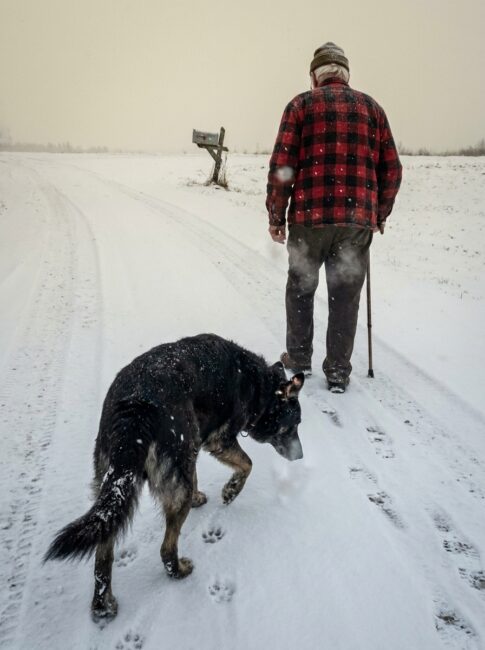
The dog didn’t come to him. Didn’t wag. Just stood at the bottom of the steps in the snow, watching him, the way a wild thing watches you — ready to be gone the second you reach for it.
Walter, being Walter, didn’t reach for it.
He said, “Well.” And then he started his walk.
And the dog followed him.
Not close. Twenty, thirty feet back, off in the tree line at first, then in the road. The whole mile to the mailbox. Walter opened the empty box, looked inside, closed it, and turned around, and the dog was sitting in the road watching, and when Walter walked back, the dog followed him home and lay down at the bottom of the porch steps again.
Walter put out a little food. Not too much. He told me he was careful about that. “You feed a stray too good too fast, you’ve made a decision you didn’t mean to make.”
Because Walter had already decided.
He was not going to keep this dog.
He told me this very firmly, at the kitchen table, with the dog asleep under it. He said an 87-year-old man has no business taking on a dog. He could barely take care of himself, some days. His hands shook. His knees were going. What happens to a dog when the man who owns it falls and can’t get up, or has the stroke the doctor keeps warning him about, or just doesn’t wake up one morning? You don’t take on a life you can’t promise to finish caring for. That’s not kindness. That’s selfishness wearing kindness’s coat.
So Walter did not keep the dog.
He just — didn’t chase it off, either.
And every morning, the dog was at the bottom of the steps. And every morning, when Walter started his walk to the empty mailbox, the dog walked it with him.
PART 3
I should tell you who I am, since I’m the one writing this down.
My name is Dana. I’m a rural mail carrier. I’ve run the route that includes Walter’s road for nine years. And for most of those nine years, Walter’s box was the saddest stop on my whole route, because there was never anything to deliver to it, and I’d see him sometimes — the old man in the flannel, a mile off, just starting down his road as I pulled away — and I knew exactly where he was headed and exactly what he was going to find.
Nothing.
I thought about it more than I should have, probably. You see a lot on a rural route. You become a kind of witness to people’s lives by the things that do and don’t show up in their boxes. And Walter’s box told me a story I didn’t like.
So that November, when I started seeing a dog with him — first one morning, then every morning — I’ll admit I watched for it. It became the good part of my day. I’d come over the rise on the paved road and look down his dirt lane and there’d be the two of them, the old man and the rough black dog, walking the mile together in the snow.
They were a strange pair.
Walter walked slow, with a cane some days, the flannel and a wool hat, his breath fogging. The dog walked off his left side, always the left, about six feet out — close enough to be with him, far enough to bolt if he had to. The dog never came when called, because Walter never called him. They had an arrangement that ran entirely on Walter pretending not to care and the dog pretending not to stay.
I started leaving things in the box.
I want to be honest that I broke a small rule to do it. I’d write a couple of lines on a card — about the weather, about how the Sox looked, nothing much — and I’d put it in the box, unstamped, no address, just so the old man would open that thing one morning and find it not empty.
I never signed them. I didn’t want him to feel watched. I just couldn’t stand the box being empty one more winter.
I don’t know if he knew it was me. He never said. But I noticed, over that winter, that he started walking just a little faster on the way down. Like there might be something worth getting to.
The dog walked with him through December. Through the worst of January, the cold that cracks trees, when I genuinely worried about both of them. Through the February thaw that turns the road to a foot of mud. The dog filled out — Walter was feeding him more than “a little” by then, whatever he said — the bare patches grew back, the limp went away. He was still a rough-looking animal. But he was a healthier rough-looking animal, and he had a road to walk and an old man to walk it beside, and an old man who absolutely was not keeping him.
Six months it went on like that.
Every morning. The two of them. Down to the box and back.
And the dog still slept at the bottom of the porch steps, outside, even in the cold, because Walter would not let him in.
“I’m not keeping him,” he’d say, to the dog, to me, to the empty kitchen.
The dog would lie down on the steps anyway.
PART 4
It was a morning in late May. The 16th.
I came over the rise on the paved road, and I looked down Walter’s lane the way I always did, and there was no old man.
There was just the dog.
The dog was up on the porch — not at the bottom of the steps where he always lay, but up at the top, at the front door — and he was throwing himself at it. I could see it from the paved road. Up on his hind legs, slamming his front paws into the door, dropping down, slamming into it again. And barking. A sound I could hear from a quarter mile off, over the engine, over the spring morning.
I’d never once heard that dog bark.
In six months of watching them, that dog had never made a sound. He was a silent dog. A wild thing’s silence, that doesn’t waste noise.
And he was screaming at that door.
I turned down the lane. I don’t think I’d ever driven the mail truck down somebody’s private road before, but I did then. The dog heard the truck and came off the porch and ran at me — not at me, around me, back to the door, then back to me, the way a dog does when it’s trying to take you somewhere — and I got out and I went up the steps and I knocked and called Walter’s name, and there was no answer.
The door was unlocked. Country people.
He was on the kitchen floor.
He’d gotten up that morning, he told me later, put on his boots and the flannel, and his knee had gone out from under him on the way across the kitchen, and he’d come down hard on the linoleum and couldn’t get back up. He’d been there since just after dawn. Hours. Couldn’t reach the phone. Couldn’t make his legs work to stand. An 87-year-old man on a cold floor a mile from the nearest neighbor, with the heat off and the morning getting away from him.
He told me the last clear thing he remembered before I came through the door was the sound of the dog.
The dog hitting the door. Over and over. Barking like the world was ending.
“I kept thinking,” Walter said, “what’s gotten into him. He doesn’t bark. And then I thought — oh. He’s calling somebody.”
I called 911 from his kitchen. The ambulance came out from town. They got him up, got him warm, got him checked — bruised hip, mild hypothermia, dehydrated, but nothing broken, nothing that wouldn’t mend. Another few hours on that floor and they told me it would have been a different conversation. The cold does to old bodies what it does. He was right at the edge of it.
The dog did not leave his side the whole time the paramedics worked.
For six months that dog had kept six feet of distance from Walter at all times. Close enough to walk with. Far enough to run.
When they loaded Walter onto the stretcher, the dog put his head on the old man’s chest and would not be moved, and one of the paramedics — a young guy, seen everything — had to stop for a second and look out the window.
PART 5
Here’s the part Walter takes the most time with, when he tells it.
That dog had been at the bottom of his porch steps every morning for six months, refusing to leave, while Walter refused to keep him.
But that morning, the dog wasn’t at the bottom of the steps.
He was at the top.
At the door.
He had never been allowed on that porch. Walter had been very clear about it — the steps, not the porch, that was the line, that was the deal. The dog had honored it for six months. Six feet of distance and the bottom of the steps. The whole arrangement ran on the dog respecting every boundary Walter set, because that was the price of being allowed to stay near a man who wouldn’t admit he wanted him there.
And on the one morning it mattered, the dog broke every rule he’d ever kept.
He came up onto the porch he wasn’t allowed on. He went to the door he was never let through. He made the noise he never made. He broke the distance he’d held for half a year — all of it, all at once — because the old man hadn’t come out, and the road hadn’t been walked, and something was wrong with the only fixed point in that dog’s entire world.
For six months Walter had told himself he wasn’t keeping the dog because he was too old, too frail, too close to the end to be responsible for another life.
The dog had spent those same six months quietly becoming the one thing standing between Walter and dying alone on his kitchen floor.
Walter, who would not take responsibility for the dog’s life, had had his own life taken responsibility for — by the dog, without permission, the way the dog did everything, on his own terms, from six feet away, until the morning six feet wasn’t close enough and he closed the distance for good.
PART 6
Let me go back and tell you what the whole strange six months had actually been.
The distance — the six feet, always off the left side. I’d thought it was a wild dog’s wariness, a stray keeping his escape open. And it was. But it was also a post. That dog had assigned himself a position relative to Walter and held it with absolute discipline, on the walk, in the yard, at the steps. He wasn’t keeping his distance to be ready to leave. He was keeping his station so he’d always be in the same place relative to the man — so he’d always know, without looking, exactly where Walter was and whether Walter was where he was supposed to be.
The morning Walter wasn’t where he was supposed to be, the dog knew it before anyone in the world could have known it.
The walk to the empty box. For three years it had been a man going to nothing, for no reason but the reason of going. For six months it had been two of them. And what I understood, finally, sitting at that kitchen table, was that the dog had turned the saddest walk in the county into the thing it had only ever pretended to be.
A man checks a mailbox because he is hoping something came for him. For three years, nothing did. Walter walked anyway, to an empty box, performing hope with no object, because the performing was all he had left.
And then something came for him.
It just didn’t come through the box.
It came up the road behind him, six feet off his left side, and walked him to the mailbox and back every morning, and filled the empty thing the walk had always been about, and then, on a cold May morning, it threw itself against a door until it had delivered him — Walter, the man himself — back to the world that had stopped sending him anything.
The box was never going to bring Walter what he was walking for.
The dog brought it up the road on his own four legs.
I sat in that kitchen and I thought about the unsigned cards I’d been sneaking into the box all winter, my small dumb attempt to make the box less empty for him, and I understood I’d been trying to do a thing a dog had already done better than I ever could.
I’d been putting words in a box.
The dog had walked the actual answer up the road and lain down at the bottom of the steps and waited six months to be claimed.
PART 7
Walter came home from the hospital after three days.
He kept the dog.
He didn’t make a speech about it. He just left the front door open the first evening he was back, and the dog stood at the bottom of the steps the way he always had, and Walter stood in the doorway, and after a minute he said, “Well. Come on, then.”
And the dog came up the steps and up onto the porch he’d never been allowed on, and through the door he’d never been let through, and into the house, and he lay down in front of the woodstove like he’d been doing it his whole life.
Walter named him Mailman.
He told me why with that particular dry Maine delivery that doesn’t crack a smile. He said the mailbox had let him down for three years straight. Empty every morning. Never once brought him a single thing he was walking down there to get.
“And then,” Walter said, “the mailbox finally delivered. Took its sweet time. But it delivered.”
He nodded at the dog by the stove.
“Brought me him.”
I told him the mailbox didn’t bring the dog. The dog brought himself. The dog walked up the road on his own.
Walter looked at me like I’d missed something obvious.
“That’s the only mail worth waiting three years for,” he said. “The kind that walks up the road on its own.”
I still run his route.
There’s mail in the box now, real mail — Walter started writing to a couple of old Army friends he tracked down, and they write back, and the box isn’t empty anymore. He still walks down to it every morning.
But he doesn’t walk alone, and he never will again.
Mailman walks on his left. Six feet out, by old habit, for the first few yards.
Then he closes the distance, and walks right beside him, all the way down.
PART 8
Walter is 89 now.
The walk is slower than it was. Some mornings he uses two canes. But he makes it, every day, down the mile to the box and back.
I asked him once if he ever worries anymore about what happens to the dog when he’s gone.
He thought about it a while.
“He found me on an empty road,” Walter said. “I figure he can find his way after.”
Then he looked down at Mailman in the snow at his side.
“But not yet.”
He picked up the one card in the box, and the two of them turned around, and walked home.
Follow this page for more stories about the things that finally show up — and the ones who walk the road beside us.