Part 2: He Was Mocked for Never Visiting Disneyland — What He Said in Class Made His Teacher Turn Away to Wipe Her Tears
Inside the plastic bag was a red Minnie Mouse keychain.
The paint had faded around the edges. One white dot on the bow had almost disappeared, and the silver ring was slightly bent.
Mrs. Bennett had seen that keychain before.
Ethan’s mother, Claire, used to carry it on her purse.
Claire Carter had worked in the school cafeteria for six years. She remembered which children hated peas, which ones needed extra time opening milk cartons, and which students quietly asked for a second breakfast.
She never made those children explain.
Mrs. Bennett looked at Ethan.
He quickly shoved the keychain back into his backpack.
“Please sit down,” she said softly.
Ethan sat, but the room no longer felt ordinary.
During recess, Mrs. Bennett asked him to stay behind.
He stood beside his desk with both hands inside his sweatshirt pockets.
“Did your mother give you that keychain?” she asked.
Ethan shook his head.
“I took it from her purse.”
Mrs. Bennett waited.
Ethan looked toward the window.
“She was not using it anymore.”
The words landed heavily.
Claire had died nine months earlier.
Most families at the school knew she had been sick, but few understood how quickly everything had changed.
The cafeteria staff had organized meals for Ethan and his father, Daniel. Parents had sent grocery-store gift cards. Mrs. Bennett had mailed a sympathy card and received a short thank-you note written in Daniel’s careful handwriting.
After that, Ethan returned to school.
He stopped asking for help.
He stopped talking about his mother.
He stopped eating strawberry yogurt because Claire used to pack it in his lunchbox with small notes folded beneath the lid.
Mrs. Bennett pulled a chair beside his desk.
“You do not have to enter the essay contest,” she said.
Ethan nodded.
“But you also do not have to pretend you are angry when you are sad.”
Ethan’s jaw tightened.
“I am not sad.”
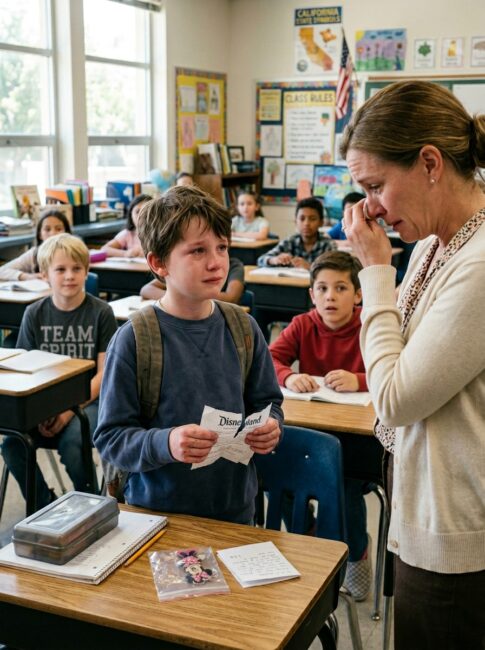
He picked up the torn permission slip.
“I just do not want to go.”
Mrs. Bennett noticed a line of handwriting on the back of one piece.
It was not Ethan’s handwriting.
The letters were rounded and neat.
Ethan’s first Disneyland trip. Save for summer.
Mrs. Bennett looked at him.
“Was this your mother’s?”
Ethan took the paper from her hand.
“She kept lists everywhere,” he said.
His voice became quieter.
The Disneyland trip had been Claire’s promise.
Not a grand promise. Not something announced at birthdays or posted online.
It began with a coffee can on top of the refrigerator.
Claire slipped spare bills inside whenever she could.
Five dollars after a weekend cafeteria shift.
Three dollars saved by packing her own lunch.
Loose change from the bottom of her purse.
She drew a small castle on the label with a black marker and wrote:
Ethan’s Summer Adventure.
Daniel added money too, although his hours at the auto-repair shop became unpredictable after the business changed owners.
They planned carefully.
They would drive instead of fly.
They would pack sandwiches.
They would stay at a motel outside the resort.
Claire told Ethan they did not need expensive souvenirs.
“We will take pictures,” she said. “Pictures do not take up closet space.”
Then Claire began feeling tired.
At first, she blamed the long cafeteria shifts.
By the time doctors discovered the cancer, the Disneyland money was no longer vacation money.
It became gas money for hospital visits.
It paid for prescriptions insurance did not fully cover.
It covered groceries during the weeks Daniel missed work.
The coffee can disappeared from the refrigerator.
Ethan never asked about it.
But he noticed.
That afternoon, Mrs. Bennett called Daniel.
He answered on the fourth ring, apologizing because he was under a car and had not heard his phone.
When she explained what happened, Daniel went quiet.
“I thought he wanted to go,” he said.
Mrs. Bennett glanced toward Ethan’s desk.
Beneath the torn permission slip, she noticed another folded piece of paper.
It was Ethan’s unfinished essay.
The first sentence read:
I would like my trip to go to Olivia because her mom is sick too.
Olivia Sanders sat two rows behind Ethan.
She was ten years old, with curly brown hair and a habit of chewing the end of her pencil when she became nervous.
Most children knew her mother had missed the recent school concert.
They did not know why.
Olivia’s mother, Jenna, had lupus. Some mornings she felt almost normal. Other mornings, lifting a coffee mug hurt.
The foundation’s Disneyland trip covered admission and transportation for each selected student and one adult guest.
Olivia wanted to enter the essay contest.
She had mentioned it quietly during lunch.
Then she changed her mind.
Her mother had experienced another flare-up that week, and Olivia worried the trip would be too difficult.
Ethan overheard the conversation.
That was why he asked Mrs. Bennett to give his place to someone whose mother could go with them.
It was not because he disliked Disneyland.
It was because he understood what a child remembered when a parent’s strength became uncertain.
Ethan remembered the last Saturday Claire felt well enough to leave the house.
Daniel had driven them to a small park near the river.
Claire walked slowly, resting twice before they reached the picnic tables.
Ethan noticed, although he pretended not to.
They ate sandwiches from paper bags and watched ducks gather near the water.
Claire handed Ethan her purse while she fixed her hair.
The Minnie Mouse keychain swung from the zipper.
“Are we still going someday?” Ethan asked.
Claire looked at the keychain.
For one second, her smile trembled.
Then she touched his cheek.
“Someday, you will go somewhere wonderful,” she said.
Ethan wanted a clearer answer.
Children often do.
“Will you come?”
Claire pulled him closer.
“I will be wherever you keep the good parts.”
At the time, Ethan thought she meant she would get better.
After she died, those words became harder to carry.
The Disneyland contest brought the promise back into the classroom before he was ready.
He had not torn the permission slip because he was ungrateful.
He tore it because the paper felt like proof that someone else could offer the trip, but nobody could restore the person he wanted beside him.
Mrs. Bennett found him in the library after school.
He sat at a small table near the children’s books, pretending to finish math homework.
She placed his essay beside him.
“You were writing about Olivia,” she said.
Ethan shrugged.
“She should go.”
“Would you like to tell me why?”
He erased the same number twice.
“My mom waited too long.”
Mrs. Bennett sat across from him.
Ethan continued without looking up.
“She kept saying we could do things later. After she felt better. After Dad had more hours. After summer started.”
His pencil stopped moving.
“Olivia should go while her mom can still have a good day.”
Mrs. Bennett pressed her lips together.
She turned toward the bookshelves and pretended to straighten a stack of paperbacks.
Ethan noticed her wiping her eyes.
“You are crying,” he said.
“A little,” she admitted.
“I did not mean to make you cry.”
“You did not do anything wrong.”
The next morning, Mrs. Bennett spoke privately with the principal and the foundation director.
The trip had twelve available spaces. The selection process could not simply be ignored, but the foundation allowed students to nominate another child.
Ethan finished his essay.
He did not write about roller coasters or fireworks.
He wrote about waiting.
He wrote about how grown-ups sometimes say “later” because they are tired, worried, or short on money.
He wrote that later was a useful word, but it should not become the only word a family used.
His final paragraph was simple:
Olivia should go with her mom on a day when her mom feels strong. She should take pictures. Pictures help when a day is over.
Mrs. Bennett read the essay alone during her planning period.
Then she read it again.
The foundation selected Olivia.
When Mrs. Bennett announced the names, the class applauded.
Olivia covered her mouth with both hands.
Then she looked toward Ethan.
“Thank you,” she whispered.
Ethan nodded and opened his notebook.
Mason Parker did not clap at first.
He stared at his desk.
At recess, he approached Ethan near the basketball court.
Mason held something behind his back.
“My sister has a bunch of these,” he said awkwardly.
He handed Ethan a new pair of mouse ears.
The ears were black, with a red bow in the center.
Ethan looked at them.
“I am not going.”
“I know,” Mason said. “You can keep them anyway.”
Ethan did not reach for them immediately.
Mason shifted his weight.
“I should not have said that stuff about the laundromat.”
Ethan glanced at him.
“My dad does go there a lot.”
Mason looked embarrassed.
“Our washer broke last year. My mom hated the laundromat.”
For the first time, Ethan smiled slightly.
He accepted the mouse ears but tucked them carefully inside his backpack.
The biggest surprise came two days later.
Daniel arrived at school wearing his mechanic’s uniform, with grease still darkening the lines around his fingernails.
He asked to speak with Mrs. Bennett.
“I found something in the garage,” he said.
He placed Claire’s old coffee can on her desk.
The label was peeling. The black-marker castle had faded, but the words were still visible.
Ethan’s Summer Adventure.
Inside were seventeen dollars and eighty-three cents.
Daniel looked toward the classroom door.
“I thought I emptied it for the hospital bills,” he said. “Claire must have started saving again.”
Beneath the coins was a folded note.
Daniel had not opened it.
Mrs. Bennett handed it back to him.
“That belongs to Ethan.”
Daniel gave the can to his son that evening.
Ethan unfolded the note at the kitchen table.
Claire’s handwriting filled only three lines.
Dear Ethan, wonderful places will wait for you. Do not rush because you are afraid of missing something. Go when your heart is ready. Love, Mom.
Ethan read it twice.
Then he placed the note beside the faded keychain.
For the first time since the contest began, Disneyland did not feel like a door that had closed.
It felt like a place still standing in the distance.
Olivia visited Disneyland with her mother on a cool Saturday in early spring.
Jenna rested often, just as Ethan’s mother once had at the park.
They rode the gentler rides.
They shared a soft pretzel.
They watched the parade from a bench because standing became difficult after lunch.
Olivia took pictures.
Lots of them.
One week later, she brought a small envelope to school and placed it on Ethan’s desk.
Inside was a photograph of Olivia and Jenna smiling in front of the castle.
Jenna looked tired but happy. Olivia wore the mouse ears Mason had given Ethan.
He had quietly lent them to her the day before the trip.
On the back of the photograph, Olivia had written:
Mom had a good day. Thank you for giving us one.
Ethan kept the photograph inside his notebook for the rest of the school year.
Mason stopped making jokes about money.
The change was not dramatic. He still interrupted too often and occasionally forgot to raise his hand.
But one afternoon, Mrs. Bennett saw him sliding an extra granola bar onto the desk of a student who often arrived without breakfast.
He did it quickly, when nobody appeared to be watching.
Mrs. Bennett did not say anything.
At home, Daniel placed Claire’s coffee can back on top of the refrigerator.
He started adding a few dollars whenever he could.
Ethan contributed too.
Two dollars from helping an elderly neighbor carry groceries.
Five dollars from raking leaves.
A handful of coins he found beneath the couch cushions.
The Disneyland fund grew slowly.
There was no deadline.
That mattered.
The following summer, Daniel asked Ethan whether he felt ready.
Ethan considered the question for several days.
Then he placed the faded Minnie Mouse keychain and Claire’s handwritten note inside a small zippered pocket of his backpack.
“I think Mom would be mad if we kept saving forever,” he said.
Daniel laughed quietly.
“She did hate wasting a coupon.”
They drove to California in Daniel’s old pickup truck.
They packed sandwiches in a cooler and stayed at a modest motel outside the resort.
When they entered Disneyland, Ethan did not run toward the rides.
He stood still for a moment, watching families move past him in every direction.
Some children were laughing.
Some were tired.
A toddler sat on the pavement because he refused to leave a balloon display.
Daniel placed one hand on Ethan’s shoulder.
“We can go back to the motel,” he said. “There is no rule that says today has to be perfect.”
Ethan shook his head.
“I am okay.”
Near the castle, Daniel asked whether Ethan wanted a picture.
Ethan hesitated, then pulled the Minnie Mouse keychain from his backpack.
He held it carefully in one hand.
Daniel took the photograph.
That evening, they sat on a bench and watched the fireworks rise above the castle.
Ethan did not say much.
He leaned against his father and listened to the music.
Inside his backpack were Claire’s note, the faded keychain, and the photograph Olivia had given him months earlier.
Three small reminders of days that could not last forever, but still mattered because someone had chosen not to wait.
When they returned home, Ethan placed a new photograph on the refrigerator beside the old coffee can.
In the picture, he stood in front of the castle holding Claire’s keychain between his fingers.
He was smiling, although his eyes looked slightly wet.
Beneath the photograph, Daniel found a note written in Ethan’s uneven handwriting.
Mom came with us. I kept the good parts.
Follow our page for more heartfelt stories about the quiet moments that stay with us long after the day is over.