Part 2: I Asked a Biker If He Killed People — Three Years Later, I Called Him Dad
People think foster kids remember houses.
We remember smells.
The first house smelled like laundry soap and old carpet. The second smelled like dogs and cigarette smoke. The third smelled like pancakes in the morning and yelling after dark. The fourth smelled like bleach. The fifth smelled like a woman who hugged too hard when people were watching. The sixth had no smell at all, which scared me the most.
By the time I met Frank Doyle, I had learned to read adults faster than most adults read books.
Fake happy. Real tired. Church nice. Court nice. Social-worker nice. Angry-but-hiding-it nice.
Frank was none of those.
He was uncomfortable.
That made him feel real.
The Adopt-a-Foster program started with his motorcycle club, the Iron Shepherds, though they were not a church club exactly. Some prayed. Some cursed. Some did both in the same sentence. They met behind a diner off Route 66 where the coffee tasted burned and the pie case hummed like an old refrigerator about to die.
There were twenty-five of them in the program. White, Black, Latino, Native. Men and women. Veterans, mechanics, welders, nurses, truck drivers, one retired school principal named Rooster who looked like Santa if Santa had done time and hated paperwork.
They wanted every foster kid matched with one steady adult.
Not a savior.
Not a replacement parent.
Just somebody who showed up when they said they would.
Frank did not sign up first.
His brothers signed him up.
He told me later he had said, “I don’t know a damn thing about kids.”
Rooster answered, “Good. Then you might listen.”
Frank had no children. No wife. No clean past. He lived in a small white house outside Sapulpa with a one-car garage, a black Harley-Davidson touring cruiser, two toolboxes, and a kitchen table with one chair.
His Harley was always parked nose-out like it was ready to leave before regret caught up. The engine had that deep V-twin pulse that made windows tremble when he pulled into the community center lot. But Frank never revved it for attention. He shut it down fast around kids because he said, “Little ears don’t need my noise.”
That was one of the first things I noticed.
The second was his hands.
They looked dangerous until he used them.
He fixed a broken zipper on my backpack with a pair of needle-nose pliers and the patience of a grandmother. He opened juice boxes for younger kids. He tied shoes. He carried chairs after meetings. He never grabbed. Never crowded. Never touched without asking.
“You good with a fist bump?” he asked me after our third meeting.
“No.”
“Okay.”
He never asked again.
Most adults made my no feel rude.
Frank made it feel like a locked door he respected.
He had been in prison once. He told me that before anyone else could weaponize it.
“Drugs. Theft. Fighting,” he said one afternoon while we sat outside the diner eating fries. “I was stupid, mad, and proud of being both.”
“You still mad?”
“Every day.”
“Then how come you don’t hit people?”
He looked at his hands.
“Because mad ain’t the boss of me anymore.”
That sentence stayed.
I did not trust him after one meeting.
Or ten.
Trust is not a switch. It is a staircase with broken steps.
Frank climbed slowly.
He came to my school play even though I had one line and forgot it. He sat in the back, leather cut folded on his lap because my foster mother said it looked “intimidating.” He did not argue. He just took it off and clapped when I stood there silent as a lamp.
He came to court review days and waited in the hallway with coffee he did not drink.
He showed up when House Number Eight decided I was “too difficult” and the agency moved me again. I expected him to disappear then, because adults often stayed attached to the version of me that lived near them. When I moved, their care got lost in the mail.
Frank followed the caseworker’s car to the new placement.
Not close. Not weird. Just enough that when I stepped out with my trash bag of clothes, his Harley was across the street, engine off, kickstand down, Frank leaning against the seat.
He lifted two fingers.
I cried that night where nobody could see.
The blue cross inside his vest became my secret proof.
Every time his leather cut shifted open, I saw it. Tiny. Crooked. Hand-stitched.
One day I asked, “Who made that?”
He rubbed his thumb over it.
“The woman who believed me.”
“What was her name?”
“Marian.”
“Where is she?”
He looked toward Route 66, where trucks rolled past the diner windows.
“Gone.”
That was all he said.
Frank did not give speeches.
He gave presence.
For a kid like me, that was louder.
The first time I tried to make him leave, I was ten.
Not because I hated him.
Because I loved him enough to panic.
That is what people misunderstand about foster kids. We do not always push people away because they hurt us. Sometimes we push them because we know they can.
It happened at a Saturday club picnic near Keystone Lake. The Iron Shepherds had invited foster kids, caseworkers, and caregivers. There were burgers, hot dogs, folding tables, motorcycles lined up like sleeping animals, and twenty-five bikers pretending they knew how to organize children.
They did not.
One little boy put mustard in Rooster’s helmet. A teenage girl convinced three grown riders to do a TikTok dance and then refused to post it because they were “emotionally damaging.” Somebody’s toddler fell asleep on a leather vest.
Frank stood beside the grill wearing an apron that said KISS THE COOK and looking like he would rather be in traffic court.
I had been in my ninth home for three weeks.
The foster mother, Denise, was not cruel. She was tired. Tired people can hurt you without meaning to. She had two younger kids already, a sick mother, and a husband who thought foster care was “her project.”
That morning, I overheard Denise telling a caseworker, “I don’t know if Lily is a good fit long-term.”
Good fit.
I hated those words.
Shoes are good fits.
Kids are not shoes.
At the picnic, Frank handed me a plate.
I slapped it out of his hand.
The beans hit his boots.
The whole table went quiet.
Frank looked down at the mess.
His jaw tightened once.
I knew that look. I had seen men before they yelled. Before they grabbed. Before they became the thing everybody pretended they were not.
So I struck first.
“You don’t have to pretend,” I said. “You’re gonna quit too.”
Frank’s eyes lifted.
The old bikers around us went still. Not angry at me. Watchful of him.
That was brotherhood tested.
Not with fists or loyalty slogans.
With a child throwing fear at a man who had once answered fear with violence.
Frank’s hands curled.
Then opened.
Curled.
Then opened.
He took one slow breath.
Leather creaked around his shoulders.
“I’m gonna clean my boots,” he said.
Then he walked away.
I told myself I had won.
Five minutes passed.
Ten.
I stood near the picnic table with shame crawling up my neck. Denise whispered something about apologies. Rooster told her softly, “Let the kid breathe.”
Frank came back with wet boots and a clean plate.
He set it on the table near me, not in my hands.
“Burger’s getting cold,” he said.
That was all.
No lecture.
No “after all I’ve done.”
No adult performance.
I stared at the plate.
Then at him.
“You left.”
“Cleaned my boots.”
“You were mad.”
“Yep.”
“Why didn’t you yell?”
He looked at the lake.
“Because mad ain’t the boss.”
My throat hurt.
I hated him then for being exactly who he said he was.
A month later, my ninth placement ended.
Not because of the picnic.
Because “needs exceeded household capacity.”
That was the phrase in the file.
I learned to hate phrases almost as much as houses.
The caseworker picked me up after school. My things were already packed. Trash bags again. One black. One white. One small backpack.
I did not cry until I saw Frank in the parking lot.
He had not been told officially. Rooster heard from somebody who heard from somebody. The club phone tree worked faster than the state.
Frank stood beside his Harley with his helmet in one hand and his face empty.
I got angry because crying felt like losing.
“Don’t,” I snapped.
He nodded.
“I won’t.”
“You can’t fix this.”
“I know.”
“Then why are you here?”
His voice was rough.
“Because moving days count.”
That was the false climax of my childhood.
I thought the big heartbreak was being moved again.
It was not.
The real heartbreak was realizing someone had shown up for a day nobody else thought mattered.
Six months after we met, Frank filed to adopt me.
Nobody told me at first.
Adults love secrets when they think secrets are kindness.
I found out because my caseworker, Ms. Alvarez, accidentally left a folder open during a visit. I saw his name.
Francis Doyle.
Prospective adoptive placement.
I laughed.
Not happy.
Mean.
“Is this a joke?”
Ms. Alvarez closed the folder too fast.
“Lily—”
“He’s a biker.”
“Yes.”
“He went to prison.”
“Yes.”
“He has one chair at his table.”
“We discussed furniture.”
That made me laugh harder, then cry, then stop because crying in offices gives adults ideas.
Frank did not mention it during our next visit. We sat at the diner off Route 66. He ordered black coffee. I ordered fries and a chocolate shake because he said vegetables were “between me and God.”
Finally I said, “You trying to adopt me?”
He stared at his cup.
“Yep.”
“Why?”
He did not say because you are special.
Adults say that when they want kids to glow on command.
He said, “Because you shouldn’t have to keep asking who’s coming.”
That hurt too much.
So I attacked the weak spot.
“They won’t let you.”
“Maybe not.”
“You got a record.”
“Yep.”
“You don’t know how to be a dad.”
“Nope.”
“You’re old.”
“Rude, but accurate.”
I almost smiled.
Almost.
Then I whispered, “What if I’m bad?”
Frank leaned back. His vest creaked. The little blue cross showed inside the leather.
“Then we’ll have a bad day,” he said. “Not a goodbye.”
That was the twist.
Adoption was not his rescue fantasy.
It was his refusal to use the exit.
The process was ugly.
People like warm adoption stories after the judge smiles and the kid gets a teddy bear. They do not talk about the 200 pages of paperwork, the background checks, the home study, the financial review, the safety plan, the character references, the medical forms, the parenting classes where Frank sat in a plastic chair too small for him while a woman explained child development to a man who looked like he would rather rebuild a transmission with a spoon.
There were twelve interviews.
Three judges across different hearings.
Ms. Alvarez asked him why he wanted me.
Rooster and Jo wrote letters.
His club brothers showed up in clean shirts and still looked like the parking lot of a bar had learned manners.
One interview asked Frank about prison.
He answered every question.
No excuses.
No poetry.
“I broke the law. I hurt people. I served time. I got sober. I stayed sober. I learned repair don’t erase damage. You just keep repairing.”
Another interviewer asked what discipline would look like.
Frank said, “No hitting. No screaming. Natural consequences. Therapy. Probably me calling Jo because I’m in over my head.”
Jo, a Black American woman in her sixties with silver braids and a leather vest full of memorial patches, nodded from the hallway.
“Damn right,” she said.
The hardest hearing came in a courthouse that smelled like paper, old carpet, and fear.
The judge was a white man with tired eyes and a careful voice. He looked at Frank’s record. Then at Frank’s tattoos. Then at me.
“Mr. Doyle,” he said, “you are a biker. You have a felony record. You live alone. This court must determine whether your home is the safest environment for this child.”
Frank stood straight.
Huge hands at his sides.
For once, he did not look like a biker.
He looked like a man waiting for a verdict he knew he might deserve.
“I understand, Your Honor,” he said.
“Do you want to argue your suitability?”
Frank glanced at me.
Then back at the judge.
“No, sir.”
The room shifted.
He continued, “I don’t want to talk you into me. Ask Lily. It’s her life. Not mine.”
That was when the judge put down his pen.
I was wearing a navy dress Ms. Alvarez bought from Target.
It itched.
My shoes pinched.
My hands were sweating so badly I kept wiping them on the skirt.
The judge looked at me over his glasses.
“Lily, do you understand what Mr. Doyle is asking?”
“Yes.”
“Do you feel safe with him?”
I looked at Frank.
He did not smile at me.
He did not nod.
He did not perform hope.
He just stood there, steady as a wall, letting me tell the truth even if the truth hurt him.
That is when I understood the difference between being wanted and being needed.
Some adults needed me to be grateful.
Some needed me to be quiet.
Some needed me to make their house feel generous.
Frank did not need me to save his image.
He wanted me to have a chair at the table.
So I told the judge the only thing that mattered.
“He’s the only one who didn’t return me,” I said.
The courtroom went silent.
I kept going because if I stopped, I would not start again.
“All the nice-looking people returned me. People with clean houses and church clothes and pictures on the wall. They said I was too much. He never said that. I threw beans on his boots and he came back with a burger.”
Somebody behind me made a sound.
Maybe Jo.
Maybe Ms. Alvarez.
I looked at the judge.
“He’s scary if you only look at him. But he asks before he hugs. He waits when I’m mad. He tells the truth. He says bad days aren’t goodbyes.”
The judge’s face changed.
Not soft exactly.
Human.
I looked down at my shoes.
“He’s enough.”
Frank’s breath caught.
Just once.
The judge asked me one more question.
“Do you want Mr. Doyle to become your father?”
I had practiced saying yes in my head, but when the moment came, the word felt too small.
So I said, “I want to go home with Frank.”
That was the revelation.
The court had been asking whether Frank was good enough for a child.
Nobody had asked whether the polished people before him had been good enough to keep one.
The adoption was approved after final review.
Not that day. Courts do not move like movies. There were still forms, waiting periods, a final inspection, more signatures, more people checking boxes.
Frank bought a second chair before the final hearing.
Then a bed.
Then a dresser.
Then another chair because Rooster said, “Kid might have a friend someday, genius.”
He turned the spare room into mine without asking me what color I liked because he was afraid to guess wrong. He just painted the walls plain white and said, “We can mess it up together.”
I chose yellow.
He hated yellow.
He painted anyway.
The first night in his house, I slept in my clothes with my shoes beside the bed.
Habit.
At 2:00 a.m., I woke up thirsty and found Frank sitting at the kitchen table assembling a bookshelf. The Harley was in the garage. The house smelled like sawdust, coffee, leather, and the frozen pizza he had burned because neither of us knew how long “until golden” meant.
“You leaving?” I asked.
He looked up.
“No.”
“Why are you awake?”
“Bookshelf’s dumb.”
I stood in the hallway.
He looked at me, then at the second chair.
“You want water?”
I nodded.
He got me a glass and slid it across the table.
Not too close.
Never too fast.
On the wall beside the kitchen door, he had hung a small wooden sign.
No returns.
I stared at it.
He cleared his throat.
“Rooster made it. It’s stupid. I can take it down.”
“No,” I said.
So it stayed.
Years later, people would call Frank beautiful because of my essay.
But I knew it first in that kitchen, at 2:00 a.m., with a crooked bookshelf, burnt pizza, and a man who had built a home around a promise.
The Iron Shepherds became my weird, loud, leather-covered family.
Not overnight.
At first, they scared me.
Twenty-five bikers at a cookout look like trouble even when one of them is holding potato salad. But they learned me the way Frank did. Slowly. Carefully.
Rooster taught me how to check tire pressure on a bicycle. Jo taught me how to throw a punch into a bag, then told me the real lesson was walking away before I needed it. A Latino American rider named Mateo helped me with math and called fractions “small crimes against children.” A Black American mechanic named Ellis fixed my science project motor and pretended I had done most of it.
Frank made rules.
Helmet near motorcycles.
No rides unless approved by court, therapist, caseworker, and “my own nervous system,” as he put it.
No secrets with adults.
No disappearing when angry; leaving a note that says “mad, backyard” counted.
Therapy every Tuesday.
Dinner at the table unless the day was too heavy, in which case we ate on the porch.
Every Thursday night, Frank rode the Harley to the diner off Route 66 and I followed in Jo’s truck until the court cleared me to ride short distances with him. The first time I got on the back, Frank spent ten minutes explaining where to put my feet, how to tap his shoulder, what to do if I felt scared.
I said, “You talk too much.”
He looked offended.
Jo laughed so hard she dropped her keys.
The Harley started under us with that deep iron heartbeat. I felt it through my boots, my knees, my chest. It did not feel like freedom. Frank hated that word when people used it cheap.
It felt like staying.
Like the road was moving but the person in front of me was not leaving me behind.
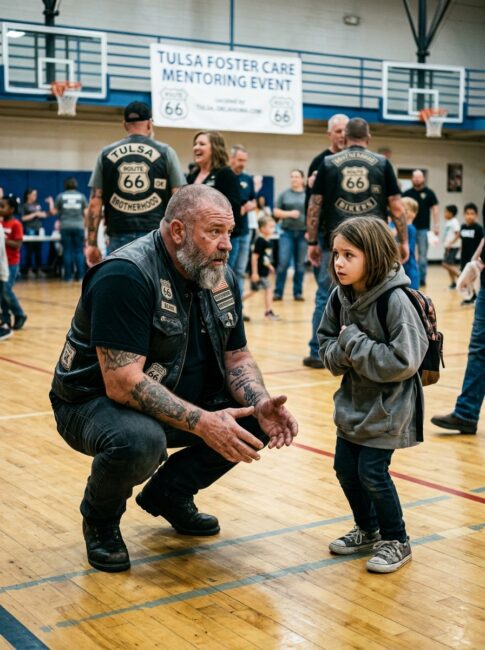
Every adoption anniversary, Frank and I went back to the community center gym where we met. Sometimes Adopt-a-Foster had new kids there. New bikers. New scared faces pretending not to care.
Frank still looked like a warning sign. Bigger, older, beard more white than gray, tattoos fading at the edges.
But I watched kids read him.
They noticed what I noticed.
The distance he kept.
The way he crouched sideways instead of towering.
The way he answered hard questions with truth.
One boy asked, “Were you in jail?”
Frank said, “Yes.”
The boy asked, “Are you still bad?”
Frank said, “Some days I’m still working.”
The boy nodded like that was the most honest thing an adult had said all year.
The blue cross inside Frank’s vest stayed hidden unless the leather shifted.
One day I asked about Marian again.
This time, he told me.
She had been a prison counselor. White hair. Church shoes. Voice like gravel in a jar. She did not excuse him. Did not pity him. Just kept showing up to group even when Frank sat with his arms crossed and said nothing for seven months.
One day she told him, “You are not the worst thing you did unless you keep doing it.”
He believed her once.
That was enough to start.
After she died, he stitched the blue cross inside his cut.
Not outside.
“Outside patches are for what people need to know,” he said. “Inside ones are for what I better not forget.”
I understood that.
I had inside patches too.
Mine just did not show.
When I was twelve, my English teacher asked us to write about the best person we knew.
I wrote about Frank.
I did not tell him.
The essay started like this:
“People ask if I’m scared to live with a biker. I say no. My dad wears leather and tattoos. My dad also taught me that beautiful does not always look clean. My dad is the most beautiful person I know.”
My teacher cried.
Then the local paper printed it after asking permission.
Frank found out because Rooster brought twenty copies to the diner and slapped one onto the table beside his coffee.
For once, Frank had no words.
He read the whole thing with his gray beard tucked down, one scarred thumb holding the paper still. The diner got quiet around him. Twenty-five bikers pretended not to watch.
At the last line, his eyes went wet.
Nothing fell.
Bikers like Frank do not cry easy in public.
But Jo reached over and put one hand on his shoulder.
He did not pull away.
The last line said:
“He did not save me by being perfect. He saved me by staying.”
Frank folded the newspaper carefully and slid it inside his vest, behind the blue cross.
Then he looked at me.
“Kid,” he said, voice rough, “you made me sound better than I am.”
I shook my head.
“No. I made people look longer.”
Outside, his Harley waited by the curb on Route 66, black paint dusty, engine cold, saddlebags scratched from years of showing up. The evening traffic moved past the diner. Boots scraped. Leather creaked. Somebody laughed too loud in the kitchen.
Frank stood, held the door open, and waited for me.
He still does that.
Waits.
I walked out beside him, no trash bag in my hand, no next house waiting, no adult pretending goodbye was paperwork.
Just Frank.
Just Dad.
The Harley started with a low, steady heartbeat.
And we went home.
Follow the page for more biker stories about rough men, second chances, and the kids nobody should return.