I Tore Open a College Student’s Backpack in Front of Everyone—But Only I Saw the Stranger Who Had Touched It First
The moment I tore a college student’s backpack from his shoulder and dumped everything across a crowded bus station floor, thirty strangers saw a tattooed thief—only I had seen the quiet hand that touched the bag first.
His name was Ethan Park. He was twenty years old, thin, clean-cut, and wearing a gray University of New Mexico sweatshirt with one earbud still hanging from his ear. He had been standing beside a vending machine at Albuquerque’s old Route 66 transit terminal, checking the departure time for a bus to Santa Fe.
I was standing twelve feet behind him.
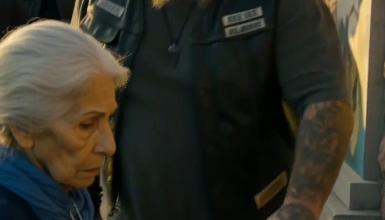
My name is Wade “Gravel” Mercer. I’m fifty-five, six-foot-four, and built like the kind of man parents warn their children not to stare at. My head is shaved, my beard hangs gray over my chest, and faded tattoos cover both arms beneath a black leather cut that smells permanently of gasoline, rain, and old road dust.
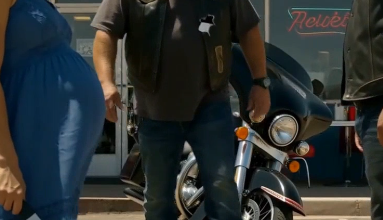
My Harley was parked outside, its cooling engine ticking beneath the afternoon sun. I had stopped for coffee before riding north to meet three brothers from my club.
Then I saw someone move behind Ethan.
A young man in a brown jacket drifted through the crowd with his face lowered beneath a baseball cap. He bumped Ethan’s shoulder, apologized without making eye contact, and continued toward the east doors.
It looked accidental.
Almost.
Ethan never noticed the stranger’s right hand hover beside the open zipper of his backpack. He didn’t see the small movement beneath the canvas or the way the man immediately checked the police officers standing near the ticket counter.
I did.
The stranger disappeared into the crowd just as Ethan pulled the zipper closed and started toward the boarding gates. One of the officers looked in his direction, and the man in the brown jacket raised his phone as if sending someone a signal.
I crossed the terminal quickly.
“Kid, stop.”
Ethan turned and saw a huge tattooed biker approaching him with a hard expression. His shoulders stiffened, and his hand tightened around one backpack strap.
I reached him before he could step away.
Then I grabbed the bag.
“What are you doing?” he shouted.
He tried to pull it back, but I was already sliding it from his shoulder. A woman near the vending machines screamed for security, while two men stood and began recording with their phones.
Ethan grabbed my arm.
“That’s mine!”
“I know.”
I dropped to one knee, opened the main compartment, and began pulling out everything he owned.
Laptop.
Textbooks.
A blue hoodie.
Charging cables.
A plastic container holding his mother’s dumplings.
To everyone watching, it looked like I was robbing a frightened college student in broad daylight.
Then one of the officers started running toward us.
And I still hadn’t found what the stranger had hidden.
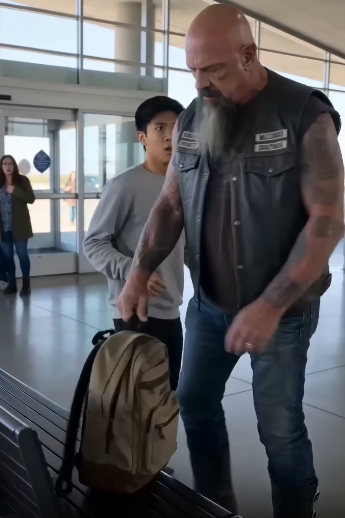
Ethan kept demanding his bag while the crowd closed around us. His voice shook with anger and humiliation, and I could hear people describing me to the emergency dispatcher as if I were armed, violent, and trying to escape.
I didn’t blame them.
Years earlier, I would have judged a man like me exactly the same way. I had spent eight years drinking too much, riding angry, and believing every problem could be left behind if I kept enough highway between myself and home.
My younger brother Danny had followed a different road. He became addicted to pills after a construction injury, then moved to whatever was cheaper and easier to find when the prescriptions ended.
The last time I saw him alive, he was sitting on the steps behind our mother’s house, trembling beneath a borrowed coat. He asked me for money, and I told him I was finished helping someone who refused to help himself.
Danny died eleven days later.
Afterward, I began volunteering at a recovery center in Albuquerque. I drove people to appointments, repaired the center’s broken furniture, and sat through training sessions about street drugs, manipulation, and the ways dealers recruited young couriers.
That was where I first learned about planted packages.
Someone slips contraband into a traveler’s open bag, watches from a distance, then retrieves it after the person crosses a checkpoint or boards a bus. If police discover it first, the innocent carrier takes the blame while the person who planted it walks away.
Sometimes the victim is chosen at random.
Sometimes the victim is chosen because nobody will believe him.
I had seen the movement before: the false collision, the apology, the hidden hand and the immediate retreat. I had watched it in security footage during a community training session, but the images had seemed clinical and distant then.
At the terminal, it happened in seconds.
The stranger also made one mistake. As he moved away, I saw the corner of a silver-wrapped packet disappear beneath Ethan’s hoodie.
I knew Ethan might be searched the moment he approached the gate. Two uniformed officers were conducting random bag inspections beside the boarding area after receiving a tip about narcotics moving through the station.
The man in the brown jacket knew it too.
That was why he stayed nearby.
He wasn’t waiting to retrieve the packet.
He was waiting for Ethan to be caught with it.
By the time I emptied the side pockets, the first officer had reached us. He was a Latino man in his early forties named Officer Ramirez, and his hand rested near his belt as he ordered me to step away from the student.
I raised one hand but kept the other on the backpack.
“Sir, release the bag.”
“Give me ten seconds.”
“You don’t have ten seconds.”
Ethan stood beside him, pale with fury. His laptop lay on the dusty tile, one textbook had fallen open beneath a bench, and his mother’s dumplings were scattered across the floor.
“He attacked me,” Ethan said. “I don’t even know him.”
That sentence rippled through the crowd.
A middle-aged man pointed at the club patch on my vest and told the officer I had been behaving suspiciously. A woman said she had watched me follow Ethan. Another witness insisted I had probably planted something inside the bag myself.
The stranger in the brown jacket stood near the east doors.
Watching.
Our eyes met for less than a second, but that was enough. He began moving toward the exit, neither running nor walking slowly enough to attract attention.
I pointed at him.
“Stop that man.”
Half the crowd turned. The stranger glanced over his shoulder, then continued through the doors.
Officer Ramirez didn’t move. From his position, I was the obvious threat—a giant biker kneeling over a young man’s belongings while witnesses shouted and phones recorded every angle.
“Both hands where I can see them,” he ordered.
I released the backpack and raised my hands.
A second officer approached Ethan and asked whether anything valuable was missing. Ethan began listing his laptop, wallet, headphones, and medication, but I watched the brown jacket vanish beyond the glass doors.
Then I noticed the backpack’s inner lining.
There was a narrow opening near the bottom seam that did not match the rest of the stitching. One section bulged slightly beneath Ethan’s folded hoodie.
“Officer,” I said, keeping my hands raised, “check the lining.”
Ethan looked confused.
“What lining?”
Officer Ramirez ordered me backward, then crouched beside the bag. He pulled out the hoodie and examined the compartment beneath it.
Nothing.
The crowd began murmuring that I had invented the story to avoid arrest. Ethan stared at the mess on the floor, then at me, as if trying to understand why a complete stranger had singled him out.
Officer Ramirez reached for his handcuffs.
That was when I saw the silver edge caught inside the torn seam.
“Lower left corner,” I said. “Don’t let the kid touch it.”
The officer followed my gaze.
His expression changed.
Officer Ramirez put on gloves before reaching into the opening. When he pressed the fabric flat, a tightly wrapped rectangular package slid through the damaged seam and landed beside Ethan’s calculus textbook.
The terminal went silent.
It wasn’t large—about the size of a deck of cards, wrapped in silver plastic and clear tape—but both officers stepped back as if the object had changed the air around us.
Ethan stared at it.
“What is that?”
Nobody answered immediately.
His face lost all color as he looked from the package to his backpack. He began shaking his head before anyone accused him of anything.
“That isn’t mine. I’ve never seen it. I swear.”
The second officer moved him several steps away while Ramirez called for a supervisor. People who had been yelling at me moments earlier lowered their phones.
I kept watching the east doors.
“The man in the brown jacket put it there,” I said. “Blue cap, white sneakers, about twenty-five. He bumped the kid near the vending machines.”
Officer Ramirez asked how I could be certain.
“I saw his hand go into the bag.”
Ethan looked at me as if hearing my voice for the first time.
Security staff locked the terminal exits while police reviewed the surveillance cameras. One camera above the vending machines had captured the collision from behind, but the stranger’s hand was blocked by Ethan’s body.
A second camera provided a clearer angle.
On the monitor, the man approached Ethan, removed the packet from inside his jacket, pushed it through the partially open zipper, then stepped away. Thirty seconds later, he sent a message and positioned himself where he could watch the police inspection area.
The same recording showed me watching him.
It showed me leave my coffee on a bench, cross the terminal, stop Ethan and take the backpack. It showed the crowd gathering and the suspect slipping toward the exit while everyone’s attention remained fixed on the tattooed biker.
Officers found him outside near a rideshare pickup lane. He had removed the brown jacket and hidden the baseball cap beneath a trash bag, but a patrol officer recognized his white sneakers and detained him before his car arrived.
His phone contained photographs of Ethan entering the terminal.
It also contained a message sent moments before I intervened: “Gray sweatshirt. Bag loaded. Tell them gate three.”
Someone had planned to report Ethan.
The narcotics test later confirmed that the package contained illegal drugs. Investigators believed the intention had not been simple transportation. Ethan had been selected, loaded and anonymously reported so police would arrest him while the people responsible disappeared.
Officer Ramirez asked me to repeat my statement for a body camera.
I looked at Ethan, who was sitting against the wall with both hands pressed to his face.
“There was someone planting drugs in his backpack,” I said. “I searched it to get the package out before he was arrested for something he never did.”
For the first time since I grabbed the bag, nobody called me a thief.
Ethan’s parents arrived an hour later. His mother, a Korean American nurse still wearing navy hospital scrubs, ran across the terminal and wrapped both arms around him before speaking to anyone else.
His father stood beside them with one hand covering his mouth. He had spent the drive believing his son had been arrested for drug possession.
Officer Ramirez explained what the cameras showed. He also told them that if Ethan had reached the inspection area with the package concealed inside his backpack, officers would have had probable cause to detain him.
The video might eventually have cleared him.
Eventually.
But first there would have been handcuffs, questioning, missed classes, legal fees and a photograph attached to an accusation that could follow him for years. His scholarship might have been suspended while the university investigated.
An innocent person can survive a false accusation.
That doesn’t mean the accusation leaves nothing behind.
Ethan’s mother looked at the belongings scattered across the floor. She picked up the cracked food container and gathered the dumplings she had prepared that morning.
Then she walked toward me.
I expected anger. I had frightened her son, damaged his bag, and thrown his belongings across a public terminal.
Instead, she took my rough right hand in both of hers.
“You believed him before he knew he needed to be believed,” she said.
I didn’t know what to say to that.
Ethan approached slowly. His anger had faded, but embarrassment remained in the way he avoided my eyes.
“Why didn’t you just tell me?” he asked.
“I tried to stop you.”
“You grabbed my bag.”
“You were three steps from the checkpoint.”
He looked toward the officers, then back at the floor.
I crouched and began collecting his things. The zipper had torn when I pulled the bag open, and one strap had nearly separated from the canvas.
Ethan knelt beside me.
For several minutes, the frightening biker and the terrified student quietly repacked a laptop, three textbooks, charging cables, a blue hoodie and one ruined lunch.
The crowd drifted away.
The phones lowered.
Nobody apologized, but I didn’t need them to.
Ethan was going home.
Police kept the backpack as evidence, so Ethan had nothing to carry his belongings in. I walked outside, opened my Harley’s saddlebag, and removed the faded army-green pack I used for overnight rides.
A small stitched patch sat inside its front flap.
DANNY MERCER
1987–2017
COME HOME, BROTHER
Ethan read it but didn’t ask questions. He simply ran his fingers over the stitching before placing his books inside.
I had carried that pack to recovery-center meetings for seven years. It held spare gloves, tools, rain gear and the photograph of my brother I never showed anyone.
Giving it away felt strange.
It also felt right.
Ethan tried to refuse, but I closed the flap and pushed the bag gently toward him.
“Bring it back when you graduate.”
“That’s three years away.”
“I’ve waited longer.”
His mother began crying quietly. I pretended not to notice because some people need privacy even when standing beneath fluorescent lights in a crowded station.
The investigation later uncovered a small network that used unwitting travelers as disposable carriers and false targets. The man in the brown jacket had watched bus schedules, selected passengers traveling alone, and photographed them before planting packages.
Ethan had been chosen because he looked distracted, young and unlikely to confront a stranger.
They were right about one thing.
Ethan never saw them coming.
They had not expected someone else to be watching.
I didn’t hear from Ethan for several months. Then a photograph arrived at the recovery center showing him standing beside his parents at a university awards ceremony, the green backpack still hanging from one shoulder.
After that, he sent a picture every few months.
The backpack appeared in all of them.
In the library during finals.
Beside a broken-down car he had repaired himself.
At a food drive where he volunteered during Thanksgiving.
On the day he received his first engineering internship.
Three years after the terminal incident, my Harley rumbled into the university parking lot beneath a sky heavy with summer rain. Twenty-one members of my club rode behind me, their engines rolling between the concrete buildings like distant thunder.
Ethan waited outside the arena wearing a black graduation gown.
The old green backpack was in his hand.
Its zipper had been replaced, two seams had been repaired, and Danny’s patch remained inside the flap. Ethan handed it back to me with a small envelope tucked into the front pocket.
Inside was a photograph of him in his cap and gown.
On the back, he had written six words:
“You made sure I came home.”
I stood there longer than I meant to. Ethan’s father shook my hand, his mother embraced me, and Ethan placed the backpack over my shoulder.
Then he looked at the rows of tattooed riders waiting beside their Harleys.
“Are all of them here for me?”
“Every one.”
“Why?”
I started the engine and handed him the spare helmet.
“Graduates deserve an escort.”
Ethan climbed onto the passenger seat, and twenty-two Harleys carried him past the same Route 66 terminal where strangers once believed I was stealing his future.
The green backpack rested between us.
Danny rode with us too.
Follow our page for more unforgettable biker stories about misunderstood riders, hidden courage, and the rough-looking strangers who step forward when everyone else looks away.